Dermorphin
Aeterna does not sell peptides. External link, vendor independently verified.
Mechanism
Dermorphin did not emerge from a medicinal chemistry laboratory. It was found – in the granular skin glands of a South American tree frog – and its existence forced a revision of what was thought possible in opioid peptide design. The presence of a D-amino acid at position two, a feature essentially absent from vertebrate peptides at the time of its discovery, conferred receptor affinity and metabolic resistance that no synthetic analogue had yet achieved. What the frog evolved over millions of years, pharmacology has spent decades attempting to understand.
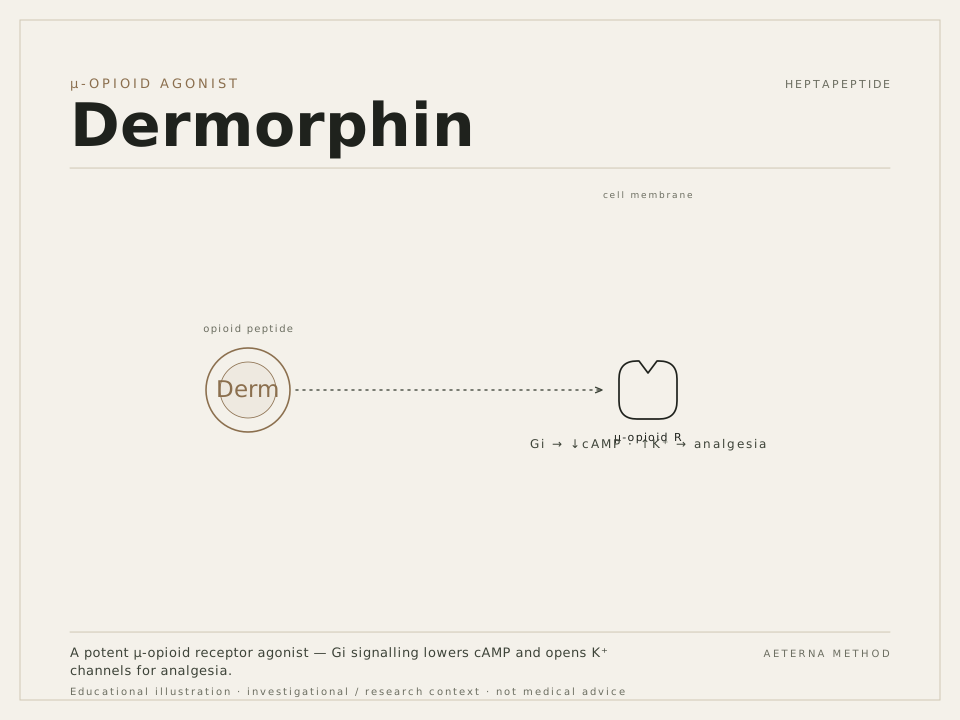
μ-opioid receptor binding is exceptionally strong, with reported low-nanomolar affinity that exceeds morphine in classic radioligand assays. The D-Ala² substitution also increases resistance to enzymatic degradation, helping preserve activity in experimental systems.
Analgesic signaling is expressed across both spinal and supraspinal circuits. Intrathecal exposure engages dorsal horn MOR populations, while supraspinal administration recruits regions such as the periaqueductal gray and rostral ventromedial medulla.
Receptor regulation includes GRK-mediated MOR phosphorylation followed by β-arrestin-2 recruitment and receptor internalization. In context, this pathway is often discussed in relation to tolerance development and opioid-induced hyperalgesia.
Receptor selectivity favors MOR over both DOR and KOR, though the separation is not absolute at higher concentrations. This matters because detectable off-target opioid receptor activity can shape the overall pharmacologic profile in research settings.
What we observe
Observed pain relief in lab work
The following observations are drawn from preclinical and early translational research. Dermorphin has not completed controlled clinical trials in humans. Patterns described here reflect what the published literature reports under experimental conditions; they do not constitute predicted outcomes for any individual.
01
Potent Spinal Analgesia
02
Supraspinal Antinociception
03
Prolonged CNS Residence
04
Reference Standard for MOR Selectivity
05
Tolerance Development
06
Cardiovascular Modulation
Evidence
The data on opioid action
Three studies are presented as representative entries in a larger body of work. Dermorphin’s published record spans four decades and multiple research traditions. These selections illustrate the arc from initial characterization to mechanistic inquiry. Aeterna does not endorse any specific protocol derived from this literature.
Dermorphin: a novel opioid heptapeptide from the skin of Phyllomedusa sauvagei with high affinity and selectivity for μ-opioid receptors
Erspamer and colleagues reported the isolation and sequence determination of dermorphin, demonstrating nanomolar binding affinity at μ-opioid receptors and potent antinociception in rodent models following intracerebroventricular administration. The presence of D-alanine at position two was identified as essential for both receptor affinity and metabolic stability.
Spinal and supraspinal synergy of dermorphin analgesia: isobolographic analysis in the rat tail-flick model
Investigators administered dermorphin intrathecally and intracerebroventricularly, alone and in combination, demonstrating supra-additive (synergistic) antinociception. Isobolographic analysis confirmed that combined spinal-supraspinal dosing produced analgesia at total doses substantially below those required at either site alone, suggesting coordinated engagement of descending inhibitory circuitry.
β-Arrestin-2 dependence of dermorphin-induced tolerance: comparison with morphine in MOR-expressing cell lines and intact rodents
Using β-arrestin-2 knockout mice and HEK293 cell expression systems, researchers demonstrated that dermorphin-induced receptor internalization and analgesic tolerance were attenuated in the absence of β-arrestin-2, while acute antinociception was preserved. The findings positioned dermorphin as a reference compound for studying the G-protein versus arrestin signaling dichotomy at MOR.
From lyophilized powder to a usable solution.
Peptide
1 mg (typical research vial)
Diluent
Sterile 0.9% saline or sterile water for injection · acidified vehicle (0.1% acetic acid) may improve solubility
Final concentration
100 µg/mL (1 mg reconstituted in 10 mL diluent) · further dilution required for most experimental dose ranges
01

Prepare the vial
02

Draw the diluent
03

Add slowly
04

Prepare the vial
Note
Dosing rythm
A patient titration
No legitimate human clinical dosing exists; dermorphin is an investigational mu-opioid agonist with potency ~30-40× morphine. Reported research dosing is 10-20 mcg/kg, with serious abuse and overdose risk.
Storage, caution, contradiction
Storage
Cold, dark, undisturbed
- Store lyophilized peptide at −20 °C, desiccated and protected from light.
- Reconstituted solution: stable for up to 7 days at 4 °C; aliquot to avoid repeated freeze-thaw cycles.
- Freeze-thaw cycles degrade potency; prepare single-use aliquots at working concentration where feasible.
- Avoid prolonged exposure to ambient temperature; peptide bond hydrolysis accelerates above 25 °C in aqueous solution.
- Label all vials with concentration, reconstitution date, and lot number; maintain chain-of-custody records per institutional requirements.
Side effects
What members describe
- Respiratory depression: MOR agonism at supraspinal sites carries dose-dependent risk of respiratory rate reduction; naloxone reversal should be immediately available in any experimental setting.
- Bradycardia and hypotension: central cardiovascular effects observed in anesthetized preparations; hemodynamic monitoring is appropriate in in vivo protocols.
- Sedation and motor impairment: supraspinal opioid effects may confound behavioral assays; rotarod and open-field controls are standard practice.
- Analgesic tolerance: repeated dosing schedules produce MOR desensitization; experimental designs should account for tolerance when interpreting longitudinal data.
- Physical dependence: sustained MOR activation produces neuroadaptation; withdrawal phenomena have been documented in rodent models following abrupt cessation of chronic dosing.
Contradictions
Reasons to abstain
- Not for human administration under any circumstances in the absence of regulatory approval and clinical trial infrastructure.
- Contraindicated in experimental animals with pre-existing respiratory compromise; baseline pulmonary function should be assessed before opioid peptide protocols.
- Do not combine with other MOR agonists, benzodiazepines, or CNS depressants in experimental designs without explicit pharmacokinetic justification and appropriate safety monitoring.
- Jurisdictional scheduling: dermorphin is subject to controlled-substance regulations in several countries; researchers must confirm legal status and obtain appropriate permits before acquisition or use.
- Not suitable for use outside of institutional research settings with IACUC or equivalent ethical oversight; no self-experimentation context is appropriate for this compound.
Synergies
Which combos make sense
The following pairings reflect combinations that have appeared in published preclinical research, typically to dissect receptor contributions or to probe synergistic mechanisms. They are presented as intellectual context, not as protocols. Aeterna does not prescribe, dispense, or sell any compound.
FAQ
Your questions, patiently answered
Virtually all endogenous vertebrate peptides are composed exclusively of L-amino acids. The D-alanine at position two of dermorphin is a post-translational modification catalyzed by a peptide isomerase in the frog’s skin glands. Its functional consequence is twofold: it confers resistance to aminopeptidase cleavage, extending the peptide’s biological half-life, and it positions the N-terminal pharmacophore in a receptor-complementary geometry that dramatically increases μ-opioid binding affinity. The discovery of this feature in 1981 was genuinely surprising and stimulated an entire field of D-amino acid peptide pharmacology.
In radioligand binding assays, dermorphin’s Ki at the μ-opioid receptor is approximately 1,000-fold lower than morphine’s, indicating substantially greater affinity. In functional antinociception assays, the potency advantage is somewhat smaller but remains substantial – intrathecal ED50 values in rodents are typically reported in the sub-microgram range. The comparison is complicated by route of administration, since dermorphin’s peripheral bioavailability is limited by plasma peptidases, whereas morphine is orally active.
No. Dermorphin has not received regulatory approval for human therapeutic use in any jurisdiction as of 2025. Its research history is almost entirely preclinical. There is no approved clinical formulation, no completed Phase III trial, and no IND on record with the FDA. The compound is of interest as a pharmacological tool and as a structural template for analogue design, not as a clinical agent in its current form.
Biased agonism – the capacity of a ligand to preferentially activate G-protein signaling over β-arrestin recruitment, or vice versa – has become a central concept in opioid drug development, motivated by the hypothesis that G-protein-biased MOR agonists might produce analgesia with reduced tolerance and respiratory depression. Dermorphin, as a well-characterized reference MOR agonist with documented tolerance liability, has served as a comparator in studies evaluating the degree of bias in novel synthetic ligands. Its β-arrestin-2-dependent tolerance profile, demonstrated in knockout models, has helped calibrate what arrestin engagement actually contributes to opioid side effects.
Dermorphin gained notoriety in the early 2010s when it was detected in post-race urine samples from racehorses in the United States. Its extreme potency at MOR and its structural novelty – not yet included in standard doping panels at the time – made it attractive to those seeking an analgesic advantage in performance horses. The episode prompted rapid expansion of equine anti-doping testing protocols and highlighted the gap between research-grade peptide availability and regulatory surveillance. It remains a prohibited substance under all major equine sport governing bodies.
DAMGO ([D-Ala², N-Me-Phe⁴, Gly⁵-ol]-enkephalin) is a synthetic MOR-selective research tool designed by medicinal chemists to maximize receptor selectivity and metabolic stability. Dermorphin is a natural product that arrived at similar properties through evolutionary pressure. The two peptides share the D-amino acid strategy and high MOR selectivity but differ in sequence, size, and the precise receptor contacts they make. DAMGO is more commonly used in receptor internalization and trafficking studies; dermorphin is more often employed in in vivo analgesia and tolerance paradigms. Neither is a clinical compound.
In the same family
Further entries in the curriculum.
Sourcing · Independently verified
When you're ready, source thoughtfully.