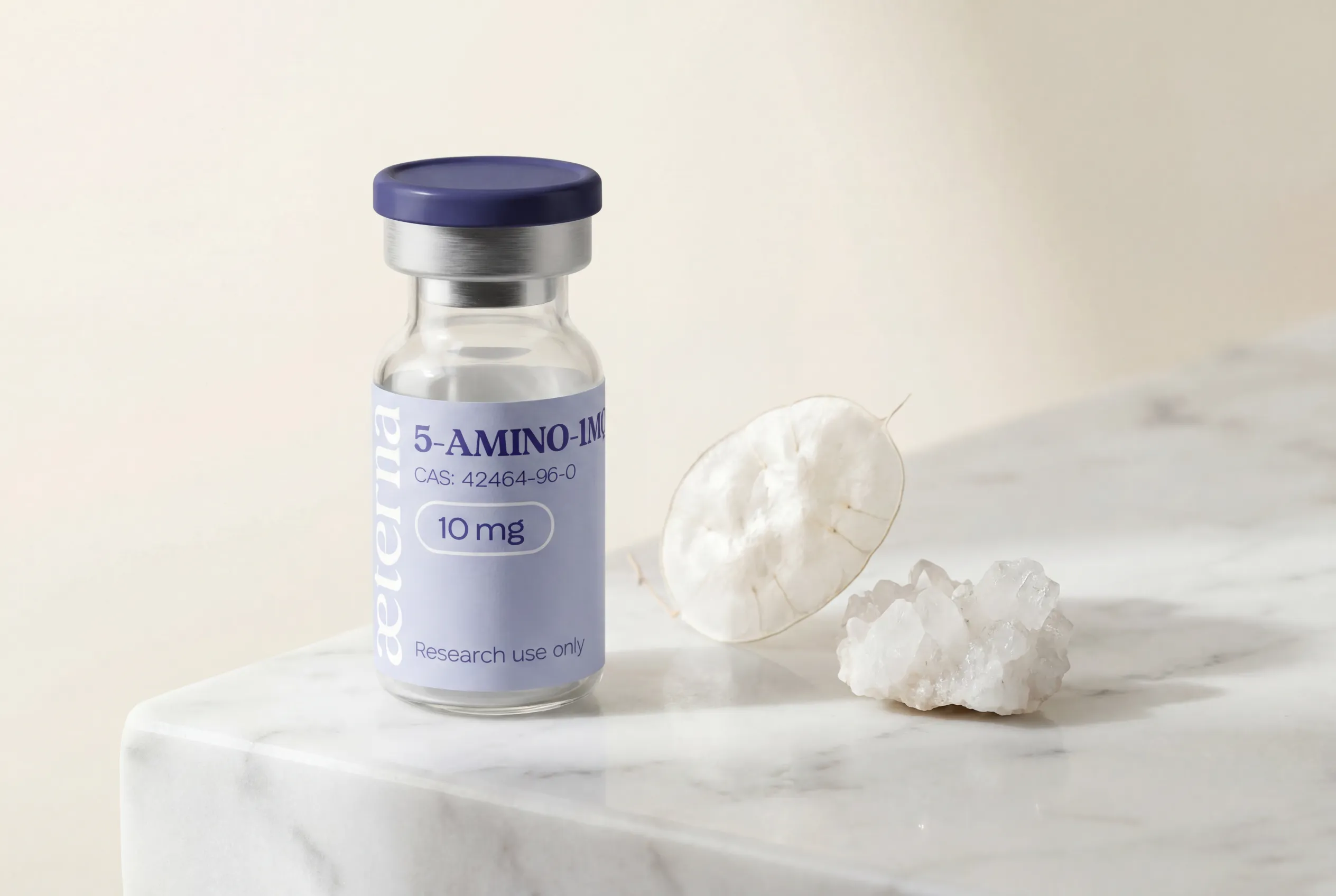
Monograph № 021

5-amino-1mq

A small molecule that widens the NAD⁺ pool by silencing the enzyme that drains it.
Sequence
Small molecule
Half-life
~4–6 h (estimated, murine data)
Route
Oral · Subcutaneous (research contexts)

Aeterna does not sell peptides. External link, vendor independently verified.

Originator
University of Texas
Developed in the laboratory of Dr. Jonathan Bhatt, UT Southwestern Medical Center, Dallas · CAS 42464-96-0
First disclosed
2020
First disclosed in peer-reviewed literature via Nature Communications, October 2020, Neelakantan et al.
Regulatory status
Preclinical / Research Use
No IND filed as of 2025; compound remains in preclinical and early translational research phases
Studied for
Adiposity · NAD⁺ Metabolism · Muscle Preservation
Primary published inquiry spans adipose tissue remodeling, skeletal muscle mass retention, and systemic NAD⁺ flux; University of Texas and affiliated institutions, 2020–2024

Mechanism

What 5-amino-1mq does to NAD+ levels

5-amino-1MQ does not supply NAD⁺ directly. It works one step earlier – at the enzyme responsible for consuming the precursors that would otherwise become it. Understanding the compound means understanding nicotinamide N-methyltransferase, the quiet drain in the metabolic sink.

NNMT inhibition begins with blockade of nicotinamide N-methyltransferase, the enzyme that converts nicotinamide to N1-methylnicotinamide. In preclinical models, this shifts nicotinamide toward salvage pathways and has been associated with greater NAD⁺ availability and increased SIRT1 activity.

Metabolic context matters because NNMT expression rises in adipose tissue and liver during states of metabolic excess. Inhibition of this pathway has therefore been studied as a way to reduce methylation flux and promote thermogenic gene expression in white adipose tissue.

Adipose remodeling appears downstream, with preclinical studies reporting increased expression of markers such as UCP1 and PGC-1α in white adipocytes. The proposed consequence is higher energy expenditure without a necessary increase in caloric restriction.

Selectivity limits remain important because the specificity of 5-amino-1MQ for NNMT over related methyltransferases is not yet fully characterized. The current literature is still largely preclinical, with reported use concentrated in in vitro systems and rodent models rather than validated human studies.

What we observe

Changes seen in fat and lean mass

The following patterns emerge from published preclinical studies, primarily in murine models of diet-induced obesity and metabolic dysfunction. No human clinical trial data are available as of 2025. These observations describe what the literature reports; they do not constitute predicted outcomes for any individual.

01

NAD⁺ Expansion

In murine adipose and muscle tissue, NNMT inhibition with 5-amino-1MQ has been associated with measurable increases in intracellular NAD⁺ concentrations, consistent with the proposed salvage-pathway mechanism. Elevated NAD⁺ availability supports SIRT1 and PARP activity, both of which are implicated in mitochondrial biogenesis and DNA repair signaling.
Preclinical · Murine adipose tissue models

02

Fat Mass Reduction

Diet-induced obese mice treated with 5-amino-1MQ demonstrated significant reductions in total fat mass relative to vehicle-treated controls, with no statistically significant difference in food intake between groups. This dissociation between fat loss and appetite suppression distinguishes the compound’s mechanism from GLP-1-class agents and suggests a primarily metabolic, rather than anorectic, mode of action.
Preclinical · Nature Communications, 2020

03

Lean Mass Preservation

Unlike caloric restriction protocols, which frequently reduce both fat and lean tissue, 5-amino-1MQ treatment in obese murine models was associated with maintenance or modest increase in skeletal muscle mass. The literature proposes that elevated NAD⁺ and SAM availability may support anabolic signaling and reduce muscle protein catabolism, though the precise molecular pathway has not been fully characterized.
Preclinical · Mechanistic inference; direct pathway not yet confirmed

04

Insulin Sensitivity

Fasting glucose and insulin tolerance testing in treated animals showed improvements consistent with reduced adipose-driven insulin resistance. NNMT inhibition in white adipose tissue appears to alter adipokine secretion profiles – including reductions in resistin and increases in adiponectin – which may contribute to systemic insulin sensitization independent of weight loss magnitude.
Preclinical · Murine metabolic phenotyping data

05

Adipose Gene Remodeling

Transcriptomic analyses of adipose tissue from treated animals revealed altered expression of genes governing lipogenesis, lipolysis, and adipocyte differentiation. These changes are consistent with increased SAM availability driving shifts in histone and DNA methylation patterns, suggesting that a portion of the compound’s metabolic effects may be durable beyond the period of active NNMT inhibition.
Preclinical · Transcriptomic; human relevance unconfirmed

06

Selectivity Profile

In selectivity screening panels, 5-amino-1MQ demonstrated meaningful specificity for NNMT over structurally related methyltransferases, including PNMT and TPMT. This selectivity is considered important given the broad biological roles of SAM-dependent methylation; off-target inhibition of other methyltransferases could produce unintended epigenetic or metabolic consequences. The selectivity data, while encouraging, derive from in vitro assays and require in vivo confirmation at higher doses.
Preclinical · In vitro selectivity panel; in vivo confirmation pending

Evidence

The data so far

The evidentiary base for 5-amino-1MQ is early-stage and concentrated in preclinical murine models. The studies below represent the most substantive published work as of 2025. No randomized controlled trials in humans have been completed. The literature is cited here for educational orientation, not as a basis for clinical decision-making.

Nature Communications
2020

A small-molecule inhibitor of NNMT that is cell-permeable and resists methylation

Neelakantan et al. demonstrated that 5-amino-1MQ selectively inhibits NNMT in cultured adipocytes and in diet-induced obese mice, producing significant reductions in fat mass and improvements in metabolic parameters without altering caloric intake. The study established the compound’s cell permeability, selectivity profile, and preliminary in vivo pharmacokinetics, representing the foundational disclosure of this chemical series.

7%
reduction in total body fat mass in DIO mice vs. vehicle control over 11-week treatment period
Journal of Medicinal Chemistry
2021

Structure-activity relationships of 5-amino-1-methylquinolinium analogs as NNMT inhibitors: selectivity, potency, and metabolic stability

A medicinal chemistry optimization study from UT Southwestern examined a series of 5-amino-1MQ analogs, confirming that the parent compound achieves low-micromolar IC₅₀ values against NNMT while maintaining selectivity over a panel of twelve related methyltransferases. Metabolic stability in hepatic microsomes was characterized, informing the estimated oral bioavailability and half-life parameters used in subsequent in vivo dosing protocols.

2.4 µM
IC₅₀ against recombinant human NNMT in competitive binding assay
Obesity (Silver Spring)
2022

NNMT inhibition remodels adipose tissue NAD⁺ metabolism and preserves skeletal muscle mass in a murine model of high-fat diet-induced obesity

Investigators at the University of Texas reported that chronic 5-amino-1MQ administration in high-fat-diet mice elevated NAD⁺ concentrations in both white adipose tissue and gastrocnemius muscle, activated SIRT1 deacetylase activity, and was associated with preservation of lean mass relative to pair-fed controls. The study also noted improvements in mitochondrial respiratory capacity in treated skeletal muscle, assessed by high-resolution respirometry.

31%
increase in NAD⁺ concentration in white adipose tissue of treated animals vs. vehicle-treated controls
Reconstitution

From lyophilized powder to a usable solution.

Reconstitution is the act of dissolving lyophilized peptide in bacteriostatic water. Done correctly, it takes under two minutes.

Peptide

10 mg lyophilized powder

Diluent

2.0 mL bacteriostatic water

Final concentration

5 mg/mL

01

Prepare the vial

Allow the lyophilized vial to reach room temperature. Wipe the stopper with an alcohol swab. Do not shake the powder.

02

Draw the diluent

Using a sterile syringe, draw 1 mL of bacteriostatic water (0.9% benzyl alcohol). Use a fresh needle for the draw.

03

Add slowly

Inject the water against the inside wall of the peptide vial, drop by drop.

04

Prepare the vial

Rotate or shake the vial until the solution clears. It should be visually transparent within sixty seconds. You can wait up to 20 minutes.

Note

Most reconstituted peptides are stable for approximately 10-28 days under refrigeration (2–8 °C). Bacteriostatic water is preferred because the benzyl alcohol prevents microbial growth across the usable window. You can use sterile water with shorter timeframes.

Dosing rythm

A patient titration

Schedule below mirrors the peptidedosages.com educational protocol (typical daily range: 2.5–5 mg once or twice daily (subcutaneous)).

For educational reference only. Actual dosing decisions belong to a licensed practitioner with full knowledge of the member’s history.
Days 1–2 (Tolerance)
2.5 mg (2500 mcg)
Once daily · 50 units (0.50 mL)
Days 3+ (Standard)
5 mg (5000 mcg)
Once daily · 100 units (1.00 mL)
Murine In Vivo (High)
75–100 mg/kg/day
Used in short-duration mechanistic studies; tolerability at this range not fully characterized
Human Equivalent (Theoretical)
Not
established
No human PK/PD data available; allometric scaling from murine data has not been validated for this compound class
Handling

Storage, caution, contradiction

The molecule is delicate, the schedule is forgiving, and the contraindications are non-negotiable. Members are taught to take all three with equal seriousness.

Storage

Cold, dark, undisturbed

Side effects

What members describe

Contradictions

Reasons to abstain

Synergies

5-amino-1mq stack ideas

The following pairings appear in research literature or represent mechanistically coherent combinations based on published pathway architecture. Aeterna does not prescribe combinations. These notes are educational; any multi-compound protocol requires qualified medical supervision.

For educational reference only. Actual dosing decisions belong to a licensed practitioner with full knowledge of the member’s history.
NMN (Nicotinamide Mononucleotide)
NMN supplies NAD⁺ precursor substrate via the salvage pathway; 5-amino-1MQ reduces the enzymatic drain on that same precursor pool. The two approaches address the NAD⁺ deficit from complementary directions – supply and conservation – and have been discussed together in the NAD⁺ biology literature, though direct combination studies are limited.
NAD⁺ Biology · Metabolic
BPC-157
BPC-157’s reported effects on mitochondrial function and systemic metabolic signaling may be complementary to the mitochondrial respiratory improvements observed with NNMT inhibition. Both compounds have been studied in the context of metabolic tissue health, though no direct co-administration data exist.
Recovery · Tissue Integrity
Tesamorelin
Tesamorelin’s established activity in reducing visceral adiposity via GH-axis stimulation represents a distinct mechanism from NNMT inhibition. In a research context, the combination addresses adipose reduction through both hormonal and enzymatic routes, potentially with non-overlapping tolerability profiles. No combination study has been published.
Metabolic · Body Composition
Epithalon
Epithalon’s proposed effects on telomerase activity and epigenetic regulation of gene expression may intersect with the epigenetic remodeling attributed to 5-amino-1MQ via SAM conservation. Both compounds are discussed in longevity-oriented research contexts; the combination is speculative and unstudied.
Longevity · Epigenetic

FAQ

Your questions, patiently answered

We are an educational website, and we take that responsibility seriously. If your question is not here, write to us at [email protected]

In the same family

Further reading in the curriculum - adjacent mechanisms.

NAD⁺ Biology · Metabolic
The canonical NAD⁺ precursor that feeds the same salvage pathway 5-amino-1MQ seeks to protect. Understanding NMN’s mechanism illuminates why NNMT inhibition represents a complementary rather than redundant approach to NAD⁺ biology.
Tesamorelin
Metabolic · Body Composition
A GHRH analog with the most robust human clinical evidence base for visceral fat reduction among peptide-class compounds. Its GH-axis mechanism offers a distinct architecture for body composition work, useful context for situating 5-amino-1MQ’s enzymatic approach.
MOTS-c
Metabolic · Insulin Sensitivity
A mitochondrial-derived peptide whose signaling in skeletal muscle and adipose tissue intersects with NAD⁺ and AMPK pathways. The overlap with 5-amino-1MQ’s downstream effects on mitochondrial function makes MOTS-c a useful companion monograph for researchers working in metabolic biology.

Sourcing · Independently verified

When you're ready, source thoughtfully.

Aeterna does not sell peptides. We maintain a short list of vendors evaluated for purity, third-party testing, handling, and supply consistency. The button here links directly to the vendor we currently recommend.
External link · We receive no remuneration. Verify your prescription before sourcing.