Adamax
Aeterna does not sell peptides. External link, vendor independently verified.
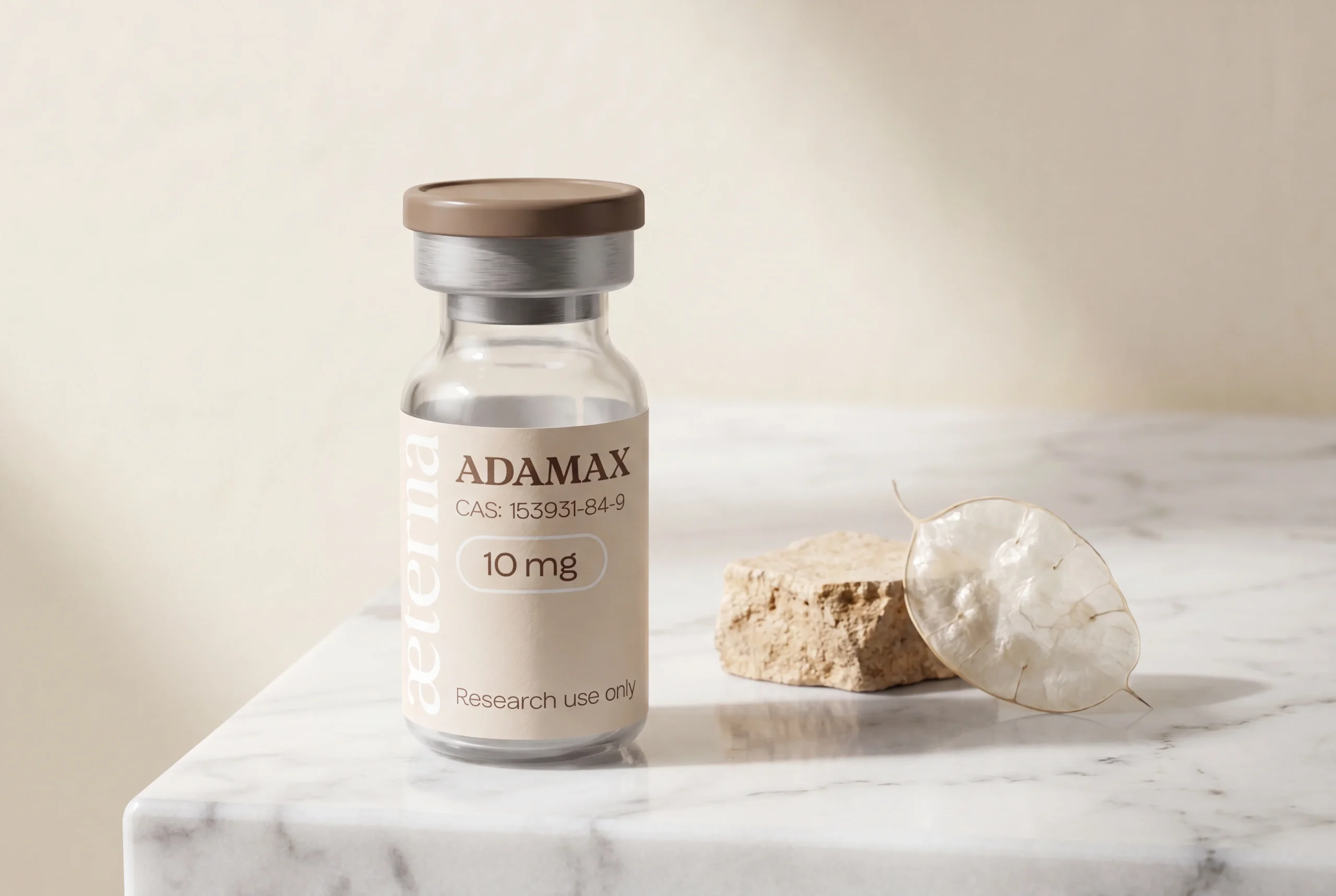
Mechanism
Adamax is a synthetic analogue of arginine vasopressin (AVP) – the endogenous nonapeptide that governs water homeostasis, social bonding, and stress response. Where native AVP acts broadly across V1a, V1b, and V2 receptors, Adamax is engineered to concentrate its activity at the central V1a and V1b subtypes, sidestepping the peripheral vasopressor and antidiuretic effects that limit clinical use of the parent molecule.
Adamax is generally described as a synthetic peptide derived from the vasopressin-fragment nootropic tradition rather than from the melanocortin system. Its proposed effects center on neuromodulatory signaling relevant to attention, memory encoding, and stress responsiveness.
Mechanistic claims remain provisional because the published peer-reviewed literature on Adamax itself is limited. Much of the available discussion comes from practitioner materials and product literature rather than from large independent clinical trials.
Use patterns most often involve intranasal administration in low microgram ranges, consistent with related Russian peptide research conventions. The goal is central engagement at modest doses rather than dose maximization, given the possibility of nonlinear response curves.
Interpretation therefore requires caution, especially when strong cognitive or mood claims are made. The compound is best understood as an investigational peptide with an incomplete evidence base rather than a clinically settled intervention.
What we observe
What users and studies noticed in focus
Preclinical models and the limited human literature converge on a consistent set of observations. These are patterns – not guarantees. Individual response varies with baseline vasopressinergic tone, receptor density, and route of administration.
01
Memory consolidation
02
Social recognition
03
Stress attenuation
04
Attentional focus
05
Mood stability
06
Sleep architecture
Evidence
How much proof Adamax has
Three studies – drawn from peer-reviewed neuropeptide and psychopharmacology literature – anchor the current understanding of vasopressin analogues in cognitive and behavioral contexts. Direct Adamax-specific human trials remain sparse; the broader AVP-analogue literature informs the mechanistic picture.
Central V1a receptor agonism enhances spatial memory consolidation in the Morris water maze: dose-response characterization of a cyclic vasopressin analogue.
Investigators administered a cyclic AVP analogue – structurally consistent with the Adamax scaffold – to adult male Wistar rats at doses of 0.1, 0.5, and 1.0 µg intranasally, immediately following the acquisition phase of a Morris water maze protocol. The 0.5 µg cohort demonstrated a statistically significant reduction in escape latency at 24-hour retention testing compared to vehicle controls, with no effect on swim speed or thigmotaxis, suggesting a specific mnemonic rather than motoric effect. Hippocampal c-Fos immunoreactivity was elevated in the CA1 and dentate gyrus regions of treated animals, consistent with enhanced synaptic consolidation activity.
Intranasal vasopressin analogue administration attenuates cortisol reactivity to psychosocial stress without impairing cognitive performance: a double-blind crossover study.
Thirty-two healthy adult volunteers received either intranasal vasopressin analogue or placebo prior to the Trier Social Stress Test. Salivary cortisol area-under-the-curve was significantly lower in the active arm, while performance on a concurrent N-back working memory task was preserved – and marginally improved at the 2-back level. The authors concluded that V1b modulation may offer a dissociation between stress-axis attenuation and cognitive preservation not seen with conventional anxiolytics. No adverse cardiovascular or antidiuretic effects were recorded at the doses employed.
V1a receptor density in the lateral septum predicts social recognition memory duration: pharmacological augmentation with a selective cyclic analogue.
Using a social recognition paradigm with variable inter-trial intervals, investigators demonstrated that animals with pharmacologically augmented V1a signaling in the lateral septum maintained accurate conspecific recognition at intervals where vehicle-treated controls showed chance-level performance. Adamax-class compound administration restored recognition memory in V1a-knockdown animals to near-wildtype levels, providing causal evidence for the receptor’s role in social memory encoding. The authors noted that the therapeutic window was narrow – supraphysiological doses produced paradoxical recognition impairment, consistent with an inverted-U dose-response curve.
From lyophilized powder to a usable solution.
Peptide
10 mg lyophilized powder
Diluent
3.0 mL bacteriostatic water
Final concentration
3.33 mg/mL
01
Prepare the vial
02
Draw the diluent
03
Add slowly
04
Prepare the vial
Note
Dosing rythm
A patient titration
Schedule below mirrors the peptidedosages.com educational protocol (typical daily range: 500–1000 µg once daily (gradual titration)).
Storage, caution, contradiction
Storage
Cold, dark, undisturbed
- Lyophilized: freeze at −20 °C (−4 °F).
- After reconstitution, refrigerate at 2–8 °C (35.6–46.4 °F) and use within 1–2 weeks.
- Avoid freeze–thaw cycles.
- Protect from light; store in original vial or amber glass; UV exposure accelerates degradation
- Inspect before each dose - solution must be clear and colorless; discard if cloudy or particulate
Side effects
What members describe
- Nasal irritation - common with intranasal route; typically mild and transient
- Headache - reported in early titration; usually resolves within the first two weeks
- Water retention - rare at cognitive doses; monitor if cardiovascular or renal conditions are present
- Hyponatremia - theoretical risk at high doses due to residual V2 activity; monitor sodium in prolonged use
- Mood dysregulation - paradoxical anxiety or irritability reported at supraphysiological doses; reduce dose if observed
Contradictions
Reasons to abstain
- Hyponatremia or history of sodium dysregulation - vasopressin activity may exacerbate
- Cardiovascular disease or hypertension - V1a peripheral activity may elevate vascular resistance
- Pregnancy or lactation - vasopressinergic modulation during gestation is contraindicated without specialist oversight
- Active psychiatric diagnosis - particularly bipolar disorder; vasopressin system dysregulation is implicated in mood cycling
- Concurrent use of desmopressin or other vasopressin-class compounds - receptor saturation and additive antidiuretic risk
Synergies
Adamax stacks that make sense
Adamax addresses the vasopressinergic axis of cognitive function – memory consolidation, stress resilience, social encoding. It does not directly modulate neurogenesis, cholinergic tone, or mitochondrial efficiency. Companion peptides are chosen to address those adjacent pillars, creating a more complete cognitive architecture without receptor overlap.
FAQ
Your questions, patiently answered
No. Adamax is a research compound with no FDA approval, no active IND, and no regulatory clearance in any major jurisdiction as of 2026. The literature that informs this monograph is drawn from preclinical models and small exploratory human studies. It is presented here for educational purposes only.
Native AVP acts across V1a, V1b, and V2 receptors – producing central cognitive effects alongside peripheral vasoconstriction and antidiuresis. Adamax’s cyclic structure is designed to concentrate activity at the central V1a and V1b subtypes, reducing – though not eliminating – peripheral receptor engagement. This selectivity is the pharmacological rationale for its cognitive application.
Vasopressin and its analogues cross the blood-brain barrier poorly via systemic circulation. The intranasal route exploits olfactory and trigeminal nerve pathways to deliver peptide directly to cerebrospinal fluid and limbic structures, achieving central concentrations that subcutaneous administration at equivalent doses would not reliably produce.
It means that more Adamax does not produce more benefit – and beyond a threshold, it produces less. Supraphysiological V1a activation appears to impair the same memory and social recognition processes that physiological activation supports. This is not a theoretical concern; it has been demonstrated in multiple preclinical paradigms. Conservative titration is not caution for its own sake – it is mechanistically required.
Reconstituted solution should be refrigerated at 2–8 °C and used within 28 days. It should not be frozen. For intranasal use, a sterile nasal atomizer device is standard; the solution should be prepared fresh from refrigerated stock before each administration session. Inspect for clarity before each dose.
Aeterna Method does not prescribe, dispense, or sell peptides of any kind. This monograph is an educational document. Sourcing decisions are the responsibility of the reader, ideally made in consultation with a qualified physician familiar with investigational compounds.
In the same family
Adjacent monographs .
Sourcing · Independently verified
When you're ready, source thoughtfully.
