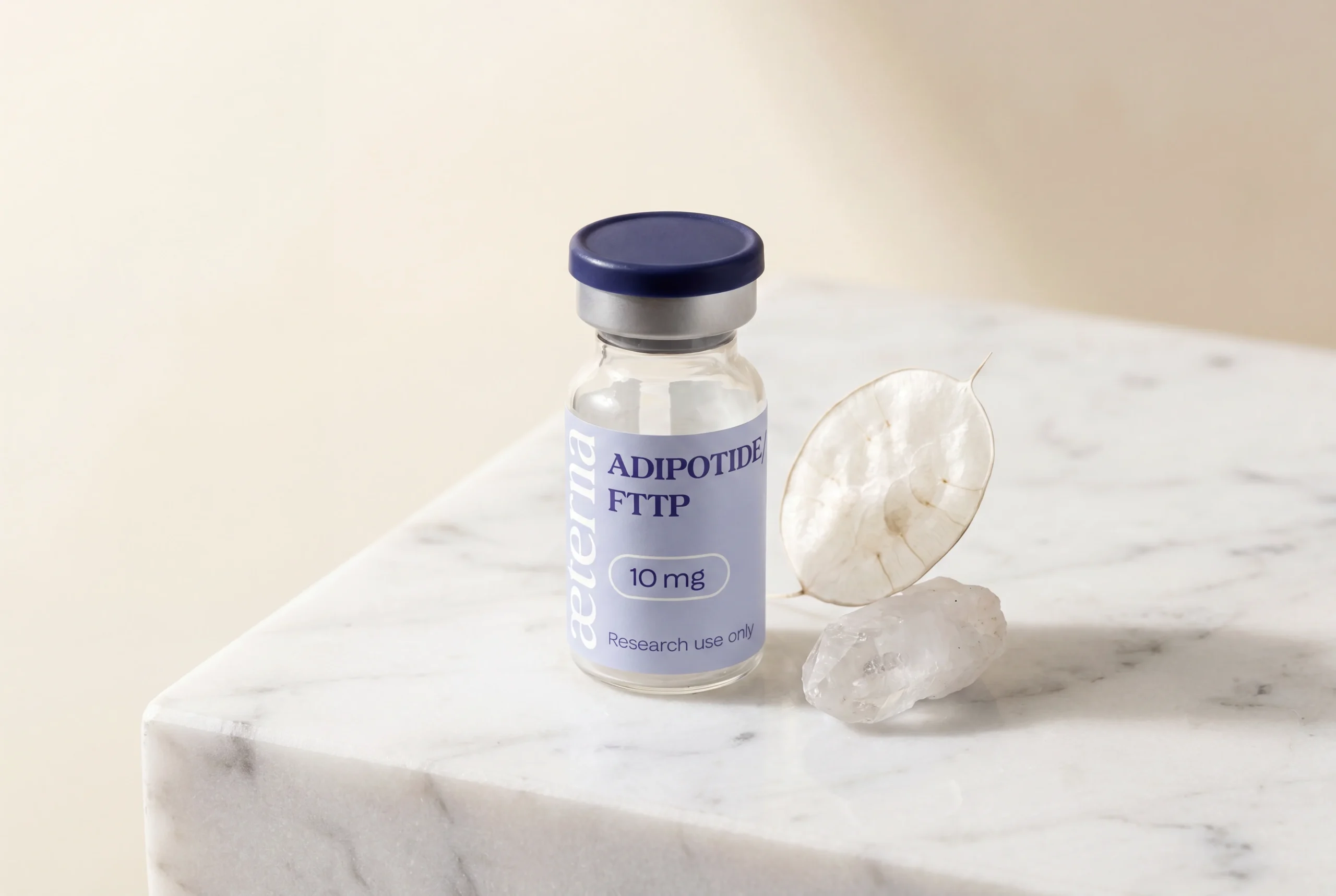
Adipotide/FTTP
Aeterna does not sell peptides. External link, vendor independently verified.
Mechanism
Most metabolic peptides work at the level of appetite or substrate utilization. Adipotide – formally designated FTTP, for fat-targeted proapoptotic peptide – operates at a more fundamental register: it withdraws the vascular infrastructure that adipose tissue depends upon to survive. The mechanism is not hormonal. It is architectural. Two discrete peptide domains, joined by a glycine–glycine linker, perform separate but coordinated functions – one navigates, one destroys. Together they constitute a binary weapon aimed specifically at the vasculature of fat.
Adipose vascular targeting is the defining mechanism of Adipotide, which binds prohibitin on the surface of adipose vascular endothelial cells. The peptide conjugate then induces apoptosis within the capillary network that supplies fat tissue.
Selective vascular disruption leads to local ischemia and downstream adipocyte loss within the targeted depot. In preclinical primate studies, visceral fat appeared more affected than subcutaneous fat.
Appetite-independent fat loss sets this mechanism apart from centrally acting weight-loss agents. In treated animals, reductions in fat mass were reported without corresponding decreases in caloric intake.
Developmental limitation is the renal safety signal that halted clinical progress after early human trials. As a result, the compound now functions primarily as an experimental tool for studying adipose vascular biology.
What we observe
Observed drops in fat and waist size
The following patterns emerge from published preclinical studies – principally non-human primate and murine models. No human clinical trial data exist as of 2025. Each observation carries the weight of its model system, not of clinical evidence. The distinction is not a formality; it is the difference between a hypothesis and a finding.
01
Visceral Fat Reduction
02
Subcutaneous Adipose Loss
03
Body Weight Decline
04
Insulin Sensitivity Improvement
05
Lipid Profile Modulation
06
Reversibility of Effect
Evidence
What the research shows
Three studies anchor the published record on Adipotide. The literature is narrow – a consequence of the compound’s preclinical status and the absence of human trials. What exists is methodologically careful and mechanistically illuminating. Aeterna presents these findings as a reading list, not a clinical endorsement.
Reversal of Obesity by Targeted Ablation of Adipose Tissue Vasculature
The foundational publication from Kolonin, Arap, Pasqualini and colleagues at MD Anderson. Obese rhesus macaques treated with Adipotide over a 28-day course lost an average of 11% of body weight, with MRI-confirmed reductions in both visceral and subcutaneous fat compartments. Histological analysis confirmed endothelial apoptosis and adipocyte loss in treated depots. Metabolic improvements – including reduced fasting insulin – accompanied fat mass reduction. Renal tubular vacuolization was noted as an adverse finding at higher doses, establishing a safety signal that has informed all subsequent discussion of the compound.
Targeted Proapoptotic Peptides and Adipose Vascular Disruption: Dose–Response Relationships in Diet-Induced Obese Murine Models
A follow-on murine study examining dose–response characteristics of FTTP across a range of subcutaneous dosing regimens. Lower doses produced measurable fat mass reduction with attenuated renal findings; higher doses recapitulated the nephrotoxic signal observed in the NHP study. The study established a preliminary therapeutic index and suggested that intermittent dosing schedules might preserve efficacy while reducing organ burden – a hypothesis not yet tested in primates or humans.
PHB-Directed Vascular Targeting: Selectivity of CKGGRAKDC Homing in Adipose versus Tumor Vasculature
An investigation into the tissue selectivity of the CKGGRAKDC homing domain, comparing its biodistribution in adipose and tumor vascular beds. Fluorescently labeled peptide accumulated preferentially in adipose vasculature over a 4-hour window, with lower but non-negligible signal in tumor endothelium – a finding with implications for both the therapeutic specificity of Adipotide and its potential off-target effects. The study reinforced PHB as a viable vascular address but cautioned against assuming absolute tissue exclusivity.
From lyophilized powder to a usable solution.
Peptide
10 mg lyophilized powder
Diluent
3.0 mL bacteriostatic water
Final concentration
3.33 mg/mL
01
Prepare the vial
02
Draw the diluent
03
Add slowly
04
Prepare the vial
Note
Dosing rythm
A patient titration
Schedule below mirrors the peptidedosages.com educational protocol.
Storage, caution, contradiction
Storage
Cold, dark, undisturbed
- Lyophilized: freeze at −20 °C (−4 °F).
- After reconstitution, refrigerate at 2–8 °C (35.6–46.4 °F).
- Avoid freeze–thaw cycles [5].
- Avoid vigorous agitation during and after reconstitution. The D(KLAKLAK)₂ domain is surface-active; foaming indicates structural disruption.
- Inspect solution before each use. Discard if particulate matter, cloudiness, or discoloration is present.
Side effects
What members describe
- Renal tubular vacuolization: the most significant safety signal identified in NHP studies at doses ≥1 mg/kg/day. Mechanism is not fully characterized; may reflect off-target PHB binding in renal tubular endothelium.
- Injection-site reactions: erythema, induration, and localized discomfort reported in preclinical subjects at the site of subcutaneous administration.
- Transient elevations in serum creatinine and BUN observed in higher-dose NHP cohorts, consistent with the renal histological findings.
- Fatigue and reduced activity levels noted in treated NHP subjects during active dosing periods - possibly secondary to metabolic adaptation accompanying rapid fat mass reduction.
- Partial fat mass rebound following cessation, consistent with neovascularization of adipose tissue. This is not an adverse effect per se, but a pharmacodynamic characteristic with implications for any sustained-use protocol.
Contradictions
Reasons to abstain
- No human safety data exist. Use outside of a formal research protocol with institutional oversight is not supported by the available evidence base.
- Pre-existing renal impairment represents a theoretical contraindication given the nephrotoxic signal in NHP models. Renal function monitoring is indicated in any research application.
- Pregnancy and lactation: no data. The proapoptotic mechanism and vascular-disrupting activity present theoretical risks that preclude use in these populations.
- Concurrent use of nephrotoxic agents (NSAIDs, aminoglycosides, contrast media) should be avoided given the additive renal burden suggested by preclinical findings.
- Individuals with active malignancy: the PHB-targeting homing domain has demonstrated non-negligible affinity for tumor vasculature in biodistribution studies. The implications for oncological safety are unstudied.
Synergies
Useful partners for fat loss
Adipotide’s mechanism – vascular withdrawal from adipose tissue – is structurally distinct from every other metabolic peptide in the Aeterna curriculum. Stacking considerations therefore center on complementarity rather than synergy at the receptor level. The following companions address either the metabolic consequences of rapid fat loss, the preservation of lean mass, or the inflammatory milieu that accompanies adipose apoptosis. All combinations are theoretical in the absence of human data.
FAQ
Your questions, patiently answered
GLP-1 receptor agonists reduce fat mass primarily by suppressing appetite and, to a lesser extent, by altering substrate utilization and energy expenditure. Adipotide does not interact with appetite-regulating receptors at all. Its mechanism is vascular: it targets the blood supply of adipose tissue and induces endothelial apoptosis, causing fat depots to regress through ischemic loss rather than caloric deficit. The two approaches are not competing – they are operating at entirely different levels of biological organization.
No. As of 2025, no human clinical trials have been registered or completed. All published efficacy and safety data derive from murine and non-human primate models. The renal safety signal identified in rhesus macaques at higher doses has been cited as a primary reason for the absence of IND-stage development. The gap between preclinical promise and clinical investigation remains wide and, for now, unbridged.
In the foundational 2011 Science Translational Medicine study, histological examination of renal tissue in treated rhesus macaques revealed tubular vacuolization – a morphological change associated with cellular stress in the proximal tubule. The mechanism is not fully characterized but may reflect PHB expression in renal tubular endothelium, making those cells susceptible to the same apoptotic cascade intended for adipose vasculature. This finding does not preclude further development, but it establishes a clear safety threshold that any clinical program would need to address.
Preclinical evidence suggests it is not. Following cessation of treatment, adipose vasculature can regenerate – a process consistent with the known plasticity of the adipose microenvironment – and fat mass partially returns. The degree of rebound appears related to the duration of the recovery period and the metabolic state of the subject. Whether repeated treatment cycles could produce durable structural changes has not been studied.
FTTP – fat-targeted proapoptotic peptide – is the systematic descriptive designation used in the primary scientific literature. Adipotide is a colloquial name that gained currency in research and enthusiast communities following the 2011 publication. Both names refer to the same compound: the bifunctional peptide comprising the CKGGRAKDC homing domain linked to D(KLAKLAK)₂. Aeterna uses both designations interchangeably, with a preference for FTTP in mechanistic discussion.
Yes – and the connection is foundational rather than incidental. The CKGGRAKDC homing domain was originally identified through phage display screens designed to find peptides that home to tumor vasculature. PHB was subsequently recognized as a shared vascular address in both tumor and adipose endothelium. The proapoptotic D(KLAKLAK)₂ effector domain was itself developed in the context of cancer vascular targeting. Adipotide is, in a precise sense, an oncology tool repurposed for metabolic application – a lineage that explains both its mechanism and its safety profile.
In the same family
Further reading in the curriculum.
Sourcing · Independently verified
When you're ready, source thoughtfully.