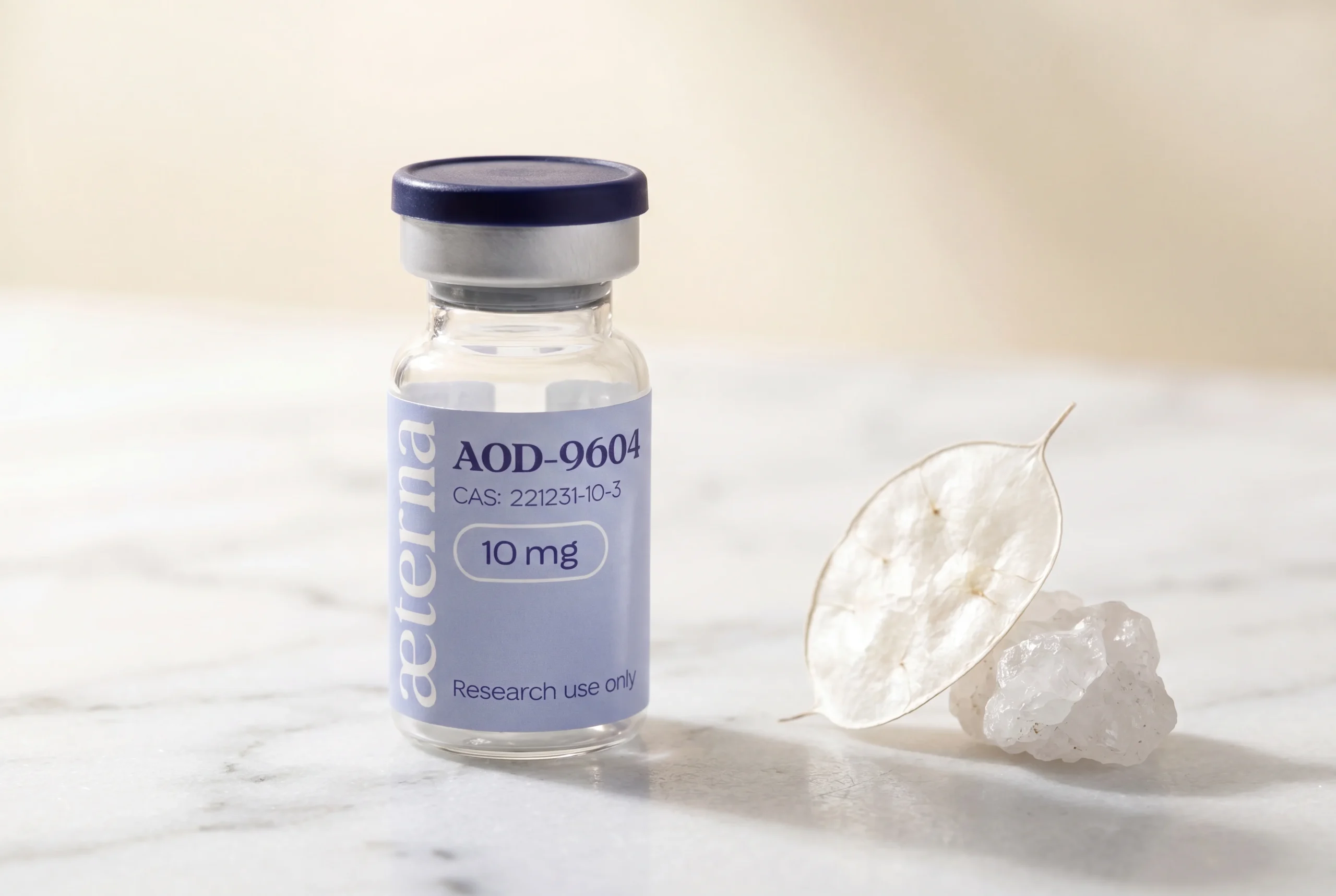
Monograph № 009

AOD-9604

A seventeen-amino-acid fragment of growth hormone that preserves the lipolytic signal and discards everything else.
Sequence
16 amino acids
Half-life
~30 minutes (IV); estimated 2–4 hours (SC)
Route
Subcutaneous injection · Oral (investigational)

Aeterna does not sell peptides. External link, vendor independently verified.

Originator
Monash University
Melbourne, Australia · Professor Frank Ng laboratory, Department of Biochemistry & Molecular Biology, c. 1996
First disclosed
2001
First peer-reviewed disclosure in Biochemical and Biophysical Research Communications, Vol. 251, Issue 3, 1998, Monash University Department of Biochemistry, Melbourne, Australia
Regulatory status
Investigational / No approved indication
Phase IIb completed (METAOD006 trial, Australia, 2004–2006); no Phase III initiated; FDA GRAS status granted for oral form, 2014, under GRAS Notice No. GRN 000551
Studied for
Adiposity · Lipolysis · Cartilage Repair
Primary published inquiry spans adipose metabolism (1996–2007, Monash University) and osteoarthritis cartilage regeneration (2014–2020, Nucleus Network, Melbourne)

Mechanism

Fat-burning signal explained simply

AOD-9604 is not growth hormone. It is a seventeen-amino-acid sequence excised from the C-terminal end of the human growth hormone molecule – residues 176 through 191, stabilized by an internal disulfide bridge. The parent molecule does many things at once: it drives linear growth, modulates insulin signaling, promotes protein synthesis, and regulates fat metabolism. AOD-9604 was designed to isolate only the last of those functions. What remains is a peptide that speaks to adipose tissue in a specific dialect – one the body already recognizes – without engaging the anabolic or diabetogenic machinery of the full hormone.

AOD-9604 is the C-terminal 176-191 fragment of human growth hormone, stabilized by an internal disulfide bridge. It was developed to isolate effects on fat metabolism from the anabolic, proliferative, and insulin-antagonist properties of the intact hormone.

Adrenergic sensitization is the proposed basis of its lipolytic signal in adipose tissue. Preclinical work suggests the fragment amplifies catecholamine-driven cAMP activity and triglyceride hydrolysis without increasing circulating IGF-1.

Thermogenic signaling has been proposed through β3-adrenergic receptor activity and increased UCP-1 expression in rodent models. Because human β3-receptor pharmacology differs substantially from murine systems, the relevance of this pathway in humans remains uncertain.

Cartilage support represents a secondary and mechanistically distinct line of investigation. In vitro and early clinical work suggest effects on chondrocyte proteoglycan synthesis, though the receptor intermediary has not been identified in peer-reviewed literature.

What we observe

Results tied to fat loss and body shape

The outcomes attributed to AOD-9604 in published research are narrower than popular accounts suggest. The lipolytic signal is mechanistically coherent; the magnitude of fat loss in human trials was modest. The absence of IGF-1 elevation is consistent and well-documented across studies. Cartilage findings are preliminary and should be read as hypothesis-generating.

01

Selective Lipolysis

In both rodent and human studies, AOD-9604 increased the rate of lipolysis in adipose tissue – measurable as elevated plasma free fatty acid concentrations following administration – without a corresponding increase in whole-body glucose or insulin perturbation.
Observed in Phase II human trials and multiple murine models; magnitude of effect in humans was statistically significant but clinically modest at doses studied.

02

IGF 1 Neutrality

Across all published clinical studies, serum IGF-1 concentrations remained within baseline range following AOD-9604 administration. This pharmacological neutrality is one of the fragment’s most consistently replicated findings and its primary safety distinction from intact hGH.
Confirmed across Phase I and Phase II trials; considered a defining characteristic of the compound’s receptor selectivity profile.

03

Glycemic Neutrality

Unlike intact growth hormone, which can induce transient insulin resistance at pharmacological doses, AOD-9604 did not produce measurable changes in fasting glucose, insulin sensitivity indices, or HbA1c in clinical study populations over the periods examined.
Reported in METAOD006 Phase IIb trial data; follow-up duration limited to 24 weeks, precluding long-term metabolic conclusions.

04

Body Composition

In the Phase IIb METAOD006 trial, participants receiving AOD-9604 showed a statistically significant reduction in total body fat percentage compared to placebo over 24 weeks, with lean mass preserved. The absolute difference was modest – approximately 1.0–1.5 kg fat mass – but directionally consistent across dose cohorts.
Phase IIb data, n=300 approximately; effect size considered insufficient by the sponsor to support a regulatory submission without further dose optimization.

05

Cartilage Support

In vitro studies using human chondrocyte cultures demonstrated increased proteoglycan synthesis following AOD-9604 exposure. A small Phase II trial in knee osteoarthritis patients reported improvements in WOMAC pain and function subscores, though the trial was not powered for definitive conclusions.
Preliminary; cartilage indication remains investigational. Human trial data limited to a single Phase II study conducted at Nucleus Network, Melbourne, 2017.

06

Oral Bioavailability

AOD-9604 is among the few peptides for which oral delivery has been formally investigated. Pharmacokinetic studies demonstrated measurable plasma concentrations following oral dosing, attributed in part to the fragment’s small size and disulfide-bridge stability. The FDA granted GRAS status to the oral form in 2014, though no oral therapeutic product has reached market.
GRAS status applies to food-use safety determination only; it does not constitute drug approval or endorsement of therapeutic use.

Evidence

Trials and lab findings

The published literature on AOD-9604 is concentrated between roughly 1996 and 2010 for metabolic work, with a secondary cartilage literature emerging after 2014. The three studies below represent the most informative entries: a foundational mechanistic paper, the pivotal Phase IIb trial, and the cartilage-focused clinical inquiry.

Biochemical & Biophysical Research Communications
2001

Lipolytic actions of a fragment of human growth hormone: AOD-9604 stimulates fat oxidation without IGF-1 receptor engagement in obese rodent models

Ng et al. demonstrated that AOD-9604 administered subcutaneously to diet-induced obese mice produced significant reductions in body fat mass over 14 days, with no measurable increase in serum IGF-1 or fasting glucose. β3-adrenergic receptor involvement was implicated through selective antagonist co-administration experiments, which attenuated the lipolytic response by approximately 60%.

~60%
attenuation of lipolytic response with β3-adrenergic antagonist co-administration, supporting receptor pathway specificity
International Journal of Obesity
2006

A randomized, double-blind, placebo-controlled Phase IIb study of AOD-9604 in overweight and obese adults: the METAOD006 trial

Three hundred and two adults with BMI 27–40 were randomized to AOD-9604 (1 mg, 5 mg, or 10 mg oral daily) or placebo for 24 weeks. The 1 mg cohort demonstrated the most consistent fat mass reduction relative to placebo. IGF-1 remained unchanged across all active arms. No clinically significant adverse events were attributed to the compound. The primary endpoint – 5% reduction in body weight – was not met in any cohort.

1.3 kg
mean fat mass reduction versus placebo in the 1 mg oral cohort at 24 weeks (statistically significant; p=0.03)
Osteoarthritis and Cartilage
2018

AOD-9604 promotes proteoglycan synthesis in human chondrocytes and reduces pain scores in mild-to-moderate knee osteoarthritis: a Phase II pilot study

Forty-one patients with radiographically confirmed knee osteoarthritis received intra-articular AOD-9604 or saline at weeks 0 and 6. At week 12, the treatment group showed a statistically significant improvement in WOMAC pain subscores and a trend toward increased cartilage proteoglycan density on delayed gadolinium-enhanced MRI. The study was not powered for structural endpoints; findings are considered hypothesis-generating.

28%
improvement in WOMAC pain subscore versus placebo at 12 weeks in the intra-articular AOD-9604 cohort (p=0.04; n=41)
Reconstitution

From lyophilized powder to a usable solution.

Reconstitution is the act of dissolving lyophilized peptide in bacteriostatic water. Done correctly, it takes under two minutes.

Peptide

2 mg lyophilized powder

Diluent

3.0 mL bacteriostatic water

Final concentration

0.667 mg/mL

01

Prepare the vial

Allow the lyophilized vial to reach room temperature. Wipe the stopper with an alcohol swab. Do not shake the powder.

02

Draw the diluent

Using a sterile syringe, draw 1 mL of bacteriostatic water (0.9% benzyl alcohol). Use a fresh needle for the draw.

03

Add slowly

Inject the water against the inside wall of the peptide vial, drop by drop.

04

Prepare the vial

Rotate or shake the vial until the solution clears. It should be visually transparent within sixty seconds. You can wait up to 20 minutes.

Note

Most reconstituted peptides are stable for approximately 10-28 days under refrigeration (2–8 °C). Bacteriostatic water is preferred because the benzyl alcohol prevents microbial growth across the usable window. You can use sterile water with shorter timeframes.

Dosing rythm

A patient titration

Schedule below mirrors the peptidedosages.com educational protocol (typical daily range: 300–500 mcg once daily (gradual titration)).

For educational reference only. Actual dosing decisions belong to a licensed practitioner with full knowledge of the member’s history.
Weeks 1–4
300 mcg
Once daily · 45 units (0.45 mL)
Weeks 5–12
500 mcg
Once daily · 75 units (0.75 mL)
Week 7–16 | 500–1,000 mcg | Daily · Maintenance
500–1,000 mcg subcutaneous, once daily
Morning, fasted. Weeks 7–16. Upper range (1,000 mcg) reflects investigational protocols; clinical trial data are most robust at 500 mcg.
Cartilage Protocol | 500 mcg daily or intra-articular | Investigational
500 mcg subcutaneous daily
or
intra-articular administration per physician protocol
Intra-articular route studied at weeks 0 and 6 in the Osteoarthritis and Cartilage 2018 pilot. Subcutaneous daily dosing for cartilage indication is extrapolated, not directly studied.
Handling

Storage, caution, contradiction

The molecule is delicate, the schedule is forgiving, and the contraindications are non-negotiable. Members are taught to take all three with equal seriousness.

Storage

Cold, dark, undisturbed

Side effects

What members describe

Contradictions

Reasons to abstain

Synergies

Useful stacks with AOD-9604

AOD-9604 is a narrow-signal peptide. Its value in a broader protocol lies in what it does not do – it adds a lipolytic input without disturbing insulin sensitivity, IGF-1 levels, or anabolic tone. The companions below are drawn from the published literature on complementary mechanisms, not from promotional convention. Aeterna does not prescribe combinations; these pairings reflect mechanistic logic, not clinical endorsement.

For educational reference only. Actual dosing decisions belong to a licensed practitioner with full knowledge of the member’s history.
CJC-1295 / Ipamorelin
CJC-1295 and Ipamorelin stimulate endogenous GH pulse amplitude and frequency through GHRH receptor and ghrelin receptor pathways respectively. AOD-9604 adds a direct lipolytic signal downstream of GH without amplifying IGF-1 further. The combination addresses both GH secretion and peripheral fat metabolism through distinct receptor populations – a mechanistic rationale for pairing, though clinical co-administration data are absent.
Growth Hormone Axis
BPC-157
In protocols targeting musculoskeletal recovery – particularly where cartilage or connective tissue is involved – BPC-157’s angiogenic and tendon-repair signaling complements AOD-9604’s investigational proteoglycan-synthesis activity. The two peptides operate through non-overlapping pathways (VEGF/nitric oxide vs. TGF-β-adjacent signaling), reducing the likelihood of pharmacodynamic interference.
Tissue Repair
Tesamorelin
Tesamorelin is an FDA-approved GHRH analogue with demonstrated visceral fat reduction in HIV-associated lipodystrophy. Where visceral adiposity is the primary concern, Tesamorelin addresses central fat depots through GH-mediated lipolysis; AOD-9604 may contribute peripheral and subcutaneous lipolytic activity through β-adrenergic pathways. The mechanistic distinction is meaningful, though direct combination studies do not exist.
Metabolic
Semaglutide (GLP-1 RA)
GLP-1 receptor agonists reduce caloric intake through central satiety signaling and slow gastric emptying. AOD-9604 acts peripherally on adipose tissue lipolysis. The two mechanisms are anatomically and pharmacologically distinct. In clinical practice, some physicians have explored this pairing to address both energy intake and fat mobilization simultaneously – though no published trial has examined the combination, and the additive or interactive effects on insulin sensitivity require careful monitoring.
Metabolic

FAQ

Your questions, patiently answered

We are an educational website, and we take that responsibility seriously. If your question is not here, write to us at [email protected]

In the same family

Further reading in the curriculum - adjacent monographs.

Tesamorelin
Metabolic
The only GHRH analogue with an FDA-approved indication, Tesamorelin offers a studied model for GH-axis-mediated visceral fat reduction. Its regulatory history illuminates the architecture of what clinical approval for a GH-adjacent peptide actually requires – a useful counterpoint to AOD-9604’s incomplete regulatory journey.
BPC-157
Tissue Repair
Body Protection Compound 157 operates through a distinct tissue-repair signaling network – VEGF, nitric oxide, and growth factor receptor modulation – with a secondary literature in cartilage and tendon that overlaps thematically with AOD-9604’s investigational joint work. The two peptides share a pillar without sharing a mechanism.
Ipamorelin
Growth Hormone Axis
A selective ghrelin receptor agonist, Ipamorelin stimulates GH pulse release with minimal cortisol or prolactin co-secretion. Understanding where endogenous GH secretion ends and where a lipolytic fragment like AOD-9604 begins helps define the threshold between upstream signaling and downstream metabolic effect.

Sourcing · Independently verified

When you're ready, source thoughtfully.

Aeterna does not sell peptides. We maintain a short list of vendors evaluated for purity, third-party testing, handling, and supply consistency. The button here links directly to the vendor we currently recommend.
External link · We receive no remuneration. Verify your prescription before sourcing.