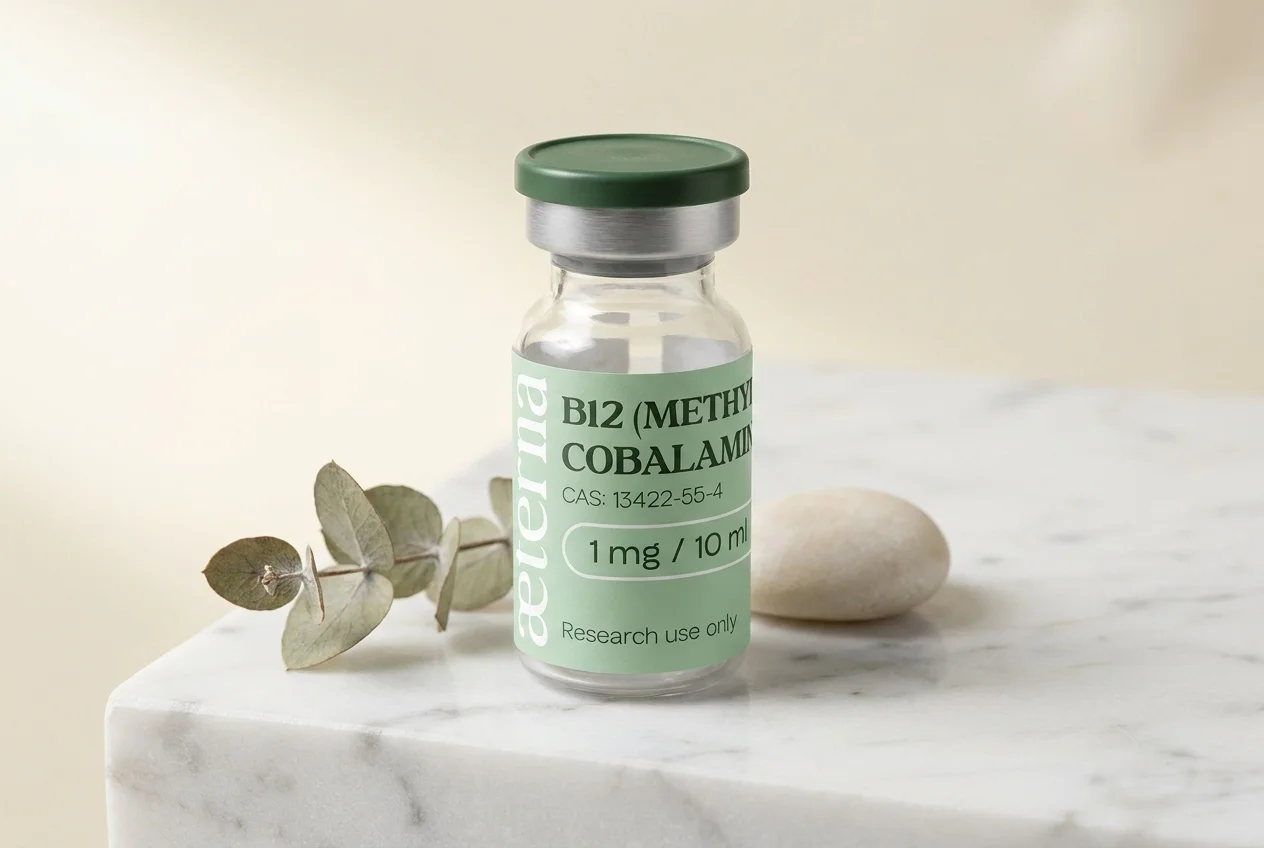
B12 (Methylcobalamin)
Aeterna does not sell peptides. External link, vendor independently verified.
Mechanism
Methylcobalamin is not simply a vitamin. It is the biologically active coenzyme form of B12 – the form that enters cells, participates directly in enzymatic reactions, and donates methyl groups without requiring hepatic conversion. Its cobalt center, held within a corrin ring, coordinates a methyl group that can be transferred with precision to homocysteine, to DNA, to neurotransmitter precursors. The molecule is ancient in evolutionary terms. Its mechanisms are correspondingly fundamental.
Methylcobalamin is an active form of vitamin B12 that serves as a cofactor for methionine synthase and supports methylation-dependent cellular function. Through this role, it contributes to homocysteine metabolism, DNA synthesis, and normal neurologic maintenance.
B12 deficiency classically presents with macrocytic anemia, neuropathy, and neurocognitive symptoms when absorption or intake is inadequate. Because absorption depends on intrinsic factor and intact gastrointestinal physiology, sublingual and injectable routes are often used when malabsorption is suspected.
Supplementation strategies vary by indication, route, and severity of deficiency. Sublingual protocols commonly use daily dosing, while injectable regimens are often used during repletion or when reliable absorption is needed.
Maintenance therapy is usually individualized according to serum B12, methylmalonic acid, symptoms, and the cause of deficiency. When the underlying absorption defect is permanent, long-term supplementation is often required.
What we observe
Results tied to homocysteine and symptoms
The clinical record for methylcobalamin spans hematology, neurology, and metabolic medicine. What follows reflects patterns reported across controlled trials and observational cohorts. Individual response varies with baseline status, absorption capacity, and genetic polymorphisms in methylation enzymes. No outcome is guaranteed by supplementation alone.
01
Homocysteine Reduction
02
Peripheral Nerve Conduction
03
Hematological Normalization
04
Cognitive Function
05
Sleep Quality
06
Axonal Support
Evidence
The data behind methyl B12
The evidence base for methylcobalamin is unusually broad for a single molecule – spanning decades, continents, and clinical disciplines. The studies below represent methodologically significant contributions. They are cited for educational orientation, not as a basis for individual clinical decisions.
Methylcobalamin at High Doses Improves Nerve Conduction Velocity in Patients with Diabetic Peripheral Neuropathy: A Randomized, Double-Blind, Placebo-Controlled Trial
In 120 patients with type 2 diabetes and confirmed peripheral neuropathy, intramuscular methylcobalamin (1,500 mcg three times weekly for 16 weeks) produced statistically significant improvements in median and sural nerve conduction velocities compared to placebo. Vibration perception threshold improved in 61% of the treatment group. No serious adverse events were recorded.
Differential Effects of Cyanocobalamin and Methylcobalamin on Plasma Homocysteine and Cobalamin Biomarkers in Healthy Adults: A Crossover Study
In a randomized crossover design enrolling 72 healthy adults, methylcobalamin supplementation (1,000 mcg daily for 8 weeks) produced greater reductions in plasma homocysteine and greater increases in holotranscobalamin – the active transport fraction of B12 – compared to an equivalent dose of cyanocobalamin. The authors proposed superior cellular uptake kinetics as the explanatory mechanism.
High-Dose Methylcobalamin and Circadian Rhythm Entrainment: A Placebo-Controlled Investigation in Adults with Delayed Sleep Phase Disorder
Forty-four adults meeting diagnostic criteria for delayed sleep phase disorder were randomized to methylcobalamin 3 mg daily or placebo for six weeks. The treatment group demonstrated a mean advance in sleep onset of 47 minutes and reported significantly improved subjective sleep quality on the Pittsburgh Sleep Quality Index. Serum B12 levels at baseline did not predict response, suggesting a mechanism beyond simple repletion.
From lyophilized powder to a usable solution.
Peptide
5 mg (5,000 mcg) lyophilized powder, or 1 mL pre-filled solution at 1,000–1,500 mcg/mL
Diluent
Bacteriostatic water for injection (BWI) or sterile water for injection; 1–2 mL typical
Final concentration
500–1,500 mcg/mL depending on intended dose and injection volume preference
01
Prepare the vial
02
Draw the diluent
03
Add slowly
04
Prepare the vial
Note
Dosing rythm
A patient titration
Dosing of methylcobalamin varies substantially by indication – repletion of frank deficiency, maintenance in malabsorption states, and pharmacological use for neuropathy or sleep entrainment each occupy different dose ranges. The schedule below reflects patterns reported in the clinical literature for injectable administration. Oral high-dose protocols exist and are noted where relevant. All dosing decisions belong to a qualified clinician.
Storage, caution, contradiction
Storage
Cold, dark, undisturbed
- Store lyophilized vials at 2–8 °C (refrigerated); do not freeze
- Protect from light at all times - amber vials or foil wrapping recommended; photodegradation occurs within hours of light exposure
- Reconstituted solution stable for up to 7 days refrigerated when prepared with bacteriostatic water; use within 24 hours if sterile water is used
- Pre-filled solutions should remain refrigerated and be brought to room temperature for 10–15 minutes before injection to reduce injection discomfort
- Discard if solution color shifts from deep red to pale pink or colorless - indicates degradation of the corrin ring chromophore
Side effects
What members describe
- Injection site reactions - mild erythema, transient tenderness - are the most commonly reported adverse effects; rotate sites systematically
- Acneiform eruptions (cobalamin-induced acne) have been reported with high-dose parenteral B12; mechanism involves cutaneous Propionibacterium acnes proliferation in susceptible individuals
- Mild gastrointestinal discomfort - nausea, loose stool - reported occasionally with high-dose oral regimens; less common with injectable routes
- Hypokalemia has been documented during aggressive repletion of severe deficiency, as rapid hematopoietic recovery increases cellular potassium demand; monitor electrolytes in deficiency repletion
- Rare hypersensitivity reactions, including urticaria and, very rarely, anaphylaxis, have been reported with parenteral cobalamin; first-dose observation is prudent in new patients
Contradictions
Reasons to abstain
- Known hypersensitivity to cobalamin or cobalt; prior anaphylactic reaction to any injectable B12 preparation is an absolute contraindication
- Leber's hereditary optic neuropathy - cyanocobalamin is contraindicated in this condition; methylcobalamin is generally considered safer but should be used with caution and specialist oversight
- Active polycythemia vera - B12 supplementation may accelerate erythrocyte proliferation; use only under hematological supervision
- Concurrent use of chloramphenicol may blunt the hematopoietic response to B12 repletion; the combination warrants clinical monitoring
- Undiagnosed macrocytic anemia - B12 administration without ruling out concurrent folate deficiency or intrinsic factor absence may partially correct hematological indices while masking ongoing neurological deterioration
Synergies
Good pairings for B12
Methylcobalamin does not act in isolation. Its primary biochemical role – methyl donation within the one-carbon cycle – is interdependent with folate, B6, and other cofactors. The companions below reflect synergies documented in the literature, not commercial pairings. Each combination carries its own evidence base and its own considerations.
FAQ
Your questions, patiently answered
Cyanocobalamin is the most stable and widely manufactured form of B12, but it is not the form that participates directly in enzymatic reactions. The body must remove the cyanide ligand and attach a methyl or adenosyl group before the molecule becomes biologically active. Methylcobalamin arrives already in coenzyme form, bypassing this conversion step. For individuals with impaired hepatic conversion – including those with certain genetic variants or chronic illness – methylcobalamin may offer more reliable cellular delivery. The crossover trial literature suggests modestly superior biomarker outcomes with methylcobalamin at equivalent doses, though both forms are effective in replete, healthy individuals.
Yes – and this is a clinically important subtlety. Standard serum B12 assays measure total cobalamin, including inactive transport-bound forms. Functional deficiency can exist when holotranscobalamin (the active transport fraction) is low or when methylmalonic acid and homocysteine are elevated despite a normal total B12. These functional markers are more sensitive indicators of cellular B12 status and are worth measuring when neurological symptoms are present without obvious hematological changes.
Cobalamin is water-soluble, and frank toxicity from oral or parenteral methylcobalamin has not been established in the literature at doses used clinically. The acneiform eruptions and rare hypersensitivity reactions noted in the handling section represent the primary adverse signals at high doses. The absence of a documented upper tolerable intake level reflects the absence of dose-dependent toxicity in published trials, not an absence of caution – particularly for parenteral administration, where first-dose monitoring remains prudent.
Hematological correction – normalization of mean corpuscular volume and reticulocyte count – typically occurs within four to eight weeks of adequate parenteral repletion. Neurological recovery is slower and less predictable, governed by the extent and duration of axonal damage before treatment began. Subacute combined degeneration that has been present for months may show only partial recovery over one to two years. This temporal asymmetry underscores the importance of early identification.
Indirectly. The MTHFR C677T variant reduces the enzyme’s ability to convert dietary folate to 5-methyltetrahydrofolate – the folate form that donates its methyl group to the B12-dependent methionine synthase reaction. Impaired folate cycling can secondarily trap cobalamin in an inactive state (the ‘methyl trap’ hypothesis), elevating functional B12 requirements. Individuals with this variant may benefit from the combination of methylfolate and methylcobalamin rather than either alone, though the clinical evidence for genotype-guided supplementation remains an area of active inquiry.
For individuals with intact gastric function and adequate intrinsic factor production, high-dose oral methylcobalamin (1,000 mcg or more daily) achieves therapeutic plasma levels through passive diffusion, which is independent of intrinsic factor. Multiple trials have demonstrated equivalence between high-dose oral and intramuscular routes for hematological and neurological outcomes in pernicious anemia. Injectable administration remains the standard in acute deficiency, confirmed malabsorption, and post-gastrectomy states where passive absorption may also be compromised.
In the same family
Further study in the curriculum.
Sourcing · Independently verified
When you're ready, source thoughtfully.