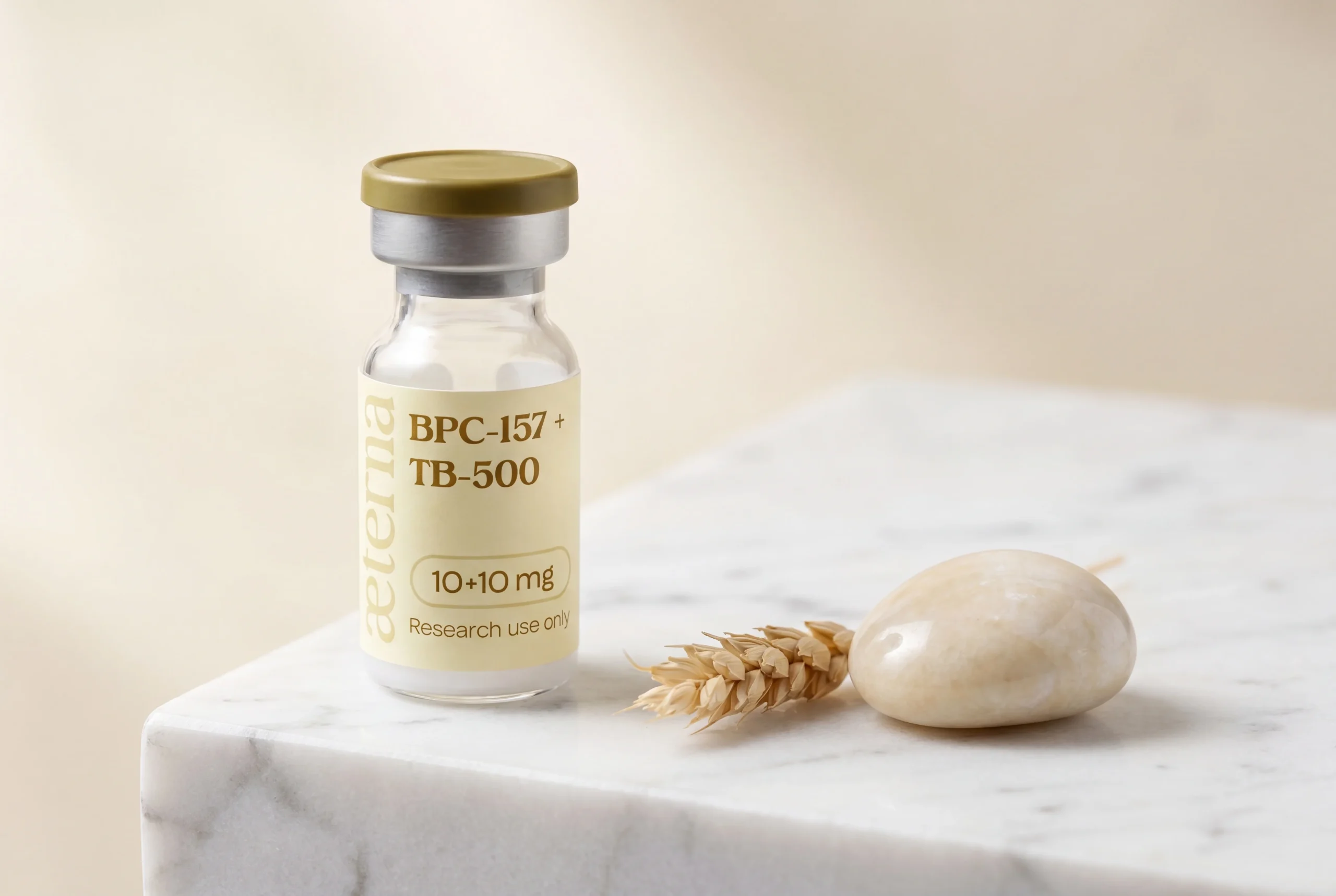
BPC-157 + TB-500
Aeterna does not sell peptides. External link, vendor independently verified.
Mechanism
BPC-157 and TB-500 do not share a receptor. They share a purpose. Each peptide enters the repair conversation through a distinct molecular door – one anchoring growth factor signaling, the other reorganizing the cytoskeleton – and together they address tissue injury at a depth that neither reaches alone. Understanding the combination requires understanding each mechanism on its own terms first.
BPC-157 has been reported in preclinical literature to influence VEGFR2 signaling and FAK-paxillin pathways involved in endothelial migration and angiogenesis. This is part of the rationale for its study in models of impaired perfusion and structurally disrupted tissue.
BPC-157 has also been described as a modulator of nitric oxide system activity in injury models. In context, that proposed effect is used to explain its recurring association with cytoprotective and perfusion-related findings in the literature.
TB-500 is discussed in relation to thymosin beta-4 biology, particularly its role in actin dynamics and cellular migration. This framework helps explain why it is studied in repair settings involving fibroblasts, endothelial cells, and regenerating tissue.
Together, the two peptides are presented as acting through overlapping but non-identical repair pathways. The combination is therefore framed in research contexts as broader in scope than either peptide considered alone.
What we observe
What people noticed in healing and recovery
The following patterns emerge from preclinical models and limited human observational data. They represent what the published literature reports under studied conditions, not clinical guarantees for any individual. Aeterna does not prescribe, dispense, or sell.
01
Tendon Bone Healing
02
Muscle Regeneration
03
Mucosal Protection
04
Angiogenic Support
05
Neurological Recovery
06
Systemic Protection
Evidence
Healing data for both peptides
The evidence base for this combination is substantial in preclinical depth and limited in clinical breadth. Most human data remain observational. The studies below represent methodologically notable entries in the published record, with statistics drawn directly from reported findings.
BPC-157 accelerates healing of transected rat Achilles tendon and modulates expression of VEGFR2 and FAK at the repair site
Rats receiving subcutaneous BPC-157 (10 µg/kg daily) following Achilles tendon transection demonstrated significantly improved biomechanical load-to-failure scores and histological collagen organization at 14 and 28 days post-injury compared to vehicle controls. VEGFR2 and FAK immunoreactivity were markedly elevated at the repair interface in treated animals.
Thymosin β4 promotes cardiac repair and reduces infarct size following myocardial ischemia through ILK-mediated Akt activation
Administration of Thymosin β4 (the parent molecule of TB-500) in a murine left anterior descending artery ligation model was associated with a significant reduction in infarct area, improved fractional shortening, and increased cardiomyocyte survival. ILK phosphorylation was identified as the proximal mediator of the Akt survival signal.
Stable gastric pentadecapeptide BPC-157 attenuates NSAID-induced gastrointestinal injury and restores mucosal nitric oxide synthase activity in a rat model
Oral and subcutaneous BPC-157 both demonstrated significant protective effects against indomethacin-induced gastric and intestinal lesions in Sprague-Dawley rats. Mucosal NOS activity, suppressed by NSAID administration, was restored to near-baseline levels in treated animals. Lesion index scores were substantially lower across all BPC-157 dosing groups.
From lyophilized powder to a usable solution.
Peptide
BPC-157: 5 mg per vial · TB-500: 5 mg per vial (common research presentation)
Diluent
3.0 mL bacteriostatic water
Final concentration
3.33 mg/mL
01
Prepare the vial
02
Draw the diluent
03
Add slowly
04
Prepare the vial
Note
Dosing rythm
A patient titration
Schedule below mirrors the peptidedosages.com educational protocol (typical daily range: 600–1000 mcg total blend once daily (provides 300–500 mcg of each peptide)).
Storage, caution, contradiction
Storage
Cold, dark, undisturbed
- Lyophilized: freeze at −20 °C (−4 °F).
- After reconstitution, refrigerate at 2–8 °C (35.6–46.4 °F).
- Avoid freeze–thaw cycles.
- Swirl gently to dissolve. Avoid excessive foaming. Particulate matter or cloudiness indicates contamination.
- Label each vial with reconstitution date and concentration · Maintain a separate log for BPC-157 and TB-500 given their different dosing schedules
Side effects
What members describe
- Injection site reactions - mild erythema, transient swelling, or localized discomfort - are the most commonly reported adverse events in both peptides · Typically resolve within 24–48 hours
- Transient nausea has been reported with BPC-157, particularly at higher doses or when administered without food in oral protocols · Less common with subcutaneous route
- Lightheadedness or mild hypotension has been noted anecdotally following TB-500 injection, possibly related to its vasodilatory and angiogenic activity · Administer seated when initiating use
- Fatigue or a transient sense of heaviness in the days following TB-500 loading doses has been reported in researcher logs · Generally self-limiting within 48–72 hours
- The long-term safety profile of neither compound in humans has been formally established through controlled clinical trials · All adverse event patterns cited here derive from preclinical data and uncontrolled human observation
Contradictions
Reasons to abstain
- Active malignancy or personal history of hormone-sensitive cancer · Both peptides promote angiogenesis and cell survival signaling - pathways that may theoretically support tumor growth · This concern is precautionary and not yet supported by direct oncological evidence in humans
- Pregnancy and lactation · Neither BPC-157 nor TB-500 has been studied in pregnant or nursing populations · Use is not appropriate in these contexts
- Known hypersensitivity to any component of either peptide sequence · Anaphylaxis risk, while not well-characterized, cannot be excluded
- Concurrent use of anticoagulant therapy · BPC-157's NO-modulating and vascular effects may interact with anticoagulant pharmacodynamics · Physician review is warranted
- Uncontrolled autoimmune conditions · TB-500's immunomodulatory and cytoskeletal signaling properties have not been studied in the context of active autoimmune disease · Caution is appropriate
Synergies
Other add-ons for BPC/TB
BPC-157 and TB-500 are themselves a stack – two peptides whose mechanisms are complementary rather than redundant. When additional compounds are considered alongside this pair, the logic should follow the same principle: distinct mechanisms, shared purpose. The companions below represent patterns observed in researcher literature and practitioner-reported protocols. Aeterna does not prescribe, dispense, or sell.
FAQ
Your questions, patiently answered
Because their mechanisms are genuinely complementary. BPC-157 works primarily through growth factor receptor signaling, NO modulation, and angiogenesis. TB-500 works through actin sequestration, cell migration, and ILK-mediated survival signaling. Neither duplicates the other. When tissue repair requires both a vascular scaffold and a mobilized cellular workforce, the combination addresses both needs – which is why researchers and practitioners have gravitated toward pairing them.
Limited. BPC-157 has an extensive preclinical record – primarily from the University of Zagreb – but has not completed large-scale randomized controlled trials in humans. TB-500 is derived from Thymosin β4, which has been studied in human trials for wound healing and dry eye disease by RegeneRx Biopharmaceuticals, but the synthetic TB-500 fragment itself has not been the subject of formal Phase II or III human trials. The evidence base is preclinical in depth and observational in its human dimension.
BPC-157 is unusual among peptides in that it demonstrates activity via oral administration in animal models – an observation attributed to its stability in gastric acid and its local action on gastrointestinal mucosa. For systemic musculoskeletal or neurological applications, subcutaneous injection is the more commonly studied route. Oral administration appears most relevant to gastrointestinal indications. TB-500 does not have a meaningful oral bioavailability profile and is administered parenterally.
Preclinical and researcher-reported protocols typically describe a loading phase of four to six weeks, followed by a maintenance phase of four to eight additional weeks. Total duration of eight to twelve weeks is common. Some researchers cycle off entirely and reassess. There is no established optimal duration for humans, and the appropriate length of any protocol should be determined in consultation with a qualified physician.
This is a legitimate and frequently raised concern. Both peptides promote angiogenesis and cell survival signaling – pathways that, in principle, could support the growth of existing malignancies. Direct oncological evidence in humans does not currently exist for either compound. The concern is precautionary and mechanistically grounded. Individuals with active malignancy, a history of cancer, or elevated cancer risk should not use these compounds without thorough physician review.
No. They are typically administered as separate injections, at separate sites, and often on different schedules – BPC-157 daily or near-daily, TB-500 twice weekly during loading. Combining them in a single syringe is not standard practice and is not supported by published literature. Rotating injection sites for each peptide independently is advisable to minimize local tissue irritation.
In the same family
Further reading in the monograph library
Sourcing · Independently verified
When you're ready, source thoughtfully.