BPC-157
Aeterna does not sell peptides. External link, vendor independently verified.
Mechanism
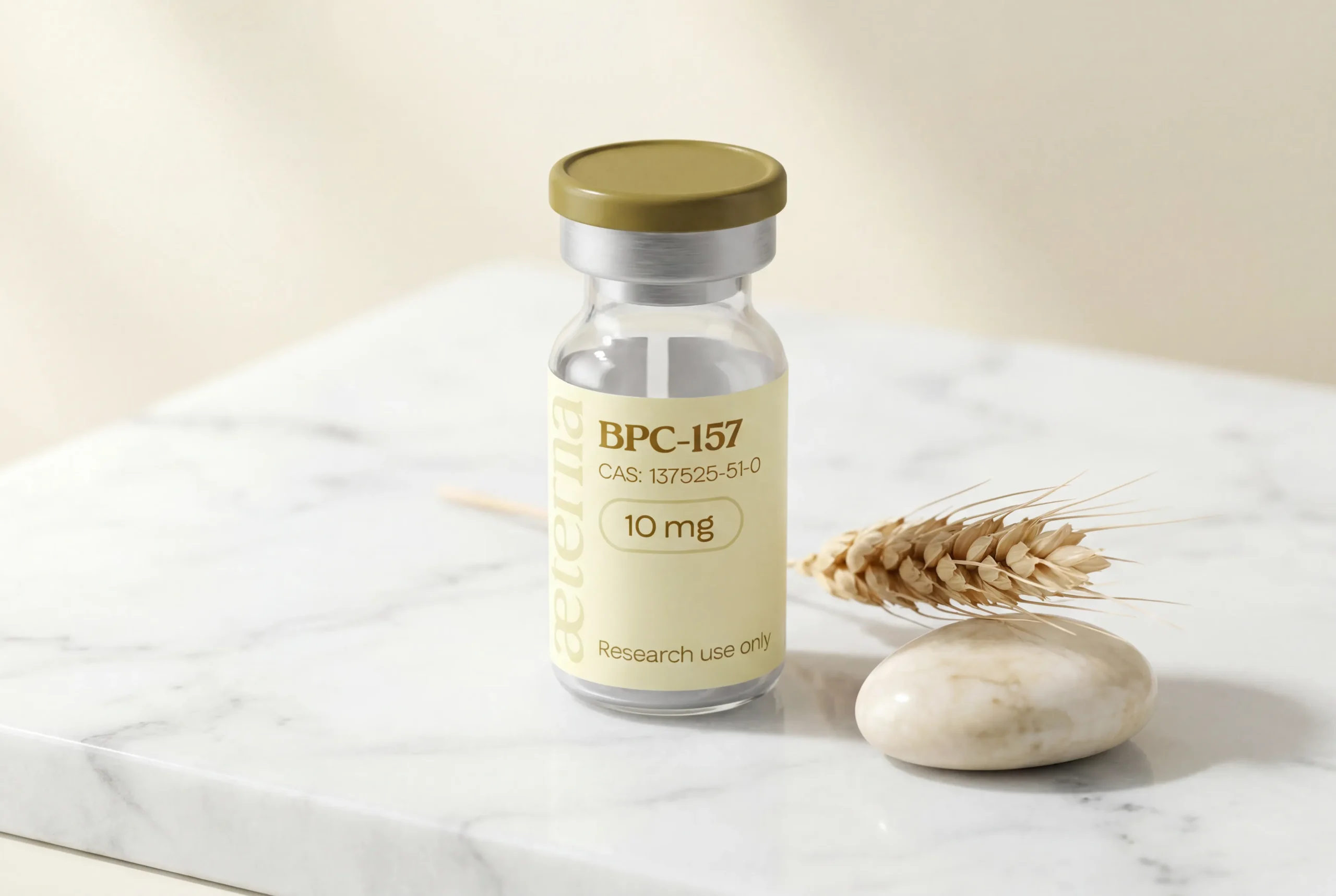
BPC-157 – Body Protection Compound 157 – is a synthetic pentadecapeptide whose sequence is derived from a naturally occurring protein found in human gastric juice. It does not belong to a single receptor class. Instead, it appears to operate as a pleiotropic signaling molecule, engaging several parallel pathways simultaneously. The literature describes it less as a switch and more as a conductor – coordinating angiogenesis, nitric oxide release, growth factor upregulation, and inflammatory modulation in concert. What follows is a pathway-by-pathway account of what the preclinical record currently supports.
Endothelial nitric oxide signaling appears to increase local nitric oxide bioavailability at sites of injury, supporting vasodilation and early microvascular adaptation. This cytoprotective vascular signature is one of the main mechanisms proposed in the preclinical literature.
Angiogenic signaling involves VEGF and VEGFR2 activity in parallel with nitric oxide pathways. In rodent models, this combination is associated with faster wound closure and improved tendon-to-bone healing.
Cell migration machinery is influenced through FAK and paxillin phosphorylation, which supports cytoskeletal reorganization in fibroblasts and tendon cells. This helps explain why tendon and ligament repair findings occupy such a large share of the preclinical record.
Gut-brain signaling may also be affected through interactions involving dopaminergic and serotonergic systems. Rodent studies describe gastroprotective and CNS-relevant effects, though these findings remain preclinical and mechanistically incomplete.
What we observe
What improved in animal injury models
The outcomes catalogued here reflect findings from peer-reviewed animal studies and a limited body of human case observations. No randomized controlled trial in humans has been completed as of early 2026, and each item is qualified accordingly. Aeterna does not prescribe, dispense, or sell; this summary exists to translate the existing record, not to extend it beyond its current boundaries.
01
Tendon and Ligament Repair
02
Gastric Mucosal Cytoprotection
03
Inflammatory Bowel Disease Models
04
Peripheral Nerve Regeneration
05
Bone Healing
06
Systemic Anti-inflammatory Activity
Evidence
Research behind BPC-157
The evidentiary base for BPC-157 is unusually extensive for a compound without a formal clinical trial program, and unusually narrow in its direct human applicability. The Sikirić laboratory at the University of Zagreb has produced the majority of primary literature over three decades, a concentration that warrants both respect and scrutiny regarding independent replication. Three representative studies are summarized below; readers are encouraged to consult primary sources directly.
Stable gastric pentadecapeptide BPC-157 in trials for inflammatory bowel disease and wound healing
This foundational review consolidated early rodent evidence demonstrating BPC-157’s cytoprotective effects across gastric ulcer, colitis, and cutaneous wound models. The authors documented consistent dose-dependent reductions in ulcer index scores and proposed the NO-eNOS axis as the primary mediating mechanism, distinguishing BPC-157’s activity from prostaglandin-dependent cytoprotection.
BPC-157 accelerates Achilles tendon-to-bone healing in a rat model of surgical detachment
Rats undergoing surgical Achilles tendon detachment and reattachment received either BPC-157 (10 µg/kg, subcutaneous) or saline for 14 days post-operatively. Histological analysis at day 14 revealed significantly greater collagen fiber organization, increased fibroblast density at the enthesis, and measurably higher load-to-failure values in the BPC-157 group. FAK-paxillin pathway activation was confirmed by Western blot.
Pentadecapeptide BPC-157 reduces colitis severity and restores mucosal architecture in TNBS-induced rat model
Adult Sprague-Dawley rats with TNBS-induced colitis received BPC-157 at 10 µg/kg or 10 ng/kg intraperitoneally for seven days. Both doses produced significant reductions in macroscopic damage score, mucosal TNF-α concentration, and myeloperoxidase activity relative to untreated colitis controls. Crypt architecture was substantially preserved in treated animals. The authors noted that the lower dose (10 ng/kg) retained meaningful efficacy, suggesting high potency at the tissue level.
From lyophilized powder to a usable solution.
Peptide
5 mg lyophilized powder
Diluent
3.0 mL bacteriostatic water
Final concentration
1.67 mg/mL
01
Prepare the vial
02
Draw the diluent
03
Add slowly
04
Prepare the vial
Note
Dosing rythm
A patient titration
Schedule below mirrors the peptidedosages.com educational protocol (typical daily range: 200–600 mcg once daily (gradual titration)).
Storage, caution, contradiction
Storage
Cold, dark, undisturbed
- Lyophilized: freeze at −20 °C (−4 °F).
- After reconstitution, refrigerate at 2–8 °C (35.6–46.4 °F).
- Avoid freeze–thaw cycles.
- Protect from light at all stages; amber vials or foil wrapping are appropriate for extended storage.
- Inspect solution before each use; discard if particulate matter, cloudiness, or discoloration is observed.
Side effects
What members describe
- Injection site reactions - mild erythema, transient swelling - are the most commonly reported adverse events in observational accounts.
- Nausea and mild gastrointestinal discomfort have been noted at higher doses, though the compound's primary literature describes gastroprotective rather than gastrotoxic effects.
- Transient dizziness or lightheadedness has been reported anecdotally, possibly related to NO-mediated vasodilation at higher doses.
- The long-term safety profile in humans is not established; the absence of reported serious adverse events in the literature reflects limited human exposure data, not confirmed safety.
- Interactions with anticoagulant or antiplatelet therapies are theoretically plausible given the compound's vascular activity; no formal interaction studies exist.
Contradictions
Reasons to abstain
- Active malignancy - the angiogenic activity of BPC-157 raises a theoretical concern regarding tumor vascularization; this has not been studied directly but warrants caution.
- Pregnancy and lactation - no safety data exists; use is not appropriate in these populations.
- Known hypersensitivity to any component of the preparation.
- Concurrent use with VEGF-targeting therapies (e.g., bevacizumab) - mechanistic overlap creates an uncharacterized interaction risk.
- Pediatric populations - no data; not appropriate outside of formal research contexts.
Synergies
What BPC-157 goes with
BPC-157 is frequently discussed alongside other peptides in the context of musculoskeletal repair and systemic recovery. The combinations below reflect mechanistic rationale drawn from the preclinical literature and the observed complementarity of signaling pathways. No human trial has evaluated these combinations formally. Aeterna does not prescribe or dispense; this section is a curriculum in mechanism, not a protocol.
FAQ
Your questions, patiently answered
As of 2026, BPC-157 holds no approved human indication in any major regulatory jurisdiction. It remains a research compound. A related formulation, PL-10, has been studied in early-phase human trials for inflammatory bowel disease in Croatia, but no Phase III data has been published and no approval has been granted.
The Sikirić laboratory at the University of Zagreb has produced the preponderance of BPC-157 primary literature since the early 1990s. Independent replication exists but is less extensive. This concentration of authorship is a legitimate methodological consideration – it does not invalidate the findings, but it does mean the compound’s evidentiary base carries a narrower foundation than compounds studied across many independent centers.
Rodent studies have demonstrated activity via both oral and intragastric routes, which is pharmacologically unusual for a peptide of this size and suggests some resistance to gastrointestinal proteolysis – or, alternatively, a local mucosal mechanism that does not require systemic absorption. Whether oral bioavailability is sufficient for systemic effects in humans is not established. The subcutaneous route is the most commonly cited in the literature for systemic indications.
Formal human pharmacokinetic data does not exist. Rodent estimates suggest a plasma half-life in the range of 4 hours following subcutaneous administration, though the compound’s tissue-level activity appears to persist beyond what circulating half-life alone would predict – possibly reflecting receptor-level or matrix-bound activity at the site of injury.
This is a reasonable and unresolved question. BPC-157 promotes angiogenesis – the formation of new blood vessels – which is a mechanism shared with tumor vascularization. No study has directly examined BPC-157’s effect on tumor growth, and the compound has not been shown to be carcinogenic in standard rodent toxicology models. The theoretical concern, however, is sufficient to warrant caution in individuals with active or recent malignancy. The literature does not resolve this question; it simply has not addressed it adequately.
BPC-157 and TB-500 (Thymosin Beta-4) are both studied for tissue repair but operate through distinct mechanisms. BPC-157 primarily engages the eNOS-NO axis, VEGF signaling, and FAK-paxillin pathways to drive angiogenesis and fibroblast recruitment. TB-500 acts principally through actin sequestration and the promotion of cell migration and differentiation. They are mechanistically complementary rather than interchangeable – a distinction that matters when considering them together or separately.
In the same family
Further reading in the curriculum - adjacent compounds worth understanding.
Sourcing · Independently verified
When you're ready, source thoughtfully.

