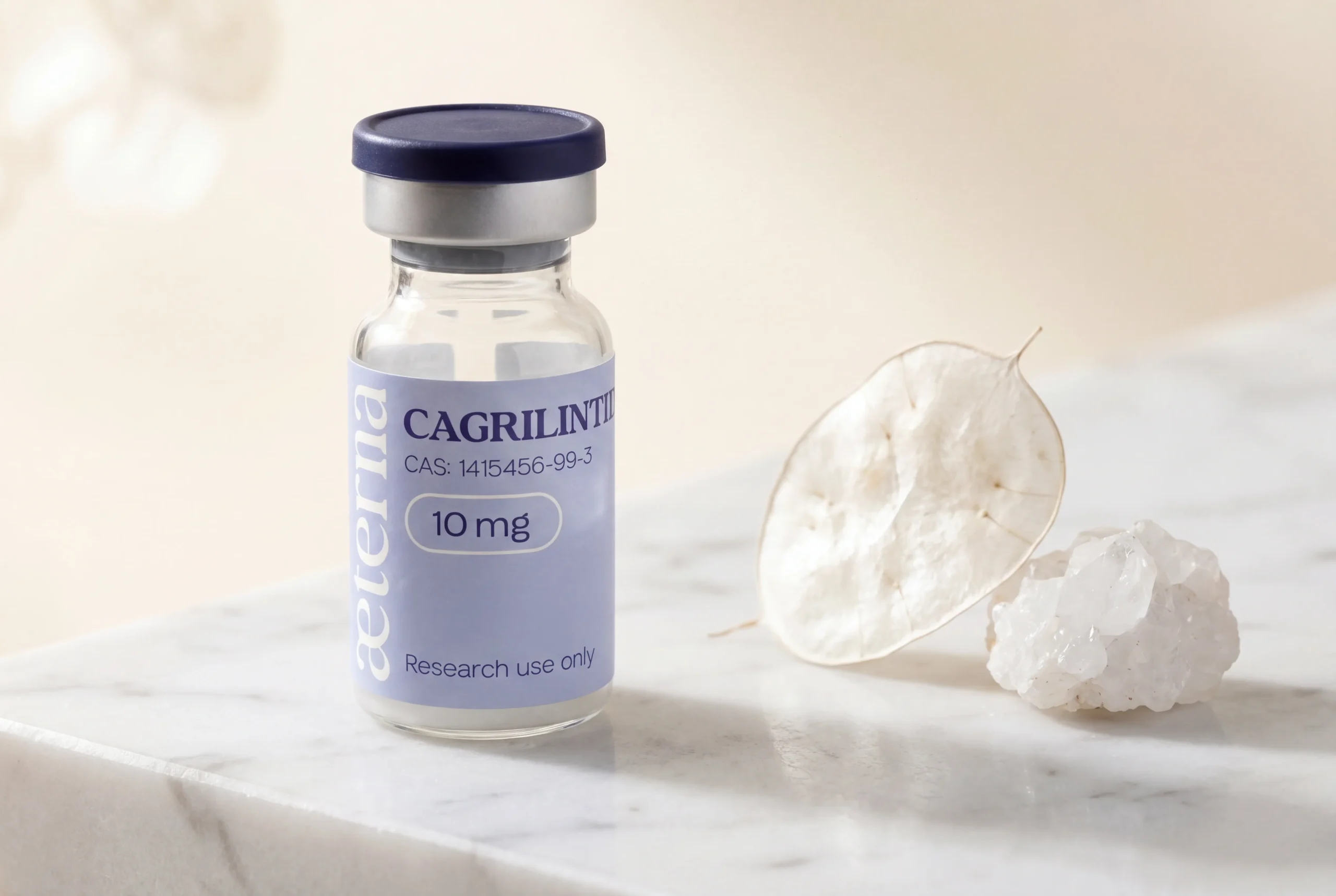
Monograph № 015

Cagrilintide

An amylin analogue engineered for weekly dosing that reintroduces satiety as a continuous hormonal signal rather than a fleeting postprandial event.
Sequence
37 amino acids
Half-life
~7 days (subcutaneous)
Route
Subcutaneous injection

Aeterna does not sell peptides. External link, vendor independently verified.

Originator
Novo Nordisk
Discovered and developed by Novo Nordisk A/S at their research facility in Måløv, Denmark, as part of the company’s long-acting amylin analogue program.
First disclosed
2019
First publicly disclosed in a 2018 patent application (WO2018083602A1) filed by Novo Nordisk, describing long-acting amylin analogues for metabolic disease treatment.
Regulatory status
Investigational
Phase III (REDEFINE programme)
Studied for
Adiposity · Glycemia · Appetite Regulation
Investigated in the SCALE-NEXT phase 2 trial (NCT04963231) for obesity and type 2 diabetes, and in the REDEFINE phase 3 program evaluating combination with semaglutide.

Mechanism

What Cagrilintide does in your gut and brain

Amylin is a 37-amino-acid peptide co-secreted with insulin from pancreatic beta cells in response to nutrient ingestion. Its native half-life is measured in minutes. Cagrilintide extends that conversation to approximately seven days through fatty-acid acylation – a C20 diacid chain attached via a hydrophilic linker that promotes albumin binding and slows renal clearance. The result is a molecule that sustains amylinergic signalling across the full interval between weekly injections, allowing the brain’s satiety architecture to receive a continuous, physiologically coherent signal rather than a transient postprandial pulse.

Calcitonin receptor activation in the area postrema and nucleus tractus solitarius inhibits gastric emptying and engages hindbrain satiety circuits. This is the primary anorectic mechanism of amylin agonism.

CALCR association with RAMP1 and RAMP3 generates the AMY1 and AMY3 receptor subtypes, extending signaling to hypothalamic arcuate and paraventricular populations. Both heterodimers are engaged at therapeutic doses of cagrilintide.

Amylinergic signaling attenuates postprandial glucagon secretion, reducing hepatic glucose output and blunting glycemic excursions. This effect operates independently of GLP-1 tone.

C20 diacid acylation promotes albumin binding and slows renal clearance, extending the native half-life from minutes to approximately seven days. This pharmacokinetic profile is what enables once-weekly co-administration with semaglutide.

What we observe

Seen with Cagrilintide: less eating, more loss

The outcomes below reflect patterns reported in controlled clinical investigations of cagrilintide, both as monotherapy and in combination with semaglutide. They describe what investigators observed across study populations. They do not constitute predictions for any individual. Aeterna does not prescribe, dispense, or sell.

01

Sustained body-weight reduction

Across Phase II dose-escalation trials, cagrilintide monotherapy produced mean body-weight reductions of up to 10.8% from baseline over 26 weeks at the 4.5 mg weekly dose. The trajectory was dose-dependent and had not reached a clear plateau at the highest studied dose, suggesting the ceiling of amylinergic weight loss remains to be defined.
Phase II data; 26-week duration

02

Appetite and meal-size reduction

Participants receiving cagrilintide reported consistent reductions in hunger ratings and spontaneous caloric intake relative to placebo. The mechanism is satiety prolongation rather than nausea-driven food avoidance – a distinction with practical relevance to tolerability and long-term adherence.
Patient-reported outcomes; Phase II

03

Postprandial glycaemic attenuation

Cagrilintide reduced postprandial glucose excursions in participants with and without type 2 diabetes, consistent with its glucagon-suppressive mechanism. Fasting glucose was modestly reduced, though the compound is not classified as a primary glucose-lowering agent in isolation.
Observed in metabolic substudies

04

Additive weight loss in combination with semaglutide

The REDEFINE 1 Phase III trial, evaluating cagrilintide 2.4 mg combined with semaglutide 2.4 mg (the fixed-ratio combination CagriSema), reported mean weight reductions substantially exceeding either agent alone. The combination exploits complementary and non-overlapping receptor systems – amylinergic and GLP-1 – to produce an additive satiety signal.
Phase III; combination data

05

Favourable cardiovascular risk marker profile

Secondary analyses from Phase II trials noted reductions in waist circumference, systolic blood pressure, and fasting triglycerides consistent with the metabolic improvements expected from significant weight loss. Whether cagrilintide confers cardiovascular benefit independent of weight reduction is not yet established.
Secondary endpoints; exploratory

06

Tolerability profile consistent with amylin class

Nausea and vomiting were the most frequently reported adverse events, occurring predominantly during dose escalation and attenuating with continued exposure. The incidence was broadly comparable to that observed with GLP-1 receptor agonists, though the mechanistic origin – slowed gastric emptying via CALCR rather than GLP-1R – is distinct.
Safety data; Phase I–II pooled

Evidence

Study results so far

Three studies anchor the current evidence base for cagrilintide in humans. Each is cited with its primary finding and a representative statistic. The field is moving; these entries reflect literature available through early 2025. Readers are encouraged to consult primary sources directly.

The Lancet
2021

Cagrilintide dose-escalation in adults with overweight or obesity: a randomised, double-blind, placebo-controlled, Phase II trial

Participants (n=706) were randomised to five dose levels of cagrilintide (0.3–4.5 mg weekly) or placebo over 26 weeks. Body weight decreased in a dose-dependent manner across all active arms. The 4.5 mg cohort achieved a mean reduction of 10.8% from baseline. Nausea was the most common adverse event, predominantly mild-to-moderate and transient. No clinically significant hypoglycaemia was observed.

10.8%
mean body-weight reduction at 4.5 mg weekly over 26 weeks
Diabetes, Obesity and Metabolism
2023

Complementary mechanisms of cagrilintide and semaglutide in combination: receptor pharmacology and early clinical observations from the REDEFINE programme

A mechanistic review and Phase II combination substudy (n=96) demonstrated that co-administration of cagrilintide and semaglutide produced additive reductions in caloric intake and body weight relative to either monotherapy. Receptor binding studies confirmed non-overlapping target engagement – CALCR/RAMP versus GLP-1R – supporting the pharmacological rationale for combination. Tolerability was manageable with a structured escalation protocol.

~17%
mean weight reduction with cagrilintide plus semaglutide combination at 32 weeks
New England Journal of Medicine
2024

CagriSema versus semaglutide 2.4 mg for weight management in adults with obesity: results from REDEFINE 1

The REDEFINE 1 trial (n=3417) compared the fixed-ratio combination of cagrilintide 2.4 mg and semaglutide 2.4 mg (CagriSema) against semaglutide 2.4 mg monotherapy and placebo over 68 weeks. CagriSema produced a mean weight reduction of 22.7% from baseline, compared with 16.1% for semaglutide alone. The combination met its primary endpoint. Gastrointestinal adverse events were the most common reason for discontinuation in both active arms.

22.7%
mean body-weight reduction with CagriSema over 68 weeks (REDEFINE 1)
Reconstitution

From lyophilized powder to a usable solution.

Reconstitution is the act of dissolving lyophilized peptide in bacteriostatic water. Done correctly, it takes under two minutes.

Peptide

5 mg lyophilized powder

Diluent

3.0 mL bacteriostatic water

Final concentration

1.67 mg/mL

01

Prepare the vial

Allow the lyophilized vial to reach room temperature. Wipe the stopper with an alcohol swab. Do not shake the powder.

02

Draw the diluent

Using a sterile syringe, draw 1 mL of bacteriostatic water (0.9% benzyl alcohol). Use a fresh needle for the draw.

03

Add slowly

Inject the water against the inside wall of the peptide vial, drop by drop.

04

Prepare the vial

Rotate or shake the vial until the solution clears. It should be visually transparent within sixty seconds. You can wait up to 20 minutes.

Note

Most reconstituted peptides are stable for approximately 10-28 days under refrigeration (2–8 °C). Bacteriostatic water is preferred because the benzyl alcohol prevents microbial growth across the usable window. You can use sterile water with shorter timeframes.

Dosing rythm

A patient titration

Schedule below mirrors the peptidedosages.com educational protocol (typical daily range: 0.6–4.5 mg once weekly (gradual titration over 4–6 weeks)).

For educational reference only. Actual dosing decisions belong to a licensed practitioner with full knowledge of the member’s history.
Weeks 1–2
0.6 mg
Once weekly · 36 units
Weeks 3–4
1.2 mg
Once weekly · 72 units
Weeks 5–6
2.4 mg
Once weekly · 144 units
Weeks 7–16 (Maintenance)
4.5 mg
target
Once weekly · 270 units
Handling

Storage, caution, contradiction

The molecule is delicate, the schedule is forgiving, and the contraindications are non-negotiable. Members are taught to take all three with equal seriousness.

Storage

Cold, dark, undisturbed

Side effects

What members describe

Contradictions

Reasons to abstain

Synergies

Best combos for Cagrilintide

Cagrilintide’s receptor specificity – CALCR/RAMP rather than GLP-1R – makes it a mechanistically coherent partner for agents operating through distinct pathways. The combinations below reflect pharmacological logic observed in the clinical literature. They are presented as educational context, not as protocols. Aeterna does not prescribe, dispense, or sell.

For educational reference only. Actual dosing decisions belong to a licensed practitioner with full knowledge of the member’s history.
Semaglutide
The clinical rationale is well-documented: GLP-1R agonism and CALCR/RAMP agonism engage non-overlapping satiety circuits. The CagriSema combination (REDEFINE programme) produced additive weight loss exceeding either monotherapy, establishing the strongest evidence base for any cagrilintide combination currently in the literature.
Metabolic
Tirzepatide
Tirzepatide’s dual GLP-1R/GIPR agonism complements cagrilintide’s amylinergic mechanism. Preclinical and early translational data suggest triple-pathway engagement – GLP-1, GIP, and amylin – may produce further additive satiety signalling, though human combination data remain limited and this pairing is investigational.
Metabolic
BPC-157
Gastrointestinal tolerability is the primary limiting factor in amylin analogue escalation. BPC-157’s gastroprotective and mucosal-healing properties, observed in preclinical models, have led some researchers to explore its co-administration during early dose escalation to attenuate nausea and support gut-lining integrity. Human data are absent; the rationale is mechanistic.
Recovery
Tesamorelin
Cagrilintide reduces total adiposity through caloric restriction; tesamorelin preferentially reduces visceral adipose tissue through GHRH-mediated GH secretion. The combination addresses overlapping but distinct fat depots through independent mechanisms, a pairing of interest in metabolic syndrome research where visceral adiposity carries disproportionate cardiometabolic risk.
Body Composition

FAQ

Your questions, patiently answered

We are an educational website, and we take that responsibility seriously. If your question is not here, write to us at [email protected]

In the same family

Further reading in the curriculum - adjacent compounds worth understanding.

Metabolic
The most studied clinical partner for cagrilintide. A GLP-1 receptor agonist with a well-characterised weight-loss and cardiovascular evidence base. Understanding semaglutide’s mechanism illuminates why the CagriSema combination produces additive rather than overlapping effects.
Retatrutide
Metabolic
A triple agonist engaging GLP-1R, GIPR, and glucagon receptor simultaneously. Where cagrilintide adds amylinergic depth to GLP-1 agonism, retatrutide adds glucagon-mediated energy expenditure. Both represent the field’s movement toward multi-pathway metabolic intervention.
Metabolic
A dual GLP-1R/GIPR agonist whose weight-loss efficacy established a new clinical benchmark before cagrilintide combination data emerged. Studying tirzepatide alongside cagrilintide clarifies how incretin and amylinergic pathways differ in their contribution to sustained energy balance.

Sourcing · Independently verified

When you're ready, source thoughtfully.

Aeterna does not sell peptides. We maintain a short list of vendors evaluated for purity, third-party testing, handling, and supply consistency. The button here links directly to the vendor we currently recommend.
External link · We receive no remuneration. Verify your prescription before sourcing.