Cardiogen
Aeterna does not sell peptides. External link, vendor independently verified.
Mechanism
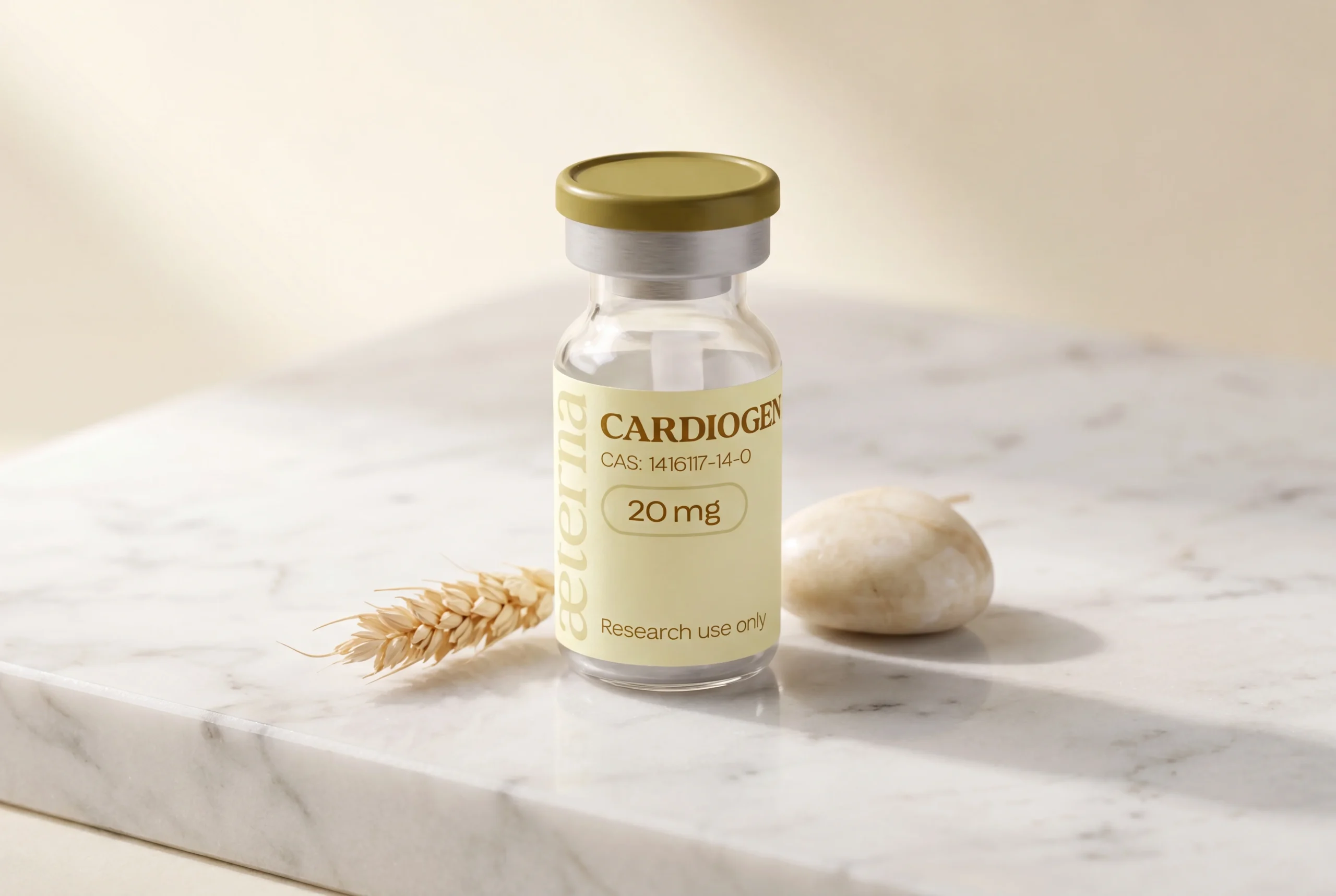
Cardiogen is a tetrapeptide – Ala-Glu-Asp-Arg – isolated from bovine cardiac tissue and subsequently synthesized. Its mechanism is not receptor-mediated in the classical pharmacological sense. Instead, the literature describes an epigenetic mode of action: short peptide sequences of this class are proposed to interact directly with chromatin, influencing histone acetylation patterns and, by extension, the transcriptional availability of genes associated with cellular repair and longevity. The cardiac tissue origin is not incidental – it reflects the tissue-specificity hypothesis central to Khavinson’s peptide bioregulation framework, which holds that organ-derived short peptides preferentially influence gene expression in the tissue from which they originate.
Cardiogen is the tetrapeptide Ala-Glu-Asp-Arg, proposed to bind histone proteins and interact with DNA in the minor groove. The mode of action is epigenetic rather than receptor-mediated, altering transcriptional access to repair and survival genes in cardiomyocytes.
In cardiomyocyte preparations under oxidative stress, Cardiogen exposure correlates with reduced telomere shortening rates and altered telomerase-related gene expression. The molecular intermediary linking peptide binding to telomerase regulation has not been established.
In ischemic and oxidative-stress models, Cardiogen reduces Bax expression and increases Bcl-2, shifting the apoptotic balance toward survival. The effect is notable in terminally differentiated cardiomyocytes, which cannot compensate for cell loss through proliferation.
Labeled amino acid incorporation into cardiac tissue rises in aged animals following Cardiogen administration, interpreted as partial restoration of anabolic capacity. The clinical significance of this signal in controlled human trials has not been established.
What we observe
What studies saw in aging hearts
The findings below are drawn from preclinical models and observational studies conducted primarily within the Russian bioregulation research tradition. No large-scale randomized controlled trials in human populations have been completed as of 2025. Each item represents a signal in the published record, not a confirmed clinical endpoint.
01
Cardiomyocyte Survival
02
Telomere Preservation
03
Chromatin Accessibility
04
Protein Synthesis
05
Oxidative Stress Markers
06
Animal Longevity Signals
Evidence
What the research says
Published literature on Cardiogen originates predominantly from the St. Petersburg Institute of Bioregulation and Gerontology. Independent replication in Western research institutions remains limited. The studies listed represent the most substantive findings available as of 2025.
Effect of the Tetrapeptide Ala-Glu-Asp-Arg on Cardiomyocyte Apoptosis in Aged Rats Following Experimental Ischemia
Aged Wistar rats (24 months) subjected to 30-minute coronary artery occlusion followed by reperfusion showed significantly reduced TUNEL-positive cardiomyocytes in the Cardiogen-treated group compared to saline controls. Bax/Bcl-2 protein ratio was reduced by approximately 38% in treated animals. No significant difference in infarct area was observed, suggesting the effect was cytoprotective rather than hemodynamic.
Telomere Dynamics in Human Cardiomyocyte-Derived Cells Treated with Short Peptide Bioregulators: A Focus on Cardiogen
Human AC16 cardiomyocyte-derived cells subjected to repeated hydrogen peroxide challenge over 14 days showed attenuated telomere shortening in the Cardiogen-treated group relative to untreated controls. Mean telomere length at day 14 was 12% greater in treated cells. Telomerase activity (TRAP assay) did not differ significantly between groups, implicating reduced oxidative telomeric damage rather than active elongation as the primary mechanism.
Peptide Bioregulation of Cardiac Aging: Lifespan and Oxidative Stress Outcomes in a Long-Term Rat Cohort Receiving Cardiogen and Epithalon
A 30-month longitudinal study in aged Sprague-Dawley rats receiving a combination of Cardiogen and Epithalon reported a mean lifespan extension of 11.4% relative to untreated aged controls. Cardiac MDA levels were reduced and SOD activity was elevated in treated animals at 24-month assessment. The authors acknowledged that isolating Cardiogen’s independent contribution from the combination regimen was not possible within the study design.
From lyophilized powder to a usable solution.
Peptide
5 mg (typical research vial)
Diluent
Bacteriostatic water for injection (0.9% benzyl alcohol)
Final concentration
500 mcg/mL (add 1 mL diluent to 500 mcg vial; scale proportionally)
01
Prepare the vial
02
Draw the diluent
03
Add slowly
04
Prepare the vial
Note
Dosing rythm
A patient titration
The schedule below is drawn from published Khavinson bioregulation protocols and clinical observation programs associated with the St. Petersburg Institute. It does not constitute medical advice; any dosing decision requires a qualified clinician.
Storage, caution, contradiction
Storage
Cold, dark, undisturbed
- Store lyophilized powder at −20°C, protected from light and moisture, until reconstitution.
- Reconstituted solution should be refrigerated at 2–8°C and used within 28 days; do not refreeze.
- Avoid repeated temperature cycling; prepare working aliquots to minimize freeze-thaw events.
- Keep away from direct light at all stages; amber vials or foil wrapping are advisable for storage.
- Inspect solution before each use; discard if particulate matter, cloudiness, or discoloration is observed.
Side effects
What members describe
- Mild injection-site reactions - transient erythema or localized discomfort - have been noted in observational reports; typically self-resolving within hours.
- Transient fatigue or mild headache has been reported in a small subset of subjects in early observational programs; causality has not been established.
- No significant cardiovascular adverse events have been reported in published studies at doses within the described range; the dataset remains small.
- Immunogenic responses have not been characterized in human populations; the short peptide length reduces theoretical antigenicity, but this has not been formally studied.
- The long-term safety profile in humans is not established. Published studies are of limited duration and scale; absence of reported harm is not equivalence to confirmed safety.
Contradictions
Reasons to abstain
- Known hypersensitivity to any component of the formulation, including the peptide sequence or excipients used in reconstitution.
- Active cardiac pathology requiring pharmacological management - use in this context requires direct cardiologist involvement and is not supported by current evidence.
- Pregnancy and lactation - no safety data exist; use is not appropriate in these populations.
- Concurrent use with anticoagulant or antiarrhythmic agents - potential interactions have not been studied; caution is warranted.
- Pediatric populations - no data; not appropriate for use outside of supervised research contexts.
Synergies
What to pair with Cardiogen
The following pairings reflect patterns observed in the bioregulation literature and in structured longevity protocols. They are presented as intellectual context – not as prescriptive combinations. Aeterna does not prescribe, dispense, or sell. Each pairing requires independent clinical evaluation.
FAQ
Your questions, patiently answered
Cardiogen is tissue-specific in its derivation – isolated originally from bovine cardiac muscle – and the bioregulation hypothesis holds that this origin confers preferential activity in cardiac tissue. Other peptides in the same series (Epithalon, Thymalin, Cortagen) are derived from pineal, thymus, and brain tissue respectively, and are proposed to act in their corresponding tissue environments. Whether this tissue-specificity is pharmacologically meaningful in humans remains an open question.
No. Brain natriuretic peptide (BNP) and atrial natriuretic peptide (ANP) are endogenous hormones with well-characterized receptor-mediated cardiovascular effects. Cardiogen is a short synthetic tetrapeptide with a proposed epigenetic mechanism; it does not share structural, receptor, or functional class with natriuretic peptides. The comparison is not pharmacologically meaningful.
Most pharmaceuticals act by binding to a specific receptor, enzyme, or ion channel – a lock-and-key interaction that produces a defined downstream effect. The proposed mechanism for Cardiogen involves direct interaction with chromatin structure, influencing which genes are transcriptionally accessible rather than activating a specific signaling cascade. This is a less conventional and less fully characterized mode of action; the evidence for it is suggestive rather than definitive.
Cardiogen was developed within the peptide bioregulation research program established at the St. Petersburg Institute of Bioregulation and Gerontology, led by Vladimir Khavinson. This program has operated largely outside the Western pharmaceutical development framework, which relies on IND filings, phase-structured trials, and peer review in high-impact English-language journals. The science is not therefore invalid, but it has not been subjected to the same independent replication standards that Western regulatory science demands. This is a meaningful limitation to acknowledge.
As of 2025, Cardiogen does not hold regulatory approval from the FDA, EMA, or equivalent agencies in major Western jurisdictions. It has been used within Russian Federation clinical and research contexts under the bioregulation framework, but this does not constitute approval in the regulatory sense. It remains an investigational compound outside those contexts.
The existing literature would benefit substantially from: randomized, placebo-controlled trials in human populations with defined cardiovascular endpoints; independent replication of the chromatin-interaction mechanism by laboratories outside the originating institution; and longer-term safety data in humans. The preclinical signal is coherent and internally consistent, but the translation to human clinical benefit has not been demonstrated by the standards that evidence-based medicine requires.
In the same family
Further reading in the curriculum.
Sourcing · Independently verified
When you're ready, source thoughtfully.
