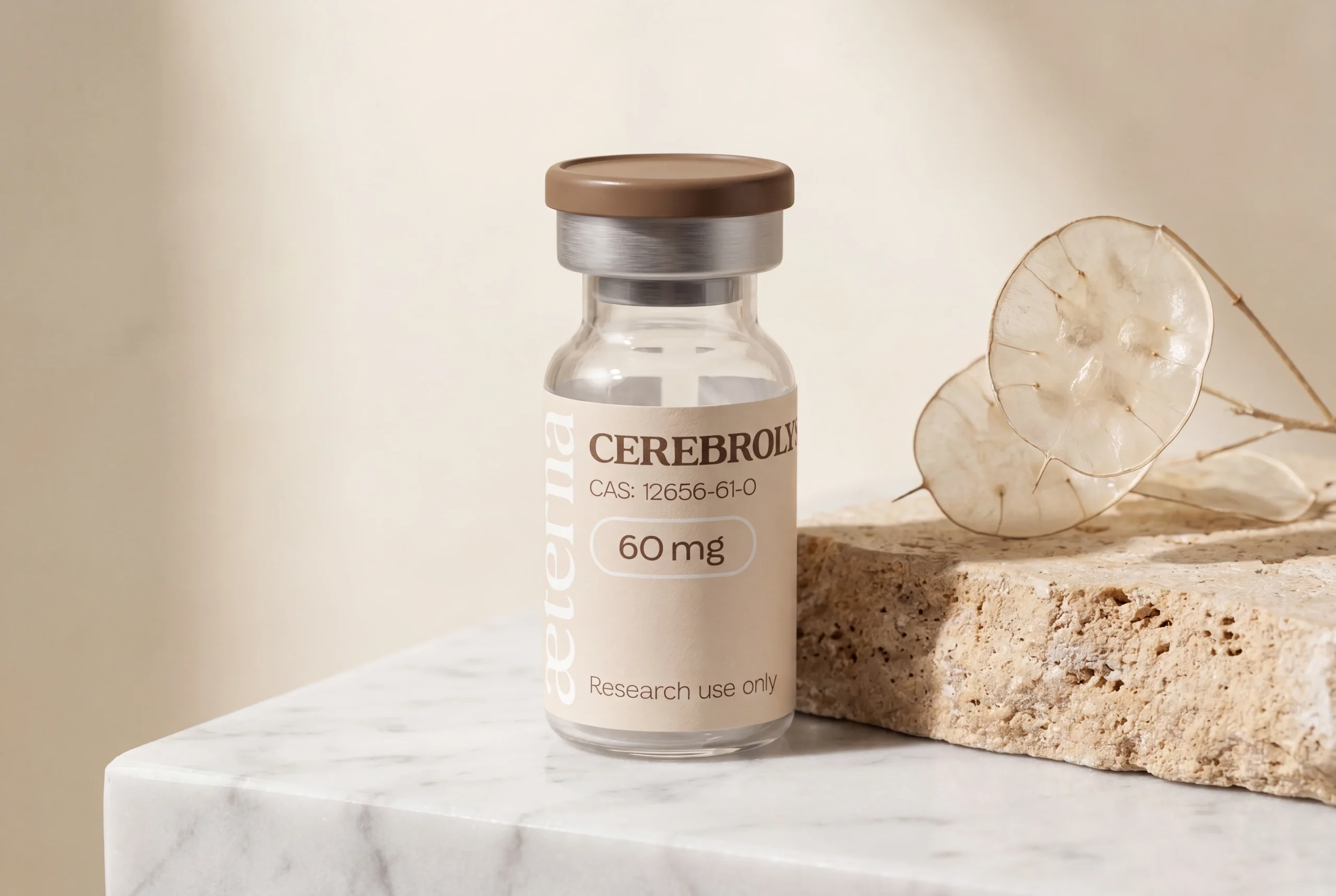
Monograph № 021

Cerebrolysin

Four decades of controlled neuroscience research, concentrated into a peptide preparation that speaks the language of endogenous neurotrophins.
Sequence
Neuropeptide mixture (<10 kDa)
Half-life
~15–30 min (active peptide fractions); neurotrophic effects persist hours beyond clearance
Route
Intravenous (IV) or Intramuscular (IM)

Aeterna does not sell peptides. External link, vendor independently verified.

Originator
EVER Neuro Pharma
Unterach am Attersee, Austria · developed under the Ebewe Pharma lineage; commercial designation FPE 1070
First disclosed
1954
First described in the Austrian pharmacological literature, 1954; systematic neurotrophic characterization published in Journal of Neural Transmission, 1991
Regulatory status
Approved (select jurisdictions) · Investigational (US, UK)
Registered and in clinical use across China, Russia, South Korea, and much of Eastern Europe; not FDA-approved; reviewed under EMA scientific advisory proceedings as of 2024
Studied for
Neurodegeneration · Stroke Recovery · Cognitive Decline
Primary published inquiry spans Alzheimer’s disease (ADAS-Cog endpoints), acute ischaemic stroke (Barthel Index), and traumatic brain injury rehabilitation; Cochrane reviews published 2013 and 2020

Mechanism

How Cerebrolysin supports brain repair

Cerebrolysin does not operate through a single receptor or a cleanly defined molecular target. It is, by nature, a conversation – a mixture of peptide fragments whose collective activity approximates the signaling vocabulary of endogenous neurotrophins. Understanding it requires setting aside the reductionist instinct and attending instead to the system it addresses.

BDNF TrkB potentiation is presented as the primary neurotrophic driver, with low molecular weight peptide fractions activating MAPK ERK and PI3K Akt cascades. In preclinical systems, these downstream effects include neuronal survival, dendritic arborization, and support for synaptic plasticity in stressed tissue.

NGF TrkA support is proposed to help preserve the cholinergic neuronal population most vulnerable in Alzheimer’s disease. This rationale underlies Cerebrolysin’s investigation in dementia and its reported effects on acetylcholine synthesis capacity in basal forebrain neurons.

APP processing and tau signaling represent the preparation’s putative disease-modifying axis, with preclinical models suggesting a shift toward alpha secretase processing and reduced tau phosphorylation. Human confirmation at scale remains limited, so this mechanism is best understood as suggestive rather than established.

Neuroinflammation and oxidative stress modulation appears to occur through parallel effects on inflammatory cytokines and endogenous antioxidant systems. In experimental ischemia, this combined profile is associated with an extended survival window for penumbral neurons.

What we observe

Results reported in memory and recovery

The outcomes associated with Cerebrolysin span acute neuroprotection and longer-arc cognitive support. The evidence base is substantial in volume but uneven in methodological quality — a distinction this curriculum holds carefully. What follows reflects patterns the literature reports, not outcomes any individual should expect.

01

Cognitive Function in Alzheimer's Disease

Multiple randomized controlled trials have reported statistically significant improvements on the Alzheimer’s Disease Assessment Scale – Cognitive Subscale (ADAS-Cog) following 4–6 week IV courses of Cerebrolysin at doses of 20–30 mL daily. Effects appear most pronounced in mild-to-moderate disease stages.
RCT evidence; effect sizes modest to moderate; durability beyond treatment course variable across studies

02

Stroke Rehabilitation

In acute ischaemic stroke, Cerebrolysin administered within 24–72 hours of onset has been associated with improved Barthel Index scores and reduced neurological deficit on the NIH Stroke Scale at 90-day follow-up. The proposed mechanism involves both neuroprotection of penumbral tissue and facilitation of neuroplastic reorganization.
Phase III trial data available; findings replicated in Asian and European cohorts; effect size varies with time-to-treatment

03

Traumatic Brain Injury Recovery

Observational and controlled data from rehabilitation settings suggest accelerated functional recovery in moderate-to-severe TBI when Cerebrolysin is incorporated into the acute and subacute care period. Improvements in attention, processing speed, and executive function have been the most consistently reported domains.
Evidence base smaller than stroke literature; heterogeneity of TBI populations complicates pooled analysis

04

Neuroplasticity

Animal studies using synaptophysin immunoreactivity as a proxy for synaptic density have shown measurable increases following Cerebrolysin treatment in aged rodents. Whether this translates to human synaptic preservation at the scale detectable by current imaging modalities remains an open question.
Preclinical data; human synaptic imaging correlates not yet established in adequately powered trials

05

Mood Symptoms

Secondary analyses from dementia trials have noted improvements in apathy, depressive symptoms, and sleep architecture in treated subjects. These findings are thought to reflect downstream serotonergic and dopaminergic modulation secondary to neurotrophic support, though direct monoaminergic mechanisms have not been fully characterized.
Secondary endpoint data; not a primary studied indication; interpret with appropriate caution

06

Metabolic Stress Protection

In models of hypoxia and glucose deprivation – conditions that approximate the metabolic environment of the ischaemic penumbra – Cerebrolysin fractions have demonstrated capacity to maintain mitochondrial membrane potential and reduce cytochrome c release, delaying the apoptotic cascade in vulnerable neurons.
Primarily in vitro and ex vivo evidence; clinical translation of mitochondrial endpoints not yet validated

Evidence

Studies on Cerebrolysin

Cerebrolysin carries one of the longer clinical research histories among neuropeptide preparations, spanning more than four decades of controlled investigation. The studies below represent methodologically significant contributions to current understanding. Aeterna does not prescribe, dispense, or sell; this section exists to illuminate the record.

Journal of Neural Transmission
2014

Cerebrolysin in Mild-to-Moderate Alzheimer's Disease: A Randomized, Double-Blind, Placebo-Controlled Trial Assessing Cognitive and Global Outcomes

Two hundred and seventy-nine patients with mild-to-moderate Alzheimer’s disease were randomized to receive 30 mL Cerebrolysin IV daily for 4 weeks or placebo, with follow-up at 12 and 24 weeks. The treatment group demonstrated statistically significant improvement on the ADAS-Cog at week 4 and week 12. Global clinical impression scores (CIBIC-Plus) also favored the active arm. Cognitive benefits showed partial attenuation by week 24, suggesting the need for repeated treatment cycles.

3.8
point improvement on ADAS-Cog at 12 weeks versus placebo (p < 0.01)
Stroke: Journal of the American Heart Association
2012

Early Cerebrolysin Treatment Following Acute Ischaemic Stroke: A Multicentre, Randomized, Placebo-Controlled Trial (CASTA)

The CASTA trial enrolled 1,070 patients with moderate-to-severe acute ischaemic stroke across 33 centres in China. Cerebrolysin 30 mL IV daily for 10 days was initiated within 72 hours of symptom onset. While the primary endpoint (modified Rankin Scale at 90 days) did not reach significance in the full population, pre-specified subgroup analysis of patients with moderate stroke severity showed meaningful functional improvement. The safety profile was comparable to placebo.

1,070
patients enrolled; functional benefit observed in moderate-severity subgroup (Barthel Index ≥75 at day 90)
Neuropsychiatric Disease and Treatment
2019

Neurotrophic and Neuroprotective Effects of Cerebrolysin in Traumatic Brain Injury: A Prospective Controlled Study in Rehabilitation Settings

Sixty-four patients with moderate-to-severe TBI were enrolled in a prospective controlled study across two neurorehabilitation centres in Vienna and Prague. Those receiving Cerebrolysin 20 mL IM daily for 21 days alongside standard rehabilitation demonstrated significantly greater gains in attention composite scores and processing speed indices at 6-week assessment compared to rehabilitation alone. Serum BDNF levels were measured as a secondary biomarker and showed a 28% greater increase in the treatment group.

28%
greater increase in serum BDNF levels in the Cerebrolysin group versus rehabilitation-only controls at 6 weeks
Reconstitution

From lyophilized powder to a usable solution.

Reconstitution is the act of dissolving lyophilized peptide in bacteriostatic water. Done correctly, it takes under two minutes.

Peptide

60 mg lyophilized powder

Diluent

3.0 mL bacteriostatic water

Final concentration

20 mg/mL

01

Prepare the vial

Allow the lyophilized vial to reach room temperature. Wipe the stopper with an alcohol swab. Do not shake the powder.

02

Draw the diluent

Using a sterile syringe, draw 1 mL of bacteriostatic water (0.9% benzyl alcohol). Use a fresh needle for the draw.

03

Add slowly

Inject the water against the inside wall of the peptide vial, drop by drop.

04

Prepare the vial

Rotate or shake the vial until the solution clears. It should be visually transparent within sixty seconds. You can wait up to 20 minutes.

Note

Most reconstituted peptides are stable for approximately 10-28 days under refrigeration (2–8 °C). Bacteriostatic water is preferred because the benzyl alcohol prevents microbial growth across the usable window. You can use sterile water with shorter timeframes.

Dosing rythm

A patient titration

Schedule below mirrors the peptidedosages.com educational protocol (typical daily range: 20–32 mg once daily (gradual titration); split doses for >20 mg).

For educational reference only. Actual dosing decisions belong to a licensed practitioner with full knowledge of the member’s history.
Week 1
20 mg (20,000 mcg)
Once daily · 100 units (1.0 mL) × 1
Week 2
24 mg (24,000 mcg)
Once daily · 60 units (0.6 mL) AM + 60 units (0.6 mL) PM
Week 3
28 mg (28,000 mcg)
Once daily · 70 units (0.7 mL) AM + 70 units (0.7 mL) PM
Week 4+
30–50 mL IV daily —
32 mg (32,000 mcg)
of published safety data
Once daily · 80 units (0.8 mL) AM + 80 units (0.8 mL) PM
Handling

Storage, caution, contradiction

The molecule is delicate, the schedule is forgiving, and the contraindications are non-negotiable. Members are taught to take all three with equal seriousness.

Storage

Cold, dark, undisturbed

Side effects

What members describe

Contradictions

Reasons to abstain

Synergies

What works alongside Cerebrolysin

Cerebrolysin is most often considered alongside compounds that address complementary aspects of neurological health – vascular integrity, mitochondrial function, synaptic signaling, and inflammatory tone. The combinations below reflect patterns observed in clinical and research practice. Aeterna does not prescribe, dispense, or sell; these pairings are presented as an educational map of the landscape, not as a protocol.

For educational reference only. Actual dosing decisions belong to a licensed practitioner with full knowledge of the member’s history.
Selank
Selank’s modulation of GABA-A receptor sensitivity and its documented influence on BDNF expression create a complementary neurotrophic environment. Where Cerebrolysin addresses structural neuronal support, Selank attends to the anxiety and stress-axis dysregulation that frequently accompanies cognitive decline.
Anxiolytic Neuropeptide
Semax
Semax independently upregulates BDNF and NGF in the prefrontal cortex and hippocampus. Pairing it with Cerebrolysin has been explored in Russian clinical literature as a means of sustaining neurotrophic signaling between Cerebrolysin infusion courses, though controlled combination data remain limited.
ACTH Analogue · Cognitive Support
BPC-157
BPC-157’s angiogenic and anti-inflammatory properties – particularly its influence on VEGF and nitric oxide pathways – may support the vascular component of neurological recovery. In stroke and TBI contexts, cerebral perfusion and tissue repair are as consequential as direct neurotrophic signaling.
Systemic Repair Peptide
Epithalon
Epithalon’s proposed influence on telomerase activity and circadian regulation offers a longevity-oriented complement to Cerebrolysin’s acute neuroprotective focus. In the context of age-related cognitive decline, addressing cellular senescence alongside neurotrophic support represents a coherent dual-axis approach.
Telomere Biology · Longevity

FAQ

Your questions, patiently answered

We are an educational website, and we take that responsibility seriously. If your question is not here, write to us at [email protected]

In the same family

Further reading in the curriculum.

Neuroprotective
An ACTH(4-7) analogue with documented BDNF-upregulating activity in the prefrontal cortex and hippocampus. Where Cerebrolysin delivers neurotrophic support exogenously, Semax instructs the brain’s own signaling architecture to produce it.
Anxiolytic Neuropeptide
A tuftsin analogue whose influence on GABAergic tone and stress-axis regulation complements the structural neuroprotection Cerebrolysin provides. The two compounds address adjacent but distinct dimensions of neurological resilience.
BPC-157
Systemic Repair
A pentadecapeptide with broad angiogenic and anti-inflammatory properties. In neurological recovery contexts, the vascular architecture that BPC-157 supports is as consequential as the neurotrophic signaling Cerebrolysin addresses.

Sourcing · Independently verified

When you're ready, source thoughtfully.

Aeterna does not sell peptides. We maintain a short list of vendors evaluated for purity, third-party testing, handling, and supply consistency. The button here links directly to the vendor we currently recommend.
External link · We receive no remuneration. Verify your prescription before sourcing.