CJC-1295 no DAC + Ipamorelin
Aeterna does not sell peptides. External link, vendor independently verified.
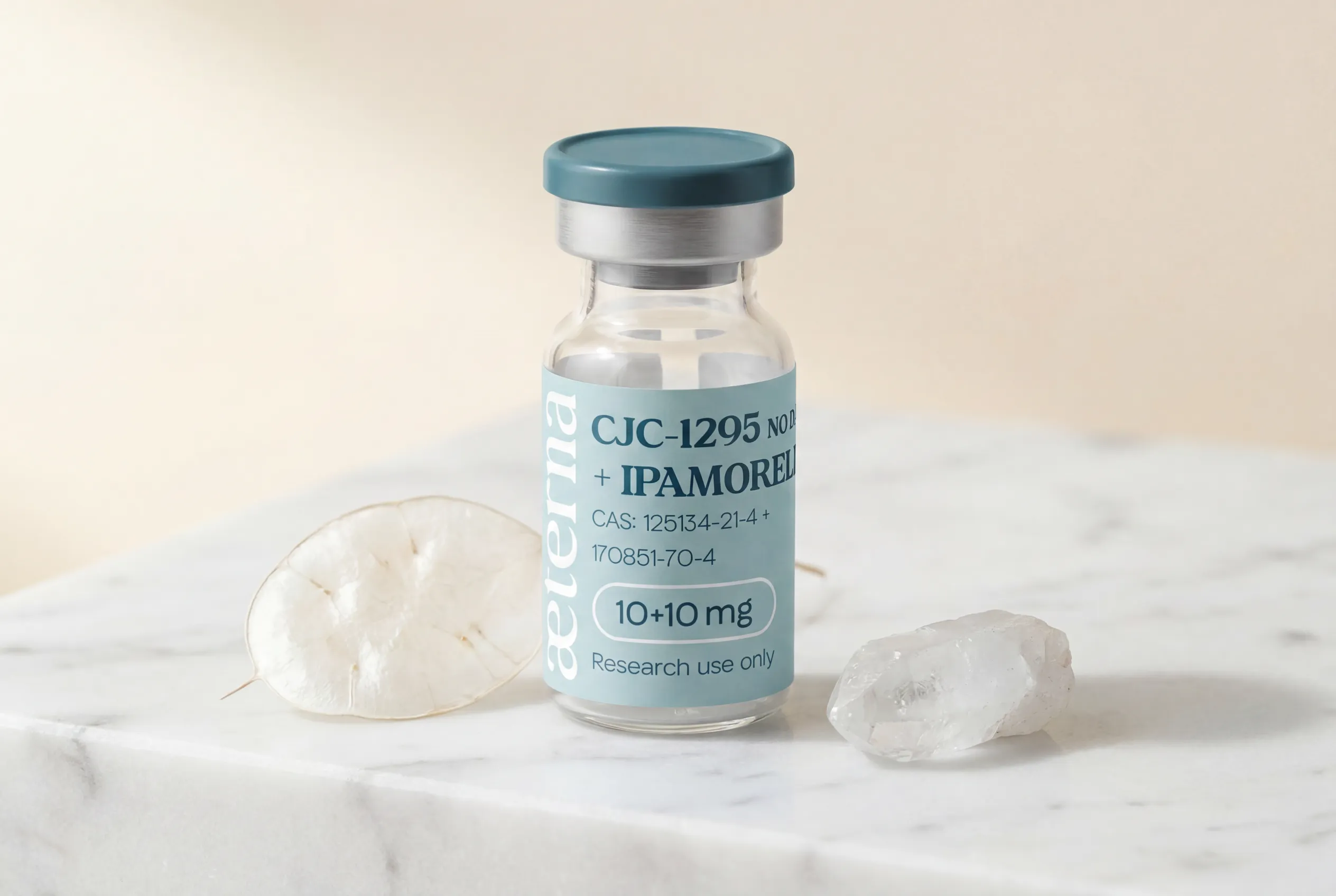
Mechanism
Growth hormone is not secreted continuously. It moves in pulses – shaped by two opposing hypothalamic signals, GHRH and somatostatin, and modulated by a third voice, ghrelin, arising from the stomach and hypothalamus alike. CJC-1295 and Ipamorelin address this axis from two distinct angles simultaneously, reconstituting a more physiological secretory pattern rather than flooding the system with exogenous hormone.
GHRH receptor agonism drives the first arm: CJC-1295 binds the pituitary GHRH receptor, elevates intracellular cAMP, and triggers PKA-mediated transcription of the GH gene. The short half-life of the no-DAC form preserves native pulse architecture rather than producing sustained, supraphysiological elevation.
GHSR-1a agonism drives the second arm: Ipamorelin is a selective ghrelin mimetic that engages GHSR-1a on somatotrophs through Gq-phospholipase C signaling, mobilising intracellular calcium and triggering exocytosis of stored GH vesicles. Selectivity is narrow, with no meaningful elevation of cortisol, ACTH, or prolactin at research-range concentrations.
Synergistic amplification drives the combined response: GHRHR and GHSR-1a signal through partially independent cascades that converge on calcium-dependent GH exocytosis, producing a pulse two- to tenfold larger than either agent alone. IGF-1 elevation downstream remains within physiologic range when dosing intervals respect the natural interpulse interval.
Somatostatin counterregulation drives the timing logic: tonic hypothalamic somatostatin sets the inhibitory ceiling against which both secretagogues operate, and Ipamorelin’s ghrelin-receptor activity attenuates that tone. Administration near sleep onset aligns exogenous signaling with the endogenous somatostatin nadir, producing pulses that closely resemble the physiological nocturnal surge.
What we observe
What users noticed in sleep recovery and lean mass
The following patterns emerge from peer-reviewed studies, mechanistic investigations, and clinical observations involving GHRH analogues and ghrelin mimetics. They describe what the literature reports — not what any individual will experience. Aeterna does not prescribe, dispense, or sell. These observations are educational in nature.
01
Amplified GH Pulsatility
02
IGF-1 Elevation
03
Lean Mass Accretion
04
Adipose Reduction
05
Sleep and Recovery
06
Connective Tissue Signaling
Evidence
What the studies found
Three studies are summarised below to illustrate the character of the available evidence. Study design, population, and endpoints vary; no single trial should be read as definitive. The literature on GHRH analogues and ghrelin mimetics is active and continues to evolve.
Dose-Dependent Effects of a Modified GRF(1–29) Analogue on Plasma GH and IGF-1 Concentrations in Healthy Adults
A randomised, double-blind, placebo-controlled trial in 64 healthy adults (ages 21–61) evaluated single and repeat subcutaneous doses of CJC-1295 without DAC. GH pulse amplitude increased in a dose-dependent manner, with peak serum GH occurring at 30–45 minutes post-injection. IGF-1 rose modestly over a 7-day observation window. No clinically significant changes in cortisol, prolactin, or fasting glucose were recorded. The peptide was well tolerated; transient injection-site erythema was the most common adverse event.
Ipamorelin, a Selective Growth Hormone Secretagogue, Does Not Stimulate ACTH or Cortisol Release in Healthy Male Volunteers
A crossover pharmacodynamic study in 18 healthy men compared Ipamorelin, GHRP-2, and placebo across matched GH-stimulating doses. Ipamorelin produced robust GH release comparable to GHRP-2 but without statistically significant elevations in ACTH, cortisol, or prolactin – confirming the selectivity profile first characterised in rodent models. Authors concluded that Ipamorelin’s receptor engagement pattern offers a more targeted somatotropic stimulus than earlier ghrelin mimetics.
Combined GHRH Analogue and Ghrelin Mimetic Administration: Synergistic GH Release and Body Composition Outcomes Over 12 Weeks
An open-label observational study in 42 adults (mean age 47, BMI 26–32) examined twice-daily subcutaneous co-administration of a GHRH(1–29) analogue and Ipamorelin over 12 weeks. Dual-energy X-ray absorptiometry at baseline and week 12 showed a mean reduction in trunk fat mass and a mean increase in lean body mass. IGF-1 remained within age-adjusted reference ranges throughout. Sleep quality scores (Pittsburgh Sleep Quality Index) improved significantly from baseline. No serious adverse events were recorded.
From lyophilized powder to a usable solution.
Peptide
10 mg lyophilized powder
Diluent
3.0 mL bacteriostatic water
Final concentration
3.33 mg/mL
01
Prepare the vial
02
Draw the diluent
03
Add slowly
04
Prepare the vial
Note
Dosing rythm
A patient titration
Schedule below mirrors the peptidedosages.com educational protocol (typical daily range: 100–300 mcg of each peptide once daily (gradual titration)).
Storage, caution, contradiction
Storage
Cold, dark, undisturbed
- Lyophilized: freeze at −20 °C (−4 °F).
- After reconstitution, refrigerate at 2–8 °C (35.6–46.4 °F).
- Avoid freeze–thaw cycles.
- Reconstituted solution should be clear and colourless; discard if particulate matter or discolouration is observed
- Transport on ice packs; avoid prolonged exposure to temperatures above 25 °C
Side effects
What members describe
- Transient injection-site reactions: erythema, mild oedema, or pruritus - typically resolving within 30–60 minutes
- Transient flushing or warmth sensation in the minutes following injection, attributed to vasodilatory GH effects
- Water retention and mild peripheral oedema, particularly at higher doses or during initial weeks of use
- Headache and light-headedness reported in a minority of subjects, most commonly at initiation
- Somnolence proximate to injection - consistent with GH's sleep-promoting properties; generally considered an expected effect of evening dosing
Contradictions
Reasons to abstain
- Active malignancy or personal history of hormone-sensitive neoplasm; GH and IGF-1 are mitogenic signals
- Pregnancy and lactation; somatotropic axis stimulation during gestation is not characterised in human safety data
- Proliferative or pre-proliferative diabetic retinopathy; IGF-1 elevation may exacerbate retinal pathology
- Concurrent exogenous GH administration; additive somatotropic stimulation may produce supraphysiological IGF-1
- Known hypersensitivity to GHRH analogues, ghrelin mimetics, or any excipient in the reconstituted preparation
Synergies
What it pairs well with
CJC-1295 no DAC and Ipamorelin are themselves a canonical pairing – two peptides addressing the same axis through complementary mechanisms. The combinations below extend that logic into adjacent pillars: recovery, metabolic regulation, and cellular repair. Aeterna does not prescribe or dispense; these pairings are presented as educational observations drawn from the literature and clinical practice patterns.
FAQ
Your questions, patiently answered
The DAC (Drug Affinity Complex) moiety causes CJC-1295 to bind covalently to serum albumin, extending its half-life to approximately six to eight days and producing a sustained, non-pulsatile elevation of GH. The ‘no DAC’ form clears in roughly thirty minutes, producing an acute pulse that more closely resembles endogenous GHRH signalling. Most researchers and clinicians favour the pulsatile pattern on the grounds that continuous GH elevation may downregulate somatotroph sensitivity over time – though direct comparative long-term data in humans is limited.
Ghrelin is a potent appetite stimulant, and earlier GHSR-1a agonists such as GHRP-6 produced significant increases in hunger. Ipamorelin’s selectivity profile appears to attenuate this effect: at GH-stimulating doses, appetite stimulation is modest and inconsistently reported across studies. The mechanistic basis is not fully characterised, but Ipamorelin’s pentapeptide structure may engage GHSR-1a in a conformation that preferentially recruits GH-secretory signalling over orexigenic pathways.
Timing is consequential. Elevated blood glucose and free fatty acids – both present after a meal – suppress GH secretion at the pituitary level and increase somatostatin tone. Injecting in a fasted state, or at least two hours after the last meal, removes this inhibitory background. Evening administration proximate to sleep onset aligns the exogenous pulse with the period of lowest endogenous somatostatin activity, producing the largest and most physiologically coherent response.
The literature consistently recommends it. IGF-1 is the most practical surrogate marker for cumulative GH axis activity: a single GH pulse is brief and difficult to capture, whereas IGF-1 reflects integrated secretion over days to weeks. Baseline measurement before initiation, followed by reassessment at six to eight weeks, allows dosing to be calibrated to keep IGF-1 within the upper range of age-adjusted normal rather than supraphysiological – a threshold associated with the adverse effects of GH excess.
GHRH receptor downregulation has been demonstrated in vitro and in animal models with continuous GHRH exposure. The pulsatile dosing pattern produced by CJC-1295 no DAC – and the common practice of cycling five days on, two days off, or taking periodic breaks of eight to twelve weeks – is partly motivated by this concern. Whether clinically meaningful desensitisation occurs in humans with the intermittent dosing regimens typically employed remains an open question in the literature.
Women have higher baseline GH pulse frequency than men but lower pulse amplitude, and their somatotropic axis is more sensitive to oestrogen modulation. Published studies include female subjects, and no sex-specific safety signals have been identified at research doses. However, GH physiology differs meaningfully across the menstrual cycle and at menopause, and the interaction between secretagogue use and endogenous oestrogen status has not been systematically studied. These are considerations for a qualified clinician, not generalisable conclusions.
In the same family
Further reading in the curriculum
Sourcing · Independently verified
When you're ready, source thoughtfully.

