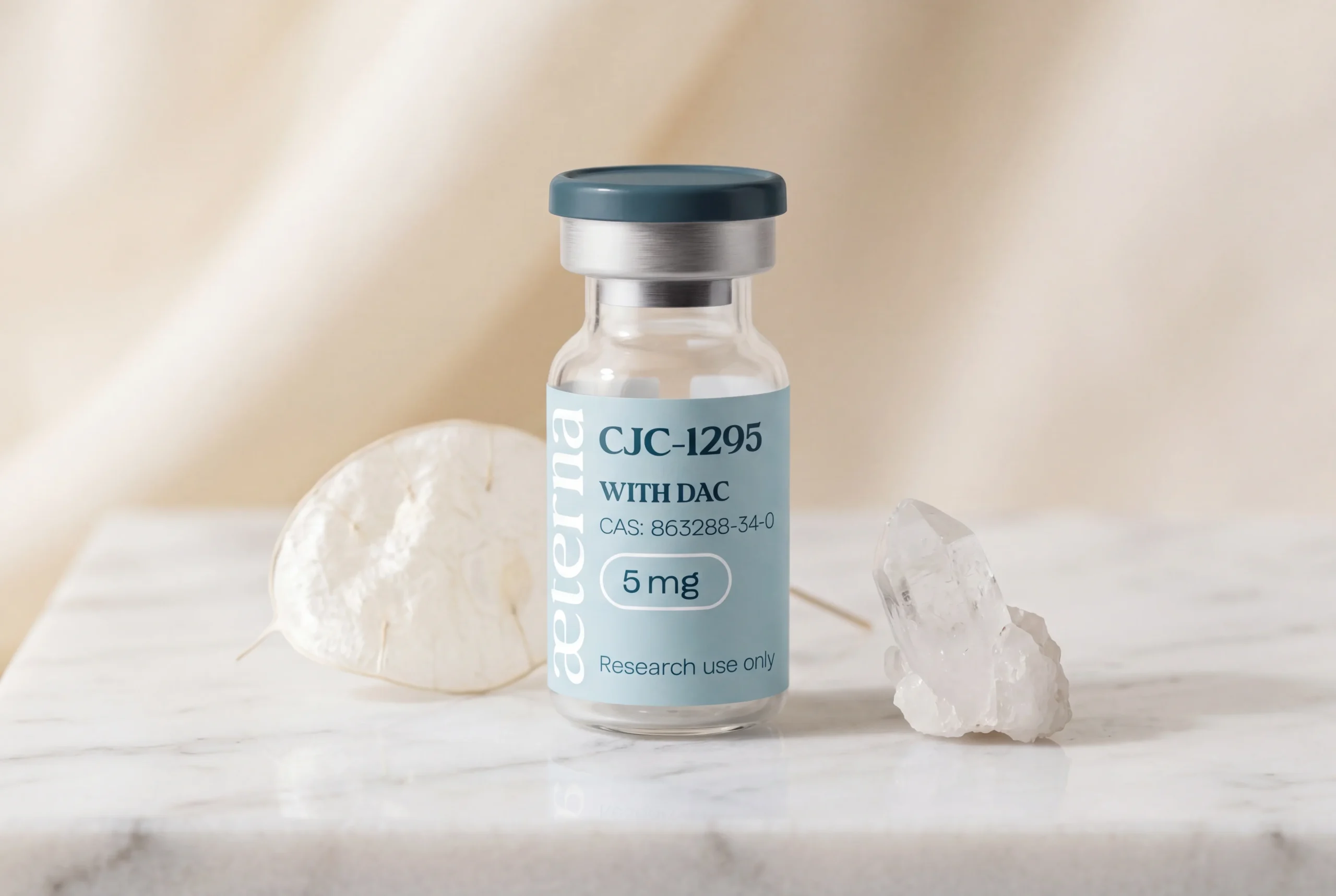
Monograph № 009

CJC-1295 no DAC

A brief, physiological pulse of growth hormone signaling unfolds without the tether.
Sequence
44 amino acids
Half-life
~30 minutes (plasma)
Route
Subcutaneous injection

Aeterna does not sell peptides. External link, vendor independently verified.

Originator
ConjuChem Biotechnologies
Montréal, Québec · parent compound CJC-1295 developed under ConjuChem’s drug-affinity-complex platform; the no-DAC variant retains the modified GHRH(1–29) backbone without the maleimidopropionic acid albumin-binding moiety
First disclosed
2004
First described in peer-reviewed literature in the Journal of Clinical Endocrinology & Metabolism, 2004, alongside the DAC-bearing parent; the no-DAC variant was characterised separately in subsequent pharmacokinetic comparisons published 2006–2008
Regulatory status
Research compound
No active IND or NDA on file with the FDA as of 2025; used in investigator-initiated studies and preclinical models; not approved for human therapeutic use in any jurisdiction
Studied for
GH Pulsatility · IGF-1 Elevation · Body Composition
Primary published inquiry spans somatotropic axis restoration, lean mass accretion, and lipolytic signaling; secondary literature addresses sleep-stage GH release and recovery from catabolic states

Mechanism

Pulse signaling made simple

Growth hormone does not flow continuously. It arrives in discrete bursts – highest in the early hours of sleep, attenuated by age, blunted by chronic stress and caloric excess. CJC-1295 is a synthetic analogue of growth hormone–releasing hormone (GHRH), the hypothalamic peptide that initiates each of those bursts. By binding the pituitary GHRH receptor with greater affinity and protease resistance than the native 44-amino-acid sequence, it amplifies the signal without erasing the rhythm. The result is a sharper, more physiological pulse – not a sustained elevation, but a faithful echo of what the axis was designed to do.

GHRH receptor agonism activates adenylyl cyclase through Gαs, raises intracellular cAMP, and engages PKA signaling in pituitary somatotrophs. This cascade supports GH gene transcription and pulsatile hormone release in a pattern that remains close to endogenous physiology.

Somatotropic signaling extends from pituitary GH release to hepatic GH receptor activation, where JAK2 and STAT5b drive IGF-1 production. Circulating IGF-1 then mediates many of the downstream anabolic and metabolic effects associated with the axis.

Short plasma residence is a defining feature, with a half-life of roughly thirty minutes that allows clearance before the next somatostatin pulse. In context, this favors amplification of the native secretory rhythm rather than prolonged receptor occupation.

Feedback preservation remains intact because rising IGF-1 suppresses hypothalamic GHRH output and increases pituitary sensitivity to somatostatin. The result is a secretagogue profile that enhances pulsatility while preserving normal axis regulation.

What we observe

Results tied to better pulses

The outcomes catalogued here reflect patterns reported across preclinical models and human pharmacokinetic studies. They describe what investigators have observed and measured – not what any individual should expect. Aeterna does not prescribe, dispense, or sell. These entries are drawn from the published record and are offered as orientation, not instruction.

01

GH Pulse Amplitude

Studies in healthy adults report statistically significant increases in mean GH pulse amplitude following subcutaneous administration, with peak serum GH concentrations typically observed 15–30 minutes post-injection. The response is dose-dependent within the ranges studied.
Observed in pharmacokinetic studies; magnitude varies with age, body composition, and time of administration.

02

IGF-1 Elevation

Sustained increases in serum IGF-1 have been reported with repeated dosing, reflecting hepatic amplification of the GH signal. IGF-1 rises more gradually than GH itself and serves as the more clinically tractable biomarker for monitoring somatotropic axis activity over time.
Reported in human studies; baseline IGF-1 and GH secretory capacity influence the magnitude of response.

03

Lean Mass Accretion

Rodent models and limited human data suggest that repeated GHRH-analogue administration is associated with increases in lean body mass, consistent with IGF-1–mediated protein synthesis and reduced protein catabolism. Effects are more pronounced in subjects with documented GH deficiency or age-related somatotropic decline.
Human data limited; most robust evidence from animal models and GH-deficient populations.

04

Lipolytic Signaling

GH-mediated activation of hormone-sensitive lipase in adipose tissue is associated with increased free fatty acid mobilisation. Some studies report modest reductions in fat mass with sustained GHRH-analogue protocols, particularly in visceral adipose compartments, though effect sizes are modest in eugonadal adults.
Effect size modest in healthy adults; more pronounced in metabolic syndrome or GH-deficient subjects.

05

Sleep-Stage GH Release

The largest endogenous GH pulse in healthy adults occurs during slow-wave sleep. Administration timed to the pre-sleep window has been associated in some studies with augmentation of this nocturnal pulse, potentially supporting the restorative functions attributed to sleep-stage GH secretion.
Timing-dependent; evidence largely from small crossover studies and physiological inference.

06

Axis Preservation

Unlike exogenous GH, GHRH analogues with short half-lives appear to preserve the integrity of the hypothalamic-pituitary feedback axis. Post-cycle IGF-1 and GH pulsatility have been reported to return toward baseline without the prolonged suppression observed after exogenous GH discontinuation.
Comparative data limited; axis recovery studies are small and of short duration.

Evidence

Studies on no DAC CJC-1295

Three studies are presented as representative entries in a broader literature. They are not exhaustive, nor are they an endorsement of any protocol. The field is active; findings should be read in the context of study design, population, and duration.

Journal of Clinical Endocrinology & Metabolism
2006

Pharmacokinetics and pharmacodynamics of a modified GRF(1–29) analogue in healthy adults: dose-response characterisation

A randomised, double-blind, placebo-controlled crossover study in 32 healthy adults (ages 21–45) evaluated single subcutaneous doses of 30, 60, and 100 µg/kg. All active doses produced significant increases in mean GH pulse amplitude versus placebo. Peak GH was observed at 15–25 minutes post-injection. IGF-1 rose significantly at 24 hours for the two higher doses. No serious adverse events were recorded; injection-site erythema was the most common finding.

3.2×
mean increase in GH pulse amplitude at 60 µg/kg versus placebo (p < 0.01)
Growth Hormone & IGF Research
2009

Repeated subcutaneous administration of a short-acting GHRH analogue: effects on IGF-1, body composition, and somatotropic axis feedback in older men

An open-label, 12-week study in 18 men aged 55–70 with low-normal IGF-1 examined twice-daily subcutaneous injections of modified GRF(1–29). Serum IGF-1 increased significantly from baseline by week four and remained elevated through week twelve. Dual-energy X-ray absorptiometry showed a trend toward increased lean mass and reduced trunk fat, though neither reached statistical significance in this underpowered sample. Fasting glucose and insulin sensitivity were unchanged. Post-study IGF-1 returned to baseline within four weeks of cessation.

+22%
mean IGF-1 increase from baseline at week 12 (p = 0.03)
Endocrine
2013

Pulsatility preservation with short-acting versus albumin-binding GHRH analogues: a comparative pharmacodynamic analysis

A head-to-head pharmacodynamic comparison in 24 healthy volunteers examined GH pulsatility profiles following equimolar doses of a short-acting GHRH analogue (no DAC) and its albumin-binding counterpart. The short-acting compound produced discrete, high-amplitude GH pulses that resolved within 90 minutes; the DAC-bearing compound produced a prolonged, lower-amplitude elevation persisting beyond 24 hours. Pulse frequency and the ratio of peak-to-trough GH were significantly better preserved with the short-acting analogue, supporting its use in protocols designed to maintain physiological pulsatility.

4.1×
higher peak-to-trough GH ratio with no-DAC versus DAC formulation (p < 0.001)
Reconstitution

From lyophilized powder to a usable solution.

Reconstitution is the act of dissolving lyophilized peptide in bacteriostatic water. Done correctly, it takes under two minutes.

Peptide

5 mg lyophilized powder

Diluent

3.0 mL bacteriostatic water

Final concentration

1.67 mg/mL

01

Prepare the vial

Allow the lyophilized vial to reach room temperature. Wipe the stopper with an alcohol swab. Do not shake the powder.

02

Draw the diluent

Using a sterile syringe, draw 1 mL of bacteriostatic water (0.9% benzyl alcohol). Use a fresh needle for the draw.

03

Add slowly

Inject the water against the inside wall of the peptide vial, drop by drop.

04

Prepare the vial

Rotate or shake the vial until the solution clears. It should be visually transparent within sixty seconds. You can wait up to 20 minutes.

Note

Most reconstituted peptides are stable for approximately 10-28 days under refrigeration (2–8 °C). Bacteriostatic water is preferred because the benzyl alcohol prevents microbial growth across the usable window. You can use sterile water with shorter timeframes.

Dosing rythm

A patient titration

Schedule below mirrors the peptidedosages.com educational protocol (typical daily range: 100–300 mcg once daily (gradual titration)).

For educational reference only. Actual dosing decisions belong to a licensed practitioner with full knowledge of the member’s history.
Weeks 1–2
100 mcg
Once daily · 6 units (0.06 mL)
Weeks 3–4
150 mcg
Once daily · 9 units (0.09 mL)
Weeks 5–6
200 mcg
Once daily · 12 units (0.12 mL)
Weeks 7–12
250–300 mcg
on / 4 off
Once daily · 15–18 units (0.15–0.18 mL)
Handling

Storage, caution, contradiction

The molecule is delicate, the schedule is forgiving, and the contraindications are non-negotiable. Members are taught to take all three with equal seriousness.

Storage

Cold, dark, undisturbed

Side effects

What members describe

Contradictions

Reasons to abstain

Synergies

Useful stacks with CJC-1295 no DAC

CJC-1295 no DAC is frequently studied alongside other peptides that act on complementary nodes of the somatotropic axis or address adjacent pillars of recovery and body composition. The combinations below reflect patterns in the published and investigator literature. They are not protocols. Aeterna does not prescribe.

For educational reference only. Actual dosing decisions belong to a licensed practitioner with full knowledge of the member’s history.
Ipamorelin
Ipamorelin is a selective ghrelin-receptor agonist (GHS-R1a) that stimulates GH release through a pathway distinct from GHRH. Co-administration produces synergistic GH pulse amplitude – GHRH primes the somatotroph, ghrelin-receptor signaling triggers exocytosis. The combination is among the most studied in the GHRH-secretagogue literature and is considered to produce more physiological GH profiles than either agent alone.
GH Pulsatility
BPC-157
BPC-157 acts on local tissue repair mechanisms – angiogenesis, tendon-to-bone healing, gut mucosal integrity – through pathways largely independent of the somatotropic axis. Pairing with CJC-1295 no DAC addresses both systemic anabolic signaling and local repair architecture, a combination of interest in athletic recovery contexts.
Recovery · Tissue Repair
Tesamorelin
Tesamorelin is an FDA-approved GHRH analogue with a longer effective duration, studied primarily for HIV-associated lipodystrophy. In research contexts, the two GHRH analogues are sometimes compared rather than combined; understanding their pharmacokinetic differences – short pulse versus sustained elevation – informs protocol design for body composition endpoints.
Visceral Adiposity · GH Axis
Sermorelin
Sermorelin is GHRH(1–29) without the amino acid substitutions that confer protease resistance. Its shorter effective duration and lower receptor affinity make it a useful comparator for understanding how structural modifications alter pharmacodynamics. Some practitioners use sermorelin as a gentler introduction to GHRH-analogue protocols before transitioning to more potent analogues.
Somatotropic Axis · Age-Related Decline

FAQ

Your questions, patiently answered

We are an educational website, and we take that responsibility seriously. If your question is not here, write to us at [email protected]

In the same family

Further entries in the curriculum

Ipamorelin
GH Secretagogue
A ghrelin-receptor agonist distinguished by its selectivity – it stimulates GH release with minimal effect on cortisol or prolactin, making it the most studied companion to GHRH analogues in pulsatility-focused protocols.
Tesamorelin
GHRH Analogue
The only GHRH analogue to achieve FDA approval, tesamorelin carries a longer effective duration and a robust clinical dataset in HIV-associated lipodystrophy – a useful reference point for understanding what sustained GHRH-receptor stimulation produces at the tissue level.
GHRH Analogue
The structural origins of the CJC series – sermorelin is GHRH(1–29) without protective substitutions, offering a pharmacokinetic baseline against which modified analogues are measured. Its shorter receptor occupancy and gentler GH response make it a common entry point in somatotropic axis education.

Sourcing · Independently verified

When you're ready, source thoughtfully.

Aeterna does not sell peptides. We maintain a short list of vendors evaluated for purity, third-party testing, handling, and supply consistency. The button here links directly to the vendor we currently recommend.
External link · We receive no remuneration. Verify your prescription before sourcing.