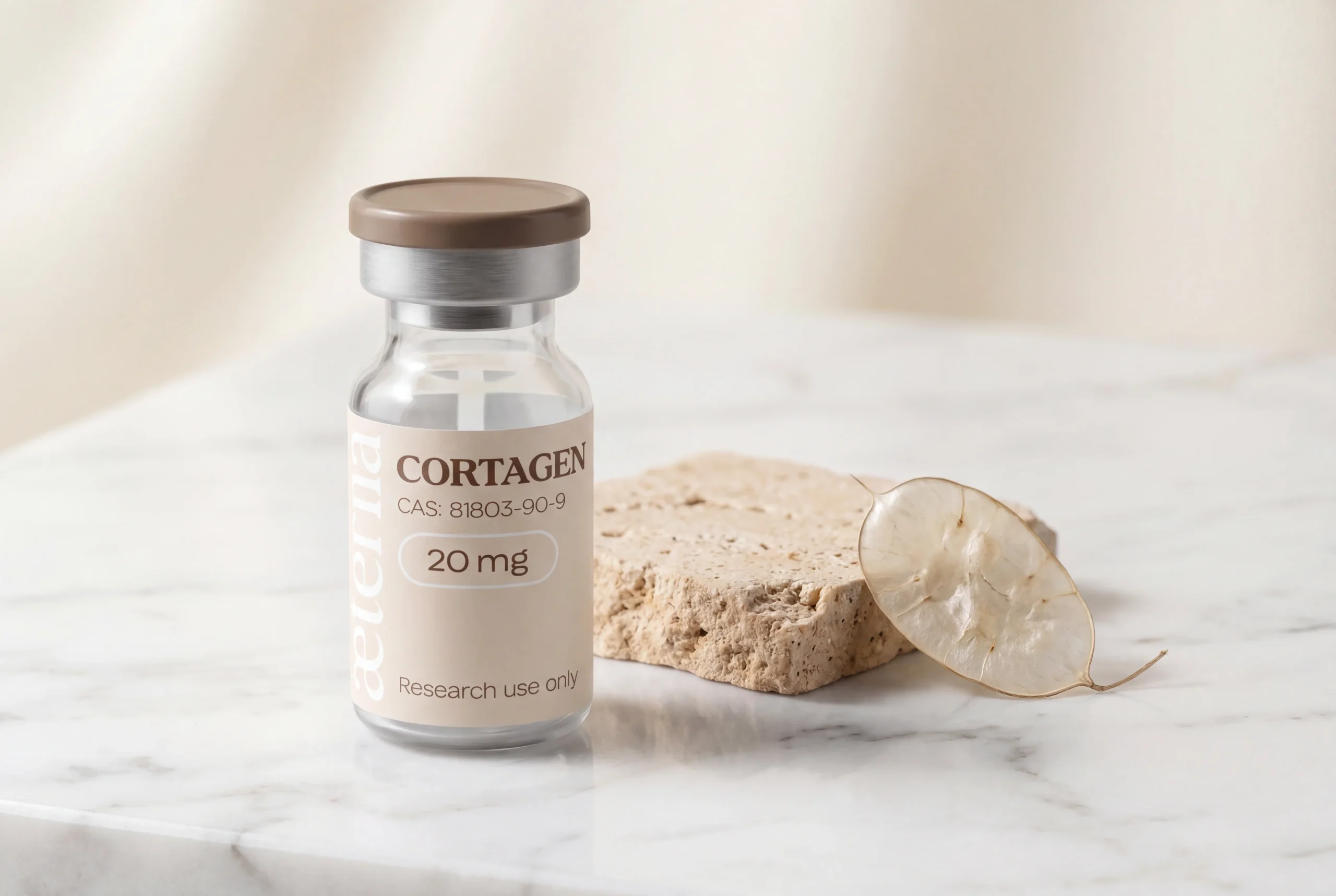
Cortagen
Aeterna does not sell peptides. External link, vendor independently verified.
Mechanism
Cortagen is a tetrapeptide – Ala-Glu-Asp-Pro – isolated originally from bovine cerebral cortex tissue. Its mechanism is not receptor-mediated in the classical pharmacological sense. Instead, the literature describes a pattern of direct chromatin interaction: short peptides of this class appear to intercalate with DNA-histone complexes, influencing transcriptional availability of genes associated with neuronal maintenance, apoptotic resistance, and antioxidant defense. The result, as observed in cell and animal models, is a shift in the gene expression landscape of aging cortical tissue – not a single-target effect, but a broad recalibration of the molecular vocabulary neurons use to sustain themselves.
Cortagen is the tetrapeptide Ala-Glu-Asp-Pro, originally isolated from bovine cerebral cortex and studied for its apparent interaction with chromatin. Fluorescence spectroscopy suggests binding at the histone-DNA interface, implying an effect on transcriptional accessibility rather than classical surface-receptor signaling.
Antioxidant gene expression appears to increase in aged cortical tissue exposed to Cortagen. In rat models, transcription of superoxide dismutase and catalase isoforms rises in older tissue, a pattern not observed in young cortex.
Apoptotic signaling is reduced in cortical neurons under oxidative stress following Cortagen treatment. Reported declines in Bax expression and caspase-3 activity support the working hypothesis that chromatin remodeling lowers transcriptional readiness across pro-apoptotic gene programs.
Neuroendocrine regulation may also shift in response to Cortagen in aged animals. Reported normalization of cortical melatonin receptor density and diurnal corticosterone rhythms remains mechanistically unresolved and may reflect either downstream chromatin effects or a separate pathway.
What we observe
Changes seen with Cortagen use
The outcomes below reflect patterns reported in cell culture, animal, and limited human observational studies from the IBG research program. These are not endpoints from randomized controlled trials. They are presented as a curriculum in what the science currently reports.
01
Cortical Neuron Survival
02
Antioxidant Gene Upregulation
03
Cognitive Performance
04
Melatonin Receptor Density
05
Pro Apoptotic Markers
06
Animal Longevity Signals
Evidence
Studies on Cortagen
The evidence base for Cortagen is concentrated within the St. Petersburg Institute of Bioregulation and Gerontology. Independent replication is sparse. The studies below represent the most substantive peer-reviewed entries in the published record as of 2025.
Effect of Cortagen on Apoptosis and Antioxidant Enzyme Expression in Aged Rat Cortical Neurons
Cortical neurons isolated from 24-month-old rats and treated with Cortagen at 0.1 µg/mL showed a 34% reduction in TUNEL-positive cells relative to untreated aged controls. Concurrent upregulation of SOD-1 mRNA was observed by RT-PCR. Authors concluded that the peptide exerts a cytoprotective effect consistent with epigenetic modulation of stress-response gene clusters.
Cortagen Administration and Melatonin Receptor Restoration in the Aging Cerebral Cortex: An Autoradiographic Study
Aged Wistar rats (22 months) receiving subcutaneous Cortagen over a 30-day protocol demonstrated a 28% increase in MT1 receptor binding density in frontal cortical regions compared to saline controls, as measured by tritiated melatonin autoradiography. The authors proposed that improved neuronal membrane integrity, rather than direct receptor synthesis induction, accounts for the observed restoration.
Long-Term Bioregulator Peptide Administration and Lifespan in Aged Rodents: A Comparative Series Including Cortagen
In a 14-month longitudinal study, aged C57BL/6 mice receiving Cortagen as part of a bioregulator peptide series showed a median lifespan extension of 11.2% relative to untreated age-matched controls. Histological examination at endpoint revealed reduced cortical neuron loss and lower lipofuscin accumulation in treated animals. The authors noted that no single peptide in the series could be isolated as solely responsible for the longevity signal.
From lyophilized powder to a usable solution.
Peptide
20 mg lyophilized powder
Diluent
3.0 mL bacteriostatic water
Final concentration
6.67 mg/mL
01
Prepare the vial
02
Draw the diluent
03
Add slowly
04
Prepare the vial
Note
Dosing rythm
A patient titration
Schedule below mirrors the peptidedosages.com educational protocol (typical daily range: 1000–2000 mcg once daily (morning administration preferred)).
Storage, caution, contradiction
Storage
Cold, dark, undisturbed
- Lyophilized: freeze at −20 °C (−4 °F).
- After reconstitution, refrigerate at 2–8 °C (35.6–46.4 °F).
- Avoid freeze–thaw cycles.
- Keep away from direct light at all stages; amber vials or foil wrapping are appropriate precautions.
- Label each vial with reconstitution date and concentration; discard any solution showing particulate matter or discoloration.
Side effects
What members describe
- Mild injection-site reactions - transient erythema or induration - have been noted in human observational reports; typically self-resolving within 24 hours.
- Transient fatigue or mild somnolence has been reported anecdotally in some users, possibly reflecting neuroendocrine modulation; the mechanism is not established.
- Headache of mild intensity has been noted in a minority of subjects in IBG observational series; causality has not been confirmed.
- No significant hematological, hepatic, or renal adverse signals have been reported in published animal toxicology studies at research doses.
- Long-term safety data in humans are absent; the absence of reported adverse events in limited observational series should not be interpreted as a safety guarantee.
Contradictions
Reasons to abstain
- Known hypersensitivity to any component of the formulation, including the tetrapeptide sequence Ala-Glu-Asp-Pro.
- Active neurological malignancy or history of cortical neoplasm - epigenetic modulators carry theoretical risk of altered gene expression in proliferating cells.
- Pregnancy and lactation - no safety data exist; use is not supported by any published evidence in these populations.
- Concurrent use of agents with significant epigenetic activity (e.g., HDAC inhibitors, DNA methyltransferase inhibitors) - additive or unpredictable transcriptional effects cannot be excluded.
- Pediatric populations - the peptide has been studied exclusively in aged adult and animal models; use in developing nervous systems is without evidence and carries unknown risk.
Synergies
Cortagen combos that make sense
The pairings below reflect patterns observed in the IBG bioregulator research series and in the broader neuroprotective peptide literature. They are not prescriptive protocols. Aeterna does not dispense or sell. These combinations are presented as a vocabulary for informed conversation with a qualified clinician – not as a recommended stack for self-administration.
FAQ
Your questions, patiently answered
Most neuroprotective peptides act through defined receptor pathways – growth factor receptors, melanocortin receptors, or ion channel modulation. Cortagen’s proposed mechanism is different in kind: it is described as a chromatin-interacting peptide, one that may influence which genes are transcriptionally available rather than which receptors are activated. This distinction matters because the effect, if real, would be broader and more durable than receptor agonism – but also harder to characterize and verify with standard pharmacological tools.
No randomized controlled human trials have been published for Cortagen as of 2025. The evidence base consists of in vitro studies, aged animal models, and limited observational series conducted within the St. Petersburg IBG research program. This is a meaningful limitation. The patterns reported are internally consistent, but they have not been subjected to the scrutiny of blinded, placebo-controlled human trials. Readers should weight the evidence accordingly.
The working model, as described in the IBG literature, holds that short peptides with the right charge distribution and spatial geometry can associate with histone proteins and linker DNA in chromatin. This association is proposed to alter the accessibility of gene promoter regions – effectively de-repressing genes that have been silenced by age-related chromatin compaction. The model is biologically plausible and consistent with what is known about chromatin remodeling, but direct structural evidence for Cortagen-chromatin binding at atomic resolution has not been published.
Cortagen is one of approximately 20 short peptide bioregulators developed and studied by Prof. Vladimir Khavinson and colleagues at the St. Petersburg IBG over several decades. The series includes tissue-specific peptides derived from or modeled on brain, thymus, pineal gland, retina, and other organs. Cortagen is the cortex-specific entry. The series shares a common theoretical framework – that short peptides carry tissue-specific epigenetic information – and a common research methodology, which means the evidence base is coherent but not independently diverse.
Intranasal administration has been explored in the IBG literature as a route that may allow direct access to the olfactory-cortical pathway, bypassing the blood-brain barrier challenge that limits many neuropeptides. Some animal studies have employed intranasal delivery. However, the pharmacokinetic data for intranasal Cortagen in humans are not published, and no standardized intranasal protocol has been established. Subcutaneous administration remains the better-documented route.
Cortagen should be understood as an investigational compound with a plausible mechanism and a coherent but limited evidence base – not as a replacement for established neuroprotective practices. The literature on sleep quality, aerobic exercise, dietary pattern, and cognitive engagement as modulators of cortical aging is vastly more robust. Cortagen, if it is to be considered at all, belongs in a conversation with a qualified clinician, positioned as an adjunct to – not a substitute for – those foundational practices.
In the same family
Further entries in the curriculum.
Sourcing · Independently verified
When you're ready, source thoughtfully.