Monograph № 009

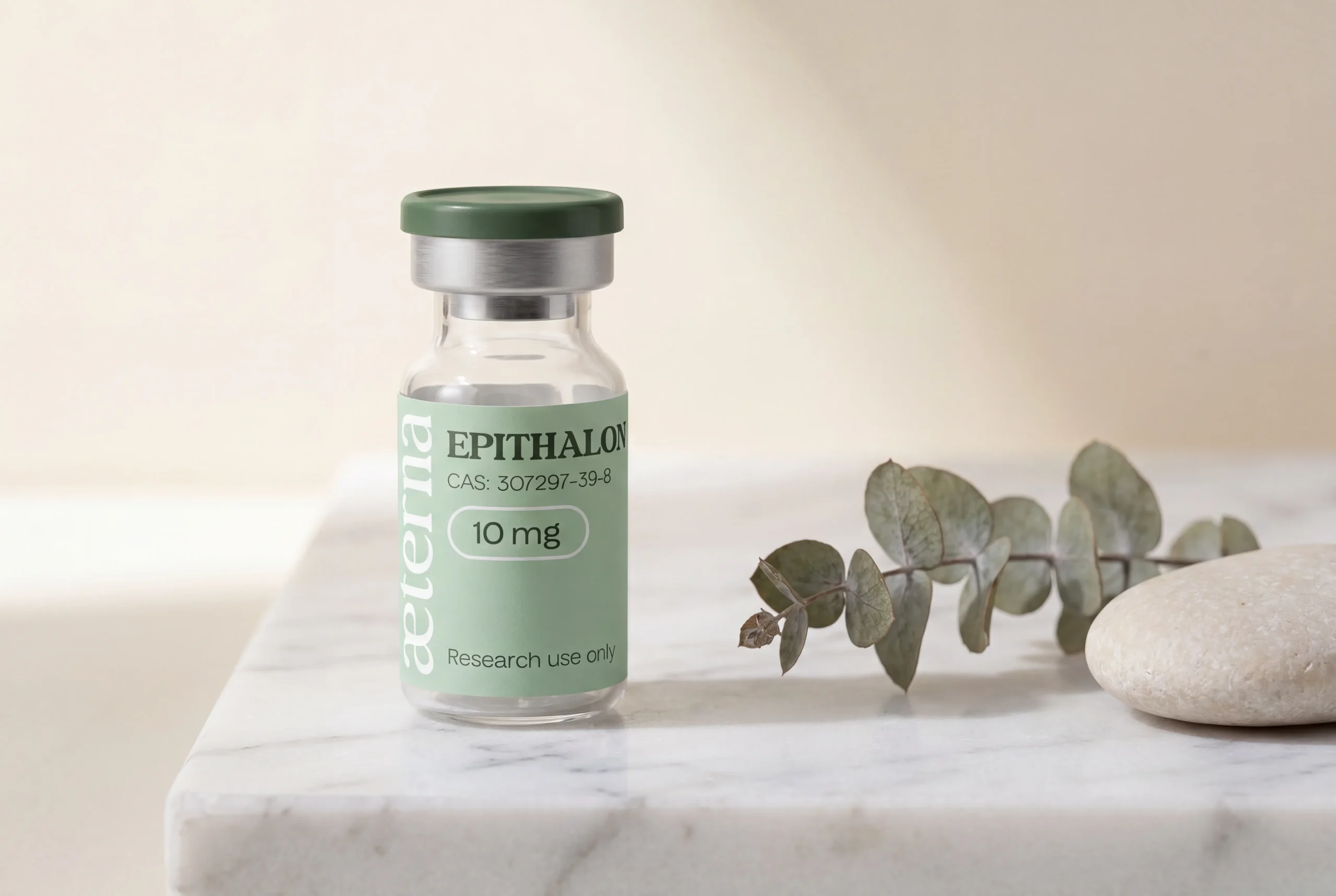
Epithalon

A tetrapeptide sequence that converges epigenetic, neuroendocrine, and redox signals into what the geroscience literature describes as a molecular reset of cellular age.
Sequence
4 amino acids
Half-life
Approximately 60–80 minutes (IV); extended tissue retention reported in animal models
Route
Subcutaneous · Intravenous · Intranasal (investigational)

Aeterna does not sell peptides. External link, vendor independently verified.
Originator
Vladimir Khavinson, Ph.D.
St. Petersburg Institute of Bioregulation and Gerontology, Russian Academy of Medical Sciences · synthetic analogue of Epithalamin, the native pineal extract
First disclosed
1994
First described in Gerontology (Karger) by Khavinson et al., 1994; foundational telomere data published in Bulletin of Experimental Biology and Medicine, 2003
Regulatory status
Unregistered / Research Use
No IND filed with FDA or EMA as of 2025; studied under Russian federal gerontology programs since the 1980s; not approved for human therapeutic use in any jurisdiction
Studied for
Telomere Biology · Neuroendocrine Aging · Oncostasis
Primary published inquiry spans telomerase activation, pineal-hypothalamic axis regulation, and age-associated epithelial carcinogenesis; literature concentrated in Russian and Eastern European journals, 1994–2024

Mechanism

How Epithalon may affect cell aging

Epithalon is a synthetic tetrapeptide – Ala-Glu-Asp-Gly – derived from Epithalamin, a polypeptide fraction isolated from bovine pineal gland. Its mechanism is not a single receptor event but a convergence of epigenetic and neuroendocrine signals that collectively slow the molecular markers of cellular aging. The literature describes it less as a drug and more as a biological instruction – a short sequence that appears to remind aged cells of earlier transcriptional states.

Telomerase induction is the core mechanism most often associated with Epithalon in the published literature. Experimental work reports restoration of TERT promoter activity in human fibroblasts, with downstream effects on replicative lifespan.

Pineal modulation is the principal neuroendocrine effect described in aged animal models. Reported changes include restoration of melatonin rhythm amplitude with downstream normalization of nocturnal cortisol and partial recovery of growth hormone pulsatility.

Antioxidant upregulation appears to account for the peptide’s redox-related effects in hepatic and neural tissue. Studies report reduced malondialdehyde alongside increased superoxide dismutase and catalase activity after administration.

Apoptotic normalization is the tumor-modulatory mechanism proposed in transgenic cancer models. In HER2-driven mammary systems, Epithalon has been reported to delay tumor onset by restoring regulatory sensitivity rather than acting as a cytotoxic agent.

What we observe

Reported shifts in aging markers and recovery

The outcomes attributed to Epithalon span molecular, physiological, and longevity endpoints across several decades of published research. Most data originate from the St. Petersburg Institute of Bioregulation and Gerontology; independent replication in Western academic centres remains limited. The patterns below reflect what the available literature reports.

01

Telomere Preservation

In vitro studies using human fetal fibroblasts demonstrated measurable telomere elongation following Epithalon exposure, with treated cells completing additional population doublings relative to untreated controls. The effect was dose-dependent within the studied range.
In vitro · Human fibroblast models · Khavinson et al.

02

Replicative Lifespan

Fibroblast cultures treated with Epithalon exceeded the Hayflick limit – the theoretical ceiling of approximately 50 population doublings for normal human somatic cells – without acquiring the genomic instability characteristic of malignant transformation. Senescence markers remained suppressed.
In vitro · Replicative senescence model · Bulletin of Experimental Biology and Medicine

03

Melatonin Rhythm

Aged rodents receiving Epithalon showed partial restoration of nocturnal melatonin amplitude toward patterns observed in younger cohorts. Circadian rhythm disruption – a hallmark of pineal aging – was attenuated across multiple experimental series conducted at the St. Petersburg Institute.
Animal model · Rodent aging cohorts · Multiple series, 1995–2009

04

Tumor Delay

In HER2-transgenic mice predisposed to mammary carcinoma, long-term Epithalon administration was associated with a statistically significant reduction in tumor incidence and a delay in median time to first tumor. The effect was attributed to restored apoptotic competence rather than direct cytotoxicity.
Animal model · Transgenic oncology model · Anisimov et al., 2003

05

Oxidative Damage

Hepatic and neural tissue from Epithalon-treated aged rats showed reduced malondialdehyde concentrations and elevated superoxide dismutase activity relative to age-matched controls. The antioxidant profile was consistent across multiple organ systems examined.
Animal model · Biochemical assay · Repeated across independent series

06

Animal Longevity

In several rodent longevity studies, Epithalon-treated animals demonstrated modestly extended median and maximum lifespan relative to controls. The magnitude varied by strain and dosing protocol; the consistency of direction across independent cohorts is the more notable finding.
Animal model · Lifespan studies · St. Petersburg Institute series, 1990s–2000s

Evidence

Human and animal findings

The evidentiary base is deep in animal and in vitro data and sparse in randomised human trials. The studies listed represent the most cited and methodologically described entries in the published record. Primary sources should be consulted directly.

Bulletin of Experimental Biology and Medicine
2003

Epithalon peptide induces telomerase activity and telomere elongation in human somatic cells

Khavinson and colleagues demonstrated that Epithalon at 0.1–1.0 µg/mL induced telomerase activity in cultured human fetal fibroblasts, with treated cells completing a mean of 10 additional population doublings beyond untreated controls. No chromosomal instability or malignant transformation was observed in extended culture. The authors proposed chromatin remodeling at the TERT promoter as the operative mechanism.

10+
additional population doublings observed in Epithalon-treated fibroblasts beyond untreated Hayflick-limit controls
Neuroendocrinology Letters
2007

Effects of Epithalon on tumor incidence and lifespan in HER2-transgenic mice: a long-term oncostatic study

Anisimov and colleagues administered Epithalon (1 µg/animal, subcutaneous, 5 days per month) to female HER2-transgenic mice from age 2 months. Treated animals showed a 27% reduction in cumulative mammary tumor incidence at 18 months and a delay in median time to first tumor of approximately 6 weeks relative to saline controls. Apoptotic index in pre-malignant tissue was significantly elevated in the treated group.

27%
reduction in mammary tumor incidence in HER2-transgenic mice receiving chronic Epithalon administration
Gerontology (Karger)
2012

Pineal peptides and circadian melatonin restoration in aged Wistar rats: a comparative analysis of Epithalon and Epithalamin

Aged Wistar rats (22–24 months) treated with Epithalon for 30 days demonstrated a 38% increase in peak nocturnal melatonin amplitude compared to age-matched controls, approaching values recorded in 6-month-old reference animals. Epithalon outperformed Epithalamin on melatonin amplitude restoration while producing equivalent antioxidant effects. Hypothalamic serotonin turnover was also normalized in the treated cohort.

38%
increase in peak nocturnal melatonin amplitude in aged rats following 30-day Epithalon administration
Reconstitution

From lyophilized powder to a usable solution.

Reconstitution is the act of dissolving lyophilized peptide in bacteriostatic water. Done correctly, it takes under two minutes.

Peptide

10 mg lyophilized powder

Diluent

2.0 mL bacteriostatic water

Final concentration

5 mg/mL

01

Prepare the vial

Allow the lyophilized vial to reach room temperature. Wipe the stopper with an alcohol swab. Do not shake the powder.

02

Draw the diluent

Using a sterile syringe, draw 1 mL of bacteriostatic water (0.9% benzyl alcohol). Use a fresh needle for the draw.

03

Add slowly

Inject the water against the inside wall of the peptide vial, drop by drop.

04

Prepare the vial

Rotate or shake the vial until the solution clears. It should be visually transparent within sixty seconds. You can wait up to 20 minutes.

Note

Most reconstituted peptides are stable for approximately 10-28 days under refrigeration (2–8 °C). Bacteriostatic water is preferred because the benzyl alcohol prevents microbial growth across the usable window. You can use sterile water with shorter timeframes.

Dosing rythm

A patient titration

Schedule below mirrors the peptidedosages.com educational protocol.

For educational reference only. Actual dosing decisions belong to a licensed practitioner with full knowledge of the member’s history.
Days 1–20 (Cycle On)
5,000 mcg (5 mg)
Once daily · 100 units (1.00 mL)
Weeks 4–26 (Cycle Off)
0 mcg
Once daily · —
Extended Longevity Cycle
1–2 µg/kg per day (animal-derived; human extrapolation unvalidated)
5 days on, 25 days off · Cycled across 6–12 months
Intranasal (Investigational)
Dose not established
in peer-reviewed human literature; animal studies used 50–100 µg per nostril
Route explored for CNS and pineal targeting · Human bioavailability data absent
Handling

Storage, caution, contradiction

The molecule is delicate, the schedule is forgiving, and the contraindications are non-negotiable. Members are taught to take all three with equal seriousness.

Storage

Cold, dark, undisturbed

Side effects

What members describe

Contradictions

Reasons to abstain

Synergies

What works with Epithalon

Epithalon is most often considered alongside other peptides and compounds that address the neuroendocrine and cellular dimensions of aging. The combinations below reflect patterns in the research literature and practitioner case reports – not validated clinical protocols. Aeterna does not prescribe or dispense.

For educational reference only. Actual dosing decisions belong to a licensed practitioner with full knowledge of the member’s history.
Thymalin (Thymus peptide extract)
Khavinson’s group studied Epithalon and Thymalin in combination across multiple longevity cohorts. The pairing addresses two distinct axes of immunosenescence – pineal-neuroendocrine and thymic – with complementary, non-overlapping mechanisms. Combined administration was associated with greater lifespan extension in rodent models than either compound alone.
Immune Architecture
Selank
Selank’s anxiolytic and BDNF-modulating properties complement Epithalon’s hypothalamic-pituitary normalization. In protocols targeting age-related cognitive and mood changes, the two peptides address different but convergent signaling pathways – Epithalon upstream at the pineal, Selank downstream at hippocampal neurotrophin expression.
Neuroendocrine Signaling
BPC-157
BPC-157’s systemic cytoprotective and angiogenic properties address the tissue-level consequences of cellular aging that Epithalon targets at the molecular level. The combination is conceptually coherent: Epithalon works at the telomere and epigenome; BPC-157 addresses the extracellular matrix and vascular integrity that aging erodes.
Cellular Repair
Melatonin (exogenous, low-dose)
Where Epithalon works to restore endogenous melatonin rhythm, exogenous low-dose melatonin (0.3–1 mg) may provide interim circadian support during the early phases of a protocol. The combination is used in some longevity-focused clinical practices, though the interaction at the pineal receptor level has not been formally characterized.
Circadian Biology

FAQ

Your questions, patiently answered

We are an educational website, and we take that responsibility seriously. If your question is not here, write to us at [email protected]

In the same family

Further study in the curriculum

Longevity
The thymic counterpart to Epithalon’s pineal focus. Thymalin addresses the immunosenescence axis – the progressive collapse of T-cell diversity and thymic output that accompanies aging. Studied alongside Epithalon in Khavinson’s longitudinal cohorts, it represents the immune pillar of the same gerontological framework.
Neuropeptide
A heptapeptide analogue of tuftsin with documented anxiolytic and BDNF-modulatory properties. Where Epithalon works upstream at the neuroendocrine level, Selank operates at the level of hippocampal neurotrophin expression – a downstream complement in protocols addressing cognitive aging.
BPC-157
Repair
Body Protection Compound 157 addresses the tissue and vascular consequences of aging that Epithalon targets at the molecular level. Its cytoprotective, angiogenic, and extracellular matrix-supporting properties make it a conceptually coherent companion in longevity-oriented research protocols.

Sourcing · Independently verified

When you're ready, source thoughtfully.

Aeterna does not sell peptides. We maintain a short list of vendors evaluated for purity, third-party testing, handling, and supply consistency. The button here links directly to the vendor we currently recommend.
External link · We receive no remuneration. Verify your prescription before sourcing.