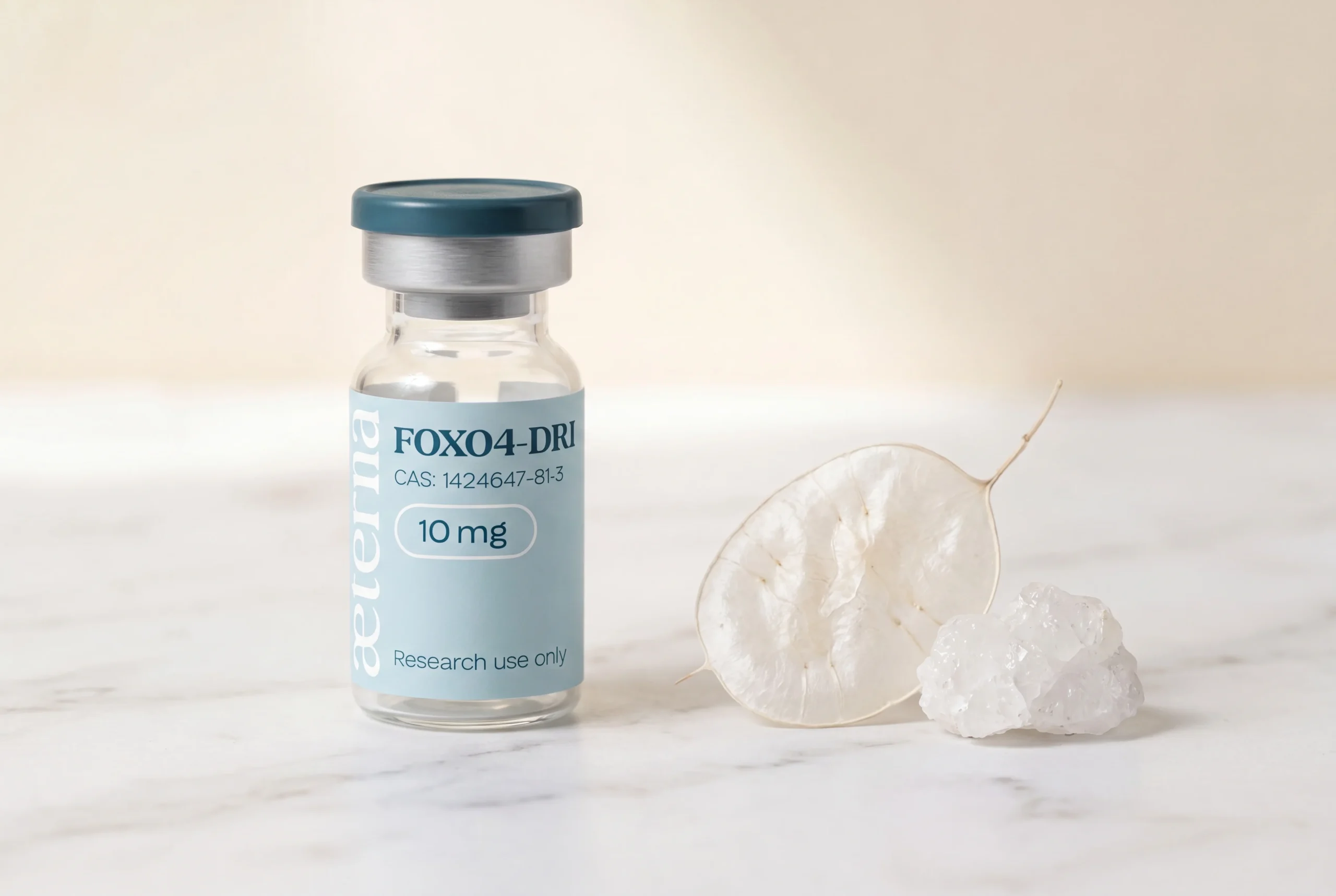
FOXO4-DRI
Aeterna does not sell peptides. External link, vendor independently verified.
Mechanism
FOXO4-DRI is a D-retro inverso peptide – a mirror-image, reverse-sequence analogue of a native FOXO4 domain – engineered to penetrate cells and disrupt a specific protein–protein interaction that keeps senescent cells alive against their own better judgment.
FOXO4-p53 disruption is the defining mechanism of FOXO4-DRI, a D-retro-inverso peptide designed to interfere with the interaction between FOXO4 and p53. By releasing p53 from that complex, it selectively induces apoptosis in senescent cells in preclinical models.
Senescent-cell clearance matters because these cells accumulate with age and secrete the inflammatory factors collectively described as the SASP. In mouse studies, FOXO4-DRI has reduced this burden and attenuated age-associated inflammatory signaling.
D-retro-inverso design improves the peptide’s resistance to enzymatic degradation. That configuration helps preserve proteolytic stability while maintaining the cell-penetrating behavior required for intracellular target engagement.
Evidence limits are unusually important here because FOXO4-DRI remains a preclinical compound rather than a clinically established one. As of 2026, the literature is confined to cell and animal studies, with no initiated human trials.
What we observe
Changes seen after senescent cell clearance
The evidence base for FOXO4-DRI is preclinical – predominantly murine – with a small and growing body of in vitro human-cell data. The patterns below reflect what the literature consistently reports within those constraints.
01
Senescent Cell Apoptosis
02
Physical Function
03
Fibrosis Attenuation
04
SASP Suppression
05
Senescence Reversal
06
Selective Cytotoxicity
Evidence
Research on FOXO4-DRI
Three peer-reviewed studies anchor the present understanding of FOXO4-DRI. All are preclinical. The translation to human biology remains the field’s central open question.
Targeted Apoptosis of Senescent Cells Restores Tissue Homeostasis in Response to Chemotoxicity and Aging
The foundational study by Baar et al. at Erasmus MC demonstrated that FOXO4-DRI disrupts the FOXO4–p53 interaction in senescent cells, triggering apoptosis selectively. Naturally aged mice and doxorubicin-treated mice showed improved fitness, reduced frailty scores, and partial restoration of renal and hepatic architecture. The study established the mechanistic rationale and provided the first in vivo proof of concept for targeted senolytic peptide therapy.
FOXO4-DRI Attenuates Senescence-Associated Secretory Phenotype and Fibrotic Remodeling in a Murine Model of Non-Alcoholic Steatohepatitis
Investigators applied FOXO4-DRI to a diet-induced NASH murine model, measuring hepatic stellate cell senescence, collagen deposition, and circulating SASP markers. Treated animals showed significant reductions in hepatic fibrosis staging and lower serum IL-6 and TGF-β1 at eight weeks. The study extended the compound’s relevance beyond aging per se into metabolic liver disease – a condition with substantial senescent-cell burden.
Intermittent Senolytic Peptide Administration Preserves Skeletal Muscle Mass and Function in Aged Murine Cohorts
This study examined whether periodic – rather than continuous – FOXO4-DRI dosing could sustain senolytic benefit while minimizing cumulative exposure. Aged mice receiving three-day treatment cycles every four weeks maintained significantly greater hindlimb muscle mass and grip strength over six months compared to vehicle controls. Histological analysis confirmed reduced intramuscular senescent-cell burden and lower local SASP expression, suggesting that intermittent clearance is sufficient to preserve the tissue environment.
From lyophilized powder to a usable solution.
Peptide
10 mg lyophilized powder
Diluent
3.0 mL bacteriostatic water
Final concentration
3.33 mg/mL
01
Prepare the vial
02
Draw the diluent
03
Add slowly
04
Prepare the vial
Note
Dosing rythm
A patient titration
Schedule below mirrors the peptidedosages.com educational protocol (typical daily range: 250–500 mcg once daily (gradual titration over 16 weeks)).
Storage, caution, contradiction
Storage
Cold, dark, undisturbed
- Lyophilized: freeze at −20 °C (−4 °F).
- After reconstitution, refrigerate at 2–8 °C (35.6–46.4 °F).
- Avoid freeze–thaw cycles [8].
- Protect from light at all stages; amber vials preferred for storage
- Inspect before each dose - discard if cloudy, particulate, or discolored
Side effects
What members describe
- Injection-site erythema - mild and transient in most reported cases
- Transient fatigue - reported in the days following a treatment cycle
- Mild nausea - occasionally noted; mechanism unclear, possibly SASP-release related
- Headache - reported anecdotally; not systematically characterized in human data
- Unknown long-term effects - the human safety profile has not been established in controlled trials
Contradictions
Reasons to abstain
- Active malignancy - senolytic activity in tumor-adjacent senescent stroma is incompletely understood
- Pregnancy or lactation - no safety data exist; contraindicated on precautionary grounds
- Recent major surgery or acute tissue injury - senescent cells play roles in wound healing; premature clearance may impair repair
- Concurrent immunosuppressive therapy - interaction with senescent-cell immune surveillance is uncharacterized
- Pediatric use - cellular senescence dynamics differ fundamentally in developing tissue; not studied
Synergies
Best combos with FOXO4-DRI
FOXO4-DRI addresses one specific mechanism – the survival of senescent cells. The broader project of longevity involves tissue repair, mitochondrial function, and systemic inflammation. These companions address those adjacent pillars.
FAQ
Your questions, patiently answered
No. As of 2026, FOXO4-DRI has no approved human indication in any jurisdiction. It remains a preclinical research compound. No Phase 1 human safety trial has been completed and published. This monograph is an educational document, not a clinical recommendation.
Dasatinib and quercetin are small molecules that act on broad survival pathways – BCL-2 family proteins, PI3K signaling – with effects across multiple cell types. FOXO4-DRI targets a single protein–protein interaction (FOXO4–p53) that is specifically load-bearing in senescent cells. The theoretical selectivity is higher, though whether that translates to a superior human safety profile is not yet established.
Senescent cells accumulate over weeks to months. Once a cycle clears the existing burden, continuous dosing offers diminishing return and introduces unnecessary cumulative exposure. The intermittent model – three days on, weeks off – mirrors the cadence used in the foundational murine studies and reflects the biology of senescent-cell re-accumulation.
This question does not have a settled answer. Senescent cells in the tumor microenvironment play complex and sometimes opposing roles – some promote tumor progression via SASP, others may restrain it. Administering a senolytic in an active oncological context without specialist oversight is not advisable. The literature does not yet support a clear recommendation.
Reconstituted solution should be refrigerated at 2–8 °C, protected from light, and used within 28 days. The lyophilized powder, unopened, is stable for up to 24 months under the same temperature conditions. Do not freeze the reconstituted form.
Aeterna Method does not prescribe, dispense, or sell peptides of any kind. This monograph exists to translate the available science into a form that supports informed conversation – between a reader and their physician, or between a researcher and the literature. Sourcing decisions are the reader’s own.
In the same family
Adjacent monographs .
Sourcing · Independently verified
When you're ready, source thoughtfully.