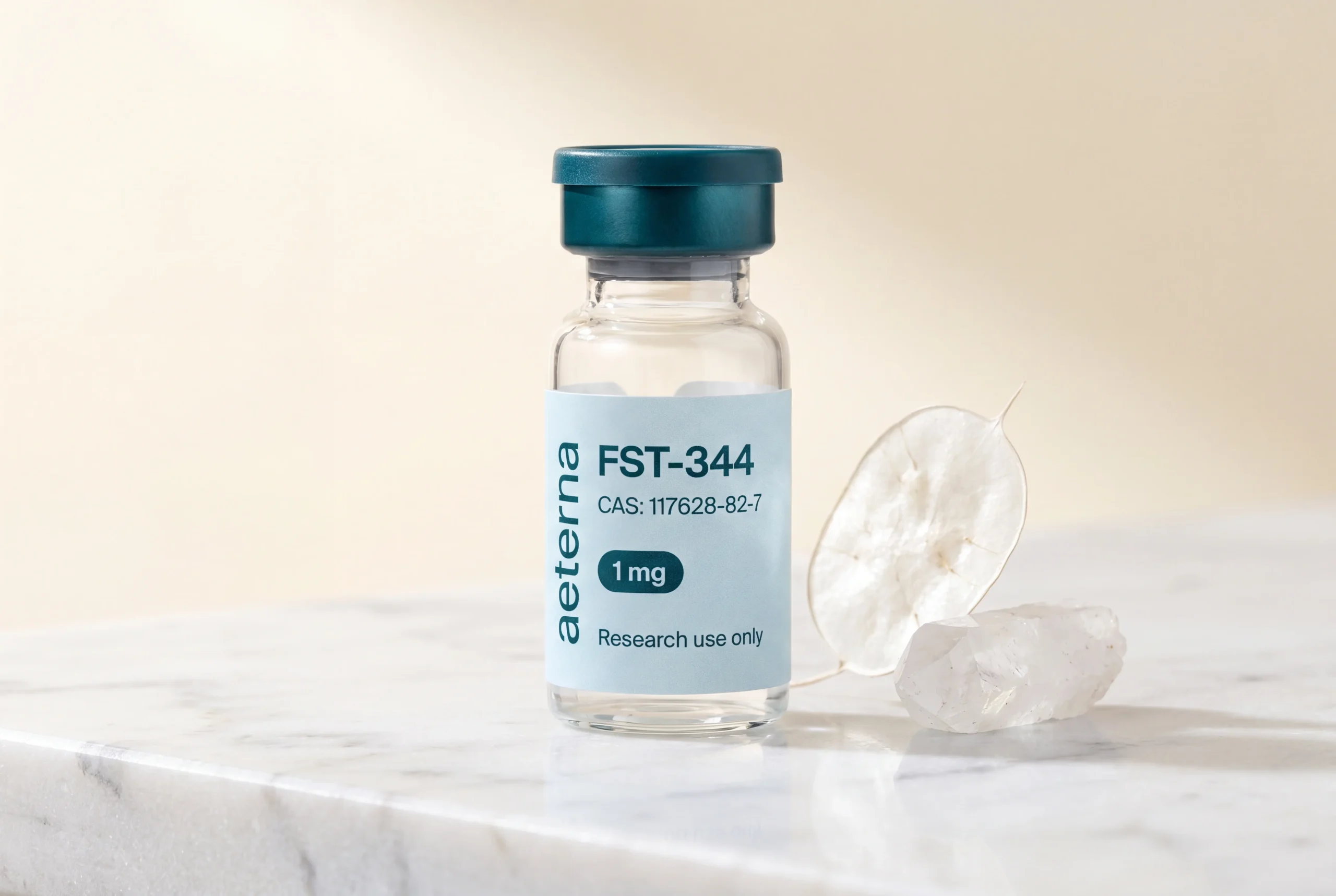
Monograph № 015

FST-344

Where the body’s own brake on muscle growth becomes the target, FST-344 explores the precise molecular threshold between restraint and abundance.
Sequence
344 amino acids
Half-life
~24–36 hours (estimated, murine models)
Route
Subcutaneous · Intramuscular (investigational)

Aeterna does not sell peptides. External link, vendor independently verified.

Originator
Varied Academic Consortia
Characterized independently at Johns Hopkins School of Medicine and the Salk Institute; CAS 117628-82-7 registered under recombinant follistatin isoform nomenclature
First disclosed
1990s–2000s
Isoform-specific biology first delineated in Journal of Biological Chemistry, 1997; muscle-hypertrophy applications described in PNAS, 2004
Regulatory status
Investigational · No IND Filed
No active IND as of 2025; gene-therapy delivery of FST-344 construct under exploratory review by FDA Office of Tissues and Advanced Therapies
Studied for
Muscle Hypertrophy · Muscular Dystrophy · Sarcopenia
Primary published inquiry spans Duchenne muscular dystrophy models (Nationwide Children’s Hospital, 2006–2014) and age-related sarcopenia (NIA-funded R01, 2018–2022)

Mechanism

FST-344 blocks myostatin signals

Skeletal muscle mass is not simply a product of anabolic signaling. It is equally the product of inhibitory tone – a ceiling imposed by circulating proteins that prevent unchecked growth. FST-344 is a naturally occurring isoform of follistatin, a secreted glycoprotein whose primary function is the sequestration of TGF-β superfamily ligands. Where other follistatin isoforms bind broadly across tissues, FST-344 – lacking the heparin-binding domain present in FST-315 – circulates freely in plasma and engages its targets systemically. The result is a molecule whose inhibitory reach is wide, whose biology is well-characterized, and whose therapeutic implications for muscle wasting remain an active area of inquiry.

Myostatin is the primary target, and FST-344 binds it in a stable non-signaling complex that prevents ActRIIB and ALK4/5 engagement. Natural loss-of-function myostatin phenotypes provide the clearest reference for the biological consequences of this pathway’s suppression.

Activin A and Activin B are important co-targets that FST-344 also binds with high affinity. Their inhibition extends the mechanism beyond pure myostatin neutralization and helps explain the broader effects observed in muscle and cachexia models.

BMP interactions appear weaker with FST-344 than with FST-315, which may preserve more osteogenic signaling while still suppressing muscle-inhibitory ligands. Whether that selectivity translates into a meaningful clinical advantage remains unsettled.

Satellite cell dynamics shift when inhibitory ligand pressure is reduced, with downstream changes that include Smad2/3 dephosphorylation and increased MyoD and myogenin activity. In preclinical systems, this environment also appears to support local IGF-1 signaling within muscle fibers.

What we observe

Measured muscle changes

The following observations derive from peer-reviewed preclinical literature and a limited body of early human data, primarily in disease populations. Aeterna does not prescribe, dispense, or sell. These patterns are presented as a curriculum in mechanism – not as a promise of personal outcome. Individual biology, training status, and baseline muscle architecture all modulate response.

01

Muscle Mass

In murine models of myostatin inhibition via recombinant FST-344 delivery, lean muscle mass increases of 15–30% have been reported over 4–8 week treatment windows, with hypertrophy distributed across both fast- and slow-twitch fiber populations.
Preclinical · Murine models · Not established in healthy human adults

02

Dystrophic Pathology

In mdx mouse models of Duchenne muscular dystrophy, FST-344 gene delivery reduced fibrosis, improved specific force generation, and extended functional ambulation. These findings informed subsequent AAV-based gene therapy trials in pediatric DMD populations.
Preclinical to early translational · DMD-specific context

03

Immobilization Preservation

Rodent hindlimb suspension studies demonstrated that FST-344 administration attenuated disuse atrophy, preserving fiber cross-sectional area and reducing the expression of atrophy-associated ubiquitin ligases MuRF-1 and MAFbx relative to untreated controls.
Preclinical · Disuse atrophy model · Human translation unconfirmed

04

Satellite Cell Expansion

Histological analysis in treated animals showed a measurable increase in Pax7-positive satellite cells per fiber, suggesting that reduced myostatin/activin tone supports the maintenance of the regenerative stem cell reservoir – a finding of potential relevance to age-related sarcopenia.
Preclinical · Histological endpoint · Mechanistic inference only

05

Strength Performance

In aged rodent cohorts receiving FST-344, grip strength and rotarod performance improved relative to vehicle-treated age-matched controls, with effects correlating with fiber hypertrophy rather than fiber number – suggesting quality, not quantity, of muscle as the primary driver.
Preclinical · Aged rodent model · Functional endpoints

06

Adipose Modulation

Secondary analyses in several studies noted modest reductions in intramuscular and visceral adipose deposition in FST-344-treated animals, likely reflecting the metabolic consequences of increased lean mass rather than direct lipolytic action of the peptide itself.
Preclinical · Secondary endpoint · Mechanism indirect

Evidence

The data on growth signals

The evidence base for FST-344 is concentrated in preclinical and early translational research. No large randomized controlled trials in healthy adults exist as of 2025. The studies below represent methodologically rigorous contributions to the mechanistic and translational understanding of this isoform. Aeterna presents them as reference points, not as proof of clinical efficacy in any population.

Molecular Therapy
2008

Systemic Delivery of Follistatin 344 via Recombinant AAV Increases Skeletal Muscle Mass and Strength in Dystrophic Mice

Intramuscular AAV6-FST-344 injection in mdx mice produced significant hypertrophy of treated limb musculature, with a 22% increase in tibialis anterior mass and measurable improvement in tetanic force output at 12 weeks. Fibrosis markers collagen I and III were reduced in treated tissue relative to controls. No adverse cardiac remodeling was observed at the doses studied.

22%
increase in tibialis anterior mass at 12 weeks in mdx mice receiving AAV6-FST-344
Journal of Clinical Investigation
2015

Follistatin Isoform 344 Attenuates Activin-Mediated Muscle Wasting in a Murine Model of Cancer Cachexia

Subcutaneous recombinant FST-344 administered to C26 tumor-bearing mice preserved lean body mass and grip strength relative to vehicle controls. Plasma activin A levels were significantly reduced in treated animals, and Smad2 phosphorylation in gastrocnemius tissue was attenuated by approximately 60%. Survival was modestly extended, though tumor burden was unaffected, suggesting the benefit was purely anti-catabolic.

~60%
reduction in Smad2 phosphorylation in gastrocnemius tissue of FST-344-treated cachectic mice
Human Gene Therapy
2019

Intramuscular AAV1-Follistatin Gene Transfer in Becker Muscular Dystrophy: A Phase I/II Open-Label Trial

Six adult males with Becker muscular dystrophy received a single intramuscular injection of AAV1 encoding FST-344. At six months, treated muscles demonstrated a mean 13.5% increase in cross-sectional area by MRI. Two of six participants showed clinically meaningful improvement in the six-minute walk test. No serious adverse events were attributed to the vector or transgene. The study was not powered for efficacy conclusions.

13.5%
mean increase in muscle cross-sectional area by MRI at 6 months in Becker MD patients receiving AAV1-FST-344
Reconstitution

From lyophilized powder to a usable solution.

Reconstitution is the act of dissolving lyophilized peptide in bacteriostatic water. Done correctly, it takes under two minutes.

Peptide

100 mcg · 500 mcg (research-grade lyophilized vials, lot-dependent)

Diluent

Sterile water for injection (SWFI) or PBS pH 7.4 · Do not use acetic acid diluents

Final concentration

10–50 mcg/mL · Gentle swirl only - do not vortex · Allow 5 minutes at room temperature before drawing

01

Prepare the vial

Allow the lyophilized vial to reach room temperature. Wipe the stopper with an alcohol swab. Do not shake the powder.

02

Draw the diluent

Using a sterile syringe, draw 1 mL of bacteriostatic water (0.9% benzyl alcohol). Use a fresh needle for the draw.

03

Add slowly

Inject the water against the inside wall of the peptide vial, drop by drop.

04

Prepare the vial

Rotate or shake the vial until the solution clears. It should be visually transparent within sixty seconds. You can wait up to 20 minutes.

Note

Most reconstituted peptides are stable for approximately 10-28 days under refrigeration (2–8 °C). Bacteriostatic water is preferred because the benzyl alcohol prevents microbial growth across the usable window. You can use sterile water with shorter timeframes.

Dosing rythm

A patient titration

No human dosing data exist. Research protocols derive from rodent gene-therapy follistatin literature and bodybuilding community reports, with intramuscular site-specific dosing across short cycles.

For educational reference only. Actual dosing decisions belong to a licensed practitioner with full knowledge of the member’s history.
Week 1
50 mcg
Daily · Test dose
Week 2-3
100 mcg
Daily · IM at target site
Week 4
100 mcg
Daily · Continued
Cycle length
10-30 days
research convention
Extended use undefined
Handling

Storage, caution, contradiction

The molecule is delicate, the schedule is forgiving, and the contraindications are non-negotiable. Members are taught to take all three with equal seriousness.

Storage

Cold, dark, undisturbed

Side effects

What members describe

Contradictions

Reasons to abstain

Synergies

Best combos for muscle goals

FST-344 addresses the inhibitory ceiling on muscle growth. The companions below address complementary pillars: repair signaling, anabolic priming, and connective tissue integrity. No stack should be assembled without understanding each component individually. Aeterna does not prescribe, dispense, or sell. These pairings reflect mechanistic logic, not clinical protocols.

For educational reference only. Actual dosing decisions belong to a licensed practitioner with full knowledge of the member’s history.
BPC-157
BPC-157 supports tendon and connective tissue healing through VEGF and growth hormone receptor upregulation. As FST-344 accelerates muscle hypertrophy, the surrounding connective tissue architecture must keep pace – BPC-157 addresses this structural vulnerability directly.
Tissue Repair
IGF-1 LR3
IGF-1 LR3 acts downstream of growth hormone to promote satellite cell activation and protein synthesis. FST-344 removes the myostatin brake; IGF-1 LR3 presses the accelerator. The combination addresses both inhibitory and stimulatory arms of muscle mass regulation, though the interaction profile in humans is not established.
Anabolic Signaling
TB-500 (Thymosin β4)
Thymosin β4 modulates actin dynamics and reduces local inflammation in stressed tissue. Rapid hypertrophic adaptation generates microtrauma; TB-500 may support the resolution phase, potentially reducing the recovery interval between training stimuli.
Recovery · Anti-inflammatory
CJC-1295 / Ipamorelin
Growth hormone secretagogues support the endocrine environment in which muscle remodeling occurs – elevating IGF-1, improving sleep architecture, and enhancing nitrogen retention. They do not directly engage the myostatin pathway, making them mechanistically complementary rather than redundant with FST-344.
Endocrine Support

FAQ

Your questions, patiently answered

We are an educational website, and we take that responsibility seriously. If your question is not here, write to us at [email protected]

In the same family

Further reading in the curriculum - adjacent monographs.

BPC-157
Musculoskeletal
Where FST-344 addresses the inhibitory ceiling on muscle mass, BPC-157 attends to the connective tissue architecture that must support it. A study in the biology of repair.
Metabolic · Anabolic
The long-acting IGF-1 analogue operates downstream of growth hormone to drive satellite cell activation and protein synthesis – the stimulatory complement to FST-344’s inhibitory relief.
Endocrine Support
Growth hormone secretagogues shape the endocrine environment in which muscle remodeling occurs. Understanding their mechanism illuminates why they are frequently considered alongside myostatin-pathway modulators.

Sourcing · Independently verified

When you're ready, source thoughtfully.

Aeterna does not sell peptides. We maintain a short list of vendors evaluated for purity, third-party testing, handling, and supply consistency. The button here links directly to the vendor we currently recommend.
External link · We receive no remuneration. Verify your prescription before sourcing.