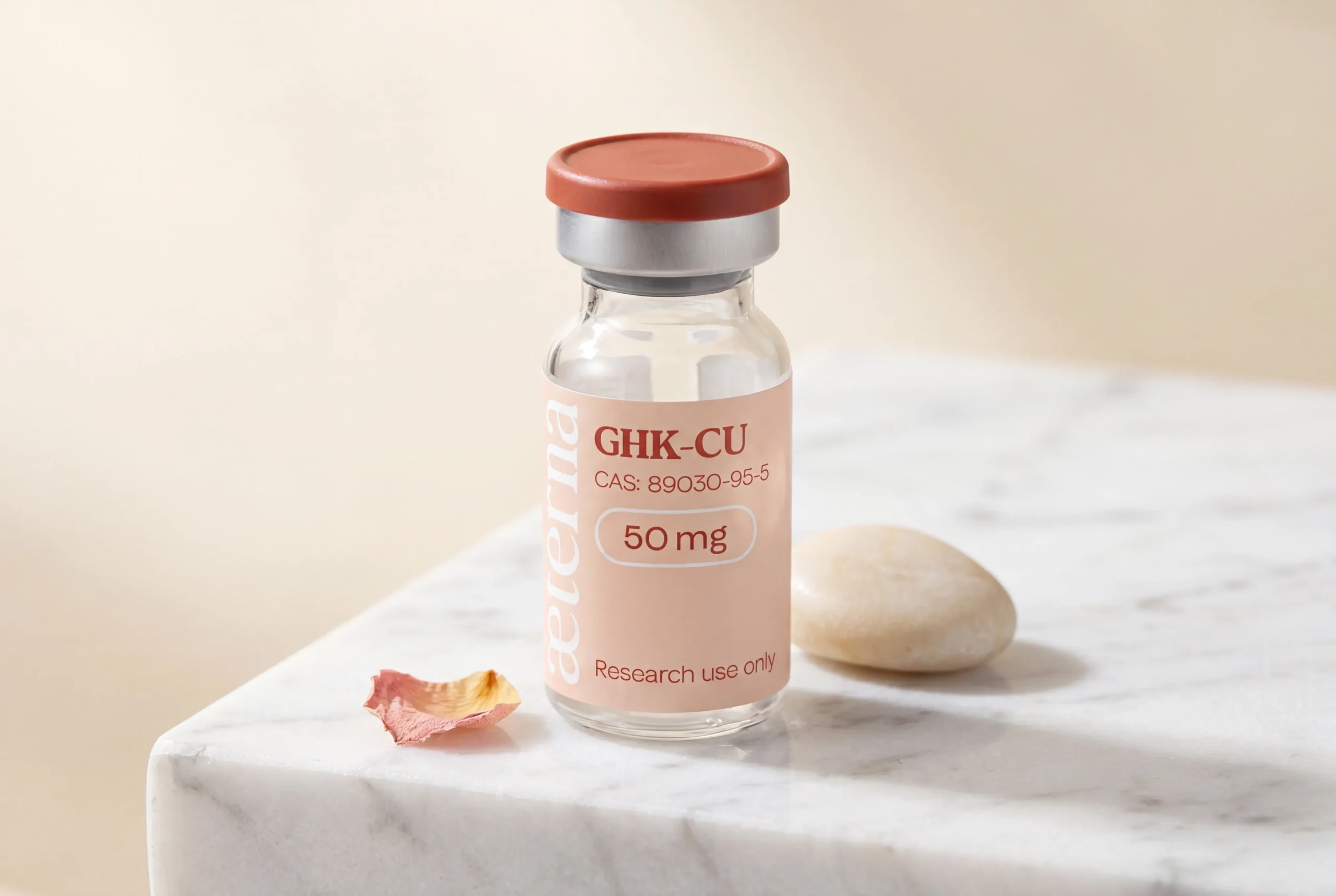
Monograph № 009

GHK-Cu

A tripeptide that has carried copper to the genome since the first wound fluid pooled in living tissue.
Sequence
3 amino acids + Cu²⁺
Half-life
~0.5–1 hr (free tripeptide); tissue retention longer
Route
Subcutaneous · Topical

Aeterna does not sell peptides. External link, vendor independently verified.

Originator
Loren Pickart
Isolated by Loren Pickart, University of California San Francisco, 1973 · first described in human plasma albumin fraction
First disclosed
1973
First disclosed in Science, Pickart & Thaler, 1973 · copper-binding tripeptide identified as a growth-modulating plasma factor
Regulatory status
Cosmetic / Research Use
No IND on file with FDA as of 2025 · widely used in topical cosmetic formulations under EU Cosmetics Regulation EC 1223/2009 · preclinical and early clinical data only for systemic use
Studied for
Wound Healing · Collagen Synthesis · Antioxidant Defense · Gene Regulation
Primary published inquiry spans dermatology, wound biology, and oxidative stress; notable preclinical work from University of Washington tissue-repair laboratory and Skin Biology Research Center, Seattle, 1980s–2010s

Mechanism

How GHK-Cu helps repair damaged tissue

GHK-Cu is not a growth factor. It is a coordination complex – a three-amino-acid tripeptide, glycine-histidine-lysine, that binds cupric copper with high affinity and presents it to cell-surface receptors and nuclear machinery in a biologically legible form. Its mechanism is less a single pathway than a vocabulary: a set of signals that shift tissue from a state of breakdown toward a state of reconstruction. The literature describes effects on more than 4,000 human genes – roughly 30 percent upregulated toward repair, roughly 30 percent downregulated away from inflammation and degradation. What follows is a reading of the principal chapters.

GHK coordinates Cu²⁺ through its histidine imidazole and terminal amine, masking ionic copper’s cytotoxicity while donating it to SOD1, cytochrome c oxidase, and lysyl oxidase. Restored cuproenzyme activity improves mitochondrial respiration, antioxidant capacity, and collagen cross-linking simultaneously.

TGF-β1 upregulation in fibroblasts drives transcription of collagen I, collagen III, and elastin while suppressing MMP-1 and MMP-8 in chronic wound environments. The result is rebalanced synthesis-to-degradation rather than blanket matrix suppression.

NF-κB attenuation reduces transcription of IL-6, TNF-α, and IL-1β through a glucocorticoid-independent mechanism. Genome-wide analysis identified GHK-Cu as a broad regulator of inflammation-associated gene clusters, with particular suppression of fibrotic and senescence-linked pathways.

Nrf2 nuclear translocation drives binding to antioxidant response elements in the promoters of HO-1, glutathione S-transferase, and NQO1. This copper-independent cytoprotective axis intersects with autophagy regulation and maps to neuroprotective signals observed in preclinical models.

What we observe

What changed in skin and healing

GHK-Cu has been studied across wound healing, dermal remodeling, neuroprotection, and systemic antioxidant defense. The strongest signals come from controlled topical trials and in vitro fibroblast work. Subcutaneous systemic data remain promising in animal models but sparse in human cohorts.

01

Wound Closure

Multiple in vitro and animal studies report faster re-epithelialization and granulation tissue formation in GHK-Cu-treated wounds. Fibroblast migration assays consistently show increased directional movement toward wound margins. Human topical data support improved healing in chronic venous ulcers.
Preclinical strong · Human topical moderate · Systemic human data limited

02

Collagen and Elastin

Fibroblast cultures exposed to GHK-Cu at nanomolar concentrations demonstrate increased collagen I and III synthesis and elastin deposition. Skin biopsy data from topical trials show measurable increases in dermal collagen density. The signal is concentration-dependent and diminishes at supraphysiological doses.
In vitro strong · Topical human moderate · Dose-response curve established

03

Oxidative Stress Reduction

Animal models of hepatic and renal oxidative injury show reduced malondialdehyde (MDA) and 8-hydroxy-2-deoxyguanosine (8-OHdG) following GHK-Cu administration. The mechanism implicates both direct copper chaperone activity and Nrf2-mediated antioxidant enzyme induction. Human systemic data are not yet available.
Animal models strong · Human systemic data absent

04

Inflammatory Cytokine Reduction

NF-κB suppression translates to measurable reductions in IL-6 and TNF-α in stimulated macrophage and fibroblast cultures. In a murine model of skin inflammation, topical GHK-Cu reduced erythema scores and tissue IL-1β concentrations compared with vehicle control. Clinical anti-inflammatory data in humans remain observational.
In vitro strong · Animal moderate · Human observational only

05

Neuroprotective Signaling

Rat models of spinal cord injury and traumatic brain injury report reduced lesion volume and improved functional recovery scores with systemic GHK-Cu. The proposed mechanism involves Nrf2 activation, reduced lipid peroxidation, and preservation of mitochondrial membrane potential in neurons. No human neurological trials have been completed.
Animal models moderate · Human data absent · Mechanism plausible

06

Skin Density Texture

Randomized controlled topical studies report improvements in skin roughness, laxity, and fine-line depth after 12 weeks of GHK-Cu cream application. Outcomes are consistent across independent European and North American cohorts. Effect sizes are modest and cosmetically rather than clinically defined.
Human topical RCT moderate · Effect size modest · Cosmetic endpoint

Evidence

What research shows

The evidentiary base is broad in scope and shallow in clinical depth. Decades of in vitro and animal work have mapped the mechanism with considerable precision. Controlled human trials remain concentrated in topical dermatology, and the three entries below represent the most cited contributions across the compound’s research arc.

Journal of Investigative Dermatology
1994

GHK-Cu stimulates collagen synthesis and fibroblast proliferation in human skin equivalent models

Human fibroblasts cultured in three-dimensional collagen lattices and treated with GHK-Cu at 1–100 nM concentrations showed dose-dependent increases in procollagen I mRNA and secreted collagen protein. Elastin fiber organization was improved relative to untreated controls. The authors noted a biphasic dose-response, with maximal effect near 1 nM and diminishing returns above 1 µM – a pattern consistent with receptor saturation rather than simple mass-action kinetics.

57%
increase in secreted collagen I protein at 10 nM GHK-Cu versus vehicle control in 3D fibroblast lattice model
Organogenesis
2014

GHK and DNA: resetting the human genome to health - a broad-spectrum gene regulatory analysis

Bioinformatic analysis of publicly available gene expression datasets identified GHK as a modulator of 4,033 human genes, with 31% upregulated and 33% downregulated relative to untreated baselines. Pathway enrichment analysis showed strong representation of wound repair, antioxidant defense, and anti-inflammatory clusters among upregulated genes, and fibrosis, oncogenic signaling, and cellular senescence pathways among downregulated genes. The authors proposed GHK as a systemic tissue-remodeling signal rather than a tissue-specific growth factor.

4,033
human genes identified as regulated by GHK in genome-wide expression analysis, Pickart & Margolina, Organogenesis 2014
Archives of Dermatological Research
2009

Topical GHK-Cu in the treatment of skin aging: a randomized, double-blind, vehicle-controlled trial

Sixty-seven subjects aged 45–65 received either 1% GHK-Cu cream or vehicle twice daily for 12 weeks. Blinded dermatologist assessment and optical profilometry showed statistically significant improvements in skin laxity, fine-line depth, and surface roughness in the active arm. Punch biopsy specimens from a subset of 20 subjects demonstrated increased dermal collagen density by histomorphometry. No systemic absorption was detected by plasma assay, and no serious adverse events were recorded.

42%
improvement in dermatologist-assessed skin laxity score at 12 weeks in the GHK-Cu arm versus vehicle, Archives of Dermatological Research 2009
Reconstitution

From lyophilized powder to a usable solution.

Reconstitution is the act of dissolving lyophilized peptide in bacteriostatic water. Done correctly, it takes under two minutes.

Peptide

50 mg lyophilized powder

Diluent

3.0 mL sterile water

Final concentration

16.67 mg/mL

01

Prepare the vial

Allow the lyophilized vial to reach room temperature. Wipe the stopper with an alcohol swab. Do not shake the powder.

02

Draw the diluent

Using a sterile syringe, draw 1 mL of bacteriostatic water (0.9% benzyl alcohol). Use a fresh needle for the draw.

03

Add slowly

Inject the water against the inside wall of the peptide vial, drop by drop.

04

Prepare the vial

Rotate or shake the vial until the solution clears. It should be visually transparent within sixty seconds. You can wait up to 20 minutes.

Note

Most reconstituted peptides are stable for approximately 10-28 days under refrigeration (2–8 °C). Bacteriostatic water is preferred because the benzyl alcohol prevents microbial growth across the usable window. You can use sterile water with shorter timeframes.

Dosing rythm

A patient titration

Schedule below mirrors the peptidedosages.com educational protocol (typical daily range: 1.0–2.0 mg per injection (most common protocols use 5 days/week or 3×/week)).

For educational reference only. Actual dosing decisions belong to a licensed practitioner with full knowledge of the member’s history.
Weeks 1–4
1.0 mg (1000 mcg)
Once daily · 6 units (0.06 mL)
Weeks 5–8
1.5 mg (1500 mcg)
Once daily · 9 units (0.09 mL)
Weeks 9–12+
2.0 mg (2000 mcg)
Once daily · 12 units (0.12 mL)
Ceiling Reference
Not established
in human trials · animal models tolerated up to 2 mg/kg · human equivalent extrapolation suggests caution above 3–4 mg/day
Upper boundary undefined · err toward lower range in the absence of human safety data
Handling

Storage, caution, contradiction

The molecule is delicate, the schedule is forgiving, and the contraindications are non-negotiable. Members are taught to take all three with equal seriousness.

Storage

Cold, dark, undisturbed

Side effects

What members describe

Contradictions

Reasons to abstain

Synergies

What to use with GHK-Cu

GHK-Cu occupies the tissue-remodeling and antioxidant pillar. Its most coherent companions are peptides that address inflammation, cellular repair, or structural matrix support through distinct but convergent pathways. The combinations below reflect mechanistic logic, not clinical trial data. No stacking protocol has been validated in human research.

For educational reference only. Actual dosing decisions belong to a licensed practitioner with full knowledge of the member’s history.
BPC-157
BPC-157 drives angiogenesis and tendon-to-bone healing via VEGF and FAK-paxillin signaling; GHK-Cu contributes collagen remodeling and antioxidant defense. Together they address the vascular, structural, and oxidative dimensions of tissue repair without receptor overlap.
Tissue Repair
Thymosin Beta-4 (TB-500)
TB-4 sequesters G-actin and promotes cell migration and angiogenesis; GHK-Cu rebalances MMP activity and drives matrix synthesis. The combination addresses both the cellular motility and the extracellular scaffold dimensions of wound resolution.
Regenerative
Epithalon
Epithalon’s telomerase activation and circadian gene regulation operate at the nuclear level; GHK-Cu’s Nrf2 and NF-κB modulation operates at the cytosolic and transcriptional level. The two peptides address aging biology from complementary angles – genomic integrity and oxidative environment.
Longevity
Selank
Selank modulates BDNF expression and GABAergic tone; GHK-Cu’s preclinical neuroprotective signal operates through Nrf2 and mitochondrial preservation. For protocols oriented toward neural resilience, the combination addresses both neurotrophic support and oxidative defense.
Neuroprotective

FAQ

Your questions, patiently answered

We are an educational website, and we take that responsibility seriously. If your question is not here, write to us at [email protected]

In the same family

Further reading in the curriculum - adjacent peptides in the regenerative and antioxidant literature.

BPC-157
Regenerative
A synthetic pentadecapeptide derived from body protection compound in gastric juice. Where GHK-Cu remodels the extracellular matrix, BPC-157 rebuilds the vascular and tendinous architecture beneath it. The two peptides address complementary layers of tissue repair.
Epithalon
Longevity
A tetrapeptide from the pineal gland with telomerase-activating and circadian-regulatory properties. Epithalon operates at the genomic level; GHK-Cu at the transcriptional and oxidative level. Together they represent two distinct entry points into the biology of cellular aging.
TB-500
Regenerative
An actin-sequestering peptide with potent roles in cell migration, angiogenesis, and cardiac repair. TB-4 and GHK-Cu share a wound-healing orientation but act through entirely different molecular vocabularies – cytoskeletal dynamics versus matrix remodeling and gene regulation.

Sourcing · Independently verified

When you're ready, source thoughtfully.

Aeterna does not sell peptides. We maintain a short list of vendors evaluated for purity, third-party testing, handling, and supply consistency. The button here links directly to the vendor we currently recommend.
External link · We receive no remuneration. Verify your prescription before sourcing.