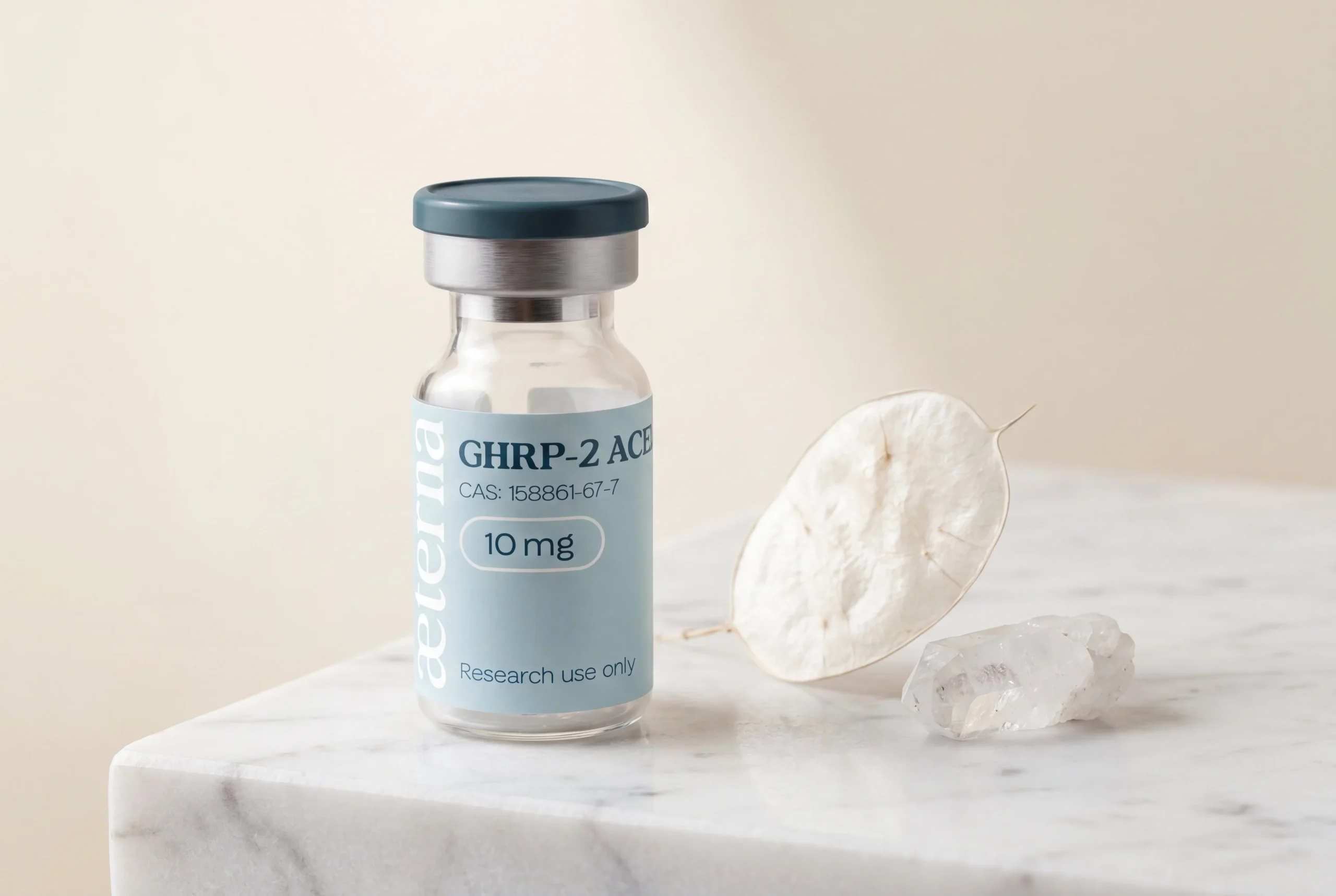
GHRP-2 Acetate
Aeterna does not sell peptides. External link, vendor independently verified.
Mechanism
GHRP-2 does not introduce exogenous growth hormone. It addresses the signaling layer upstream – engaging the receptor that governs when and how much the pituitary releases. The distinction matters. Endogenous rhythm is preserved. The axis remains responsive. What changes is the amplitude of each pulse, not the fundamental architecture of the system.
GHSR-1a agonism drives the primary effect of GHRP-2, activating Gq-phospholipase C signaling in anterior pituitary somatotrophs and triggering calcium-mediated exocytosis of growth hormone. This is the same receptor engaged by endogenous ghrelin, though GHRP-2 offers greater selectivity and enzymatic stability in research settings.
Somatostatin modulation is the second layer of the signal, with GHRP-2 attenuating hypothalamic inhibitory tone that normally constrains GH release between pulses. The result is a wider window for pituitary responsiveness and a higher peak GH amplitude without abolishing basal pulsatility.
IGF-1 induction extends the signal beyond the brief GH pulse by engaging hepatic GHR-JAK2-STAT5 signaling and increasing downstream IGF-1 synthesis. This longer-horizon endocrine response is what links GHRP-2 exposure to effects in muscle, bone, and connective tissue across published protocols.
Off-axis receptor activity helps explain the compound’s broader physiologic profile, including transient hunger and measurable elevations in cortisol and prolactin at higher doses. These effects are more pronounced than those seen with Ipamorelin and generally less pronounced than those associated with GHRP-6.
What we observe
What users noticed from higher GH
The outcomes attributed to GHRP-2 reflect patterns reported across controlled studies rather than guaranteed effects. Pituitary reserve, age, nutritional status, and somatostatin tone all modulate individual response. The signal is consistent; the magnitude varies.
01
Amplified GH Pulse Amplitude
02
Elevated Circulating IGF-1
03
Lean Mass Preservation
04
Improved Sleep-Stage GH Secretion
05
Appetite Stimulation
06
Connective Tissue and Recovery Signaling
Evidence
What the studies found
The GHRP-2 literature spans three decades, from foundational receptor characterization in the early 1990s through clinical trials in GH deficiency, cachexia, and aging. The evidence base is broader than most research peptides. Gaps remain in long-term safety data and in healthy, non-deficient populations.
Dose-dependent growth hormone release in healthy adults following intravenous GHRP-2 administration: receptor saturation and pulsatile dynamics
A double-blind crossover study in 24 healthy male volunteers (ages 22–45) evaluated GH response to escalating GHRP-2 doses (0.1, 0.3, 1.0, and 3.0 mcg/kg IV). Peak GH response increased significantly from 0.1 to 1.0 mcg/kg, with a plateau observed at higher doses consistent with GHSR-1a saturation. Co-administration with GHRH produced synergistic amplification exceeding either agent alone, supporting the complementary receptor pathway model.
GHRP-2 administration in elderly subjects with relative growth hormone deficiency: IGF-1 normalization and body composition effects over 12 weeks
A randomized, placebo-controlled trial enrolled 38 subjects aged 65–78 with documented low-normal IGF-1 levels. Twice-daily subcutaneous GHRP-2 at 1 mcg/kg was administered for 12 weeks. The treatment group demonstrated significant increases in serum IGF-1 (mean +34% from baseline), modest reductions in trunk fat mass by dual-energy X-ray absorptiometry, and preservation of lean mass compared to placebo. No serious adverse events were recorded; transient appetite increase was the most commonly reported effect.
Nocturnal GHRP-2 administration augments slow-wave sleep-associated GH secretion: a polysomnographic analysis
Fourteen healthy adults (mean age 41) received either subcutaneous GHRP-2 (1 mcg/kg) or placebo 30 minutes before habitual sleep onset in a crossover design with one-week washout. Integrated overnight GH secretion, measured by 20-minute sampling, was significantly higher in the GHRP-2 condition. Slow-wave sleep duration was not significantly altered, suggesting the peptide amplified the existing nocturnal GH pulse rather than altering sleep architecture. Morning cortisol was marginally elevated in the GHRP-2 condition but remained within normal reference ranges.
From lyophilized powder to a usable solution.
Peptide
5 mg lyophilized powder
Diluent
3.0 mL bacteriostatic water
Final concentration
1.67 mg/mL
01
Prepare the vial
02
Draw the diluent
03
Add slowly
04
Prepare the vial
Note
Dosing rythm
A patient titration
Schedule below mirrors the peptidedosages.com educational protocol (typical daily range: 100–300 mcg once daily subcutaneously).
Storage, caution, contradiction
Storage
Cold, dark, undisturbed
- Lyophilized: freeze at −20 °C (−4 °F).
- After reconstitution, refrigerate at 2–8 °C (35.6–46.4 °F).
- Do not freeze reconstituted solution; freeze-thaw cycles degrade peptide integrity and may produce aggregates.
- Protect from direct light at all stages; amber vials or opaque storage containers are preferred for reconstituted material.
- Allow refrigerated solution to reach room temperature before injection; cold solution increases injection discomfort without pharmacokinetic benefit.
Side effects
What members describe
- Transient appetite increase: the most commonly reported effect, typically occurring 30–60 minutes post-injection and resolving within two hours; more pronounced at higher doses.
- Injection site reactions: mild erythema, transient stinging, or minor induration at the subcutaneous injection site; rotate sites to minimize recurrence.
- Water retention: mild peripheral edema has been reported, particularly during the first two weeks of use, consistent with GH-mediated renal sodium retention.
- Cortisol and prolactin elevation: documented at doses above 1 mcg/kg; generally transient and within normal ranges, but relevant for subjects with adrenal or pituitary conditions.
- Transient fatigue or somnolence: occasionally reported following evening doses, likely reflecting the sedative-adjacent effects of augmented nocturnal GH release; generally considered benign.
Contradictions
Reasons to abstain
- Active malignancy: GH and IGF-1 signaling may support proliferation in certain tumor types; GHRP-2 is contraindicated in subjects with known or suspected active cancer.
- Diabetic retinopathy or uncontrolled diabetes mellitus: GH elevation can transiently worsen insulin sensitivity and exacerbate retinal pathology; use requires careful glycemic monitoring.
- Pregnancy and lactation: no safety data exist in human pregnancy; the peptide should not be used during gestation or breastfeeding.
- Hypothyroidism: untreated thyroid deficiency blunts GH axis response and may be worsened by GH-driven metabolic shifts; thyroid status should be assessed before initiating any GH secretagogue protocol.
- Concurrent exogenous GH administration: combining GHRP-2 with supraphysiologic exogenous GH removes the physiologic ceiling that makes secretagogue protocols relatively safe; the combination is not studied and is not recommended.
Synergies
Best pairings for GHRP-2
GHRP-2 is rarely studied in isolation in clinical practice. Its mechanism – amplifying pituitary GH pulses via GHSR-1a – is complementary to several other signaling pathways. The combinations below reflect patterns documented in the research literature and observed in supervised clinical settings. Stacking decisions belong to the prescribing clinician, not to this monograph.
FAQ
Your questions, patiently answered
Both peptides are GHSR-1a agonists and produce comparable GH release at equivalent doses. The principal differences are in selectivity and side-effect profile. GHRP-2 tends to produce slightly higher peak GH responses in comparative studies, while GHRP-6 is associated with more pronounced appetite stimulation. GHRP-2 also shows a marginally greater tendency to elevate cortisol and prolactin at higher doses. Neither is categorically superior; the choice depends on the clinical context and the subject’s tolerance for appetite-related effects.
The available evidence does not support significant suppression of endogenous GH secretion with standard research protocols. Because GHRP-2 amplifies existing pituitary activity rather than replacing it, the axis remains responsive. Some attenuation of receptor sensitivity has been observed with continuous high-dose use beyond twelve weeks – which is the basis for the rest-interval recommendation in most protocols. This is distinct from the axis suppression associated with exogenous GH administration.
GHRP-2 Acetate refers to the acetate counter-ion used to stabilize the peptide in its lyophilized form. The acetate salt improves solubility and shelf stability relative to the free base. The pharmacologically active moiety is the hexapeptide itself; the acetate contributes negligible mass and does not alter receptor binding or biological activity. Dosing calculations are conventionally performed on the total salt weight, which is standard practice across research-grade peptide preparations.
The short half-life is a defining pharmacokinetic feature of GHRP-2 and is not a limitation – it is consistent with the peptide’s physiologic role as a pulse-initiating signal. GH secretion is inherently pulsatile; a brief, sharp stimulus is more consistent with that architecture than a prolonged elevation would be. The practical implication is that injection timing relative to desired GH peaks – before sleep, before training, on waking – matters considerably, and that multiple daily injections are required to sustain elevated IGF-1 over time.
GHRP-2 has been studied in populations with relative GH deficiency, including elderly subjects with low-normal IGF-1, and has demonstrated meaningful IGF-1 normalization in that context. However, subjects with severe, organic GH deficiency – due to pituitary adenoma, surgical hypophysectomy, or radiation damage – may have insufficient somatotroph reserve to respond adequately to a secretagogue. In such cases, the pituitary cannot release what it does not have, and exogenous GH replacement may be the more appropriate clinical consideration. This determination belongs to an endocrinologist.
Subcutaneous injection produces reliable, well-characterized GH responses and is the route used in the majority of published studies. Intranasal administration has been explored as a less invasive alternative; bioavailability via this route is substantially lower – estimated at 10–20% relative to subcutaneous – and peak GH responses are correspondingly attenuated. Intranasal use may be appropriate in contexts where injection is not feasible, but dose adjustments are required and the evidence base for this route is considerably thinner than for subcutaneous administration.
In the same family
Further reading in the curriculum.
Sourcing · Independently verified
When you're ready, source thoughtfully.