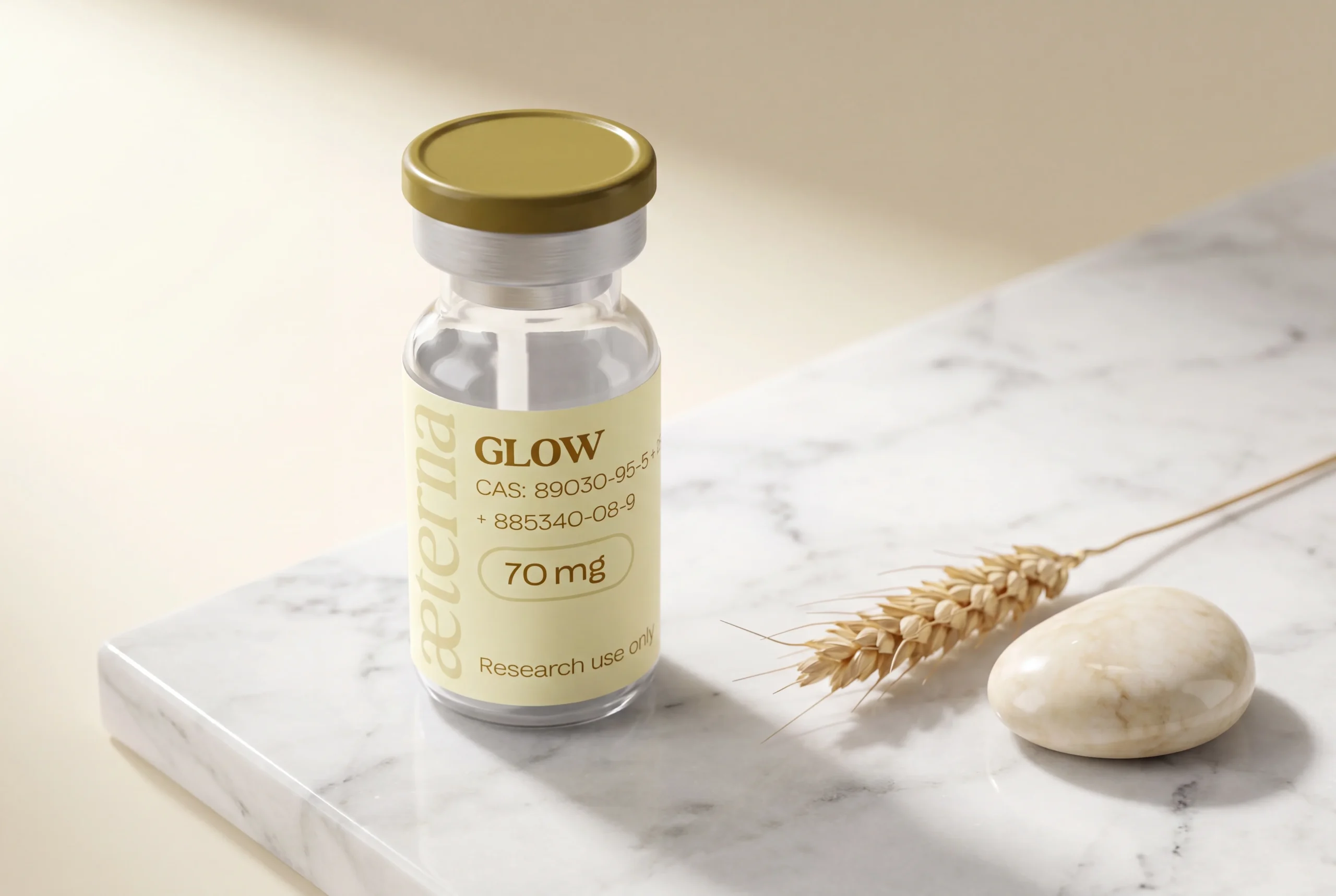
GLOW
Aeterna does not sell peptides. External link, vendor independently verified.
Mechanism
GLOW is not a single molecule. It is a considered assembly of three compounds – each with its own receptor vocabulary, each addressing a distinct layer of the biology of skin aging. GHK-Cu speaks to the extracellular matrix. Epithalon addresses the nucleus. The copper chelate mediates the conversation between them. Together, they describe a signaling environment in which repair is not forced but invited.
GHK-Cu activates signaling pathways in dermal fibroblasts that are associated with matrix repair and structural protein synthesis. In experimental systems, this includes increased collagen and elastin production alongside reduced expression of matrix-degrading enzymes such as MMP-1 and MMP-2.
Epithalon has been reported to influence telomerase-related pathways through effects on hTERT expression. Most of that literature comes from cell and animal models, and its relevance to human skin biology remains provisional.
Copper coordination gives GHK-Cu part of its functional significance by supporting enzymes involved in extracellular matrix maturation and antioxidant defense. In this context, copper contributes to lysyl oxidase activity and to the broader redox systems that help maintain tissue integrity.
The formulation is framed around converging effects on matrix remodeling, cellular maintenance, and oxidative balance. That combination is intended to address skin biology at multiple structural levels rather than through a single pathway alone.
What we observe
Changes seen in texture and healing
The outcomes below reflect patterns observed across published in vitro studies, small clinical trials, and peer-reviewed gerontological research. They describe what has been reported – not what is guaranteed. Individual biology, formulation quality, route of administration, and duration of use all modulate response. Aeterna does not prescribe, dispense, or sell.
01
Collagen Density
02
MMP Suppression
03
Telomerase Activity
04
Wound Healing
05
Antioxidant Activity
06
Neuroendocrine Modulation
Evidence
What research says about GLOW
The evidence base for GLOW’s constituent peptides spans five decades and three research traditions: American biochemistry (GHK), Russian bioregulatory medicine (Epithalon), and European cosmetic dermatology (GHK-Cu topical). Each tradition has its own methodological conventions and limitations. The studies below are representative, not exhaustive. The literature rewards careful reading.
GHK-Cu modulates collagen synthesis and MMP expression in human dermal fibroblasts: dose-response characterization
Primary human dermal fibroblasts treated with GHK-Cu at concentrations of 1 nM to 10 µM demonstrated concentration-dependent increases in procollagen I C-peptide secretion and significant downregulation of MMP-1 mRNA expression at 100 nM. The authors concluded that GHK-Cu shifts fibroblast gene expression toward a reparative phenotype consistent with younger tissue architecture.
Epithalon peptide induces telomerase activity and telomere elongation in human somatic cells in vitro
Human fetal fibroblasts and peripheral blood lymphocytes treated with Epithalon (Ala-Glu-Asp-Gly) at 0.1–10 µg/mL demonstrated measurable telomerase activity by TRAP assay and statistically significant telomere elongation after 10 passages compared to untreated controls. The authors proposed epigenetic modulation of the hTERT promoter as the operative mechanism, noting that the effect was not observed with scrambled peptide controls.
Topical GHK-Cu in photoaged skin: a randomized, double-blind, vehicle-controlled trial assessing dermal density and surface texture
Sixty-two women aged 45–65 with Glogau type II–III photoaging applied a GHK-Cu serum (2% w/v) or vehicle twice daily for 12 weeks. High-frequency ultrasound imaging at week 12 showed statistically significant increases in dermal echo density in the active group. Blinded photographic assessment by three dermatologists rated improvement in fine lines and surface texture as moderate to marked in 68% of active-group participants versus 19% in the vehicle group.
From lyophilized powder to a usable solution.
Peptide
70 mg lyophilized powder
Diluent
3.0 mL bacteriostatic water
Final concentration
23.3 mg/mL
01
Prepare the vial
02
Draw the diluent
03
Add slowly
04
Prepare the vial
Note
Dosing rythm
A patient titration
Schedule below mirrors the peptidedosages.com educational protocol.
Storage, caution, contradiction
Storage
Cold, dark, undisturbed
- Lyophilized: freeze at −20 °C (−4 °F).
- After reconstitution, refrigerate at 2–8 °C (35.6–46.4 °F).
- Use within 4 weeks.
- The pale blue-green color of reconstituted GHK-Cu is characteristic of the copper chelate and does not indicate spoilage; discard if precipitate forms or color shifts to brown
- Do not expose either peptide to repeated freeze-thaw cycles; aliquot into single-use volumes at time of reconstitution if extended storage is anticipated
Side effects
What members describe
- Injection-site reactions: transient erythema, mild swelling, or bruising at SC or intradermal injection sites; typically resolves within 24–48 hours
- Skin flushing or warmth: reported with intradermal GHK-Cu, attributed to local vasodilation; generally mild and self-limiting
- Fatigue or altered sleep onset: Epithalon's melatonin-modulatory effects may transiently shift sleep timing, particularly in the first week of a course; evening administration is preferred
- Transient headache: reported in a minority of Epithalon users in early course days; mechanism unclear; typically resolves without intervention
- Topical GHK-Cu: contact dermatitis is rare but documented; patch test recommended before widespread facial application, particularly in individuals with known metal sensitivities
Contradictions
Reasons to abstain
- Known hypersensitivity to copper or copper-containing compounds; Wilson's disease or other copper metabolism disorders are absolute contraindications to GHK-Cu
- Active malignancy: Epithalon's telomerase-activating properties are theoretically contraindicated in the presence of proliferative malignant disease; the literature does not establish safety in this context
- Pregnancy and lactation: no safety data exist for either compound in pregnant or breastfeeding individuals; use is not supported by the literature in these populations
- Concurrent use of immunosuppressive agents or chemotherapy: potential for unpredictable interaction with cellular proliferation pathways; clinician review is essential
- Autoimmune conditions with active flare: GHK-Cu's modulation of TGF-β and NF-κB signaling may theoretically influence inflammatory tone; caution is warranted and clinician oversight required
Synergies
How to stack GLOW
GLOW’s constituent peptides are already a stack – three compounds in deliberate combination. The companions below extend that conversation into adjacent pillars: systemic recovery, hormonal signaling, and cellular senescence. Each pairing reflects a biological rationale, not a commercial one. Aeterna does not prescribe or sell.
FAQ
Your questions, patiently answered
Because skin aging is not a single-pathway event. Matrix degradation, replicative senescence, and oxidative accumulation proceed simultaneously and interact. GHK-Cu addresses the extracellular matrix; Epithalon addresses nuclear telomere biology; copper cofactor chemistry addresses enzymatic antioxidant capacity. A protocol that addresses only one of these dimensions leaves the others unattended. The combination is not additive – it is, in the language of systems biology, convergent.
Yes. Epithalon and Epitalon are transliterations of the same Russian-origin compound (Эпиталон), the synthetic tetrapeptide Ala-Glu-Asp-Gly developed by Vladimir Khavinson at the St. Petersburg Institute of Bioregulation and Gerontology. The spelling varies by source and translation convention; the molecule is identical.
It is the characteristic color of the copper(II) chelate – the same coordination chemistry that gives copper sulfate its familiar hue. The color is expected and is not a sign of degradation or contamination. A solution that has shifted to brown, developed visible precipitate, or acquired an unusual odor should be discarded. The color alone is not a quality concern.
Telomerase activation is a feature of both normal stem cell maintenance and malignant transformation – the same enzyme serves different masters depending on cellular context. Epithalon’s reported mechanism involves epigenetic modulation of the hTERT promoter in somatic cells, not the constitutive overexpression characteristic of cancer. The distinction is meaningful but not absolute: the literature does not establish safety in individuals with active or recent malignancy, and this remains a genuine contraindication. The biology is nuanced; the caution is warranted.
Topical GHK-Cu has the most robust clinical evidence base of the three components, with randomized controlled trials in photoaged skin demonstrating measurable improvements in dermal density and surface texture. Topical application does not replicate the systemic signaling environment of subcutaneous administration, but it is a meaningful and well-documented mode of use – particularly as a maintenance bridge between injectable courses. Penetration enhancers (niacinamide, certain peptide carriers) may improve dermal delivery.
The Khavinson protocol, as described in the originating Russian literature, specifies 10-day courses administered twice yearly – typically spring and autumn. This cadence reflects the compound’s circadian and neuroendocrine associations and the observation that effects on melatonin and telomerase activity appear to persist beyond the active dosing window. Some practitioners extend to three courses annually. The evidence base for frequency optimization in younger, healthy adults is thin; the twice-yearly convention remains the most cited reference point.
In the same family
Further reading in the curriculum.
Sourcing · Independently verified
When you're ready, source thoughtfully.