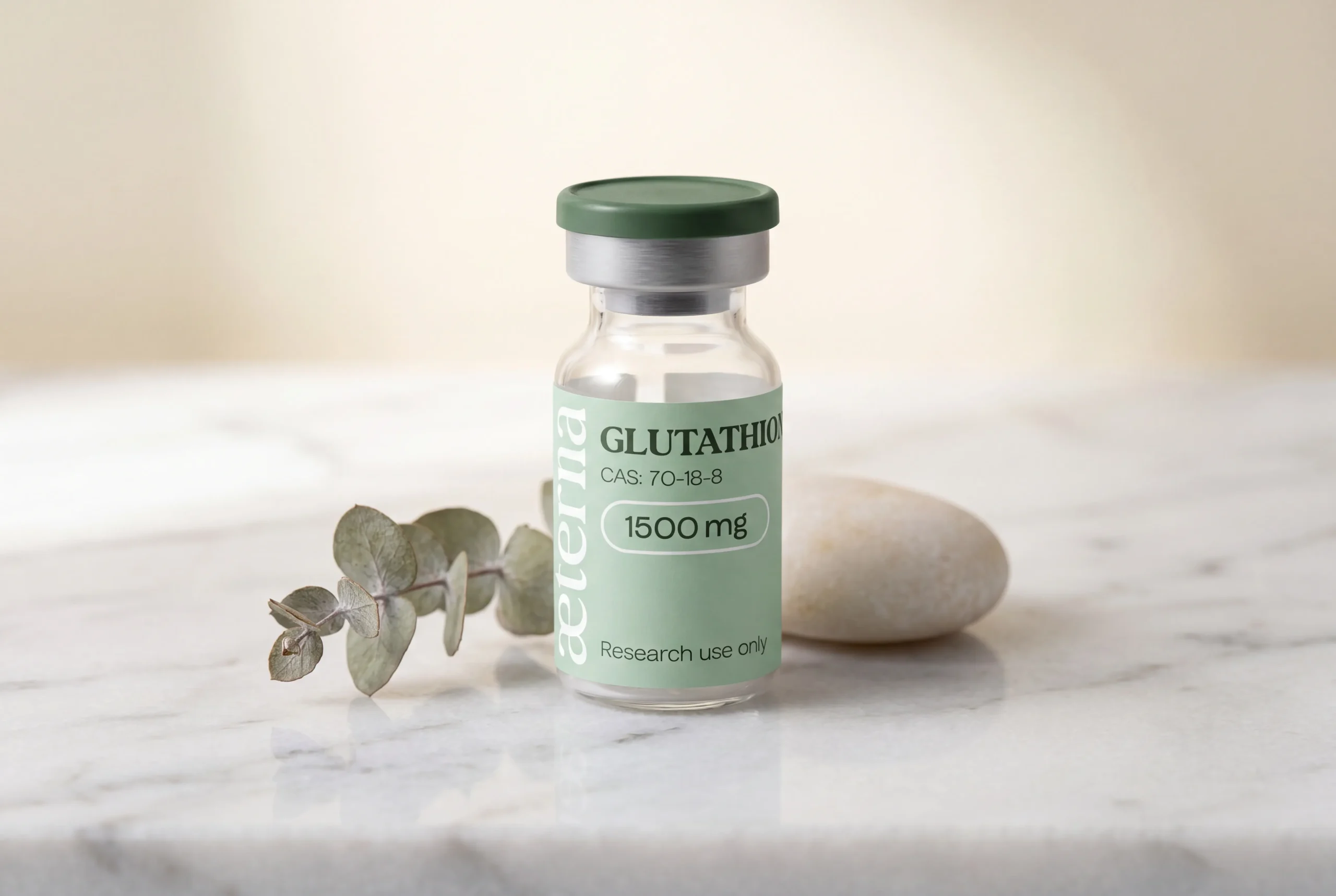
Glutathione
Aeterna does not sell peptides. External link, vendor independently verified.
Mechanism
Glutathione (γ-L-glutamyl-L-cysteinyl-glycine) is the principal non-enzymatic antioxidant in mammalian cells. Its architecture – three amino acids joined by an atypical gamma-peptide bond – confers both chemical stability and remarkable reactivity. The thiol group of its central cysteine residue is the operative site: it donates electrons to neutralize reactive oxygen species, regenerates oxidized vitamins C and E, and participates in the conjugation reactions that mark xenobiotics for hepatic export.
Glutathione is the principal intracellular antioxidant, directly neutralizing reactive oxygen species and helping regenerate vitamins C and E. It also serves as a central redox buffer and participates in detoxification through glutathione conjugation.
Absorption is route-dependent, because oral glutathione is substantially degraded by enzymatic hydrolysis in the gut. Intravenous, intramuscular, and some liposomal preparations can produce higher circulating levels, though tissue delivery remains context-specific.
Clinical use varies by indication and formulation rather than following a single standardized protocol. Published studies and clinical practice reports have used intravenous doses in the hundreds to low thousands of milligrams per session, while oral liposomal regimens are typically lower and taken daily.
The evidence base is heterogeneous across neurologic, hepatic, pulmonary, and dermatologic contexts. Interest has been especially strong where oxidative stress and glutathione depletion appear mechanistically relevant, but study quality and consistency vary by indication.
What we observe
Results tied to better redox balance
Across hepatology, oncology support, neurology, and longevity research, a consistent set of observations recurs. These are patterns – not guarantees. Individual response depends on baseline GSH status, route of administration, and concurrent health variables.
01
Oxidative Stress Markers
02
Hepatic Support
03
Pigment Modulation
04
Neuropathy Attenuation
05
Immune Parameters
06
Pulmonary Support
Evidence
The data on glutathione
Three peer-reviewed studies – spanning hepatology, oncology support, and longevity biology – anchor the present understanding of glutathione’s clinical relevance. The field is mature in some areas and still forming in others.
Intravenous glutathione supplementation in non-alcoholic fatty liver disease: a randomized, double-blind, placebo-controlled trial
Sixty-two adults with biopsy-confirmed NAFLD were randomized to IV glutathione (1,200 mg daily) or placebo for four months. The treatment group demonstrated statistically significant reductions in ALT, AST, and serum ferritin, alongside measurable improvement in hepatic steatosis grade on ultrasound. Plasma GSH:GSSG ratios normalized in 71% of treated participants. The authors noted that response magnitude correlated inversely with baseline oxidative stress burden, suggesting that individuals with the greatest deficiency derive the most measurable benefit.
Glutathione for the prevention of oxaliplatin-induced peripheral neuropathy in colorectal cancer: a phase III randomized controlled trial
One hundred and eight patients receiving FOLFOX chemotherapy were randomized to receive IV glutathione (1,500 mg/m²) or saline infusion prior to each oxaliplatin cycle. The primary endpoint – cumulative peripheral neuropathy incidence at six cycles – was significantly lower in the glutathione arm. Crucially, tumor response rates and progression-free survival did not differ between groups, addressing the theoretical concern that antioxidant co-administration might attenuate chemotherapeutic efficacy. The authors concluded that glutathione represents a viable cytoprotective strategy in this setting.
Oral liposomal glutathione supplementation raises erythrocyte GSH levels and reduces oxidative stress markers in healthy older adults: a randomized crossover study
Forty adults aged 55–75 with no acute illness received liposomal glutathione (500 mg daily) or placebo in a crossover design over twelve weeks. Erythrocyte GSH concentrations rose significantly in the active phase – an outcome not replicated in earlier trials using conventional oral GSH, which is largely degraded in the gastrointestinal tract. Plasma 8-OHdG and MDA declined in parallel. The study provides the clearest evidence to date that liposomal encapsulation meaningfully improves oral bioavailability, though the clinical significance of these biochemical changes in healthy populations remains to be established in longer-duration trials.
From lyophilized powder to a usable solution.
Peptide
600 mg lyophilized powder
Diluent
2.0 mL bacteriostatic water
Final concentration
300 mg/mL
01
Prepare the vial
02
Draw the diluent
03
Add slowly
04
Prepare the vial
Note
Dosing rythm
A patient titration
Schedule below mirrors the peptidedosages.com educational protocol (typical daily range: 100–200 mg subcutaneously (gradual titration recommended)).
Storage, caution, contradiction
Storage
Cold, dark, undisturbed
- Lyophilized: store at −20 °C (−4 °F).
- After reconstitution, refrigerate at 2–8 °C (35.6–46.4 °F).
- Avoid freeze–thaw cycles.
- Do not freeze reconstituted solution; freezing degrades the reduced thiol
- Inspect reconstituted solution for discoloration - a yellow or brown tint indicates oxidation; discard
Side effects
What members describe
- Nebulized form - bronchospasm reported in reactive airway disease; pre-treat with bronchodilator if indicated
- IV administration - transient flushing, headache, or mild hypotension at rapid infusion rates
- Oral high-dose - gastrointestinal discomfort, bloating; less common with liposomal formulations
- Theoretical zinc depletion with prolonged high-dose use; monitor trace minerals in extended protocols
- Skin lightening - an expected pharmacological effect at higher doses; inform patients prior to initiation
Contradictions
Reasons to abstain
- Known hypersensitivity to glutathione or any excipient in the formulation
- Active asthma or reactive airway disease - nebulized route requires caution and specialist oversight
- Concurrent chemotherapy regimens where antioxidant interference is a documented concern - discuss with oncologist
- Pregnancy and lactation - insufficient safety data; avoid unless benefit clearly outweighs risk under medical supervision
- Glucose-6-phosphate dehydrogenase (G6PD) deficiency - impaired NADPH regeneration may limit glutathione cycling efficacy
Synergies
Good matches for glutathione
Glutathione does not operate in isolation within the antioxidant network. Several compounds either replenish its precursors, regenerate it from its oxidized form, or address complementary aspects of oxidative and inflammatory biology. The combinations below reflect pairings with a coherent mechanistic rationale – not arbitrary assembly.
FAQ
Your questions, patiently answered
In several jurisdictions, intravenous glutathione is approved or registered for specific indications – hepatoprotection and nephroprotection among them. In the United States, it is available as a compounded preparation for IV use and is not FDA-approved as a standalone drug for most of the indications discussed here. Oral and nebulized forms occupy a more ambiguous regulatory space. The status varies by country and by the specific claim being made.
Conventional oral glutathione is substantially degraded by intestinal peptidases before reaching systemic circulation – a limitation well-documented in the literature. Liposomal encapsulation meaningfully improves this picture: a 2021 crossover trial demonstrated a 40% increase in erythrocyte GSH concentrations with liposomal supplementation, an outcome not replicated with standard capsules. Oral delivery remains inferior to IV in absolute bioavailability, but liposomal formulations represent a practical option for maintenance contexts.
Individuals with known hypersensitivity to the compound or its excipients should avoid it. Those with reactive airway disease should approach nebulized administration with caution and specialist oversight. The use of high-dose antioxidants during active chemotherapy is a nuanced question – some evidence suggests glutathione is cytoprotective without compromising efficacy, but this should be discussed with the treating oncologist, not assumed. Pregnancy and lactation are contexts where the evidence base is insufficient to support routine use.
Reduced glutathione in solution is chemically labile. Once reconstituted, it should be used within two hours and not refrigerated for later use. The lyophilized vial, by contrast, is stable at 2–8 °C for its labeled shelf life. A yellow or brown discoloration in the reconstituted solution indicates oxidation of the thiol group – that preparation should be discarded.
At higher doses and with sustained use, glutathione inhibits tyrosinase and shifts melanin synthesis toward lighter phaeomelanin. This is a pharmacological effect, not an incidental one, and it is the basis for its studied use in hyperpigmentation. The effect is dose- and duration-dependent and reverses upon discontinuation. Individuals who do not wish to alter skin tone should factor this into their decision-making.
Aeterna Method does not prescribe, dispense, or sell glutathione or any other compound. This monograph is an educational document. Decisions about supplementation or administration should be made in consultation with a qualified clinician who can assess individual health status, route appropriateness, and potential interactions.
In the same family
Adjacent monographs .
Sourcing · Independently verified
When you're ready, source thoughtfully.