Monograph № 021

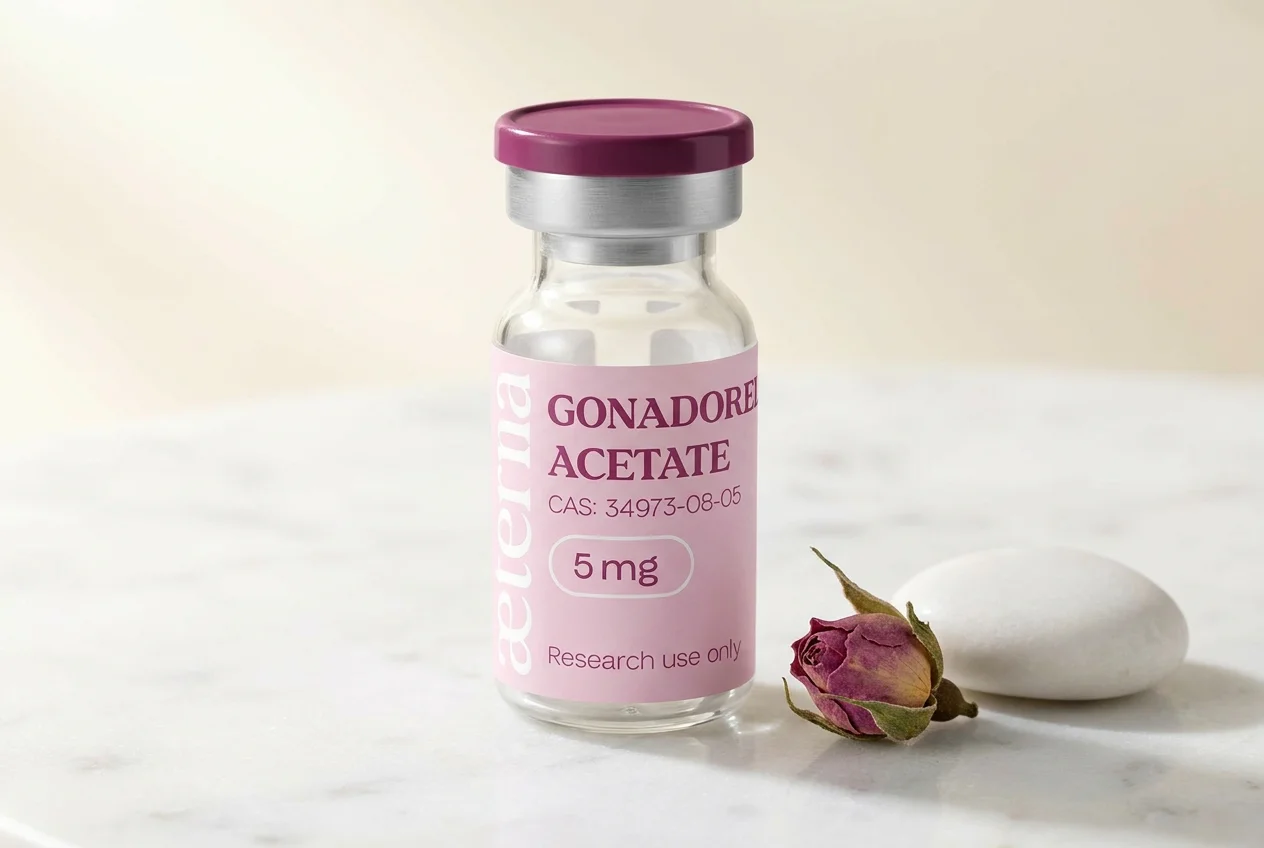
Gonadorelin Acetate

The hypothalamic signal that governs an entire endocrine cascade, restored through the one variable that determines whether it activates or suppresses: rhythm.
Sequence
10 amino acids
Half-life
2–10 min (IV); ~30 min (SC)
Route
IV · SC · Intranasal

Aeterna does not sell peptides. External link, vendor independently verified.

Originator
Andrew V. Schally / Roger Guillemin
Independently characterized at Tulane University and Baylor College of Medicine, 1971; Nobel Prize in Physiology or Medicine awarded jointly, 1977
First disclosed
1971
First full structural characterization published in Biochemical and Biophysical Research Communications, 1971; synthesis confirmed by Schally’s laboratory, New Orleans, Louisiana
Regulatory status
Approved (select indications)
FDA-approved as Factrel® (Ayerst) for diagnostic assessment of pituitary gonadotropin reserve; investigational use in hypogonadotropic hypogonadism and fertility protocols as of 2025
Studied for
Hypogonadism · Fertility · HPG Axis Diagnostics
Primary published inquiry spans hypothalamic-pituitary-gonadal axis restoration, male hypogonadotropic hypogonadism, and ovulation induction; indexed across Journal of Clinical Endocrinology & Metabolism and Fertility and Sterility

Mechanism

How pulse timing drives LH/FSH release

Gonadorelin Acetate is the synthetic, acetate-salt form of endogenous gonadotropin-releasing hormone (GnRH) – the decapeptide that governs the entire reproductive endocrine cascade. Its mechanism is not pharmacological invention; it is faithful reproduction of a language the pituitary has always understood. What distinguishes gonadorelin from its longer-acting analogues is precisely its brevity: a half-life measured in minutes, a pulse that rises and falls as nature intended, and a receptor relationship that depends entirely on the cadence of delivery rather than the magnitude of the dose.

Pituitary pulse decoding is the central principle of gonadorelin physiology. Gonadorelin, the synthetic form of GnRH, binds the Gq/11-coupled GnRH receptor on anterior pituitary gonadotrophs to activate phospholipase C and drive LH and FSH release, with pulsatile exposure sustaining output and continuous exposure suppressing it through receptor downregulation.

LH mediated steroidogenesis carries the signal from pituitary output to gonadal response. In the testis, LH binds Leydig cell receptors to upregulate StAR and engage CYP11A1 in the first committed step of testosterone synthesis, while in the ovary the same signal supports follicular maturation and triggers ovulation at mid-cycle.

FSH dependent gametogenesis complements LH by supporting the cellular programs of fertility. FSH acts on Sertoli cells to support spermatogenesis through androgen-binding protein and inhibin B, and on granulosa cells to drive follicular development and estradiol synthesis, with the LH to FSH ratio varying according to the prevailing steroid milieu.

Delivery pattern dependence explains why the same molecule can restore or suppress the axis. Because gonadorelin replicates the endogenous pulse, hypothalamic and pituitary sensitivity to testosterone and estradiol feedback remains intact, and outcome depends primarily on whether administration is pulsatile or continuous.

What we observe

What changed in testosterone and fertility

The published record on gonadorelin spans more than five decades, from initial characterization through contemporary fertility and hypogonadism protocols. Patterns reported across this literature are summarized below. These observations are drawn from indexed clinical and translational research and are presented for educational purposes only.

01

LH and FSH Secretion

Pulsatile gonadorelin administration consistently produces measurable rises in serum LH within 30–60 minutes of each pulse, with FSH following a slower, cumulative pattern. The magnitude of response reflects baseline pituitary reserve and is used diagnostically to distinguish hypothalamic from pituitary causes of hypogonadism.
Observed in diagnostic and therapeutic protocols; response magnitude varies with pituitary reserve

02

Testosterone Restoration

In men with hypogonadotropic hypogonadism – where the deficit lies at the hypothalamic level – pulsatile gonadorelin delivered via subcutaneous pump has been reported to restore serum testosterone to eugonadal range in a substantial proportion of subjects, with concurrent improvements in secondary sexual characteristics and spermatogenesis.
Reported in pump-delivery protocols; not applicable to hypogonadism of primary testicular origin

03

Spermatogenesis Induction

Unlike exogenous testosterone, which suppresses spermatogenesis through negative feedback, pulsatile gonadorelin preserves and can restore sperm production by maintaining intratesticular testosterone via endogenous LH stimulation. The literature reports sperm appearance in ejaculate in a meaningful proportion of previously azoospermic men with hypothalamic hypogonadism.
Reported in hypogonadotropic azoospermia; timeline to sperm appearance varies widely (months to over a year)

04

Ovulation Induction

In women with hypothalamic amenorrhea, pulsatile gonadorelin has been studied as an alternative to exogenous gonadotropins for ovulation induction. The approach preserves the natural follicular selection process, with reported rates of mono-follicular development higher than those seen with exogenous FSH protocols – a pattern associated with lower multiple-pregnancy risk.
Studied in hypothalamic amenorrhea; not applicable to ovarian insufficiency or pituitary-origin anovulation

05

Pituitary Reserve Assessment

A single intravenous bolus of gonadorelin (100 mcg) constitutes the GnRH stimulation test, used to evaluate anterior pituitary gonadotroph reserve. The pattern of LH and FSH response over 60–120 minutes informs differential diagnosis of delayed puberty, hypogonadism, and pituitary pathology. This diagnostic application represents the compound’s most established regulatory-approved use.
Established diagnostic application; interpretation requires baseline and post-stimulation gonadotropin measurements

06

Axis Preservation

An area of active investigational interest concerns the co-administration of low-dose pulsatile gonadorelin alongside exogenous testosterone to preserve testicular volume and residual HPG axis activity. Early observations suggest partial attenuation of testicular atrophy, though the literature here remains limited and methodologically heterogeneous.
Investigational; evidence base limited; no consensus protocol established as of 2025

Evidence

What studies found

The studies below represent a cross-section of the published record on gonadorelin acetate across diagnostic, therapeutic, and reproductive applications. They are presented as educational reference points. Interpretation and clinical application belong to the treating clinician.

Journal of Clinical Endocrinology & Metabolism
1974

Pituitary Gonadotropin Response to Synthetic Luteinizing Hormone-Releasing Hormone in Normal and Hypogonadal Men

An early characterization study administering 100 mcg IV gonadorelin to healthy male volunteers and men with hypogonadism demonstrated a rapid, reproducible LH surge peaking at 30 minutes post-injection in eugonadal subjects. Men with hypothalamic hypogonadism showed a blunted but present response, while those with pituitary-origin hypogonadism showed minimal or absent LH rise – establishing the diagnostic utility of the GnRH stimulation test and its capacity to localize the axis defect.

4.2×
mean LH increase over baseline at 30 minutes post-injection in eugonadal male subjects
New England Journal of Medicine
1985

Pulsatile Gonadotropin-Releasing Hormone Therapy for Male Hypogonadotropic Hypogonadism - Induction of Spermatogenesis and Testosterone Secretion

A prospective study of 21 men with idiopathic hypogonadotropic hypogonadism treated with pulsatile subcutaneous gonadorelin via portable infusion pump (25–600 ng/kg per pulse, every 2 hours) reported normalization of serum testosterone in 18 of 21 subjects within 3–6 months. Spermatogenesis was induced in 14 subjects, with sperm appearing in ejaculate at a median of 7.4 months. The study established pulsatile delivery as the critical variable distinguishing axis restoration from suppression.

67%
of treated subjects achieved sperm in ejaculate within 12 months of pulsatile gonadorelin therapy
Fertility and Sterility
1996

Pulsatile GnRH Versus Exogenous Gonadotropins for Ovulation Induction in Hypothalamic Amenorrhea - A Randomized Comparative Trial

A randomized trial comparing pulsatile IV gonadorelin (20 mcg per pulse every 90 minutes) to recombinant FSH in 68 women with hypothalamic amenorrhea found comparable clinical pregnancy rates per cycle (18.4% vs. 19.1%) but a significantly lower rate of multi-follicular development in the gonadorelin arm. The authors attributed this to preserved intra-ovarian feedback mechanisms, which exogenous gonadotropin protocols bypass. The multiple-pregnancy rate was 4.3% in the gonadorelin arm versus 14.7% in the FSH arm.

4.3%
multiple-pregnancy rate with pulsatile gonadorelin versus 14.7% with exogenous FSH in hypothalamic amenorrhea
Reconstitution

From lyophilized powder to a usable solution.

Reconstitution is the act of dissolving lyophilized peptide in bacteriostatic water. Done correctly, it takes under two minutes.

Peptide

2 mg lyophilized powder

Diluent

2.0 mL bacteriostatic water

Final concentration

1 mg/mL

01

Prepare the vial

Allow the lyophilized vial to reach room temperature. Wipe the stopper with an alcohol swab. Do not shake the powder.

02

Draw the diluent

Using a sterile syringe, draw 1 mL of bacteriostatic water (0.9% benzyl alcohol). Use a fresh needle for the draw.

03

Add slowly

Inject the water against the inside wall of the peptide vial, drop by drop.

04

Prepare the vial

Rotate or shake the vial until the solution clears. It should be visually transparent within sixty seconds. You can wait up to 20 minutes.

Note

Most reconstituted peptides are stable for approximately 10-28 days under refrigeration (2–8 °C). Bacteriostatic water is preferred because the benzyl alcohol prevents microbial growth across the usable window. You can use sterile water with shorter timeframes.

Dosing rythm

A patient titration

Schedule below mirrors the peptidedosages.com educational protocol (typical daily range: 50–250 mcg per injection, 2–3 times weekly).

For educational reference only. Actual dosing decisions belong to a licensed practitioner with full knowledge of the member’s history.
Weeks 1–2 (Initiation)
50 mcg
Once daily · 5 units (0.05 mL)
Weeks 3–4 (Titration)
100 mcg
Once daily · 10 units (0.10 mL)
Weeks 5–8 (Maintenance)
100–150 mcg
Once daily · 10–15 units (0.10–0.15 mL)
Investigational | 50–100 mcg SC
1–2×
daily
non-pulsatile; axis-preservation utility debated in literature
No consensus protocol established; timing and frequency under active investigation
Handling

Storage, caution, contradiction

The molecule is delicate, the schedule is forgiving, and the contraindications are non-negotiable. Members are taught to take all three with equal seriousness.

Storage

Cold, dark, undisturbed

Side effects

What members describe

Contradictions

Reasons to abstain

Synergies

What works with gonadorelin

Gonadorelin occupies the apex of the reproductive endocrine cascade; the peptides and agents most meaningfully studied alongside it operate either downstream in the same axis or in adjacent systems that modulate gonadal function. The pairings below reflect patterns in the clinical and translational literature. They are not protocols. Aeterna does not prescribe, dispense, or sell.

For educational reference only. Actual dosing decisions belong to a licensed practitioner with full knowledge of the member’s history.
Kisspeptin-10
Kisspeptin acts immediately upstream of GnRH neurons, stimulating endogenous GnRH pulse generation. In research contexts, kisspeptin and gonadorelin have been studied in sequence to characterize hypothalamic versus pituitary contributions to gonadotropin deficiency – kisspeptin probing the hypothalamic node, gonadorelin probing the pituitary.
HPG Axis Signaling
Human Chorionic Gonadotropin (hCG)
hCG acts at the LH receptor on Leydig cells, directly stimulating testosterone synthesis. In hypogonadotropic hypogonadism protocols, hCG is sometimes used to prime testicular steroidogenesis before or alongside pulsatile gonadorelin, particularly when testicular volume is markedly reduced and a period of direct gonadal stimulation is considered beneficial.
Gonadal Steroidogenesis
Recombinant FSH (rFSH)
In men with hypogonadotropic hypogonadism where gonadorelin-driven FSH secretion is insufficient to initiate spermatogenesis – particularly in cases of prolonged hypogonadism with Sertoli cell quiescence – adjunctive rFSH has been studied to augment the spermatogenic stimulus while gonadorelin maintains the LH-driven testosterone signal.
Spermatogenesis Support
Sermorelin / GHRH Analogues
Growth hormone-releasing hormone analogues and gonadorelin share a pulsatile delivery logic and a hypothalamic-pituitary signaling architecture. In research contexts examining broader neuroendocrine restoration – particularly in aging males with concurrent GH and gonadal axis decline – these agents have been studied in parallel, each addressing a distinct hypothalamic-pituitary axis without direct pharmacological interaction.
Neuroendocrine Axis Support

FAQ

Your questions, patiently answered

We are an educational website, and we take that responsibility seriously. If your question is not here, write to us at [email protected]

In the same family

Further reading in the curriculum - adjacent monographs

Endocrine
The upstream hypothalamic regulator of GnRH pulse generation. Kisspeptin-10 monograph examines the signaling architecture that governs when and how often gonadorelin neurons fire – the layer of regulation above the molecule itself.
Endocrine / Metabolic
The GHRH analogue that operates by the same pulsatile logic along the somatotropic axis. Sermorelin’s monograph illuminates how hypothalamic-pituitary signaling systems share a common design principle – and why pulse frequency is the variable that determines whether stimulation or suppression results.
Endocrine
A melanocortin receptor agonist studied in sexual dysfunction – a downstream consequence of HPG axis disruption. PT-141 operates at a different node of the neuroendocrine-reproductive interface, offering a complementary perspective on the systems gonadorelin governs from above.

Sourcing · Independently verified

When you're ready, source thoughtfully.

Aeterna does not sell peptides. We maintain a short list of vendors evaluated for purity, third-party testing, handling, and supply consistency. The button here links directly to the vendor we currently recommend.
External link · We receive no remuneration. Verify your prescription before sourcing.