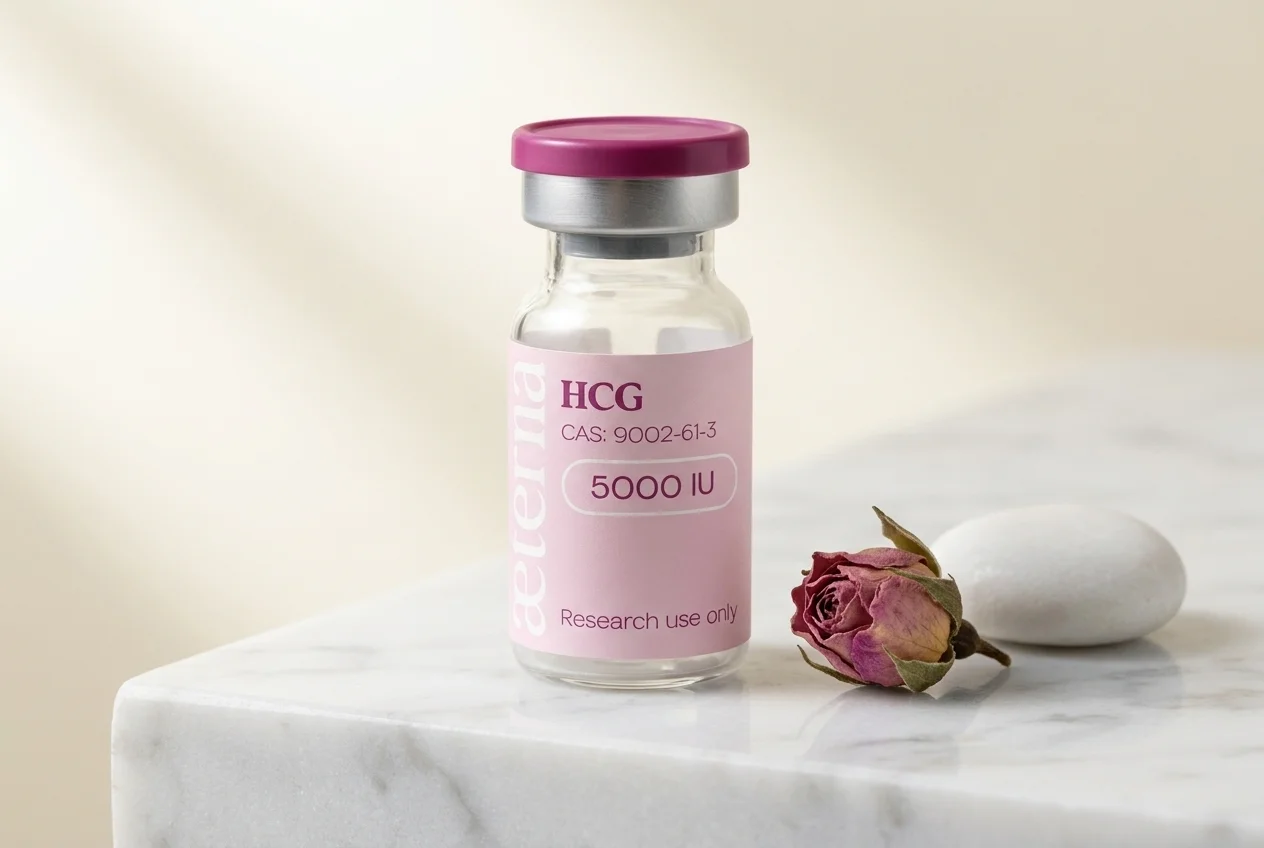
Monograph № 009

HCG

A molecule that speaks the language the testes already understand, preserving the hormonal conversation that exogenous testosterone would simply replace.
Sequence
237 aa + 145 aa subunits
Half-life
~36 hours (terminal)
Route
Subcutaneous · Intramuscular

Aeterna does not sell peptides. External link, vendor independently verified.

Originator
Organon / Pregnyl
First pharmaceutical isolation
First disclosed
1927
Ascheim & Zondek pregnancy assay
Regulatory status
FDA-Approved
Hypogonadism · Cryptorchidism · ART
Studied for
Testosterone Preservation · Fertility · Leydig Cell Function
Endogenous steroidogenesis support

Mechanism

How HCG keeps testosterone being made

HCG does not introduce testosterone. It speaks the language the testes already understand – mimicking the luteinizing hormone pulse that instructs Leydig cells to synthesize androgens from cholesterol. The distinction matters. Where exogenous testosterone replaces a signal, HCG preserves the conversation.

LH receptor binding activates adenylyl cyclase via Gs coupling, elevating intracellular cAMP and upregulating StAR protein expression. Cholesterol transport into the mitochondrial matrix is the rate-limiting step in androgen synthesis.

Leydig cell steroidogenesis proceeds sequentially through CYP11A1, CYP17A1, 3β-HSD, and 17β-HSD to produce testosterone. HCG sustains this entire enzymatic cascade during periods of HPG axis suppression.

Spermatogenesis depends on intratesticular testosterone concentrations 50 to 100 times higher than serum levels, a gradient only sustained LHR activation can maintain. Sertoli cell paracrine support proceeds in parallel and requires the same gonadal stimulus.

HCG acts downstream of the pituitary and does not restore hypothalamic GnRH pulsatility. It is a gonadal bridge, not a tool for axis rehabilitation.

What we observe

What people saw in fertility and testes

The outcomes below reflect patterns reported across clinical trials, observational cohorts, and endocrinological reviews. They describe what investigators have noted under studied conditions, not what any individual should expect. Aeterna does not prescribe, dispense, or sell; this summary exists to illuminate the evidence.

01

Intratesticular Testosterone Maintenance

Studies in men receiving exogenous testosterone report that co-administration of HCG at low doses (125–500 IU every other day) substantially preserves intratesticular testosterone concentrations compared to testosterone monotherapy, which suppresses endogenous LH to near-undetectable levels.
Observed in controlled clinical studies; magnitude varies with dose and individual LH sensitivity.

02

Testicular Volume Preservation

Testicular atrophy is a well-documented consequence of prolonged exogenous androgen use. The literature reports that concurrent HCG administration attenuates this reduction, with some cohorts demonstrating near-complete preservation of baseline testicular dimensions over 12-week observation periods.
Observational and controlled data; individual variation is considerable.

03

Spermatogenesis Support

In hypogonadotropic hypogonadism, HCG monotherapy or combination with FSH has been shown to initiate or restore spermatogenesis in a meaningful proportion of subjects. The literature reports sperm in ejaculate in approximately 75–90% of men with secondary hypogonadism treated with gonadotropin therapy over 12–24 months.
Data from fertility literature; outcomes depend heavily on etiology and baseline testicular function.

04

Serum Testosterone Elevation

In men with intact Leydig cell function, HCG administration produces dose-dependent increases in serum testosterone. Doses of 1,500–5,000 IU administered two to three times weekly have been associated with testosterone elevations into or above the physiological range, depending on baseline gonadal reserve.
Well-established pharmacodynamic effect; clinical utility depends on indication and axis status.

05

Cryptorchidism - Partial Response

In prepubertal males with undescended testes, HCG has been used to stimulate androgen-dependent gubernacular descent. Response rates in the literature range from 15–55%, with bilateral cases and those with testes palpable in the inguinal canal showing the most favorable outcomes. Surgical correction remains the standard of care when hormonal therapy is insufficient.
Established pediatric indication; response rates vary substantially by anatomy and age.

06

Luteal Phase Support in ART

In assisted reproductive technology protocols, HCG serves as the ovulation trigger – replacing the endogenous LH surge – and supports corpus luteum function in the luteal phase. The literature documents reliable oocyte maturation and luteinization when HCG is administered 34–36 hours prior to oocyte retrieval.
Standard-of-care application in reproductive medicine; well-supported by decades of clinical data.

Evidence

What the studies found

Three studies are presented here as representative entries in a larger literature spanning reproductive endocrinology, andrology, and sports medicine. Each is cited with its primary finding and a representative statistic. Readers are encouraged to consult primary sources directly.

Journal of Clinical Endocrinology & Metabolism
2005

Intratesticular Testosterone Concentrations in Men Receiving Testosterone Replacement with and without HCG Co-administration

Randomized controlled study in eugonadal men receiving exogenous testosterone enanthate with or without adjunctive HCG (125 IU every other day). The HCG group maintained intratesticular testosterone concentrations within 25% of baseline, while the testosterone-only group experienced a decline exceeding 90% from baseline values. Serum testosterone was comparable between groups, underscoring that serum measurements do not reflect intratesticular milieu.

94%
decline in intratesticular testosterone in testosterone-only arm vs. near-preservation in HCG co-administration arm
Fertility and Sterility
2013

Gonadotropin Therapy for Induction of Spermatogenesis in Men with Hypogonadotropic Hypogonadism: A Systematic Review

Systematic review of 30 studies encompassing 1,042 men with hypogonadotropic hypogonadism treated with HCG alone or in combination with FSH. Spermatogenesis was achieved in 76% of subjects overall; combination therapy with FSH produced higher sperm concentrations and shorter time to first sperm appearance. Prior testosterone therapy did not significantly impair response when gonadotropin treatment was initiated.

76%
of men with hypogonadotropic hypogonadism achieved spermatogenesis with gonadotropin therapy
Andrology
2019

Low-Dose HCG Preserves Testicular Volume and Sperm Parameters During Testosterone Replacement Therapy: A Prospective Cohort Study

Prospective 24-week cohort study in 68 hypogonadal men initiating testosterone replacement therapy. Subjects receiving adjunctive HCG (250 IU three times weekly) demonstrated preservation of mean testicular volume within 8% of baseline, compared to a 21% reduction in the testosterone-only cohort. Sperm concentration remained detectable in 89% of the HCG group versus 34% of controls at week 24.

89%
of HCG co-administration subjects retained detectable sperm concentration at 24 weeks, versus 34% in controls
Reconstitution

From lyophilized powder to a usable solution.

Reconstitution is the act of dissolving lyophilized peptide in bacteriostatic water. Done correctly, it takes under two minutes.

Peptide

5000 IU lyophilized powder

Diluent

2.0 mL bacteriostatic water

Final concentration

2,500 IU/mL

01

Prepare the vial

Allow the lyophilized vial to reach room temperature. Wipe the stopper with an alcohol swab. Do not shake the powder.

02

Draw the diluent

Using a sterile syringe, draw 1 mL of bacteriostatic water (0.9% benzyl alcohol). Use a fresh needle for the draw.

03

Add slowly

Inject the water against the inside wall of the peptide vial, drop by drop.

04

Prepare the vial

Rotate or shake the vial until the solution clears. It should be visually transparent within sixty seconds. You can wait up to 20 minutes.

Note

Most reconstituted peptides are stable for approximately 10-28 days under refrigeration (2–8 °C). Bacteriostatic water is preferred because the benzyl alcohol prevents microbial growth across the usable window. You can use sterile water with shorter timeframes.

Dosing rythm

A patient titration

Schedule below mirrors the peptidedosages.com educational protocol (typical daily range: 500 IU subcutaneous, 3× weekly (Mon/Wed/Fri) for testicular maintenance during TRT).

For educational reference only. Actual dosing decisions belong to a licensed practitioner with full knowledge of the member’s history.
Weeks 1–12
500 IU
Once daily · 20 units (0.20 mL)
Standard
500 IU
2-3x weekly · SC
Fertility protocol
1500-3000 IU
3x weekly · Higher dose
On-cycle TRT support
500 IU
twice weekly
Most common adjunct
Handling

Storage, caution, contradiction

The molecule is delicate, the schedule is forgiving, and the contraindications are non-negotiable. Members are taught to take all three with equal seriousness.

Storage

Cold, dark, undisturbed

Side effects

What members describe

Contradictions

Reasons to abstain

Synergies

What to pair with HCG

HCG rarely operates in isolation within clinical protocols. Its role as a downstream LH signal makes it a natural complement to agents that act at the hypothalamic or pituitary level, or to exogenous androgens that suppress the axis it is meant to sustain. The pairings below reflect patterns in the clinical and research literature – not protocol recommendations.

For educational reference only. Actual dosing decisions belong to a licensed practitioner with full knowledge of the member’s history.
Testosterone (Exogenous)
The most studied pairing in the andrology literature. Exogenous testosterone suppresses endogenous LH; HCG replaces that signal downstream, preserving intratesticular testosterone, testicular volume, and spermatogenic potential that testosterone monotherapy consistently erodes.
Hormonal
Clomiphene Citrate (Clomid)
Clomiphene acts at the hypothalamic level, blocking estrogen negative feedback to increase endogenous LH and FSH secretion. When used sequentially after HCG – or in combination in certain fertility protocols – the two agents address different nodes of the HPG axis, offering a more complete approach to axis rehabilitation than either provides alone.
Hormonal – Axis Restoration
Recombinant FSH (rFSH)
HCG provides the LH signal; FSH provides the Sertoli cell signal. In hypogonadotropic hypogonadism, both are absent. The literature consistently reports that combination HCG plus rFSH produces superior spermatogenesis outcomes compared to HCG monotherapy, particularly in men with no prior pubertal development.
Reproductive Endocrinology
Anastrozole
HCG-stimulated Leydig cells upregulate aromatase activity, increasing the conversion of testosterone to estradiol. In individuals prone to estrogen-mediated side effects – gynecomastia, fluid retention, mood variability – low-dose aromatase inhibition is sometimes employed as an adjunct. The literature supports this approach cautiously; over-suppression of estradiol carries its own adverse profile.
Hormonal – Estrogen Management

FAQ

Your questions, patiently answered

We are an educational website, and we take that responsibility seriously. If your question is not here, write to us at [email protected]

In the same family

Further reading in the curriculum

Hormonal
Where HCG acts downstream of the pituitary, kisspeptin operates at the hypothalamic level – the upstream pulse generator that initiates the entire gonadotropin cascade. Understanding both illuminates the full architecture of the HPG axis.
Hormonal
Gonadorelin mimics the hypothalamic GnRH pulse, stimulating pituitary release of both LH and FSH. Used in fertility protocols and axis rehabilitation, it addresses the signaling cascade at a different node than HCG – making the two agents complementary rather than interchangeable.
BPC-157
Peptide – Growth Factor
A structurally unrelated peptide with a distinct mechanism, included here as a point of contrast. Where HCG operates within a tightly defined endocrine axis, BPC-157 acts across multiple tissue systems. The curriculum benefits from understanding both the specificity of gonadotropin signaling and the broader vocabulary of peptide biology.

Sourcing · Independently verified

When you're ready, source thoughtfully.

Aeterna does not sell peptides. We maintain a short list of vendors evaluated for purity, third-party testing, handling, and supply consistency. The button here links directly to the vendor we currently recommend.
External link · We receive no remuneration. Verify your prescription before sourcing.