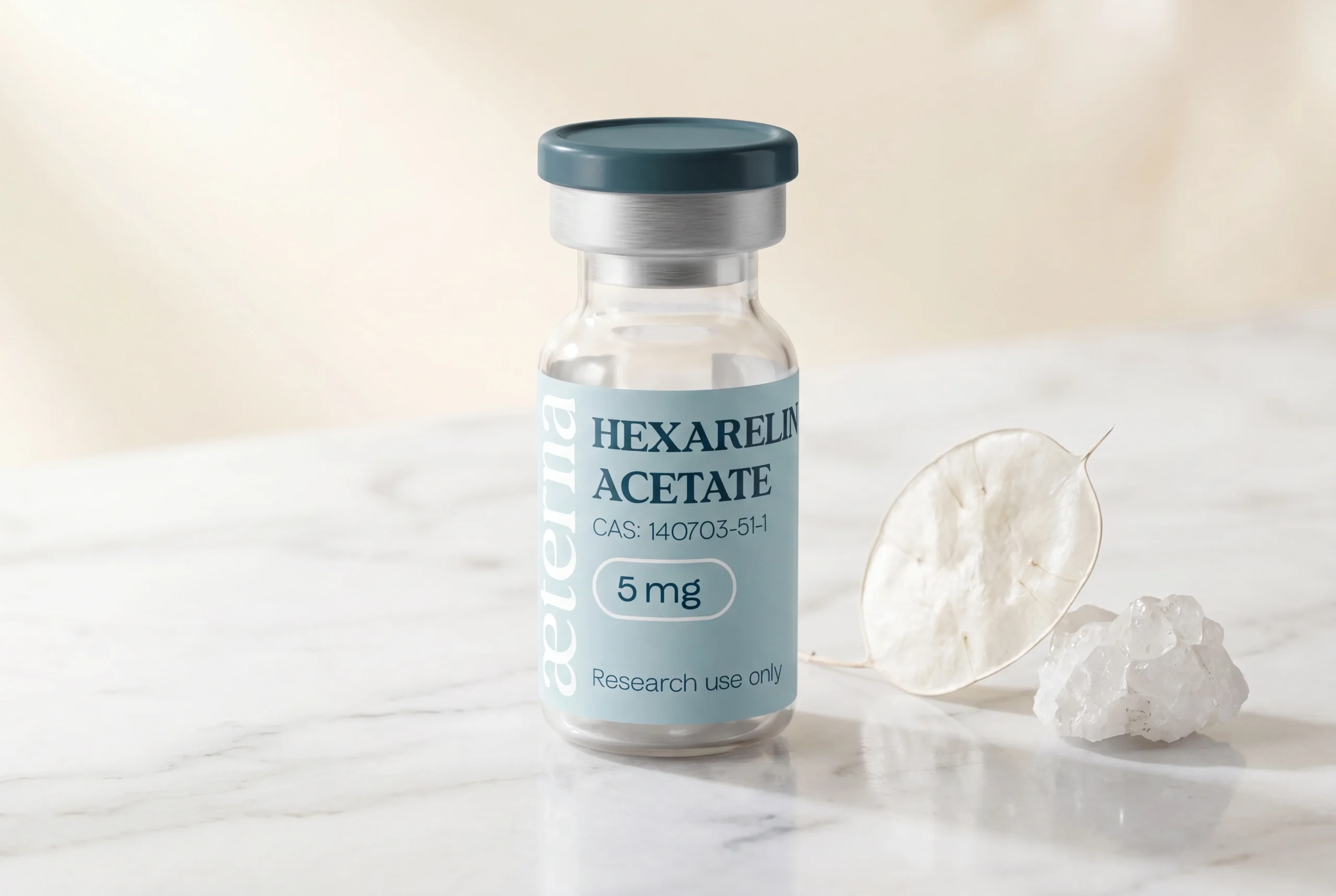
Hexarelin Acetate
Aeterna does not sell peptides. External link, vendor independently verified.
Mechanism
Hexarelin does not follow a single pathway. It enters the body and addresses two receptor populations simultaneously – one governing growth hormone release, one governing cardiac and metabolic homeostasis. Understanding both is prerequisite to understanding the compound.
GHSR-1a agonism drives the somatotropic action of Hexarelin, binding pituitary somatotrophs with high affinity and triggering pulsatile GH release through Gq-phospholipase C signaling. Unlike ghrelin, it lacks the acyl chain and generally produces less orexigenic activity per unit of GH released.
CD36 binding underlies the compound’s cardioprotective profile, with Hexarelin engaging CD36 on cardiomyocytes and endothelium through Src-family kinase signaling independent of GH release. This effect persists in hypophysectomized models, supporting a mechanism separate from the somatotropic axis.
IGF-1 extension carries the anabolic signal beyond Hexarelin’s short plasma half-life by translating GH pulses into hepatic IGF-1 synthesis. That downstream endocrine response is what links brief receptor activation to longer-lived effects in skeletal muscle, including PI3K/Akt and MAPK/ERK pathway engagement.
Tachyphylaxis is the principal pharmacologic constraint, with repeated high-dose administration desensitizing GHSR-1a and increasing compensatory somatostatin tone. Cycled dosing protocols in the literature are a direct response to this ceiling effect.
What we observe
Changes seen in body and heart
The following observations are drawn from published preclinical and early clinical research. They describe patterns reported in the literature, not guaranteed individual outcomes. Aeterna does not prescribe, dispense, or sell.
01
Pulsatile GH Release
02
Lean Mass Preservation
03
Cardiac Protection Post-Ischemia
04
Ventricular Function Improvement
05
Adipose Tissue Modulation
06
Tachyphylaxis with Continuous Dosing
Evidence
Research on Hexarelin
Three studies representative of the Hexarelin literature are cited below for orientation, not as clinical guidance. Each reflects a distinct axis of the compound’s pharmacology. The full body of evidence is broader, more contested, and more nuanced than any three papers can convey.
Hexarelin, a synthetic GH-releasing peptide, stimulates GH secretion in healthy elderly subjects: dose-response and reproducibility
Forty-two healthy volunteers aged 60–75 received single subcutaneous doses of hexarelin (0.5, 1.0, and 2.0 mcg/kg) in a crossover design. All doses produced significant GH elevation above baseline; the 2.0 mcg/kg dose produced peak GH responses approximately 4-fold greater than those elicited by GHRH alone. Reproducibility across two administrations separated by one week was high (intraclass correlation 0.81). No serious adverse events were recorded.
Hexarelin reduces myocardial infarct size and preserves left ventricular function in a rat model of ischemia-reperfusion injury via CD36-dependent signaling
Sprague-Dawley rats underwent 30-minute coronary artery ligation followed by reperfusion. Hexarelin (80 mcg/kg IV) administered at reperfusion reduced infarct size by 34% compared to vehicle. Left ventricular ejection fraction at 72 hours was significantly preserved in the hexarelin group. Hypophysectomized animals showed equivalent cardioprotection, confirming GH-independent, CD36-mediated mechanisms. Src kinase inhibition abolished the protective effect.
Short-term hexarelin administration improves cardiac performance in GH-deficient adults with idiopathic dilated cardiomyopathy
Fourteen adults with confirmed GH deficiency and dilated cardiomyopathy received hexarelin (2.0 mcg/kg SC twice daily) for three weeks in an open-label pilot study. Echocardiographic assessment demonstrated a mean increase in left ventricular ejection fraction of 6.2 percentage points from baseline. Cardiac index improved by 18% and systemic vascular resistance fell by 12%. IGF-1 levels rose in parallel, though the authors noted that the speed of cardiac response suggested a direct receptor-mediated component beyond GH-axis effects alone.
From lyophilized powder to a usable solution.
Peptide
2 mg (2,000 mcg) lyophilized powder per vial
Diluent
Bacteriostatic water for injection (0.9% benzyl alcohol); sterile water acceptable for single-use preparation
Final concentration
Common research concentration: 200 mcg/mL (add 1.0 mL diluent to 2 mg vial); 500 mcg/mL also used where smaller injection volumes are preferred
01
Prepare the vial
02
Draw the diluent
03
Add slowly
04
Prepare the vial
Note
Dosing rythm
A patient titration
The schedule below reflects dosing ranges reported in the published literature, including Ghigo et al. and subsequent research protocols. It is not a prescription or clinical directive.
Storage, caution, contradiction
Storage
Cold, dark, undisturbed
- Store lyophilized vials at 2–8 °C (refrigerated); stable for 24 months unopened under these conditions
- Reconstituted solution: store at 2–8 °C; use within 28 days when prepared with bacteriostatic water
- Do not freeze reconstituted solution; freezing disrupts peptide integrity and may cause aggregation
- Protect from light at all stages; amber vials or opaque storage preferred
- Allow refrigerated vials to reach room temperature before injection; cold solution increases injection discomfort
Side effects
What members describe
- Transient facial flushing and warmth: reported in approximately 20–30% of subjects in early human studies; typically resolves within 30 minutes of administration
- Mild cortisol and prolactin elevation: hexarelin stimulates ACTH and prolactin release in addition to GH; generally within physiological range at research doses but warrants monitoring in sensitive individuals
- Water retention and peripheral edema: a class effect of GH-axis stimulation; more pronounced at higher doses and in older subjects
- Injection site reactions: mild erythema and transient discomfort; rotate sites systematically to minimize local tissue response
- Tachyphylaxis: progressive blunting of GH response with continuous daily dosing; not a safety concern per se, but a pharmacological signal to respect cycling protocols
Contradictions
Reasons to abstain
- Active malignancy or personal history of hormone-sensitive neoplasm: GH-axis stimulation is contraindicated in the context of existing or suspected neoplastic disease
- Diabetic retinopathy or uncontrolled diabetes mellitus: GH elevation can worsen insulin resistance and exacerbate retinal pathology
- Pregnancy and lactation: no safety data exist; use is contraindicated on precautionary grounds
- Concurrent corticosteroid therapy at supraphysiological doses: glucocorticoids blunt GH-axis response and may confound both efficacy and safety assessment
- Hypothyroidism (untreated): GH secretagogue efficacy is substantially reduced in the hypothyroid state; thyroid status should be evaluated and normalized before research protocols are initiated
Synergies
Hexarelin combos that make sense
Hexarelin is rarely studied in isolation in contemporary research protocols. Its GH-releasing and cardioprotective mechanisms create logical adjacencies with compounds that address complementary pillars. The following pairings reflect patterns in the published and investigational literature – not clinical prescriptions.
FAQ
Your questions, patiently answered
Hexarelin occupies a middle position in the GHSR-1a agonist class. It produces a more robust GH pulse than ipamorelin but with broader receptor engagement – including cortisol and prolactin stimulation – that ipamorelin largely avoids. Compared to GHRP-6, hexarelin generates less appetite stimulation (ghrelin-mediated orexigenic signaling is less pronounced) while retaining comparable GH-releasing potency. Its unique distinction is CD36 binding, which neither ipamorelin nor GHRP-6 shares to the same degree, conferring cardioprotective properties that are pharmacologically independent of the pituitary.
CD36 is a scavenger receptor expressed in cardiac muscle, endothelium, platelets, and adipose tissue. Hexarelin’s binding at CD36 activates Src-family kinase signaling that promotes cardiomyocyte survival and attenuates ischemic injury – effects demonstrated in hypophysectomized animals where GH secretion is absent. This means a portion of hexarelin’s biological activity is entirely independent of the pituitary axis, a pharmacological property with implications for cardiac research that extends well beyond the compound’s original GH-releasing rationale.
Two mechanisms converge. First, sustained GHSR-1a stimulation leads to receptor internalization and reduced surface expression – a standard G-protein-coupled receptor desensitization process. Second, repeated GH pulses elevate somatostatin tone at the hypothalamic level, which opposes further GH release. Both processes are reversible with a period of abstinence, typically two to four weeks. This is not a compound failure; it is the axis restoring its own regulatory architecture. Cycling protocols in the literature are designed around this pharmacological reality.
The literature specifically includes elderly cohorts. A 1997 study in the European Journal of Endocrinology demonstrated significant GH responses in subjects aged 60–75, with the 2.0 mcg/kg dose producing responses approximately four-fold greater than GHRH alone. Somatostatin tone tends to be higher in older adults, which can blunt the ceiling of response, but the compound retains meaningful activity. The additional CD36-mediated cardiovascular dimension may carry particular relevance in aging populations, though this remains an area of active inquiry rather than established clinical practice.
Yes. Unlike the more selective ipamorelin, hexarelin stimulates ACTH (and therefore cortisol) and prolactin release in addition to GH. In short-term human studies, these elevations have generally remained within physiological ranges at research doses and resolved with the GH pulse. However, individuals with adrenal sensitivity, prolactin-sensitive conditions, or concurrent corticosteroid use should regard this as a meaningful pharmacological consideration. Monitoring of cortisol and prolactin is a reasonable component of any research protocol involving hexarelin.
This monograph is a translation of the published literature into a coherent, accessible format. It is part of the Aeterna curriculum – a practice of illuminating mechanism, evidence, and context so that physicians, researchers, and informed adults can engage with the science on its own terms. Nothing here constitutes medical advice, a treatment protocol, or a product recommendation. Aeterna does not prescribe, dispense, or sell. The appropriate next step for anyone considering hexarelin in a clinical or research context is a conversation with a qualified physician familiar with peptide pharmacology.
In the same family
Further reading in the curriculum.
Sourcing · Independently verified
When you're ready, source thoughtfully.