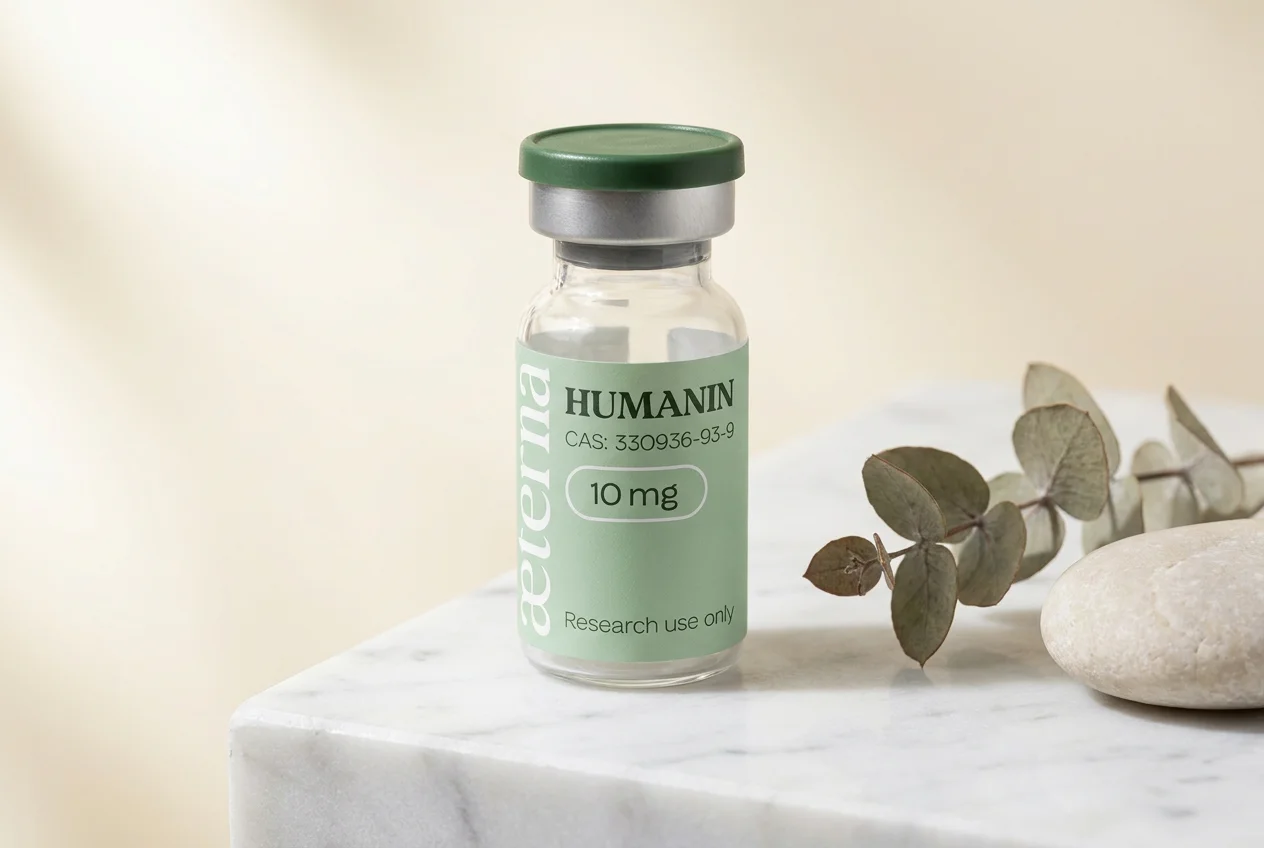
Humanin
Aeterna does not sell peptides. External link, vendor independently verified.
Mechanism
Humanin is a 21-amino-acid peptide encoded not by the nuclear genome but by the 16S ribosomal RNA region of mitochondrial DNA – a provenance that distinguishes it from virtually every other signaling peptide in the longevity literature. Its discovery emerged from a screen of cDNA fragments capable of rescuing neurons from Alzheimer’s-associated apoptosis. What followed was a gradual recognition that the mitochondrial genome, long regarded as a relic organelle transcript, harbors its own intercellular vocabulary. Humanin is the most studied member of that vocabulary – a class now called mitochondrial-derived peptides, or MDPs.
FPR2 engagement initiates the surface-receptor arm of Humanin signaling, suppressing caspase-3 activation and protecting neurons and macrophages from amyloid-beta-induced apoptosis. This pathway is the one most directly implicated in Humanin’s neuroprotective profile.
The CNTFR gp130 WSX-1 receptor complex provides Humanin with broader systemic reach by activating JAK2 and STAT3 signaling. This axis extends the peptide’s effects beyond the central nervous system into metabolic regulation and anti-inflammatory gene expression.
IGFBP-3 and IGFBP-5 binding connects Humanin to the IGF-1 axis through nanomolar-affinity interactions that modulate insulin signaling. In murine models, this relationship is associated with improved hepatic insulin sensitivity and glucose tolerance, placing Humanin within the broader GH IGF longevity network.
Bax inhibition constitutes the intracellular arm of Humanin activity at the mitochondrial membrane, where the peptide limits outer membrane permeabilization and downstream caspase activation. The result is a mechanism that operates at both surface-receptor and organelle levels simultaneously.
What we observe
Observed protection in brain and metabolism
The following patterns emerge from preclinical models and limited human observational data. Humanin circulates endogenously; plasma concentrations decline measurably with age. The outcomes below reflect what the published literature reports, not what any protocol guarantees.
01
Neuronal Survival
02
Insulin Sensitivity
03
Age Related Decline
04
Cardiovascular Protection
05
Spermatogenic Protection
06
Inflammation Modulation
Evidence
Humanin research snapshot
Three studies are presented as representative anchors in a growing body of work. The field remains predominantly preclinical; human interventional trials are absent from the registered literature as of 2025. Findings are reported as published; Aeterna draws no clinical conclusions.
Humanin rescues cultured rat hippocampal neurons from death induced by Alzheimer's disease-related insults
Nishimoto and colleagues demonstrated that synthetic Humanin at nanomolar concentrations rescued primary hippocampal neurons from apoptosis induced by amyloid-beta peptides, mutant presenilin, and V642I-APP. Protection was abolished by co-administration of an FPRL1 blocking antibody, confirming receptor dependence. The S14G analogue (HNG) showed approximately 1,000-fold greater potency than native sequence.
Humanin activates insulin signaling and improves glucose tolerance in diet-induced obese mice
Researchers at the USC Davis School of Gerontology administered Humanin intraperitoneally to high-fat-diet mice over four weeks. Treated animals showed significant improvement in glucose tolerance testing and hepatic insulin receptor substrate-1 phosphorylation. IGFBP-3 displacement was confirmed as a contributing mechanism. Body weight was not significantly altered, distinguishing the effect from GLP-1-class interventions.
Circulating Humanin levels decline with age and associate with metabolic health in the LonGenity cohort
A cross-sectional analysis of 342 participants from the Albert Einstein College of Medicine LonGenity study found that plasma Humanin concentrations declined significantly across age decades and were markedly elevated in offspring of long-lived parents compared with age-matched controls. Higher Humanin correlated with lower HOMA-IR, lower CRP, and better cognitive composite scores, independent of BMI and sex.
From lyophilized powder to a usable solution.
Peptide
1 mg · 5 mg (research vials)
Diluent
Bacteriostatic water for injection (0.9% benzyl alcohol); sterile water for single-use preparation
Final concentration
Typically 0.5–1.0 mg/mL; protect from agitation and direct light post-reconstitution
01
Prepare the vial
02
Draw the diluent
03
Add slowly
04
Prepare the vial
Note
Dosing rythm
A patient titration
The framework below reflects dosing patterns reported in preclinical literature and early human observational contexts. No standardized clinical protocol exists as of 2025; all dosing decisions require physician oversight.
Storage, caution, contradiction
Storage
Cold, dark, undisturbed
- Store lyophilized powder at −20 °C; stable for up to 24 months under these conditions.
- Once reconstituted, refrigerate at 2–8 °C and use within 28 days; do not refreeze.
- Protect from light at all stages; amber vials or foil wrapping recommended post-reconstitution.
- Avoid vigorous agitation; swirl gently to dissolve. Vortexing may induce aggregation and reduce activity.
- Discard if solution appears cloudy, discolored, or contains visible particulate matter.
Side effects
What members describe
- Injection-site reactions - mild erythema and transient discomfort reported in subcutaneous administration; typically self-resolving within hours.
- Transient hypoglycemia - possible in individuals with pre-existing insulin sensitivity or concurrent use of insulin-sensitizing agents; monitor fasting glucose during titration.
- Headache and mild fatigue - reported anecdotally in early-phase human use; mechanism unclear; generally resolves within the first two weeks.
- Nausea - infrequent; more commonly associated with higher doses or rapid titration; not a class effect of mitochondrial-derived peptides broadly.
- Theoretical immunogenicity - as an endogenous sequence, antigenic response is considered low risk, but has not been formally evaluated in long-term human studies.
Contradictions
Reasons to abstain
- Active malignancy - Humanin's anti-apoptotic signaling has not been evaluated in oncological contexts; theoretical concern regarding cytoprotection of malignant cells warrants caution.
- Concurrent use of pro-apoptotic chemotherapeutic agents - Humanin's Bax-inhibiting mechanism may theoretically attenuate intended cytotoxic effects; avoid concurrent administration without oncologist review.
- Pregnancy and lactation - no safety data exist; use is not supported in these populations.
- Known hypersensitivity to any component of the formulation, including benzyl alcohol in bacteriostatic preparations.
- Severe hepatic impairment - IGF axis modulation via IGFBP-3 displacement has not been characterized in hepatic insufficiency; exercise caution and monitor liver function.
Synergies
Useful add-ons for Humanin
Humanin’s cytoprotective and metabolic signaling profile positions it as a foundational layer in longevity-oriented protocols. The companions below are drawn from published mechanistic rationale and observed complementarity in the preclinical literature. No stack constitutes a prescription. Aeterna does not dispense.
FAQ
Your questions, patiently answered
Its origin. Virtually all peptides studied in the longevity field are encoded by the nuclear genome. Humanin is transcribed from mitochondrial DNA – specifically the 16S rRNA region – making it a representative of a class called mitochondrial-derived peptides. This provenance suggests that mitochondria are not merely energy organelles but active participants in intercellular signaling, a reframing with considerable implications for how aging is understood at the molecular level.
The observational evidence suggests it does. Cross-sectional data from the LonGenity cohort at Albert Einstein College of Medicine found that plasma Humanin concentrations declined across age decades and were significantly elevated in offspring of centenarians. Whether this decline is causal in aging phenotypes or merely correlative remains an open question – one the field has not yet resolved.
S14G-Humanin, sometimes designated HNG, is a synthetic analogue in which serine at position 14 is substituted with glycine. This single substitution increases neuroprotective potency by approximately 1,000-fold in cell-based assays, likely by enhancing receptor binding affinity at FPRL1. Most contemporary research protocols use HNG rather than native Humanin when potency is a primary consideration, though the two are not pharmacologically identical.
As of 2025, no registered phase I or phase II interventional trials for exogenous Humanin administration in humans appear in the published literature or on ClinicalTrials.gov. The human data that exists is observational – measuring endogenous circulating levels in cohorts. This is a meaningful gap. The preclinical literature is extensive; the translational bridge has not yet been formally constructed.
Humanin binds insulin-like growth factor binding proteins 3 and 5 with nanomolar affinity, displacing IGF-1 and altering its bioavailability. This interaction modulates downstream insulin receptor substrate phosphorylation and has been associated with improved glucose tolerance in murine models. The mechanism is distinct from GLP-1-class peptides and does not involve incretin pathways, making it of particular interest in contexts where insulin sensitization without weight loss is the research objective.
This monograph is the primary entry point. It situates Humanin within the mitochondrial-derived peptide class, maps its receptor pharmacology, and presents the published evidence without overstating it. Aeterna does not prescribe, dispense, or sell. The curriculum is an act of translation – rendering a complex and still-evolving literature into a form that supports informed conversation between individuals and their physicians.
In the same family
Further reading in the curriculum.
Sourcing · Independently verified
When you're ready, source thoughtfully.

