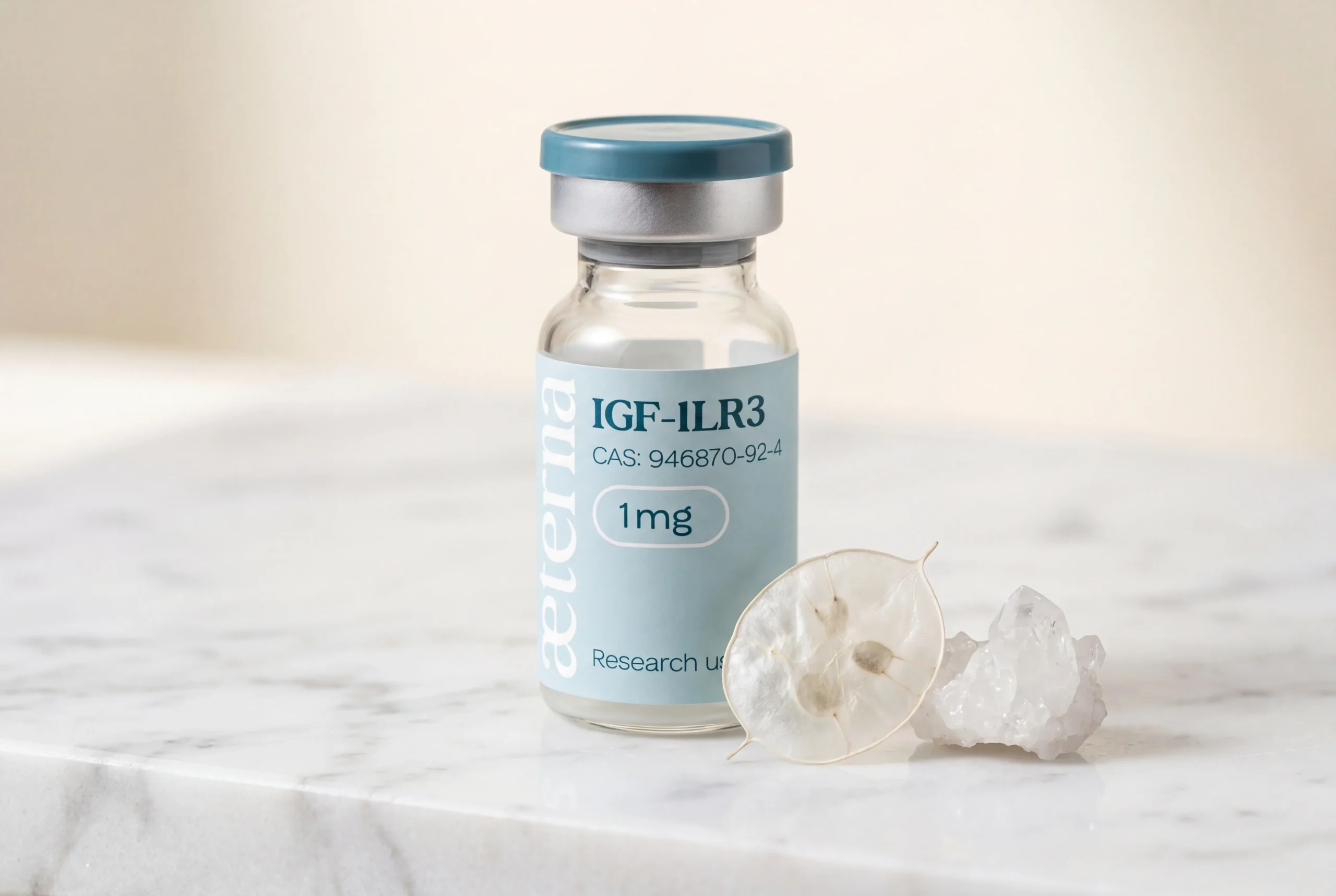
IGF-1LR3
Aeterna does not sell peptides. External link, vendor independently verified.
Mechanism
Insulin-like growth factor 1 is among the most conserved anabolic signals in vertebrate biology. Its native form, however, is rapidly sequestered by a family of binding proteins that curtail both its half-life and its receptor availability. IGF-1 Long R3 – a synthetic analogue carrying a single arginine substitution at position 3 and a thirteen-residue glutamate-rich N-terminal extension – was engineered to circumvent that sequestration. The result is a molecule that retains full receptor affinity while resisting the binding proteins that would otherwise silence it within minutes. What follows is a description of the signalling architecture that makes that extended conversation possible.
IGF-1 LR3 binds the IGF-1 receptor with affinity comparable to native IGF-1, triggering dimerisation and autophosphorylation of intracellular tyrosine kinase domains. The receptor-binding geometry is preserved; the structural modifications act elsewhere.
Receptor activation recruits IRS-1 and IRS-2, engages PI3K, elevates PIP3, and releases mTORC1 from TSC1/TSC2 suppression. Downstream phosphorylation of S6K1 and 4E-BP1 drives ribosomal biogenesis and translation initiation in skeletal muscle.
The Arg³ substitution and N-terminal glutamate extension sterically block IGFBP-3 and IGFBP-5 without altering the receptor-binding face. The free fraction persists for hours where native IGF-1 is rapidly sequestered — prolonged receptor occupancy is the design rationale.
IGF-1R activation in quiescent satellite cells suppresses FoxO transcription factors via Akt and upregulates MyoD, initiating proliferation and differentiation. In vitro, LR3 drives this sequence more rapidly than equimolar native IGF-1, attributable to sustained free-ligand availability.
What we observe
What users noticed in muscle and recovery
The outcomes below reflect patterns reported in peer-reviewed preclinical and in vitro research. No outcome constitutes a clinical claim. Individual responses depend on dose, tissue context, and concurrent signalling environment. Aeterna does not prescribe, dispense, or sell.
01
Muscle Hypertrophy
02
Satellite Cell Activation
03
Protein Catabolism Reduction
04
Muscle Glucose Uptake
05
Connective Tissue Signaling
06
Neuroprotective Signaling
Evidence
What the studies found
The studies below represent a considered selection from the preclinical and mechanistic literature, presented for educational orientation only. Effect sizes observed in animal models do not translate directly to human physiology. Read the primary sources.
Long R3 IGF-1 induces skeletal muscle hypertrophy and enhanced satellite cell activation in a rodent overload model
Intramuscular administration of IGF-1 LR3 in a synergist-ablation model produced significantly greater plantaris muscle mass and fibre CSA than equimolar native IGF-1, with immunohistochemical evidence of elevated MyoD-positive satellite cell nuclei. The authors attributed the differential effect to prolonged IGF-1R occupancy secondary to IGFBP resistance.
Differential IGFBP binding and receptor activation kinetics of IGF-1 analogues in primary human myoblast culture
In primary human myoblast preparations, LR3 maintained free-ligand concentrations approximately 8-fold higher than native IGF-1 over a 24-hour incubation period, correlating with sustained Akt and S6K1 phosphorylation. Native IGF-1 signal amplitude declined sharply after 4 hours, coinciding with IGFBP-3 accumulation in conditioned media.
IGF-1 Long R3 promotes collagen synthesis and proliferation in human tenocyte cultures: implications for connective tissue repair
Tenocytes treated with 50 ng/mL IGF-1 LR3 demonstrated a statistically significant increase in collagen type I mRNA expression and a 28% increase in cell number over 72 hours relative to vehicle. The authors noted that IGFBP-5, highly expressed in tendon tissue, was effectively bypassed by the LR3 analogue, likely accounting for the superior response versus native IGF-1 in this connective tissue context.
From lyophilized powder to a usable solution.
Peptide
1 mg lyophilized powder
Diluent
3.0 mL bacteriostatic water
Final concentration
0.333 mg/mL
01
Prepare the vial
02
Draw the diluent
03
Add slowly
04
Prepare the vial
Note
Dosing rythm
A patient titration
Schedule below mirrors the peptidedosages.com educational protocol (typical daily range: 20–50 mcg once daily subcutaneously (gradual titration recommended)).
Storage, caution, contradiction
Storage
Cold, dark, undisturbed
- Lyophilized: freeze at −20 °C (−4 °F) for up to 12 months.
- After reconstitution, refrigerate at 2–8 °C (35.6–46.4 °F) and use within 30 days.
- Avoid repeated freeze–thaw cycles.
- Protect from light at all stages; amber vials or opaque storage sleeves are appropriate for bench-top handling
- Avoid vigorous agitation; IGF-1 LR3 is susceptible to mechanical shear - swirl gently, never vortex or shake
Side effects
What members describe
- Hypoglycaemia: the most clinically significant risk; IGF-1R shares insulin receptor homology and promotes GLUT4-mediated glucose uptake - administer with or shortly after carbohydrate intake in research protocols
- Injection-site reactions: transient erythema, induration, or localised swelling, particularly with intramuscular administration; rotate sites systematically
- Jaw and soft-tissue swelling: IGF-1 promotes fluid retention and connective tissue growth; facial or acral swelling has been reported in observational accounts at higher doses
- Headache and fatigue: reported in early-phase use, likely secondary to transient hypoglycaemia or fluid shifts; typically resolves with dose adjustment
- Potential mitogenic effects: IGF-1 signalling is a recognised co-factor in cell proliferation; the theoretical oncogenic risk of exogenous IGF-1 analogues is a standing concern in the literature and warrants serious consideration
Contradictions
Reasons to abstain
- Active or suspected malignancy: IGF-1R signalling is implicated in tumour cell proliferation and survival; use in the presence of any neoplastic condition is contraindicated in all published research frameworks
- Diabetic retinopathy or proliferative retinal disease: IGF-1 promotes retinal neovascularisation; this population is excluded from all relevant research protocols
- Pregnancy and lactation: no safety data exist; the anabolic and mitogenic profile of IGF-1 LR3 presents uncharacterised risk to foetal and neonatal development
- Paediatric and adolescent populations: endogenous IGF-1 signalling is already elevated during growth phases; exogenous supplementation carries risk of disproportionate skeletal and soft-tissue growth
- Concurrent use of insulin or insulin secretagogues: additive hypoglycaemic risk; co-administration requires close glycaemic monitoring and is described with caution in the literature
Synergies
What combines well with IGF-1LR3
The combinations below reflect pairings discussed in the preclinical and observational literature. Stacking introduces compounded signalling interactions that are not always additive – some are synergistic, some antagonistic, and some simply unstudied. Each addition to a protocol is a variable that deserves its own consideration. Aeterna does not prescribe, dispense, or sell.
FAQ
Your questions, patiently answered
Two structural modifications define the analogue. First, an arginine substitution at position 3 of the mature IGF-1 sequence. Second, a thirteen-residue glutamate-rich extension at the N-terminus. Together, these changes reduce affinity for IGF-binding proteins by approximately 1000-fold relative to native IGF-1, while preserving IGF-1R binding. The practical result is a molecule with a half-life measured in hours rather than minutes – not because it is metabolised more slowly, but because it circulates in a free, receptor-accessible form for far longer.
In normal physiology, more than 95% of circulating IGF-1 is bound to IGFBPs – primarily IGFBP-3 in a ternary complex with ALS. Bound IGF-1 cannot engage its receptor. The binding proteins serve as a reservoir and a regulatory brake. An analogue that bypasses this system delivers a sustained free-ligand signal that native IGF-1, at equivalent molar doses, cannot replicate. This is the central pharmacological rationale for the LR3 design.
No. MGF is a splice variant of the IGF-1 gene – specifically the Ec isoform – that is produced locally in mechanically stressed muscle tissue. It has a distinct C-terminal peptide and a different receptor interaction profile. LR3 is a synthetic analogue of the systemic IGF-1 isoform, engineered for IGFBP resistance. The two molecules are related by lineage but distinct in structure, receptor pharmacology, and biological context.
Skeletal muscle in the post-exercise window exhibits elevated IGF-1R expression and heightened sensitivity to anabolic signalling, a state sometimes described as the anabolic window. Administering IGF-1 LR3 during this period is theorised to capitalise on receptor upregulation. The evidence base for precise timing is largely observational; the mechanistic rationale is plausible but not definitively established in controlled human studies.
The IGF-1 axis is subject to negative feedback primarily through GH suppression at the pituitary level. Exogenous IGF-1 can reduce GH secretion via hypothalamic somatostatin and direct pituitary feedback, which would secondarily reduce hepatic IGF-1 output. Whether LR3 – which resists IGFBP binding and therefore has a different distribution profile than native IGF-1 – produces the same degree of feedback suppression is not definitively characterised in the literature. Caution is warranted.
IGF-1R signalling is a well-documented survival and proliferation signal in numerous cancer cell lines. Elevated circulating IGF-1 has been associated epidemiologically with increased risk of certain malignancies, including colorectal and prostate cancers, in large prospective cohort studies. The literature treats this concern seriously – IGF-1R has been an active oncology drug target for precisely this reason. For a research compound that amplifies free IGF-1R engagement, the theoretical risk is not trivial and is consistently flagged in responsible research frameworks.
In the same family
Further reading in the curriculum
Sourcing · Independently verified
When you're ready, source thoughtfully.