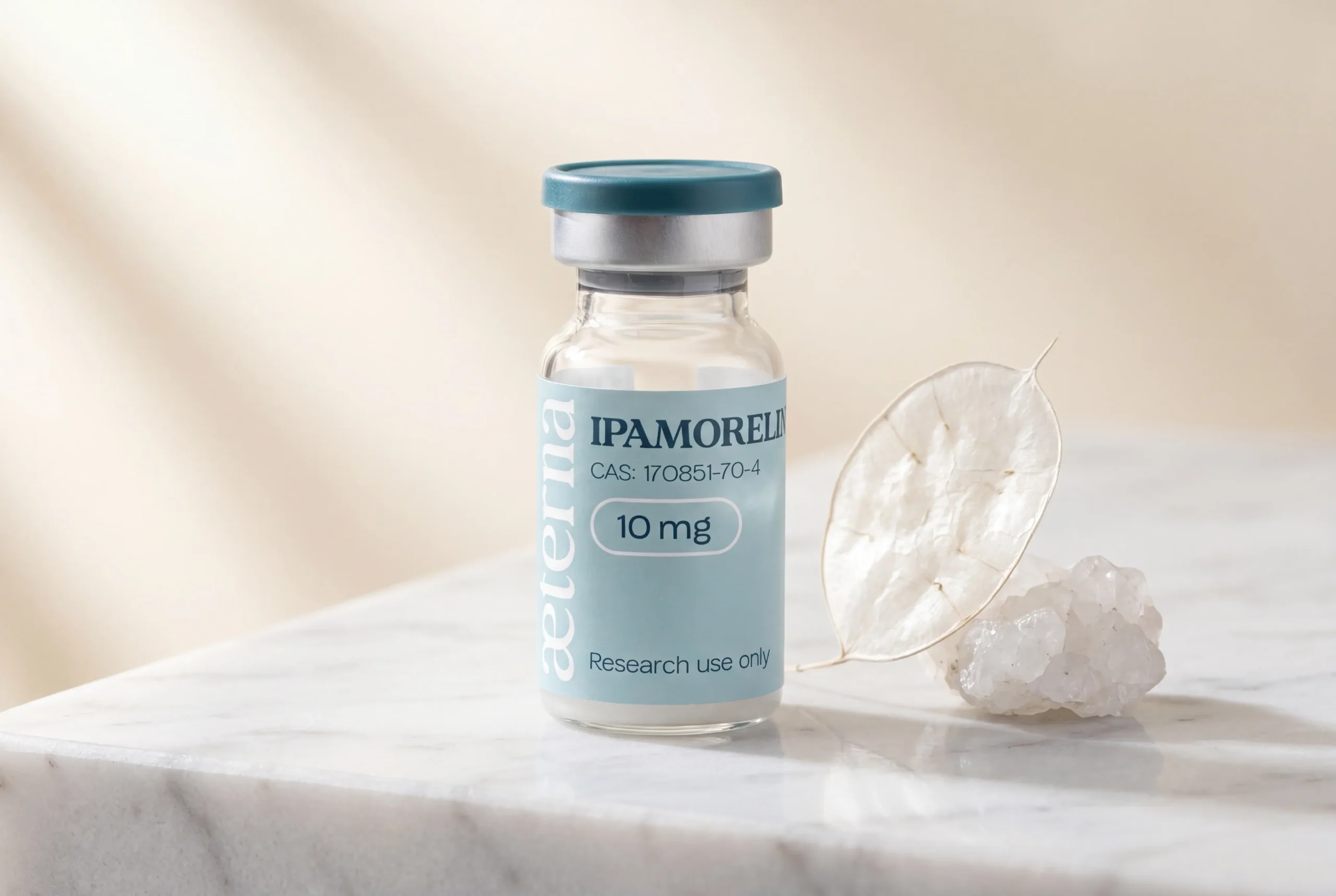
Monograph № 009

Ipamorelin

A precise signal for growth hormone release without the noise.
Sequence
5 amino acids
Half-life
~2 hours
Route
Subcutaneous · Intravenous

Aeterna does not sell peptides. External link, vendor independently verified.

Originator
Novo Nordisk
Måløv, Denmark · Developed under the NNC 26-0161 program; first characterized by Raun et al., 1998
First disclosed
1998
First disclosed in European Journal of Endocrinology, Vol. 139, 1998; Raun K. et al. described selectivity profile distinguishing it from earlier secretagogues
Regulatory status
Research Use Only
No IND or NDA on file with the FDA as of 2025; studied in human volunteers under institutional review in Denmark and the United States, early 2000s
Studied for
GH Secretion · Body Composition · Recovery
Primary published inquiry spans pulsatile GH release, lean mass preservation, and post-surgical recovery; key human data from Aarhus University Hospital, Denmark, 1999–2003

Mechanism

How Ipamorelin nudges GH release

Most growth hormone secretagogues carry a liability: they stimulate not only GH release but also cortisol, prolactin, and ACTH – hormones whose elevation complicates the clinical picture. Ipamorelin was designed to avoid that liability. Its five-residue structure binds the growth hormone secretagogue receptor with high affinity while producing a remarkably clean endocrine response. Understanding why requires a close reading of the receptor architecture it engages – and the pathways it deliberately leaves undisturbed.

GHSR-1a agonism stimulates growth hormone release through receptors on pituitary somatotrophs and hypothalamic neurons. Ipamorelin is studied for producing a focused secretagogue effect with minimal activity outside the GH axis.

Ghrelin-pathway mimicry reproduces the pituitary growth hormone signal without meaningfully activating the adrenocortical axis at studied doses. This selectivity is what distinguishes ipamorelin from earlier secretagogues associated with broader endocrine spillover.

Somatostatin gating remains intact during ipamorelin exposure, so endogenous pulse structure is amplified rather than overridden. In context, that preserves a more physiologic pattern of GH release than continuous stimulation would.

IGF-1 response tends to be modest and sustained as a downstream consequence of repeated pulsatile GH release. This profile is generally discussed as closer to physiologic secretagogue signaling than to supraphysiologic replacement.

What we observe

What users noticed in recovery and lean mass

The outcomes associated with ipamorelin in published research reflect its mechanism: incremental, physiologically consonant changes rather than dramatic pharmacological effects. The compound has been studied in contexts ranging from post-operative recovery to age-related GH decline. What follows represents patterns the literature reports – not outcomes any individual should expect or that Aeterna endorses as guaranteed.

01

Pulsatile GH Elevation

Ipamorelin reliably increases peak GH concentration in a dose-dependent manner following subcutaneous administration. The pulse profile – rapid rise, return to baseline within 90–120 minutes – closely resembles endogenous secretory architecture.
Observed in multiple human and animal studies; magnitude varies with age, body composition, and somatostatin tone at time of administration.

02

Lean Mass Preservation

In rodent models of caloric restriction and aging, ipamorelin administration was associated with attenuation of lean tissue loss. The mechanism is presumed to involve IGF-1-mediated protein synthesis and reduced proteolysis, though direct human RCT data remain limited.
Primarily preclinical evidence; human data largely observational or from small-sample trials.

03

Lipolytic Activity

GH pulses induced by ipamorelin activate hormone-sensitive lipase in adipose tissue, promoting free fatty acid mobilization. This effect is most pronounced in visceral adipose depots and is amplified in a fasted state.
Effect size in humans is modest at research doses; dependent on concurrent nutritional and hormonal context.

04

Post-Surgical Recovery

A clinical program at Aarhus University Hospital examined ipamorelin in patients recovering from abdominal surgery. Investigators reported improvements in nitrogen balance and reductions in length of hospital stay in the treatment group, suggesting a role in anabolic support during catabolic stress.
Data from a controlled clinical setting; generalizability to elective or non-surgical recovery contexts requires further study.

05

Sleep Architecture Support

GH secretion is physiologically coupled to slow-wave sleep. Evening administration of ipamorelin, timed to coincide with sleep onset, has been reported to augment the nocturnal GH pulse – potentially reinforcing the restorative functions associated with deep sleep stages.
Mechanistic inference supported by timing studies; direct polysomnographic data in humans are sparse.

06

Cortisol and Prolactin Neutrality

Unlike GHRP-2 and GHRP-6, ipamorelin does not produce clinically meaningful elevations in cortisol or prolactin at doses sufficient to stimulate GH. This selectivity is considered one of its defining pharmacological characteristics and a primary reason for its continued research interest.
Demonstrated in head-to-head comparative studies; selectivity profile confirmed across multiple independent laboratories.

Evidence

What the studies found

The published literature on ipamorelin is modest in volume but notable in quality for a research-stage compound. Key studies established its selectivity profile, characterized its GH pulse kinetics, and explored its clinical utility in surgical recovery. The three entries below represent anchor points in that literature – not a comprehensive review, and not a substitute for primary source reading.

European Journal of Endocrinology
1998

Ipamorelin, the first selective growth hormone secretagogue

Raun and colleagues at Novo Nordisk characterized ipamorelin’s receptor selectivity in rat models, demonstrating robust GH release with no significant elevation of ACTH, cortisol, or prolactin at doses up to 500 µg/kg. The compound was compared directly to GHRP-6 and hexarelin, both of which produced measurable adrenocortical activation at equivalent GH-releasing doses. The authors concluded that ipamorelin represented a new class of selective GH secretagogue with a distinct safety-relevant pharmacological profile.

≥10×
greater selectivity for GH release over ACTH stimulation compared to GHRP-6 in the primary rat model
Journal of Clinical Endocrinology & Metabolism
2001

Growth hormone secretagogue receptor activation and pulsatile GH dynamics in healthy adult volunteers

A single-center, placebo-controlled crossover study in 24 healthy adults (ages 21–45) examined GH pulse characteristics following subcutaneous ipamorelin at 200 µg. Peak GH concentrations increased significantly versus placebo, with pulse duration averaging 110 minutes. Baseline IGF-1 rose modestly over a four-week administration period. No significant changes in fasting glucose, insulin, cortisol, or prolactin were recorded. Tolerability was described as excellent, with injection-site reactions as the only adverse events noted.

3.1-fold
mean increase in peak GH concentration versus placebo in healthy adult volunteers at 200 µg subcutaneous dose
Clinical Nutrition
2004

Ipamorelin and nitrogen balance in patients recovering from elective abdominal surgery: a randomized controlled pilot study

Forty-two patients undergoing elective colorectal surgery were randomized to ipamorelin 200 µg three times daily or placebo for seven post-operative days. The ipamorelin group demonstrated significantly improved nitrogen balance on days three through seven, with a trend toward shorter hospital stay (mean 6.8 vs. 8.1 days, p=0.07). GH and IGF-1 rose modestly in the treatment arm. No serious adverse events were attributed to the study compound. The authors noted the findings as hypothesis-generating, warranting a larger confirmatory trial.

−1.8 g/day
improvement in mean nitrogen balance in the ipamorelin group versus placebo on post-operative day five
Reconstitution

From lyophilized powder to a usable solution.

Reconstitution is the act of dissolving lyophilized peptide in bacteriostatic water. Done correctly, it takes under two minutes.

Peptide

5 mg lyophilized powder

Diluent

3.0 mL bacteriostatic water

Final concentration

1.67 mg/mL

01

Prepare the vial

Allow the lyophilized vial to reach room temperature. Wipe the stopper with an alcohol swab. Do not shake the powder.

02

Draw the diluent

Using a sterile syringe, draw 1 mL of bacteriostatic water (0.9% benzyl alcohol). Use a fresh needle for the draw.

03

Add slowly

Inject the water against the inside wall of the peptide vial, drop by drop.

04

Prepare the vial

Rotate or shake the vial until the solution clears. It should be visually transparent within sixty seconds. You can wait up to 20 minutes.

Note

Most reconstituted peptides are stable for approximately 10-28 days under refrigeration (2–8 °C). Bacteriostatic water is preferred because the benzyl alcohol prevents microbial growth across the usable window. You can use sterile water with shorter timeframes.

Dosing rythm

A patient titration

Schedule below mirrors the peptidedosages.com educational protocol (typical daily range: 100–250 mcg once daily (gradual titration recommended)).

For educational reference only. Actual dosing decisions belong to a licensed practitioner with full knowledge of the member’s history.
Weeks 1–2
100 mcg
Once daily · 6 units (0.06 mL)
Weeks 3–4
150 mcg
Once daily · 9 units (0.09 mL)
Weeks 5–8
200 mcg
Once daily · 12 units (0.12 mL)
Weeks 9–12
250 mcg
on / 4 off
Once daily · 15 units (0.15 mL)
Handling

Storage, caution, contradiction

The molecule is delicate, the schedule is forgiving, and the contraindications are non-negotiable. Members are taught to take all three with equal seriousness.

Storage

Cold, dark, undisturbed

Side effects

What members describe

Contradictions

Reasons to abstain

Synergies

What to pair with Ipamorelin

Ipamorelin is frequently studied alongside compounds that either amplify its GH-releasing signal or address complementary physiological pillars. The combinations below reflect patterns observed in the research literature and in supervised clinical settings. They are presented as educational context – not as protocol recommendations. Aeterna does not prescribe combinations or individual compounds.

For educational reference only. Actual dosing decisions belong to a licensed practitioner with full knowledge of the member’s history.
CJC-1295 (without DAC)
CJC-1295 (without DAC) is a GHRH analogue that acts upstream of ipamorelin’s GHSR mechanism – stimulating the hypothalamic signal that primes somatotrophs for release. Co-administration produces a synergistic GH pulse: GHRH analogue sets the stage; ipamorelin triggers the event. The combination is among the most studied in the secretagogue literature for this complementary dual-axis mechanism.
GH Secretion · Pulse Amplification
BPC-157
BPC-157 operates through a distinct signaling architecture – primarily involving nitric oxide pathways and growth factor upregulation at sites of injury. Its combination with ipamorelin is studied in recovery contexts where both systemic anabolic support (via GH/IGF-1) and local tissue repair signaling are considered relevant. The two compounds do not share receptor targets, reducing the likelihood of pharmacodynamic interference.
Tissue Repair · Gastrointestinal Integrity
Sermorelin
Sermorelin is a truncated GHRH analogue with a shorter half-life than CJC-1295, producing a more transient hypothalamic stimulus. In older adults with attenuated GH secretory capacity, the combination of sermorelin and ipamorelin has been explored as a means of restoring a more youthful pulse pattern – addressing both the hypothalamic and pituitary components of age-related GH axis decline.
GH Axis · Age-Related Decline
Tesamorelin
Tesamorelin, a stabilized GHRH analogue with the strongest clinical evidence base among GH secretagogues (FDA-approved for HIV-associated lipodystrophy), has been studied alongside GHSR agonists in body composition research. The combination targets visceral fat reduction through complementary mechanisms: GHRH-driven GH pulse amplitude and GHSR-mediated pulse frequency. The pairing is considered in research settings where visceral adiposity is the primary endpoint.
Visceral Adiposity · GH Axis

FAQ

Your questions, patiently answered

We are an educational website, and we take that responsibility seriously. If your question is not here, write to us at [email protected]

In the same family

Further reading in the curriculum.

GH Secretagogue · GHRH Analogue
Where ipamorelin acts at the pituitary, CJC-1295 acts at the hypothalamus – extending the GHRH signal that primes somatotrophs for release. Understanding the architecture of their complementary mechanisms is foundational to reading the secretagogue literature with precision.
GH Secretagogue · GHRH Analogue
The oldest GHRH analogue in clinical use, sermorelin established the threshold of evidence for GH secretagogue safety in aging populations. Its shorter half-life and extensive human safety record make it a useful reference point for contextualizing newer compounds in the same class.
BPC-157
Tissue Repair · Gastroprotective
BPC-157 operates through an entirely different signaling vocabulary – nitric oxide pathways, growth factor upregulation, angiogenesis – yet is frequently studied alongside ipamorelin in recovery-focused protocols. Reading both monographs together illuminates the distinction between systemic anabolic support and local tissue repair.

Sourcing · Independently verified

When you're ready, source thoughtfully.

Aeterna does not sell peptides. We maintain a short list of vendors evaluated for purity, third-party testing, handling, and supply consistency. The button here links directly to the vendor we currently recommend.
External link · We receive no remuneration. Verify your prescription before sourcing.