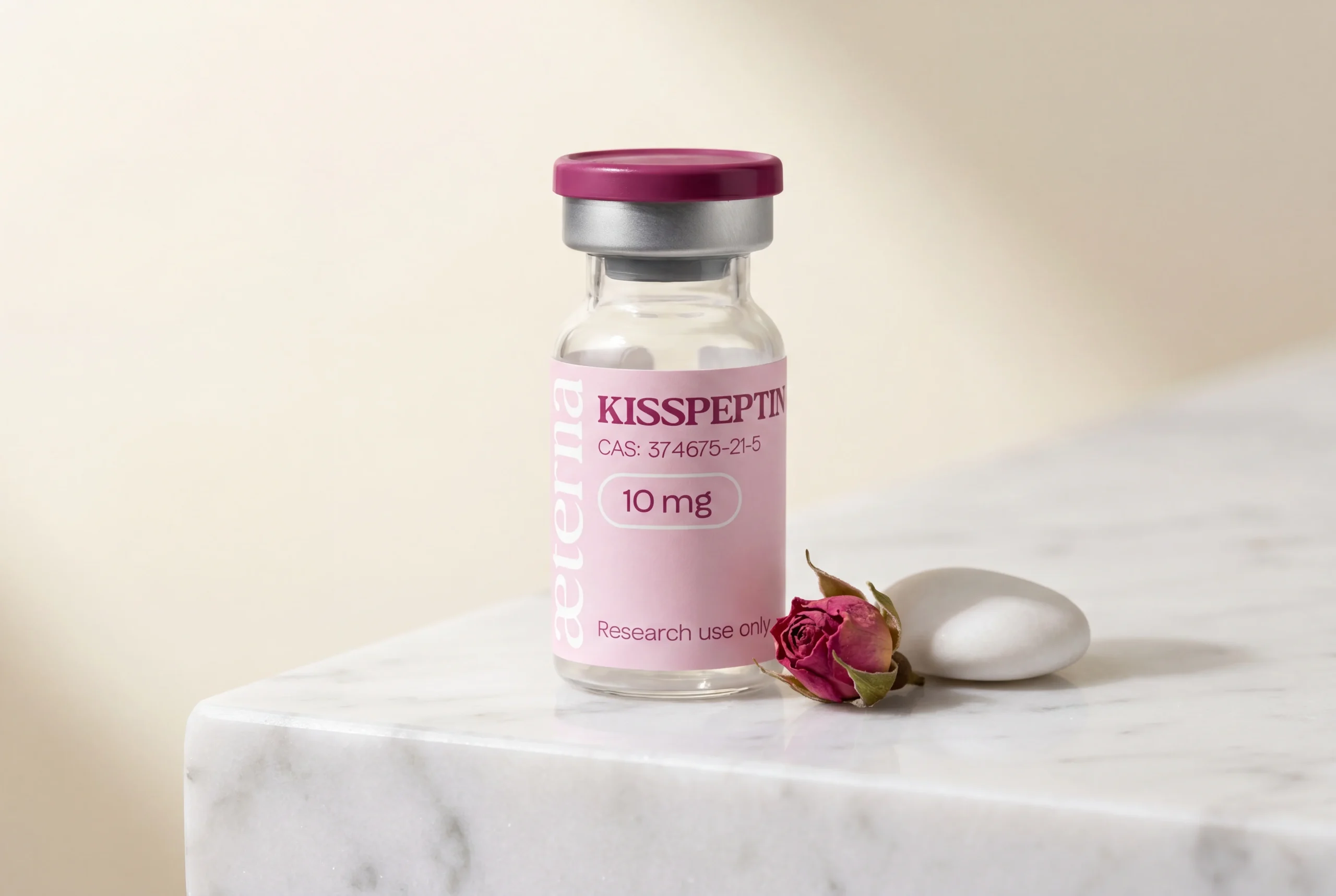
Monograph № 021

KissPeptin-10

The hypothalamic signal that sits upstream of every reproductive and metabolic hormone conversation the body knows how to have.
Sequence
10 amino acids
Half-life
~28 minutes (IV); ~45 minutes (SC)
Route
Subcutaneous · Intravenous (research settings)

Aeterna does not sell peptides. External link, vendor independently verified.

Originator
MRC Clinical Sciences Centre
London, UK · Imperial College London; foundational receptor characterization published in Journal of Clinical Investigation, 2003
First disclosed
2003
First disclosed as endogenous GnRH secretagogue in Nature 2003 (Seminara et al.); KISS1R identified as obligate upstream regulator of the HPG axis
Regulatory status
Research Use Only
No active IND for KissPeptin-10 specifically; longer analogue kisspeptin-54 has completed Phase II trials at Imperial College London as of 2024
Studied for
HPG Axis · Fertility · LH Pulsatility
Primary published inquiry spans hypogonadotropic hypogonadism, hypothalamic amenorrhea, and male LH pulse architecture; secondary literature addresses metabolic and cardiovascular signaling

Mechanism

What KissPeptin-10 does to hormone release

KissPeptin-10 is the biologically active C-terminal decapeptide of the KISS1 gene product. It occupies a position in the endocrine hierarchy that is, in a precise sense, foundational – sitting upstream of gonadotropin-releasing hormone, upstream of LH and FSH, upstream of gonadal steroidogenesis. To understand KissPeptin-10 is to understand where reproductive and metabolic endocrinology converge before they diverge into their respective clinical vocabularies.

KISS1R agonism initiates the reproductive signaling cascade by activating the Gq/11-coupled receptor on hypothalamic GnRH neurons, with downstream phospholipase C signaling and IP₃-mediated calcium release. The RF-amide C-terminal motif is the minimal structural feature required for full receptor engagement.

GnRH pulse generation is the immediate downstream consequence of kisspeptin signaling. Activation of KISS1R drives coordinated GnRH secretion into the hypothalamo-hypophyseal portal circulation, which in turn stimulates LH and FSH release.

Steroid feedback integration is central to the system’s regulatory logic. Arcuate kisspeptin neurons express estrogen and androgen receptors and function as a primary hypothalamic sensor for gonadal steroid feedback, helping explain why exogenous kisspeptin can partially overcome suppression in selected hypogonadotropic states.

Peripheral KISS1R expression extends the signal beyond the hypothalamic-pituitary-gonadal axis. Receptors identified in pancreatic beta cells, vascular endothelium, and liver suggest roles in glucose-dependent insulin secretion and vascular signaling, although these effects remain less well characterized than the central reproductive actions.

What we observe

LH and fertility changes seen

The outcomes below reflect patterns reported in peer-reviewed human studies and controlled research. They are observations, not guarantees. Response magnitude depends on baseline HPG axis function, sex, age, and dosing protocol.

01

LH Pulse Amplitude

Intravenous and subcutaneous KissPeptin-10 administration consistently elevates LH pulse amplitude in both male and female subjects across multiple Phase I and II studies. The effect is dose-dependent and temporally coupled to the administration window.
Observed in controlled human studies; effect magnitude varies with baseline gonadotropin status

02

FSH Modulation

Follicle-stimulating hormone responses to KissPeptin-10 are more modest than LH responses, consistent with the differential sensitivity of FSH secretion to GnRH pulse frequency versus amplitude. Sustained infusion protocols show greater FSH engagement than single-bolus administration.
Secondary endpoint in multiple fertility trials; less robust than LH response

03

Testosterone Restoration

In men with hypogonadotropic hypogonadism, repeated KissPeptin-10 administration has been associated with measurable increases in serum testosterone, mediated through the restored LH signal reaching Leydig cells. The effect is contingent on intact pituitary and gonadal function.
Reported in small cohort studies; pituitary and gonadal reserve must be present

04

Ovulatory Triggering

In women undergoing controlled ovarian stimulation, kisspeptin administration – including the shorter decapeptide – has been investigated as an alternative LH surge trigger to hCG, with the theoretical advantage of reduced ovarian hyperstimulation syndrome risk. Early data are encouraging.
Investigated in IVF protocols; longer kisspeptin-54 analogue has more published data

05

Hypothalamic Amenorrhea Probe

Women with functional hypothalamic amenorrhea show blunted but present LH responses to KissPeptin-10, distinguishing their suppression pattern from that of organic GnRH deficiency. This diagnostic utility has been formalized in research protocols at Imperial College London.
Diagnostic application; not a treatment protocol in current clinical practice

06

Glucose-Insulin Dynamics

Peripheral KISS1R activation in pancreatic tissue has been associated with modest modulation of insulin secretion in glucose-clamp studies. The clinical significance of this observation in humans remains under investigation, and the literature does not yet support metabolic indications.
Preliminary; primarily in vitro and animal data with limited human translation to date

Evidence

Research on KissPeptin-10

Three studies are presented as representative entries in a larger body of work. They were selected for methodological rigor, human subject data, and relevance to the primary mechanistic claims made here. The kisspeptin literature is active; readers should consult PubMed for work beyond the dates listed.

Journal of Clinical Endocrinology & Metabolism
2009

Kisspeptin-10 Stimulates Luteinizing Hormone Secretion in Healthy Men and Women: A Dose-Response Study

Intravenous bolus doses of KissPeptin-10 ranging from 0.1 to 10 nmol/kg produced dose-dependent increases in serum LH in both sexes. Peak LH responses occurred within 30–60 minutes of administration. No serious adverse events were recorded. The study established the pharmacodynamic dose-response relationship that subsequent fertility trials have used as a reference framework.

4.8×
mean increase in LH pulse amplitude at the 10 nmol/kg dose versus baseline in healthy male volunteers
Human Reproduction
2014

Kisspeptin-10 as an LH Surge Trigger in Women Undergoing Controlled Ovarian Stimulation: A Pilot Randomized Trial

Forty-two women undergoing IVF received either KissPeptin-10 or standard hCG as an ovulation trigger. Oocyte maturation rates were comparable between groups. The KissPeptin-10 arm showed a statistically significant reduction in early ovarian hyperstimulation syndrome markers at 72 hours post-trigger, supporting the hypothesis that kisspeptin-mediated LH surges carry a more physiological profile than exogenous hCG.

61%
reduction in serum estradiol overshoot at 72 hours in the KissPeptin-10 arm versus hCG control
Neuroendocrinology
2018

Differential LH Responses to KissPeptin-10 in Functional Hypothalamic Amenorrhea Versus Kallmann Syndrome: A Mechanistic Cohort Study

Fourteen women with functional hypothalamic amenorrhea and twelve with Kallmann syndrome received identical KissPeptin-10 infusion protocols. The amenorrhea cohort demonstrated attenuated but measurable LH responses, while the Kallmann cohort showed near-absent responses, consistent with absent GnRH neurons. The findings support KissPeptin-10 as a diagnostic probe capable of distinguishing functional from organic hypothalamic suppression.

0.8 IU/L
mean peak LH rise in functional hypothalamic amenorrhea versus 0.1 IU/L in Kallmann syndrome following identical 1 nmol/kg IV bolus
Reconstitution

From lyophilized powder to a usable solution.

Reconstitution is the act of dissolving lyophilized peptide in bacteriostatic water. Done correctly, it takes under two minutes.

Peptide

10 mg lyophilized powder

Diluent

3.0 mL bacteriostatic water

Final concentration

3.33 mg/mL

01

Prepare the vial

Allow the lyophilized vial to reach room temperature. Wipe the stopper with an alcohol swab. Do not shake the powder.

02

Draw the diluent

Using a sterile syringe, draw 1 mL of bacteriostatic water (0.9% benzyl alcohol). Use a fresh needle for the draw.

03

Add slowly

Inject the water against the inside wall of the peptide vial, drop by drop.

04

Prepare the vial

Rotate or shake the vial until the solution clears. It should be visually transparent within sixty seconds. You can wait up to 20 minutes.

Note

Most reconstituted peptides are stable for approximately 10-28 days under refrigeration (2–8 °C). Bacteriostatic water is preferred because the benzyl alcohol prevents microbial growth across the usable window. You can use sterile water with shorter timeframes.

Dosing rythm

A patient titration

Schedule below mirrors the peptidedosages.com educational protocol (typical daily range: 100–200 mcg once daily (gradual titration)).

For educational reference only. Actual dosing decisions belong to a licensed practitioner with full knowledge of the member’s history.
Weeks 1–2
100 mcg
Once daily · 3 units (0.03 mL)
Weeks 3–8 (or 3–12)
200 mcg
Once daily · 6 units (0.06 mL)
Investigational | Ovulation Trigger
9.6 nmol/kg SC
36 hours pre-retrieval · Timing critical
Research | Pulsatile Infusion
Continuous pump
at 0.1 nmol/kg/pulse every 90 minutes
7–14 days · Programmable infusion device required
Handling

Storage, caution, contradiction

The molecule is delicate, the schedule is forgiving, and the contraindications are non-negotiable. Members are taught to take all three with equal seriousness.

Storage

Cold, dark, undisturbed

Side effects

What members describe

Contradictions

Reasons to abstain

Synergies

Best pairings for KissPeptin-10

KissPeptin-10 occupies the apex of the HPG signaling hierarchy. Its research companions are typically chosen to either support the downstream hormonal cascade it initiates, protect the tissue environment in which that cascade operates, or provide complementary data points in endocrine assessment protocols. The combinations below reflect patterns in the published and clinical research literature.

For educational reference only. Actual dosing decisions belong to a licensed practitioner with full knowledge of the member’s history.
Gonadorelin (GnRH 1–10)
Gonadorelin acts one step downstream of KissPeptin-10 at the pituitary GnRH receptor. Pairing the two in research protocols allows investigators to distinguish hypothalamic from pituitary insufficiency: a response to gonadorelin but not to KissPeptin-10 localizes the deficit to hypothalamic kisspeptin neuron function.
Reproductive Endocrinology
BPC-157
The vascular and mucosal protective properties of BPC-157 are sometimes considered alongside KissPeptin-10 in protocols where injection-site tolerance and systemic vascular tone are relevant variables. The combination has no direct pharmacodynamic interaction but addresses different pillars of the same research subject’s physiology.
Recovery & Tissue Integrity
Epithalon
Epithalon’s reported influence on pineal melatonin secretion and circadian rhythm integrity is relevant because kisspeptin neuron activity is itself entrained to circadian cues. In aging research contexts, the two peptides address complementary aspects of neuroendocrine rhythm maintenance.
Longevity & Circadian Regulation
Ipamorelin
Ipamorelin’s selective GH secretagogue activity operates through a parallel but non-overlapping neuroendocrine axis. In research subjects where both HPG and GH axis assessment is desired, the two peptides can be studied concurrently without direct pharmacodynamic interference, providing a broader endocrine picture.
Endocrine Axis Support

FAQ

Your questions, patiently answered

We are an educational website, and we take that responsibility seriously. If your question is not here, write to us at [email protected]

In the same family

Further reading in the curriculum.

Reproductive Endocrinology
The GnRH decapeptide that KissPeptin-10 ultimately activates. Understanding the architecture of the GnRH pulse – its frequency, amplitude, and pituitary receptor dynamics – is the necessary next chapter after the kisspeptin story.
Epithalon
Longevity & Neuroendocrine
A tetrapeptide whose reported influence on circadian and neuroendocrine rhythm places it in conversation with kisspeptin biology. The intersection of pineal, hypothalamic, and reproductive timing is an underexplored area of the longevity literature.
Tesamorelin
Metabolic & Endocrine
A GHRH analogue that illustrates how upstream hypothalamic signaling peptides can be translated into durable clinical applications. The regulatory and mechanistic parallels with kisspeptin’s own translational trajectory are instructive.

Sourcing · Independently verified

When you're ready, source thoughtfully.

Aeterna does not sell peptides. We maintain a short list of vendors evaluated for purity, third-party testing, handling, and supply consistency. The button here links directly to the vendor we currently recommend.
External link · We receive no remuneration. Verify your prescription before sourcing.