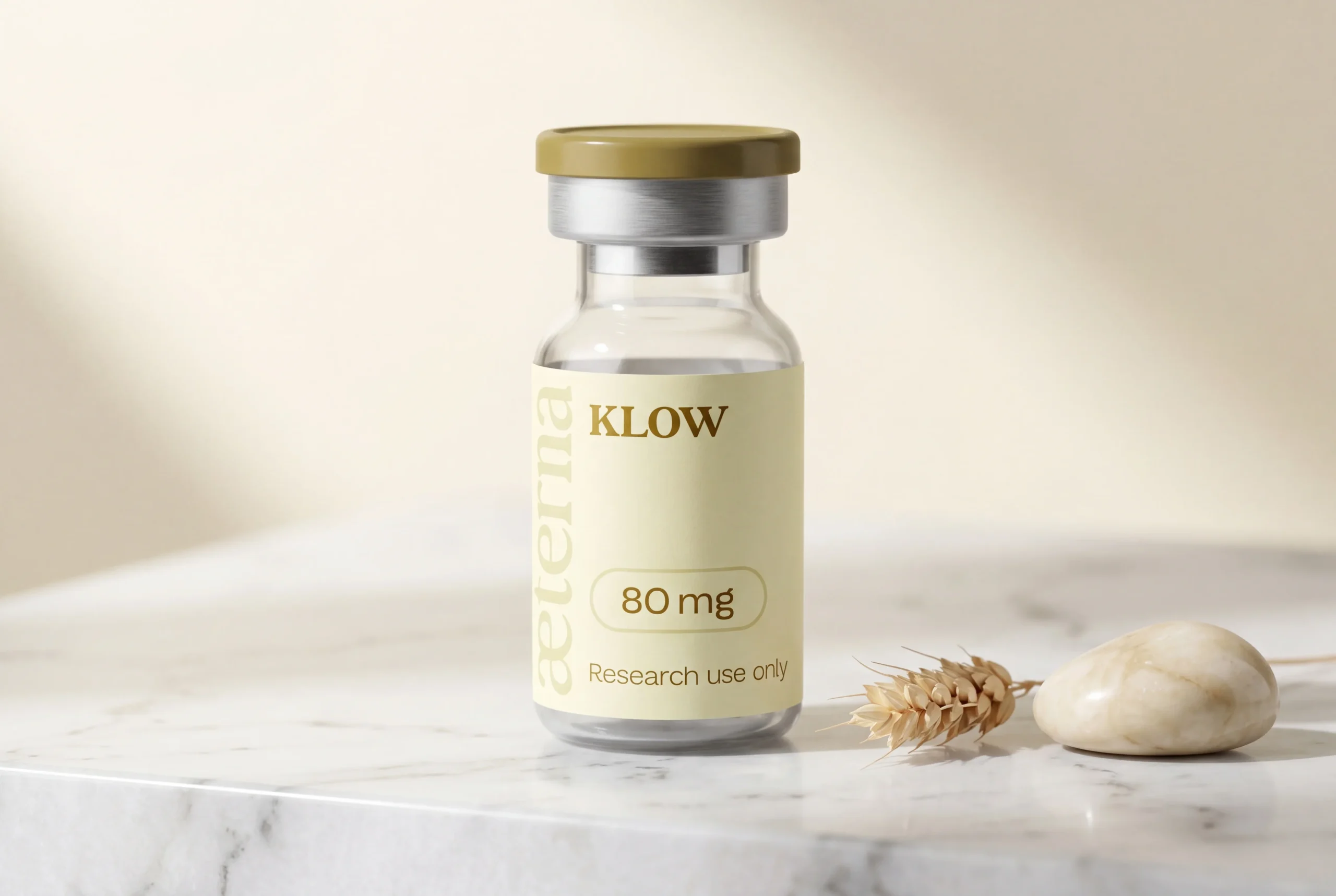
KLOW
Aeterna does not sell peptides. External link, vendor independently verified.
Mechanism
KLOW is not a single molecule. It is a deliberate assembly – four bioactive components, each with its own receptor vocabulary, each addressing a distinct layer of cellular maintenance. The logic of the combination is convergence: where one signal reaches its ceiling, another continues the conversation. Understanding KLOW requires understanding each voice in the chorus before hearing the chord.
GHK-Cu engages the extracellular matrix through coordinated MMP/TIMP regulation and activation of antioxidant signaling pathways. In preclinical work, this has been associated with broad shifts in gene expression related to oxidative stress and tissue repair.
Thymosin β4 sequesters G-actin monomers and supports cell migration while influencing Akt/PI3K-linked survival signaling. In injury models, these effects have been studied in relation to endothelial maintenance, cardiomyocyte survival, and tissue repair dynamics.
BPC-157 has been studied for effects on nitric oxide signaling, fibroblast activity, and focal adhesion pathways involved in repair. In preclinical models, this has been discussed alongside tendon healing, gastrointestinal protection, and autonomic regulation.
Cyclo(His-Pro) is a cyclic dipeptide metabolite of TRH with reported effects on monoaminergic and neuroendocrine signaling. Within the blend, it represents the neuroendocrine component rather than a direct structural repair signal.
What we observe
Observed healing and recovery effects
The outcomes attributed to KLOW’s components span multiple tissue systems and biological timescales. What follows reflects patterns reported in preclinical models and, where available, early human studies. No outcome below should be read as a guaranteed effect of the composite formulation. The literature on individual components is more developed than any evidence for the combination.
01
Dermal Remodeling
02
Wound Closure Acceleration
03
Tendon and Ligament Repair
04
Gastrointestinal Mucosal Protection
05
Neuroendocrine Modulation
06
Antioxidant Signaling
Evidence
Research behind KLOW
No published clinical trial has evaluated the KLOW composite formulation as a unified intervention. The evidence base below reflects the strongest available studies for individual components. Readers are encouraged to consult primary sources and to hold the composite’s implied benefits at appropriate epistemic distance.
GHK-Cu Modulates Collagen Synthesis and Matrix Metalloproteinase Expression in Human Dermal Fibroblasts
Human dermal fibroblasts treated with GHK-Cu at physiological concentrations (1–10 nM) demonstrated statistically significant upregulation of collagen I and III mRNA, alongside coordinated induction of MMP-1 and TIMP-1 – a pattern consistent with remodeling rather than fibrotic deposition. Nrf2 nuclear translocation was observed at 24 hours, preceding antioxidant gene expression changes.
Thymosin β4 Promotes Endothelial Progenitor Cell Recruitment and Neovascularization in a Murine Hindlimb Ischemia Model
Systemic administration of Tβ4 in a murine hindlimb ischemia model produced significant increases in endothelial progenitor cell homing to ischemic tissue, measurable neovascularization at 14 days, and improved limb perfusion ratios versus saline control. Akt phosphorylation in endothelial cells was identified as a required intermediate step; PI3K inhibition abolished the effect.
BPC-157 Accelerates Tendon-to-Bone Healing and Upregulates Growth Hormone Receptor Expression in a Rat Achilles Transection Model
Rats receiving BPC-157 (10 µg/kg, subcutaneous) following Achilles tendon transection demonstrated significantly accelerated histological healing scores at days 7 and 14, with organized collagen fiber deposition and reduced inflammatory cell infiltrate compared to controls. Growth hormone receptor mRNA in tenocytes was elevated 3.1-fold, suggesting a local anabolic signaling mechanism independent of systemic GH levels.
From lyophilized powder to a usable solution.
Peptide
80 mg lyophilized powder
Diluent
3.0 mL bacteriostatic water
Final concentration
26.7 mg/mL
01
Prepare the vial
02
Draw the diluent
03
Add slowly
04
Prepare the vial
Note
Dosing rythm
A patient titration
Schedule below mirrors the peptidedosages.com educational protocol.
Storage, caution, contradiction
Storage
Cold, dark, undisturbed
- Lyophilized: freeze at −20 °C (−4 °F).
- After reconstitution, refrigerate at 2–8 °C (35.6–46.4 °F).
- Avoid freeze–thaw cycles.
- Protect from light at all stages; the copper chelate in GHK-Cu is photosensitive and may undergo oxidation under prolonged UV exposure
- Draw and administer promptly after loading syringe; avoid prolonged contact between reconstituted solution and metal needle hubs
Side effects
What members describe
- Injection site reactions - transient erythema, mild induration, or pruritus; most common during orientation phase and typically self-resolving within 24–48 hours
- Transient fatigue or mild sedation reported anecdotally in the first week; attributed speculatively to cyclo(His-Pro) modulation of dopaminergic tone
- Nausea or mild gastrointestinal discomfort, particularly at higher doses; BPC-157's nitric oxide modulation may transiently alter gastric motility
- Skin flushing or warmth near injection site; possibly related to GHK-Cu-mediated local vasodilation via VEGF upregulation
- Vivid dreams or altered sleep architecture reported by a subset of users in anecdotal accounts; mechanism unclear; monitor and reduce dose if persistent
Contradictions
Reasons to abstain
- Active malignancy or personal history of hormone-sensitive cancer; growth-promoting signals within the complex (GHK-Cu VEGF induction, Tβ4 angiogenic activity) are theoretically contraindicated in oncological contexts
- Pregnancy and lactation; no safety data exist for any component of the composite in human pregnancy
- Known hypersensitivity to any component peptide or to copper salts; GHK-Cu contains ionic copper and may provoke reactions in copper-sensitive individuals
- Wilson's disease or other copper metabolism disorders; exogenous copper peptide administration is contraindicated in conditions of copper accumulation
- Concurrent use of immunosuppressive agents or anticoagulants without physician oversight; Tβ4's immune-modulatory and BPC-157's nitric oxide effects may interact unpredictably with these drug classes
Synergies
Useful partners for KLOW
KLOW’s four-component architecture already represents a form of internal stacking. When practitioners consider additional companions, the logic should be additive without redundancy – each added signal addressing a pillar not already covered within the complex. The following pairings reflect patterns observed in the practitioner literature, not clinical trial data.
FAQ
Your questions, patiently answered
KLOW is a compounded designation, not an acronym with a single authoritative expansion. The formulation emerged from the compounding pharmacy and research peptide communities in the late 2010s as practitioners sought to combine the complementary repair signals of GHK-Cu, Tβ4, BPC-157, and cyclo(His-Pro) in a single preparation. No single institution or researcher holds authorship over the composite. The name itself is a proprietary label applied to a fixed-ratio blend.
No. As of 2025, no published randomized controlled trial has evaluated the KLOW composite formulation. The evidence base consists entirely of studies on individual components – some robust, some preliminary. The inference that combining four well-studied components produces a predictable composite effect is plausible but unvalidated. This is a meaningful epistemic gap.
In 2023, the FDA removed BPC-157 from the list of bulk drug substances that may be used in compounding under Section 503A and 503B of the Federal Food, Drug, and Cosmetic Act, citing insufficient evidence of clinical utility and safety for compounded use. This regulatory action does not constitute a finding of harm, but it does affect the legal availability of BPC-157 in compounded preparations within the United States. Any formulation containing BPC-157 – including KLOW – is subject to this regulatory context. Practitioners and patients should consult current regulatory guidance in their jurisdiction.
Yes, and many practitioners do exactly that – sourcing each component individually to allow independent dose titration and cleaner attribution of effects. The composite formulation offers convenience and a fixed ratio, but it sacrifices flexibility. For practitioners who wish to adjust BPC-157 dosing independently of GHK-Cu, or who want to cycle components on different schedules, individual sourcing is the more considered approach.
GHK-Cu has an extensive topical literature – arguably more developed than its injectable literature – and is a common ingredient in cosmeceutical formulations. However, KLOW as a composite is formulated for subcutaneous injection. The other three components (Tβ4, BPC-157, cyclo(His-Pro)) do not have established topical bioavailability profiles. Applying the injectable composite topically would be an off-label, unstudied use with uncertain penetration and efficacy for the non-copper components.
The timeline varies considerably by component and by the condition being addressed. GHK-Cu’s effects on skin quality are typically reported over weeks to months. BPC-157’s gastrointestinal and tendon effects in animal models appear within days to two weeks. Tβ4’s angiogenic and wound-healing effects in human trials have been measured at four to twelve weeks. Cyclo(His-Pro)’s neurological effects, if present, may be among the earliest perceived. No composite timeline has been established. Patience – and careful observation – is the appropriate posture.
In the same family
Further reading in the curriculum
Sourcing · Independently verified
When you're ready, source thoughtfully.