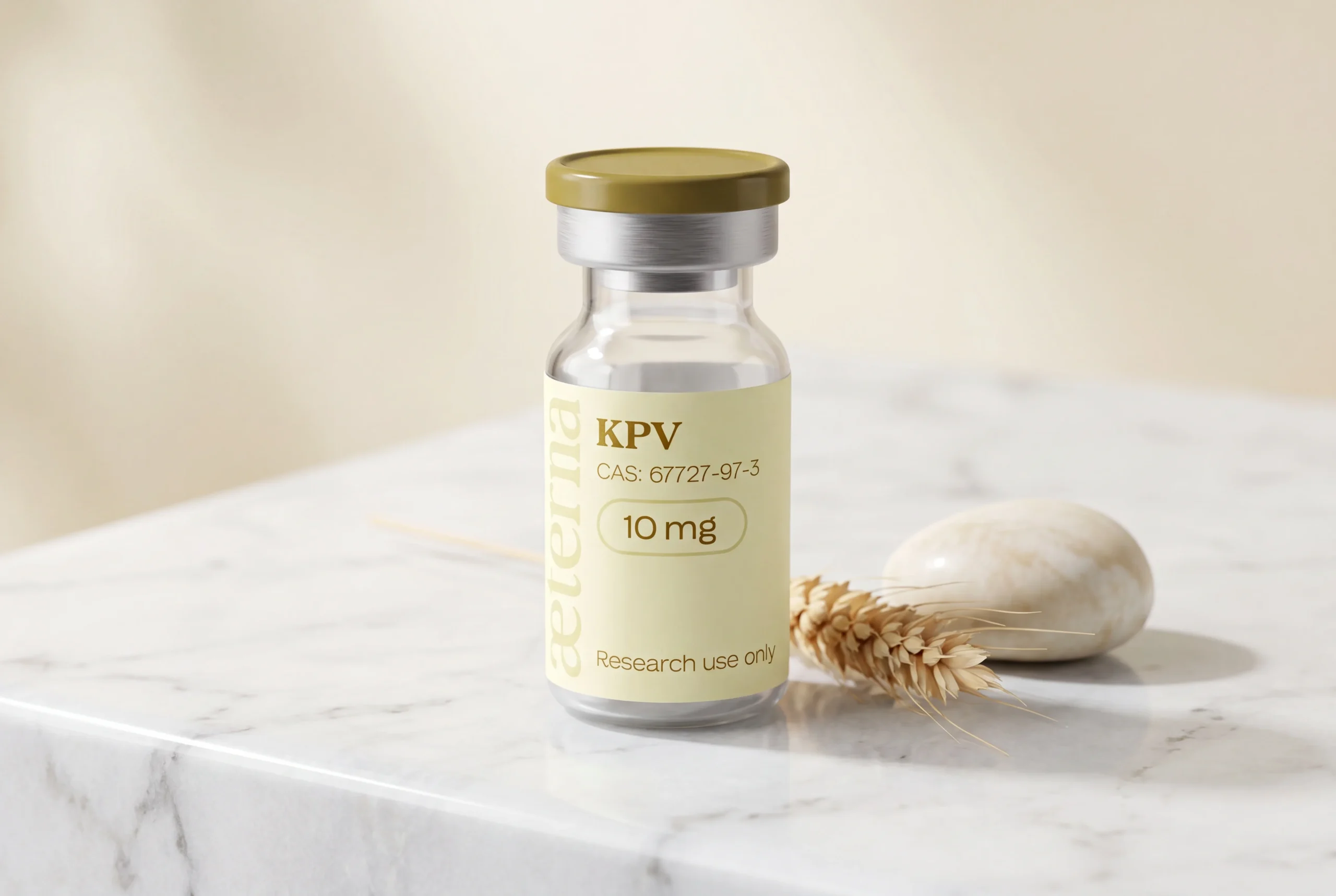
Monograph № 021

KPV

A tripeptide derived from melanocortin signaling studied for its capacity to quiet intestinal and systemic inflammation without immunosuppression.
Sequence
3 amino acids
Half-life
~2–4 hours (in vitro); oral and topical stability under investigation
Route
Subcutaneous · Oral (experimental) · Topical

Aeterna does not sell peptides. External link, vendor independently verified.

Originator
Derived from α-MSH C-terminus
Identified at the University of Texas Southwestern Medical Center; C-terminal tripeptide of α-melanocyte-stimulating hormone (α-MSH₁₁₋₁₃)
First disclosed
1995
First characterized in peer-reviewed literature, Journal of Immunology, 1995 – Lipton & Catania laboratory; CAS 67727-97-3
Regulatory status
Pre-clinical / Research Use
No active IND on file with the FDA as of 2025; studied extensively in murine colitis and wound models; not approved for human therapeutic use
Studied for
Intestinal Inflammation · Wound Healing · Systemic Immune Modulation
Primary published inquiry spans IBD models (DSS-induced colitis, TNBS colitis), dermal wound repair, and NF-κB pathway attenuation – literature concentrated in journals including Peptides, Gut, and the American Journal of Physiology

Mechanism

KPV helps calm inflammation signals

KPV is not a large molecule. It is three amino acids – lysine, proline, valine – cleaved from the C-terminal end of α-melanocyte-stimulating hormone. That brevity is, in part, the point. The parent peptide, α-MSH, carries broad melanocortin activity across five receptor subtypes. KPV retains a focused subset of that activity: principally at MC1R and MC3R, the receptors most implicated in peripheral and mucosal immune regulation. What the literature describes is a signal that enters inflamed tissue, engages specific receptor architecture, and attenuates the transcriptional machinery driving cytokine production – without the broad immunosuppression that accompanies corticosteroid intervention.

Peptide origin explains why KPV attracts interest disproportionate to its size. It is the C-terminal tripeptide fragment of alpha-melanocyte-stimulating hormone and preserves part of the parent molecule’s anti-inflammatory signaling profile.

Inflammatory control appears to center on suppression of NF-kB dependent transcription. In preclinical systems, KPV reduces mediators such as TNF-alpha, IL-1beta, and IL-6 without acting through glucocorticoid pathways.

Intestinal relevance is where the literature is most developed. Murine colitis models have shown reduced mucosal inflammation after oral, topical, and parenteral delivery, though formulation strongly influences what is feasible.

Translational status remains early. Its small size supports favorable solubility and tissue access, but as of 2026 the evidence base is still predominantly preclinical rather than clinical.

What we observe

Observed gut and skin effects

The outcomes described below reflect patterns reported in pre-clinical and early translational research. KPV has not completed controlled human clinical trials. The observations are drawn from murine colitis models, in vitro cytokine assays, and dermal wound studies. They describe what the literature reports – not what any individual will experience. Aeterna does not prescribe, dispense, or sell.

01

Colonic Inflammation

In DSS-induced and TNBS-induced murine colitis models, KPV administration – both systemic and oral nanoparticle-encapsulated – has been associated with reduced histological damage scores, lower mucosal TNF-α and IL-6 concentrations, and preserved crypt architecture compared to vehicle controls.
Pre-clinical (murine); not established in human IBD trials

02

NF kB Suppression

In vitro studies using LPS-stimulated macrophages demonstrate that KPV reduces NF-κB nuclear translocation in a concentration-dependent manner. The effect is observed at nanomolar concentrations, suggesting high receptor affinity relative to molecular weight.
In vitro; translational relevance to human macrophage biology under investigation

03

Barrier Preservation

Colonic tissue from KPV-treated animals in inflammatory models shows maintained expression of tight-junction proteins occludin and ZO-1 relative to untreated inflamed controls. The pattern suggests a role in preventing the epithelial permeability that amplifies intestinal inflammatory cycles.
Pre-clinical; mechanistic basis established, clinical correlation not yet demonstrated

04

Wound Closure

Topical and subcutaneous KPV application in excisional wound models has been associated with faster re-epithelialization rates and increased collagen deposition at wound margins. The effect is attributed to MC1R-mediated upregulation of TGF-β1 in fibroblasts and keratinocytes.
Pre-clinical (murine excisional models); topical formulation pharmacokinetics remain under study

05

Cytokine Reduction

Systemic KPV administration in sepsis-adjacent inflammatory models has been associated with reduced circulating IL-1β and TNF-α. The pattern mirrors the anti-inflammatory profile of full-length α-MSH but with a narrower receptor engagement footprint and reduced melanotropic side-effect potential.
Pre-clinical; systemic dosing parameters in humans not established

06

Oral Delivery

Research groups at the University of Massachusetts and Emory University have explored hydrogel and PLGA nanoparticle formulations that protect KPV from gastric proteolysis and deliver it intact to colonic mucosa. In murine colitis models, orally administered encapsulated KPV produced outcomes comparable to subcutaneous dosing – a finding with significant implications for non-injectable delivery.
Formulation research stage; oral bioavailability in humans not confirmed

Evidence

Evidence behind KPV

The studies below represent selected entries from a body of pre-clinical literature spanning approximately three decades. KPV’s evidence base is concentrated in animal models and in vitro systems. Human pharmacokinetic and efficacy data remain limited. The literature is cited here for orientation, not as proof of clinical effect.

Journal of Immunology
1995

Anti-inflammatory effects of the C-terminal tripeptide of alpha-melanocyte-stimulating hormone: KPV modulates NF-κB activation in murine macrophages

The founding characterization of KPV’s anti-inflammatory activity. Lipton and Catania demonstrated that the C-terminal tripeptide of α-MSH inhibited LPS-induced NF-κB nuclear translocation in peritoneal macrophages and reduced TNF-α secretion in a dose-dependent manner. The study established that the C-terminal sequence, not the full peptide, was sufficient for anti-inflammatory signaling – a finding that anchored two decades of subsequent fragment research.

62%
reduction in TNF-α secretion from LPS-stimulated macrophages at 10⁻⁸ M KPV concentration
Gut
2009

Oral delivery of KPV in hydrogel nanoparticles ameliorates intestinal inflammation in a murine model of colitis

Researchers at Emory University encapsulated KPV in PEGylated hydrogel nanoparticles and administered the formulation orally to DSS-treated mice. Colonic inflammation scores, myeloperoxidase activity, and mucosal cytokine levels were significantly reduced relative to free-peptide oral controls, demonstrating that encapsulation protected KPV from gastric degradation and enabled targeted mucosal delivery. Tight-junction protein expression was preserved in treated animals.

54%
reduction in colonic myeloperoxidase activity versus DSS-only controls in nanoparticle-KPV group
Peptides
2014

KPV accelerates cutaneous wound healing through MC1R-mediated TGF-β1 upregulation in dermal fibroblasts

A murine excisional wound model demonstrated that topical KPV application twice daily accelerated wound closure compared to vehicle controls, with histological analysis confirming increased collagen density and earlier re-epithelialization. Mechanistic assays identified MC1R as the primary receptor mediating the effect, with downstream upregulation of TGF-β1 and VEGF in wound-margin fibroblasts. The study proposed KPV as a candidate for dermal repair applications where inflammation and healing overlap.

38%
faster wound closure rate at day 7 in KPV-treated animals versus vehicle controls
Reconstitution

From lyophilized powder to a usable solution.

Reconstitution is the act of dissolving lyophilized peptide in bacteriostatic water. Done correctly, it takes under two minutes.

Peptide

10 mg lyophilized powder

Diluent

3.0 mL bacteriostatic water

Final concentration

3.33 mg/mL

01

Prepare the vial

Allow the lyophilized vial to reach room temperature. Wipe the stopper with an alcohol swab. Do not shake the powder.

02

Draw the diluent

Using a sterile syringe, draw 1 mL of bacteriostatic water (0.9% benzyl alcohol). Use a fresh needle for the draw.

03

Add slowly

Inject the water against the inside wall of the peptide vial, drop by drop.

04

Prepare the vial

Rotate or shake the vial until the solution clears. It should be visually transparent within sixty seconds. You can wait up to 20 minutes.

Note

Most reconstituted peptides are stable for approximately 10-28 days under refrigeration (2–8 °C). Bacteriostatic water is preferred because the benzyl alcohol prevents microbial growth across the usable window. You can use sterile water with shorter timeframes.

Dosing rythm

A patient titration

Schedule below mirrors the peptidedosages.com educational protocol (typical daily range: 200–500 mcg once daily (gradual titration recommended)).

For educational reference only. Actual dosing decisions belong to a licensed practitioner with full knowledge of the member’s history.
Week 1
200 mcg
Once daily · 6 units (0.06 mL)
Week 2
300 mcg
Once daily · 9 units (0.09 mL)
Week 3
400 mcg
Once daily · 12 units (0.12 mL)
Weeks 4–8
500 mcg
– not achievable with standard reconstitution
Once daily · 15 units (0.15 mL)
Handling

Storage, caution, contradiction

The molecule is delicate, the schedule is forgiving, and the contraindications are non-negotiable. Members are taught to take all three with equal seriousness.

Storage

Cold, dark, undisturbed

Side effects

What members describe

Contradictions

Reasons to abstain

Synergies

Useful partners for KPV

KPV’s primary axis is mucosal and systemic inflammation. Its companions in research protocols tend to address overlapping pillars: gut barrier integrity, tissue repair, and immune regulation. The combinations below reflect patterns observed in the literature and in researcher-reported protocols – not clinical recommendations. Aeterna does not prescribe, dispense, or sell.

For educational reference only. Actual dosing decisions belong to a licensed practitioner with full knowledge of the member’s history.
BPC-157
BPC-157’s well-documented role in promoting angiogenesis and gut mucosal repair complements KPV’s cytokine-suppressing activity. Where KPV quiets the inflammatory signal, BPC-157 supports the structural repair that follows. The combination appears in IBD-adjacent research discussions as a dual-mechanism approach to mucosal recovery.
Gut Repair · Tissue Healing
Thymosin β4 (TB-500)
Thymosin β4 promotes actin polymerization, cell migration, and tissue remodeling – processes that operate downstream of the inflammatory phase KPV attenuates. In wound-healing contexts, the pairing addresses both the inflammatory and proliferative phases of repair, which are temporally distinct but mechanistically linked.
Tissue Repair · Immune Modulation
LL-37
LL-37, the human cathelicidin antimicrobial peptide, addresses the microbial dimension of intestinal inflammation that KPV’s cytokine-focused mechanism does not directly target. In gut-health research contexts, the two peptides are discussed as complementary: one modulating the immune response, the other maintaining the antimicrobial barrier.
Antimicrobial · Mucosal Defense
Epithalon
Epithalon’s telomerase-activating and antioxidant properties address the cellular aging dimension that chronic inflammation accelerates. In longevity-oriented research protocols, KPV’s anti-inflammatory activity and Epithalon’s cellular maintenance role are positioned as addressing different but converging contributors to tissue deterioration over time.
Longevity · Cellular Regulation

FAQ

Your questions, patiently answered

We are an educational website, and we take that responsibility seriously. If your question is not here, write to us at [email protected]

In the same family

Adjacent entries in the curriculum.

BPC-157
Gut Repair
The most extensively studied peptide in mucosal and connective tissue repair. BPC-157 addresses the structural dimension of gut healing that KPV’s anti-inflammatory signaling prepares the ground for – a sequential rather than redundant relationship.
Immune Modulation
Where KPV quiets excessive inflammatory signaling, Thymosin α1 supports the adaptive immune architecture that chronic inflammation erodes. The two peptides address different phases of immune dysregulation and appear in complementary positions in immune-restoration research protocols.
Melanocortin Signaling
PT-141 operates at MC3R and MC4R – the central melanocortin receptors governing sexual arousal and energy balance. It shares receptor family ancestry with KPV but diverges entirely in clinical application, illustrating how receptor subtype selectivity shapes the pharmacological identity of melanocortin-derived peptides.

Sourcing · Independently verified

When you're ready, source thoughtfully.

Aeterna does not sell peptides. We maintain a short list of vendors evaluated for purity, third-party testing, handling, and supply consistency. The button here links directly to the vendor we currently recommend.
External link · We receive no remuneration. Verify your prescription before sourcing.