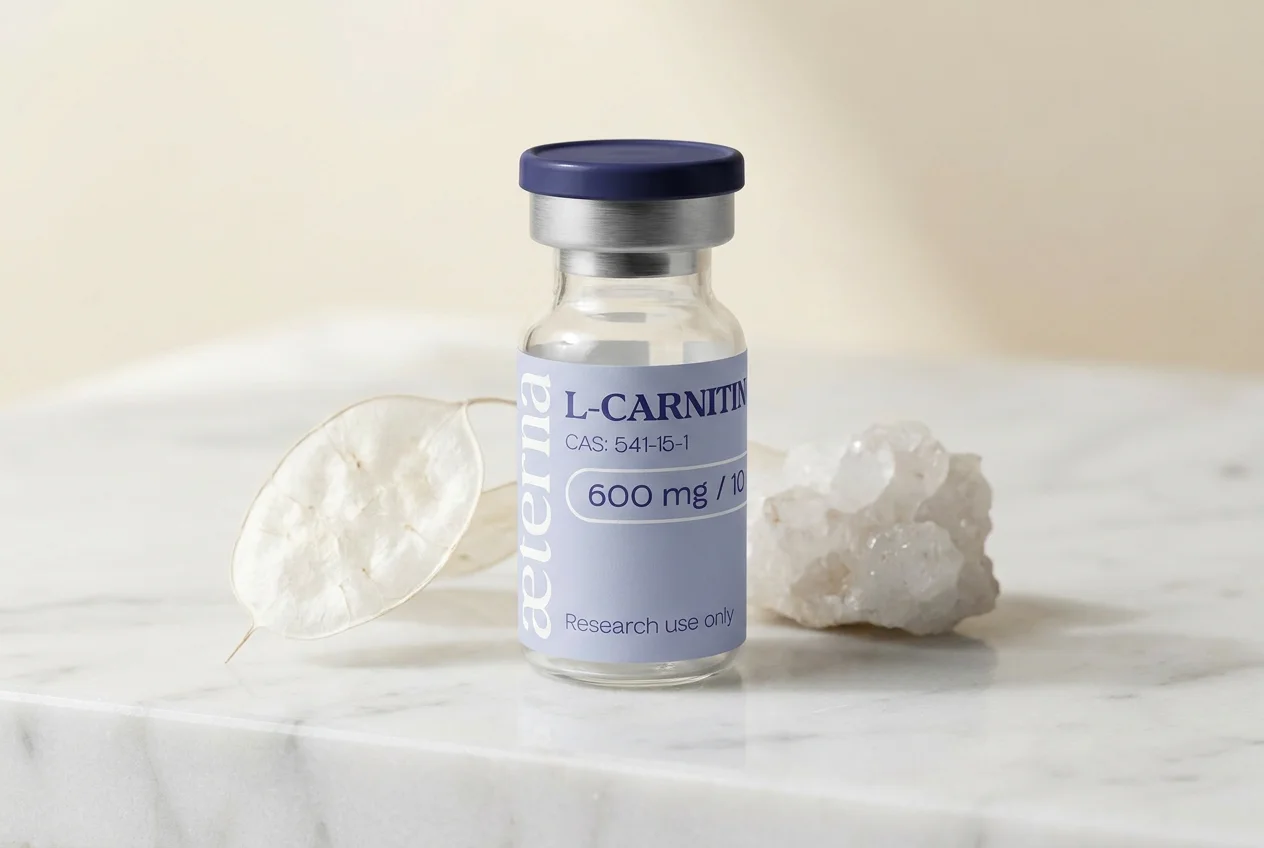
L-carnitine
Aeterna does not sell peptides. External link, vendor independently verified.
Mechanism
L-carnitine is not a stimulant, a hormone, or a signaling peptide in the conventional sense. It is a quaternary amine – small, water-soluble, and ancient in evolutionary terms – whose singular structural purpose is to escort long-chain fatty acids across a membrane that would otherwise exclude them entirely. Without it, the principal fuel of cardiac and skeletal muscle cannot reach the matrix where oxidation occurs. The mechanism is precise, the dependency absolute, and the consequences of deficiency measurable at the cellular level within days.
Mitochondrial transport is the core function of L-carnitine. It carries long-chain fatty acids into the mitochondrial matrix for beta-oxidation, a prerequisite for sustained lipid-derived energy production in tissues such as skeletal muscle and heart.
Physiologic supply comes from both diet and endogenous synthesis. Carnitine is obtained from animal foods and synthesized from lysine and methionine, with clinically meaningful deficiency arising primarily in inherited transport disorders or secondary metabolic states.
Pharmacokinetics shape how supplementation behaves in practice. Oral absorption is saturable and relatively limited at higher doses, which helps explain why route, dose, and clinical context matter more than simple total intake.
Clinical evidence is strongest in deficiency states and selected cardiometabolic settings rather than universal performance enhancement. In healthy individuals, the literature is mixed, though some controlled trials and meta-analyses suggest modest benefits in recovery-related outcomes.
What we observe
Results seen in energy and recovery
The evidence base for L-carnitine is unusually broad – spanning nephrology wards, cardiac rehabilitation units, and exercise physiology laboratories across four decades. What follows reflects patterns reported in peer-reviewed literature. Aeterna does not prescribe, dispense, or sell. Individual responses are not guaranteed, and the observations below should be read as a map of the research landscape, not a promise of personal outcome.
01
Fatty Acid Oxidation
02
Exercise Recovery
03
Cardiac Energetics
04
Insulin Sensitivity
05
Dialysis Deficiency
06
Male Fertility
Evidence
The data on L-carnitine
The studies below represent a cross-section of the published literature – selected for methodological rigor, sample size, and relevance to the primary mechanisms described in this monograph. They are presented for educational orientation. Aeterna does not interpret these findings as prescriptive guidance.
L-Carnitine in the Secondary Prevention of Cardiovascular Disease: Systematic Review and Meta-Analysis
A meta-analysis of 13 randomized controlled trials (n = 3,629) found that L-carnitine supplementation was associated with a 27% reduction in all-cause mortality, a 65% reduction in ventricular arrhythmias, and a 40% reduction in anginal symptoms compared with placebo or control in patients with acute myocardial infarction or chronic heart disease. No significant effect on re-infarction rates was observed. The authors noted that the mortality signal, while statistically significant, was derived from older trials with higher baseline event rates and should be interpreted with appropriate caution.
Oral L-Carnitine Supplementation Increases Trimethylamine-N-Oxide but Improves Malondialdehyde and Exercise-Induced Muscle Damage in Resistance-Trained Males
A 12-week double-blind, placebo-controlled trial (n = 42) in resistance-trained men found that 2 g/day oral L-carnitine significantly reduced post-exercise plasma malondialdehyde (a marker of lipid peroxidation) and creatine kinase release compared with placebo. Muscle soreness visual analogue scores were lower in the carnitine group at 24 and 48 hours post-exercise. The investigators noted a concurrent rise in plasma TMAO levels, a finding that has since prompted ongoing debate regarding the cardiovascular implications of oral carnitine in gut-microbiome-diverse populations.
Intravenous L-Carnitine Supplementation and Erythropoiesis-Stimulating Agent Responsiveness in Maintenance Hemodialysis Patients: A Prospective Randomized Trial
A 24-week prospective randomized trial conducted at the University of Catania Nephrology Unit (n = 86) evaluated intravenous L-carnitine (20 mg/kg post-dialysis, three times weekly) versus placebo in maintenance hemodialysis patients with documented carnitine deficiency (plasma free carnitine < 20 µmol/L). The carnitine group demonstrated a significant reduction in erythropoiesis-stimulating agent (ESA) dose required to maintain target hemoglobin, alongside reductions in intradialytic hypotension episodes and self-reported fatigue scores. Plasma free carnitine normalized within four weeks of initiation.
From lyophilized powder to a usable solution.
Peptide
200 mg lyophilized powder
Diluent
2.0 mL bacteriostatic water
Final concentration
100 mg/mL
01
Prepare the vial
02
Draw the diluent
03
Add slowly
04
Prepare the vial
Note
Dosing rythm
A patient titration
Schedule below mirrors the peptidedosages.com educational protocol (typical daily range: 50–100 mg once daily (gradual titration); advanced protocols may use up to 200 mg).
Storage, caution, contradiction
Storage
Cold, dark, undisturbed
- Lyophilized: freeze at −20 °C (−4 °F).
- After reconstitution, refrigerate at 2–8 °C (35.6–46.4 °F) and use within 2–4 weeks.
- Do not freeze reconstituted solution.
- Inspect injectable solution for particulate matter and discoloration prior to administration; discard if either is present.
- Keep all forms out of reach of children; pharmaceutical-grade injectable product should be handled under aseptic conditions.
Side effects
What members describe
- Gastrointestinal disturbance - nausea, vomiting, abdominal cramping, and diarrhea - is the most commonly reported adverse effect with oral administration, particularly at doses exceeding 3 g/day. Dose reduction or divided dosing typically resolves symptoms.
- A fishy body odor (trimethylaminuria-like) may occur due to bacterial conversion of carnitine to trimethylamine in the gut; more common at higher oral doses and in individuals with altered gut microbiome composition.
- Elevated plasma trimethylamine-N-oxide (TMAO) has been reported following oral L-carnitine supplementation in omnivorous subjects. The cardiovascular implications of chronically elevated TMAO remain an active area of investigation; the signal is less pronounced with IV administration, which bypasses gut metabolism.
- Seizure threshold lowering has been reported in individuals with pre-existing seizure disorders; the mechanism is not fully established but may involve carnitine's influence on GABAergic signaling. Use with caution in this population.
- Peripheral vascular disease patients receiving IV carnitine have occasionally reported transient hypotension; blood pressure monitoring during initial IV administrations is prudent.
Contradictions
Reasons to abstain
- Known hypersensitivity to L-carnitine or any component of the formulation.
- History of seizure disorder - use with caution; the literature contains case reports of increased seizure frequency with supplementation, though causality is not firmly established.
- Concurrent use of pivampicillin or other pivaloyl-conjugated antibiotics, which deplete carnitine by forming pivaloylcarnitine; supplementation may be indicated rather than contraindicated in this context, but requires clinical oversight.
- Patients with trimethylaminuria (fish odor syndrome) should avoid oral L-carnitine due to exacerbation of symptoms from increased trimethylamine production.
- Pregnancy and lactation: L-carnitine is present in breast milk and crosses the placenta; while no teratogenicity has been demonstrated, use during pregnancy or lactation should occur only under direct medical supervision.
Synergies
Best matches for L-carnitine
L-carnitine does not operate in isolation within a considered metabolic protocol. Its function – shuttling fuel to the site of oxidation – is most meaningful when the oxidative machinery itself is well-supported. The companions below reflect combinations studied in the literature or grounded in complementary mechanistic logic. Aeterna does not prescribe combinations. These pairings are offered as a map of the research conversation, not a protocol.
FAQ
Your questions, patiently answered
They are structurally related but functionally distinct. L-carnitine is the parent compound, responsible for fatty acid transport into the mitochondrial matrix. Acetyl-L-carnitine (ALCAR) carries an acetyl group rather than a long-chain acyl group, crosses the blood-brain barrier more readily, and additionally donates acetyl groups for acetylcholine synthesis. ALCAR is the preferred form in neurological and cognitive research; L-carnitine is the preferred form in metabolic, cardiac, and renal research. Some protocols use both simultaneously to address different tissue compartments.
This is one of the most persistently misunderstood questions in the carnitine literature. In individuals with normal carnitine status, oral supplementation does not reliably increase fatty acid oxidation rates – because the rate-limiting step in fat burning is not carnitine availability but rather CPT-I activity, which is regulated by malonyl-CoA and insulin signaling. The effect of supplementation is most pronounced when baseline carnitine is genuinely insufficient. The popular narrative of carnitine as a ‘fat burner’ for healthy individuals is not well-supported by controlled trial data.
Gut bacteria convert L-carnitine to trimethylamine (TMA), which is then oxidized in the liver to trimethylamine-N-oxide (TMAO). Elevated plasma TMAO has been associated with increased cardiovascular risk in observational studies, most notably by Hazen and colleagues at the Cleveland Clinic (Nature Medicine, 2013). The clinical significance of supplementation-induced TMAO elevation – as distinct from dietary TMAO from fish consumption – remains debated. The signal is substantially attenuated with intravenous administration, which bypasses gut metabolism entirely. This is an area of active investigation, not settled science.
Hemodialysis is highly efficient at removing small, water-soluble molecules – and L-carnitine, with a molecular weight of 161 Da and high water solubility, is cleared with each session. Estimates suggest that 60–70% of plasma free carnitine is removed per dialysis treatment. Because the kidneys are also the primary site of carnitine biosynthesis and reabsorption, patients with end-stage renal disease lose both the synthetic and conservation mechanisms simultaneously. The resulting deficiency is iatrogenic, predictable, and correctable – making this one of the most clearly defined indications for L-carnitine supplementation in clinical medicine.
For most omnivorous adults with intact renal function and no metabolic stress, dietary intake – primarily from red meat and dairy – is sufficient to maintain adequate tissue carnitine pools. A 100 g serving of beef provides approximately 60–160 mg of L-carnitine. Strict vegans and vegetarians, however, consume negligible dietary carnitine and rely entirely on endogenous synthesis, which may not fully compensate under conditions of increased demand. Supplementation becomes relevant in the context of documented deficiency, specific disease states, or dietary patterns that substantially limit intake.
The timeline depends entirely on the indication and the baseline carnitine status. In hemodialysis patients with documented deficiency, plasma free carnitine normalizes within three to four weeks of post-dialysis IV administration. In exercise recovery trials, measurable reductions in muscle damage markers have been reported after four to twelve weeks of oral supplementation. In cardiac and metabolic trials, meaningful clinical endpoints typically require twelve to twenty-four weeks of consistent use. There is no rapid-onset effect analogous to a stimulant; carnitine’s action is structural and cumulative, not acute.
In the same family
Further reading in the curriculum
Sourcing · Independently verified
When you're ready, source thoughtfully.