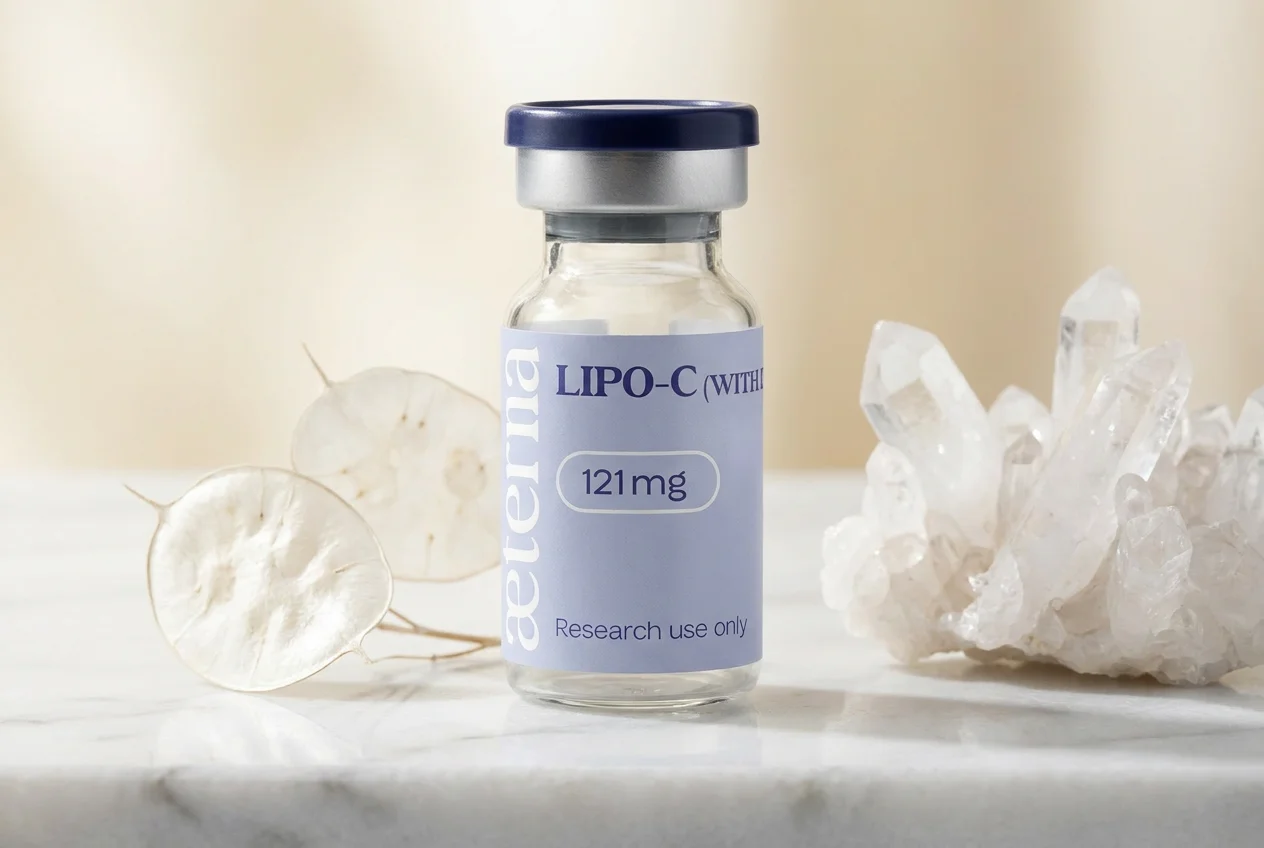
Monograph № 021

Lipo-C (With B12)

The classical lipotropic formula is reconsidered through the lens of hepatic methyl donor chemistry.
Sequence
Lipotropic blend + B12
Half-life
Variable by component (hours to days)
Route
Intramuscular · Subcutaneous

Aeterna does not sell peptides. External link, vendor independently verified.

Originator
Compounding tradition
Lipotropic injection protocols trace to mid-twentieth-century bariatric medicine; formalized in compounding pharmacopeia by the 1970s. No single originating institution.
First disclosed
Mid-20th century
Lipotropic combinations first described in clinical nutrition literature circa 1950s; choline and inositol hepatic roles established in Journal of Biological Chemistry, 1953–1961.
Regulatory status
Compounded preparation
Individual components are FDA-recognized nutrients and cofactors; the combined injectable preparation is produced under USP 797 compounding standards. Not an approved drug product.
Studied for
Hepatic lipid metabolism · Methylation · Neurological cofactor support
Primary published inquiry spans hepatic steatosis, one-carbon metabolism, and peripheral neuropathy; literature concentrated in Journal of Nutrition and Hepatology, 1990–2024.

Mechanism

What this blend does for methylation

Lipo-C is not a single molecule. It is a curated ensemble of methyl donors, phospholipid precursors, and enzymatic cofactors – each acting on a distinct node of hepatic lipid metabolism and one-carbon cycling. Understanding the preparation requires understanding each constituent’s role in the broader biochemical conversation.

Methylcobalamin extends the methionine, inositol, and choline base by supporting methionine synthase activity within one carbon metabolism. In practical terms, B12 helps recycle homocysteine to methionine and complements a formulation built around methyl donor chemistry.

The added B12 component gives the formula a clearer rationale where methylation efficiency or borderline cobalamin status is a concern. This is especially relevant when methionine is included as part of a high dose lipotropic preparation.

Administration patterns generally mirror standard Lipo-C use, with one to three injections weekly over a limited treatment window. Total duration is typically adjusted according to response, formulation, and clinician oversight.

Vitamin B12 also has independent relevance to erythropoiesis and neurologic function beyond any lipotropic intent. For that reason, compounded versions containing B12 are often preferred when cobalamin status is uncertain or low.

What we observe

Changes seen with energy and labs

The following patterns emerge from the published literature on individual components and, where available, combined lipotropic preparations. No outcome is guaranteed. The literature reports associations and mechanistic plausibility; individual response varies with baseline nutritional status, hepatic function, and concurrent dietary practice.

01

Hepatic Triglycerides

In choline- and methionine-sufficient states, VLDL assembly and export from hepatocytes proceeds with greater efficiency. Studies of choline supplementation in adults with non-alcoholic fatty liver disease report measurable reductions in hepatic fat fraction assessed by MRI spectroscopy.
Observed in controlled supplementation trials; magnitude varies with baseline hepatic fat content.

02

Homocysteine Modulation

The methionine cycle, when adequately supported by B12 and B6 cofactors, maintains homocysteine within physiological ranges. Elevated homocysteine is an independent marker of cardiovascular and neurological risk; B12 and B6 repletion consistently lowers circulating homocysteine in deficient populations.
Well-established in B-vitamin repletion literature; effect size greatest in those with documented insufficiency.

03

Insulin Sensitivity

Myo-inositol supplementation has been associated with improved insulin sensitivity indices in women with polycystic ovary syndrome and in subjects with metabolic syndrome. The proposed mechanism involves restoration of IPG second-messenger signaling downstream of the insulin receptor.
Replicated across multiple RCTs in PCOS populations; generalizability to broader metabolic populations requires further study.

04

Neuropathy Symptoms

Cobalamin (B12) is essential for myelin synthesis and axonal maintenance. In populations with B12 insufficiency – including those on long-term metformin, proton pump inhibitors, or with pernicious anemia – parenteral B12 administration reliably improves neurological symptom scores and nerve conduction parameters.
Parenteral route demonstrates superior bioavailability over oral in malabsorptive states; effect is repletion-dependent.

05

Energy Availability

The B-vitamin ensemble – particularly thiamine, riboflavin, niacin, and pantothenic acid – supports mitochondrial oxidative phosphorylation and fatty acid beta-oxidation. In states of subclinical B-vitamin insufficiency, supplementation has been associated with subjective improvements in fatigue and objective improvements in exercise metabolism markers.
Mechanistically well-supported; clinical trial data on combined B-complex injection are limited relative to individual component studies.

06

Membrane Integrity

Choline and inositol together contribute to the phosphatidylcholine and phosphatidylinositol pools that govern membrane fluidity, vesicular trafficking, and lipid raft organization. Adequate membrane phospholipid composition is associated with preserved hepatocyte function and neuronal signal fidelity.
Primarily mechanistic and preclinical; human data on membrane composition changes with lipotropic injection are an area of ongoing inquiry.

Evidence

Research on the full formula

The evidence base for Lipo-C is necessarily composite – drawn from studies of individual constituents rather than the combined injectable preparation. This is a limitation the literature acknowledges. The following studies represent anchor points in the published record for the preparation’s principal components.

Journal of Hepatology
2018

Choline supplementation reduces hepatic fat fraction in adults with non-alcoholic fatty liver disease: a randomized, double-blind, placebo-controlled trial

Adults with biopsy-confirmed NAFLD receiving 2 g daily oral choline supplementation for 24 weeks demonstrated significant reductions in hepatic fat fraction measured by proton MRI spectroscopy compared to placebo. Alanine aminotransferase levels declined in parallel, suggesting functional hepatic improvement alongside structural fat reduction.

28%
mean reduction in hepatic fat fraction in the choline-supplemented group versus 6% in placebo at 24 weeks.
European Journal of Clinical Nutrition
2021

Myo-inositol and insulin resistance: a systematic review and meta-analysis of randomized controlled trials

A meta-analysis of 14 randomized controlled trials enrolling 892 participants found that myo-inositol supplementation significantly improved fasting insulin, HOMA-IR, and fasting glucose relative to placebo. Effects were most pronounced in women with polycystic ovary syndrome and in subjects with impaired fasting glucose, consistent with inositol’s proposed role in insulin receptor second-messenger signaling.

−1.8 mIU/L
pooled mean reduction in fasting insulin with myo-inositol supplementation across included trials (95% CI: −2.4 to −1.2).
Neurology
2019

Parenteral versus oral cobalamin repletion in B12-deficient adults: neurological outcomes at 12 months

In a prospective cohort of 340 adults with confirmed B12 deficiency (serum B12 < 200 pg/mL), parenteral cobalamin administration achieved normalization of serum B12 and methylmalonic acid at 8 weeks, compared to 20 weeks for high-dose oral supplementation. Neurological symptom scores, assessed by the Total Neuropathy Score, improved significantly in both groups, with the parenteral cohort demonstrating faster and more complete resolution of sensory deficits.

8 weeks
median time to serum B12 normalization with parenteral cobalamin versus 20 weeks with oral high-dose supplementation.
Reconstitution

From lyophilized powder to a usable solution.

Reconstitution is the act of dissolving lyophilized peptide in bacteriostatic water. Done correctly, it takes under two minutes.

Peptide

10 mL or 30 mL multi-dose vial (compounded)

Diluent

Supplied as aqueous solution; no reconstitution required in standard preparations

Final concentration

Typical: Methionine 25 mg · Inositol 50 mg · Choline 50 mg · B1 2 mg · B2 2 mg · B3 2 mg · B5 2 mg · B6 2 mg · B12 1000 mcg per mL

01

Prepare the vial

Allow the lyophilized vial to reach room temperature. Wipe the stopper with an alcohol swab. Do not shake the powder.

02

Draw the diluent

Using a sterile syringe, draw 1 mL of bacteriostatic water (0.9% benzyl alcohol). Use a fresh needle for the draw.

03

Add slowly

Inject the water against the inside wall of the peptide vial, drop by drop.

04

Prepare the vial

Rotate or shake the vial until the solution clears. It should be visually transparent within sixty seconds. You can wait up to 20 minutes.

Note

Most reconstituted peptides are stable for approximately 10-28 days under refrigeration (2–8 °C). Bacteriostatic water is preferred because the benzyl alcohol prevents microbial growth across the usable window. You can use sterile water with shorter timeframes.

Dosing rythm

A patient titration

The following represents a general framework drawn from compounding and clinical nutrition practice. No dosing protocol constitutes medical advice. Frequency and volume should be determined in consultation with a qualified clinician who has reviewed the individual’s nutritional status, hepatic function, and concurrent medications. Aeterna does not prescribe, dispense, or sell.

For educational reference only. Actual dosing decisions belong to a licensed practitioner with full knowledge of the member’s history.
Introductory
0.5 mL
Once weekly · IM or SC · Assess tolerance over two to four weeks
Standard
1 mL
Once to twice weekly · IM preferred for B12 absorption · Continue for 8–12 weeks
Maintenance
1 mL
Once weekly or biweekly · Adjusted to serum B12 and homocysteine response
Clinical repletion (B12 deficiency)
1 mL daily for 7 days, then
weekly
· per clinician direction
IM · Frequency determined by severity of deficiency and neurological presentation
Handling

Storage, caution, contradiction

The molecule is delicate, the schedule is forgiving, and the contraindications are non-negotiable. Members are taught to take all three with equal seriousness.

Storage

Cold, dark, undisturbed

Side effects

What members describe

Contradictions

Reasons to abstain

Synergies

Useful combos to consider

Lipo-C occupies the nutritional-cofactor pillar of a metabolic protocol. Its companions are typically chosen to address the downstream consequences of improved hepatic lipid handling and methylation capacity – or to support the cellular environment in which those processes occur. The following pairings reflect patterns observed in clinical nutrition and longevity practice.

For educational reference only. Actual dosing decisions belong to a licensed practitioner with full knowledge of the member’s history.
AOD-9604
AOD-9604 addresses adipocyte lipolysis through growth hormone receptor fragment signaling, while Lipo-C supports hepatic clearance of the liberated fatty acids. The two operate on adjacent nodes of lipid metabolism – peripheral mobilization and central processing – making them a considered pairing in body composition protocols.
Metabolic
Semaglutide (GLP-1 RA)
GLP-1 receptor agonists reduce hepatic de novo lipogenesis and promote weight loss, but rapid fat mobilization can transiently increase hepatic fatty acid load. Lipo-C’s methyl-donor and phospholipid-precursor activity supports VLDL export capacity during periods of accelerated lipolysis, potentially mitigating hepatic lipid accumulation.
Metabolic · Glycemic
BPC-157
BPC-157’s documented cytoprotective effects on gastrointestinal mucosa and hepatic tissue complement Lipo-C’s hepatic lipid-handling support. In protocols involving caloric restriction or aggressive metabolic intervention, the pairing addresses both structural tissue integrity and biochemical substrate availability.
Recovery · Gastrointestinal
Methylcobalamin (standalone)
When neurological B12 repletion is the primary indication, some clinicians supplement Lipo-C’s cyanocobalamin or hydroxocobalamin content with standalone methylcobalamin – the neurologically active form – to ensure adequate CNS cobalamin delivery. This pairing is particularly considered in patients with MTHFR polymorphisms affecting methylation efficiency.
Neurological · Methylation

FAQ

Your questions, patiently answered

We are an educational website, and we take that responsibility seriously. If your question is not here, write to us at [email protected]

In the same family

Further reading in the curriculum on metabolic and nutritional preparations.

Metabolic
A growth hormone receptor fragment that targets adipocyte lipolysis without the proliferative signaling of full-length GH. Where Lipo-C addresses hepatic fat clearance, AOD-9604 addresses peripheral fat mobilization – adjacent pillars of the same metabolic architecture.
BPC-157
Nutritional · Recovery
Body Protection Compound 157 exerts documented cytoprotective effects on gastrointestinal and hepatic tissue. In protocols combining aggressive metabolic intervention with lipotropic support, BPC-157 addresses the structural integrity of the tissues through which Lipo-C’s substrates must pass.
Metabolic · Glycemic
A GLP-1 receptor agonist with established efficacy in glycemic control and weight management. Its hepatic effects – reduced de novo lipogenesis, improved insulin sensitivity – operate on the same organ that Lipo-C’s lipotropic constituents support, making the two preparations a considered pairing in comprehensive metabolic protocols.

Sourcing · Independently verified

When you're ready, source thoughtfully.

Aeterna does not sell peptides. We maintain a short list of vendors evaluated for purity, third-party testing, handling, and supply consistency. The button here links directly to the vendor we currently recommend.
External link · We receive no remuneration. Verify your prescription before sourcing.