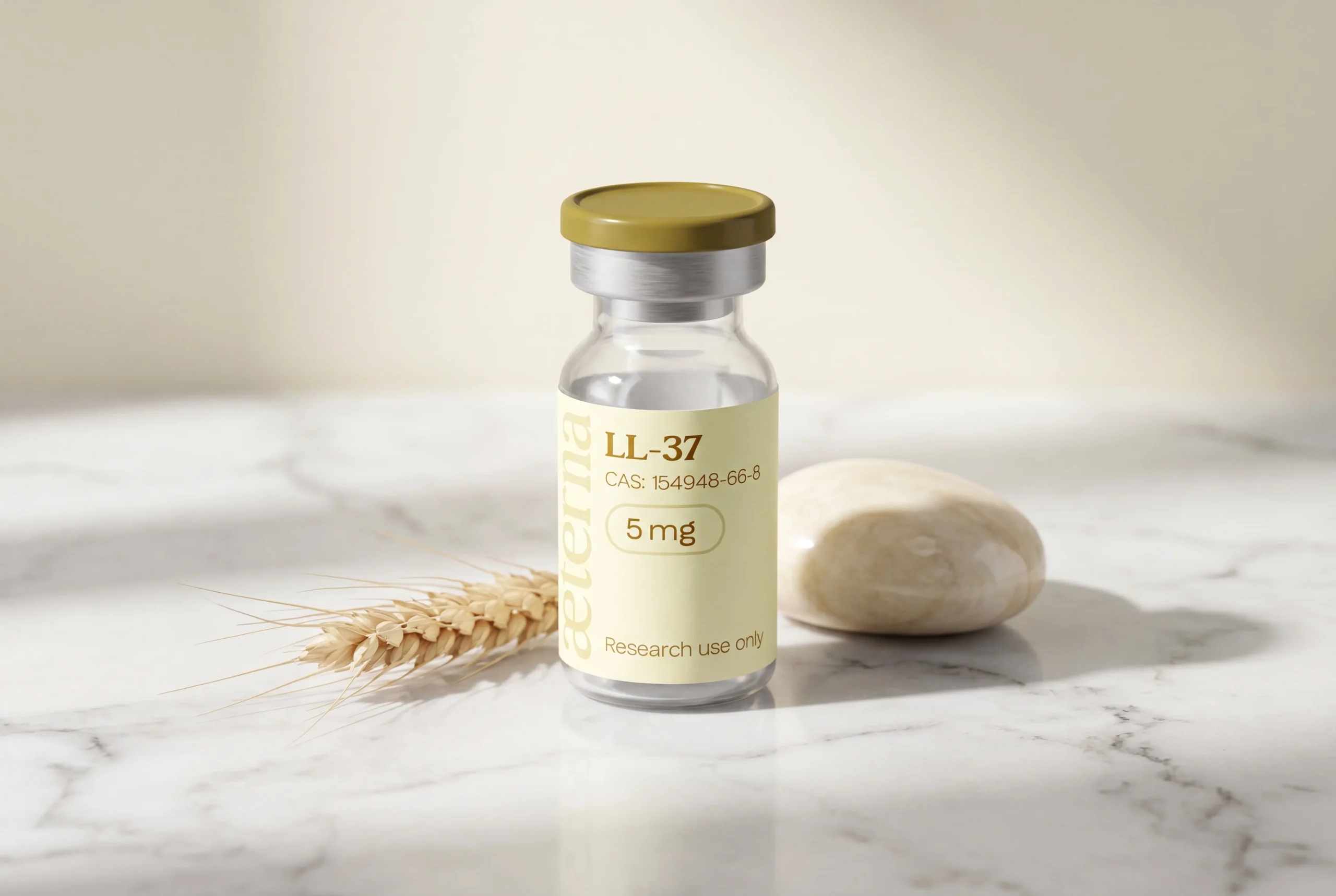
LL-37
Aeterna does not sell peptides. External link, vendor independently verified.
Mechanism
LL-37 is the sole cathelicidin expressed in humans – a cationic, amphipathic helix that operates at the intersection of innate immunity, tissue repair, and inflammatory signalling. Its actions are not reducible to a single receptor or a single pathway.
LL-37 is the only human cathelicidin antimicrobial peptide and contributes to innate host defense through direct membrane-disruptive activity against a range of microbes. Its amphipathic alpha-helical structure helps explain this broad antimicrobial effect.
Beyond direct killing, LL-37 also acts as an immunomodulatory signal that influences chemotaxis, inflammatory tone, and tissue repair. These broader effects are why it has drawn interest in wound healing and barrier dysfunction, not only in infection control.
Clinical investigation has focused most visibly on topical use in chronic wounds, including venous leg ulcers. Published studies have reported improved healing signals in difficult-to-treat wounds, though the therapeutic context remains investigational.
Biologic context matters because endogenous LL-37 expression differs across inflammatory skin diseases and may be either protective or pathologic depending on setting. That duality helps define the narrow space between useful antimicrobial signaling and excessive inflammation.
What we observe
Observed gains in wound recovery
Across in vitro studies, animal models, and early human trials, a consistent set of observations has emerged. These are patterns – not guarantees. Individual response varies with baseline immune status, route of administration, and the nature of the underlying condition.
01
Biofilm Disruption
02
Wound Re-epithelialization
03
Leukocyte Recruitment
04
Antimicrobial Activity
05
Inflammatory Calibration
06
Angiogenic Signaling
Evidence
Trials and lab findings
Three peer-reviewed studies – spanning foundational mechanism to clinical application – anchor the present understanding of LL-37. The field is active; these represent anchors, not endpoints.
LL-37 Accelerates Wound Closure and Promotes Keratinocyte Migration Through EGFR Transactivation in a Murine Excisional Model
Investigators applied recombinant LL-37 to full-thickness excisional wounds in C57BL/6 mice and measured closure rate, keratinocyte proliferation, and EGFR phosphorylation at 48-hour intervals. Wounds treated with LL-37 demonstrated significantly faster re-epithelialisation, with EGFR inhibition abolishing the effect – confirming receptor-mediated rather than purely antimicrobial mechanism. Histological analysis showed increased granulation tissue density and earlier vascular ingrowth in treated wounds.
Sub-inhibitory Concentrations of LL-37 Disrupt Pseudomonas aeruginosa Biofilm Architecture and Restore Antibiotic Susceptibility
Using confocal laser scanning microscopy and colony-forming unit assays, researchers demonstrated that LL-37 at concentrations below its minimum inhibitory concentration for planktonic Pseudomonas aeruginosa was sufficient to disrupt established biofilm matrix, reduce biofilm biomass, and restore ciprofloxacin susceptibility in previously resistant isolates. The authors proposed that LL-37’s amphipathic helix intercalates into the extracellular polymeric substance, compromising structural integrity before direct bacterial contact.
Intranasal LL-37 in Recurrent Respiratory Tract Infections: A Randomised Pilot Study
A double-blind, placebo-controlled pilot trial enrolled 64 adults with a history of recurrent upper respiratory tract infections. Participants receiving intranasal LL-37 formulation twice daily for eight weeks reported fewer infection episodes over a subsequent six-month follow-up period. Nasal lavage samples showed elevated neutrophil recruitment markers and reduced viral load during challenge periods. The authors noted the absence of significant local adverse effects and called for larger confirmatory trials, acknowledging the pilot’s limited power.
From lyophilized powder to a usable solution.
Peptide
5 mg lyophilized powder
Diluent
3.0 mL bacteriostatic water
Final concentration
1.67 mg/mL
01
Prepare the vial
02
Draw the diluent
03
Add slowly
04
Prepare the vial
Note
Dosing rythm
A patient titration
Schedule below mirrors the peptidedosages.com educational protocol (typical daily range: 100–400 µg once daily (gradual titration)).
Storage, caution, contradiction
Storage
Cold, dark, undisturbed
- Lyophilized: freeze at −20 °C (−4 °F).
- After reconstitution, refrigerate at 2–8 °C (35.6–46.4 °F) for up to 4 weeks.
- Avoid freeze–thaw cycles.
- Swirl gently to dissolve. Avoid excessive foaming.
- Inspect before each dose - discard if cloudy, particulate, or discoloured
Side effects
What members describe
- Injection site erythema - common in first week; typically self-resolving
- Transient local warmth or pruritus at administration site
- Mild flu-like symptoms - reported with higher doses; reflects immune activation
- Headache - infrequent; associated with initial immune mobilisation
- Theoretical pro-inflammatory exacerbation in autoimmune conditions - monitor closely
Contradictions
Reasons to abstain
- Active autoimmune disease - LL-37's immunostimulatory properties may exacerbate
- Known hypersensitivity to cathelicidin-derived peptides
- Active malignancy - EGFR transactivation warrants caution in oncology contexts
- Pregnancy and lactation - insufficient safety data; avoid
- Concurrent immunosuppressive therapy - potential for antagonistic or unpredictable interaction
Synergies
Pairing LL-37 with other peptides
LL-37 is rarely the only tool in a considered protocol. Its immunomodulatory and reparative properties complement several other peptides – each addressing a distinct axis of the same underlying biology.
FAQ
Your questions, patiently answered
No. As of 2026, there is no FDA-approved or EMA-approved pharmaceutical formulation of LL-37 for human use. It remains an investigational compound studied in academic and clinical research settings. Any use outside a formal research protocol is off-label and should involve a qualified physician.
Conventional antibiotics typically target specific bacterial enzymes or cell-wall synthesis pathways – mechanisms that bacteria can evolve resistance to. LL-37 disrupts bacterial membranes through physical insertion, a mechanism less susceptible to classical resistance development. It also modulates the host immune response, which antibiotics do not. These are complementary, not competing, approaches.
Individuals with active autoimmune conditions, known sensitivity to cathelicidin peptides, active malignancy, or those on immunosuppressive regimens should approach LL-37 with particular caution – or avoid it entirely pending physician review. The peptide’s immunostimulatory properties, beneficial in most contexts, carry theoretical risk in these populations.
Once reconstituted in bacteriostatic water, LL-37 solution should be refrigerated at 2–8 °C and used within 28 days. It should not be frozen in solution form, should be protected from light, and should be inspected visually before each use. Discard any vial showing cloudiness, particulate matter, or discolouration.
LL-37 is a genuine immunomodulator – it recruits immune cells and activates signalling cascades that can produce systemic effects at higher doses. A gradual introduction allows the individual and their physician to observe the immune response, identify any exaggerated reactions early, and establish the lowest effective dose before advancing. Speed here offers no advantage.
Aeterna Method does not prescribe, dispense, or sell LL-37 or any other peptide. This monograph is an educational document. We translate the scientific literature into a coherent framework for informed conversation between individuals and their physicians. Sourcing decisions belong to that clinical relationship.
In the same family
Adjacent monographs .
Sourcing · Independently verified
When you're ready, source thoughtfully.