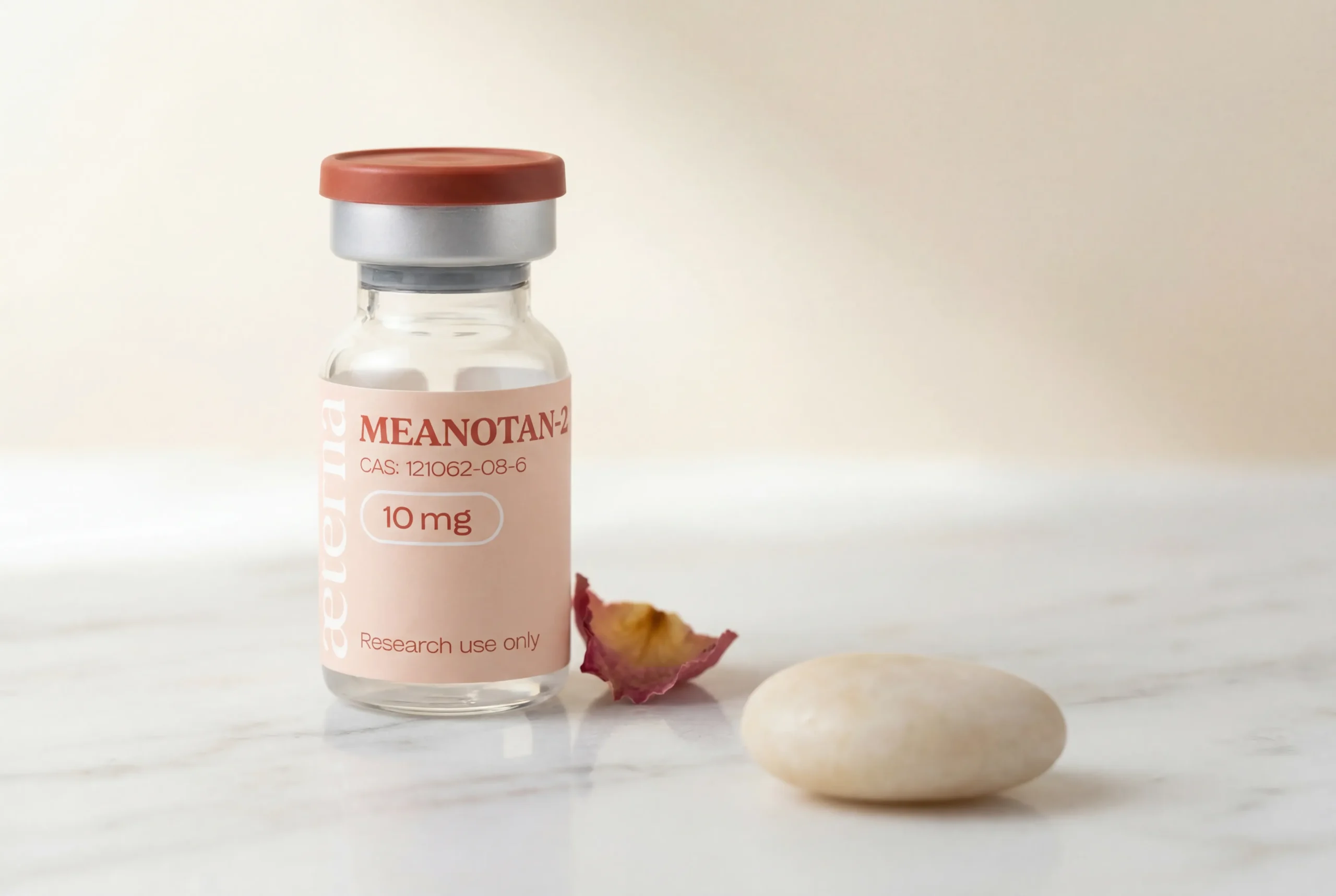
Melanotan II
Aeterna does not sell peptides. External link, vendor independently verified.
Mechanism
Melanotan II is a synthetic, cyclic analogue of alpha-melanocyte-stimulating hormone (α-MSH), itself a cleavage product of proopiomelanocortin (POMC). Where the native peptide is linear and metabolically fragile, Melanotan II introduces a lactam bridge between aspartate and lysine residues – a structural constraint that confers receptor affinity, metabolic resistance, and a potency several orders of magnitude beyond the endogenous ligand. The result is a molecule that engages the melanocortin system broadly, with consequences that extend well beyond the melanocyte.
MC1R on melanocytes governs the ratio of eumelanin to phaeomelanin, the two dominant pigment classes in human skin. Melanotan II shifts synthesis decisively toward eumelanin, the UV-absorbing fraction responsible for visible tanning.
MC4R in the hypothalamic paraventricular nucleus mediates pro-erectile signaling through oxytocinergic projections to spinal autonomic centers. This pathway operates independently of vascular PDE5 substrate, which is why the effect is observed even in the absence of sexual stimulation.
MC3R in the hypothalamus and limbic system participates in energy balance, feeding behavior, and autonomic tone. Preclinical models suggest a modulatory role in inflammatory signaling, though human data remain limited.
MC5R is expressed across exocrine glands, immune cells, and skeletal muscle. Preclinical evidence implicates it in sebaceous regulation and immune modulation; its clinical significance in humans is not yet well characterized.
What we observe
What users noticed in tanning and libido
The outcomes below reflect patterns reported in peer-reviewed human and animal studies. They describe what investigators observed under controlled or semi-controlled conditions and do not constitute predictions for any individual. Aeterna does not prescribe, dispense, or sell. This summary exists to illuminate the evidence, not to direct its application.
01
Cutaneous Pigmentation
02
Pro-Erectile Response
03
Appetite Attenuation
04
Spontaneous Erections (Non-Volitional)
05
Photoprotective Potential
06
Transient Nausea and Facial Flushing
Evidence
What the studies found
Three studies anchor the entries below, selected for methodological rigor and mechanistic relevance rather than outcome favorability. Each is cited with its primary finding and a representative statistic. The Melanotan II literature is early-stage and predominantly small-scale; conclusions should be held accordingly. Readers are encouraged to consult primary sources directly.
Melanocortin Receptor Agonism and Erectile Response: A Double-Blind Crossover Trial of Melanotan II in Men with Psychogenic Erectile Dysfunction
In a double-blind, placebo-controlled crossover design, 10 men with psychogenic erectile dysfunction received subcutaneous Melanotan II (0.025 mg/kg) or placebo. Eight of ten subjects in the active arm demonstrated clinically meaningful erectile responses by RigiScan monitoring, compared with two of ten on placebo. Nausea was reported in six active-arm subjects; spontaneous erections were noted in four. The authors concluded that central melanocortin agonism represents a mechanistically distinct pathway for erectile function.
Dose-Dependent Pigmentation Response to Subcutaneous Melanotan II in Human Volunteers: Colorimetric and Histological Assessment
Fifteen healthy volunteers of Fitzpatrick types I–III received escalating doses of Melanotan II over a four-week period without deliberate UV exposure. Reflectance colorimetry demonstrated statistically significant increases in melanin index at doses of 0.025 mg/kg and above. Skin biopsy at week four confirmed increased epidermal melanin granule density and upregulation of tyrosinase activity. No serious adverse events were recorded; nausea and flushing were the predominant side effects.
Central MC4R Activation by Melanotan II Suppresses Food Intake and Body Weight in Diet-Induced Obese Rodents: Implications for Melanocortin-Based Appetite Regulation
In diet-induced obese Sprague-Dawley rats, intracerebroventricular administration of Melanotan II produced significant reductions in 24-hour food intake and cumulative body weight over a 14-day observation period. The effect was abolished by co-administration of the MC4R antagonist HS014, confirming receptor specificity. The authors noted that peripheral subcutaneous administration produced attenuated but directionally consistent effects, suggesting partial CNS penetration via circumventricular organs.
From lyophilized powder to a usable solution.
Peptide
10 mg lyophilized powder
Diluent
3.0 mL bacteriostatic water
Final concentration
3.33 mg/mL
01
Prepare the vial
02
Draw the diluent
03
Add slowly
04
Prepare the vial
Note
Dosing rythm
A patient titration
Schedule below mirrors the peptidedosages.com educational protocol (typical daily range: 250–1000 mcg once daily (gradual titration over 8–12 weeks)).
Storage, caution, contradiction
Storage
Cold, dark, undisturbed
- Lyophilized: freeze at −20 °C (−4 °F) or below.
- After reconstitution, refrigerate at 2–8 °C (35.6–46.4 °F).
- Use within 1–2 weeks.
- Protect from light at all stages; UV exposure accelerates oxidative degradation of the tryptophan and histidine residues in the sequence
- Allow refrigerated vials to reach room temperature before injection; cold solution increases injection-site discomfort and may affect absorption kinetics
Side effects
What members describe
- Nausea - the most consistently reported effect; dose-dependent, typically onset 30–60 minutes post-injection, resolving within 1–2 hours; attenuates in some subjects with repeated administration
- Facial flushing and warmth - centrally mediated vasodilation; transient, usually concurrent with nausea; not associated with hypotension in reported studies at research doses
- Spontaneous erections - a direct pharmacodynamic consequence of MC4R activation; reported as unwanted in some subjects; duration typically under 60 minutes
- Yawning - a centrally mediated correlate of hypothalamic MC4R engagement; frequently noted in human trial reports; considered a pharmacodynamic marker rather than an adverse event
- Darkening of pre-existing nevi (moles) - MC1R activation increases melanin synthesis uniformly; existing pigmented lesions may darken; any change in nevus morphology warrants dermatological evaluation
Contradictions
Reasons to abstain
- Personal or family history of melanoma or dysplastic nevus syndrome - MC1R agonism and accelerated melanogenesis represent an unquantified risk in individuals with elevated baseline melanoma susceptibility
- History of hormone-sensitive conditions - POMC-pathway engagement has broad neuroendocrine implications; caution is warranted in individuals with pituitary pathology or adrenal disorders
- Pregnancy and lactation - no safety data exist; the peptide's central neuroendocrine activity and placental transfer potential are unstudied; use is not appropriate in this context
- Concurrent use of vasoactive medications - the pro-erectile and vasodilatory effects of MC4R activation may interact unpredictably with nitrates, antihypertensives, or PDE5 inhibitors
- Immunosuppression or active dermatological conditions - altered melanocyte biology in the context of immunosuppression or inflammatory skin disease introduces variables that the existing literature does not address
Synergies
What pairs with Melanotan II
The pairings below reflect mechanistic logic drawn from the literature – not protocols, not prescriptions. Each combination introduces additional variables. The conversation between peptides is rarely simple, and the evidence base for combination use is thinner than for monotherapy. Proceed with that asymmetry in mind.
FAQ
Your questions, patiently answered
The colloquial term refers to Melanotan II’s most visible effect – pharmacologically induced skin darkening without UV exposure. The mechanism is genuine: MC1R activation shifts melanocyte output toward eumelanin synthesis. But the compound’s pharmacology extends well beyond pigmentation, engaging central receptors that govern sexual function, appetite, and autonomic tone. Reducing it to a cosmetic agent misrepresents both its mechanism and its risk profile.
PT-141 (bremelanotide) is a direct metabolite of Melanotan II, formed by hydrolysis of the C-terminal amide. It retains MC4R affinity and the pro-erectile mechanism but has reduced MC1R activity – meaning less pigmentary effect. PT-141 has progressed through formal clinical development and received FDA approval for hypoactive sexual desire disorder in premenopausal women in 2019. Melanotan II has not entered formal regulatory development and remains a research compound.
No. This is one of the pharmacologically interesting features of the compound. Endogenous α-MSH release is triggered by UV-induced keratinocyte signaling; Melanotan II bypasses this requirement entirely, directly activating MC1R on melanocytes. Pigmentation occurs in the absence of UV exposure, though some protocols have combined low-level UV with administration to augment the response. The photoprotective hypothesis rests on this UV-independence: melanin is present before, not after, the damaging exposure.
Native α-MSH is a linear tridecapeptide, rapidly degraded by plasma peptidases with a half-life measured in minutes. The lactam bridge introduced by Hruby and Hadley – connecting aspartate at position 5 to lysine at position 10 – constrains the backbone into a bioactive conformation that resists enzymatic cleavage. The result is a molecule with plasma half-life measured in hours rather than minutes, and receptor affinity orders of magnitude greater than the endogenous ligand. The structural innovation is the pharmacology.
This is the most consequential unanswered question in the Melanotan II literature. MC1R activation accelerates melanogenesis, and melanocyte proliferation is a component of melanoma pathogenesis. Several case reports have associated Melanotan II use with changes in pre-existing nevi, and at least one case of melanoma in a user has been reported in the dermatological literature – though causality cannot be established from case reports. The absence of long-term safety data is not reassurance; it is a gap. Individuals with personal or family history of melanoma, or with dysplastic nevus syndrome, should regard this compound with particular caution.
The compound’s broad receptor engagement – spanning pigmentation, sexual function, appetite, and autonomic signaling – creates a complex benefit-risk profile that has made formal development challenging. The side-effect burden (nausea, spontaneous erections, flushing) at doses required for pigmentation is significant. More selectively, the metabolite PT-141 was developed precisely to isolate the sexual function mechanism with a more manageable profile. The original photoprotection indication has not attracted the commercial investment required for Phase III development. The compound remains, as it has for three decades, a research molecule of considerable mechanistic interest and unresolved clinical status.
In the same family
Further reading in the curriculum.
Sourcing · Independently verified
When you're ready, source thoughtfully.