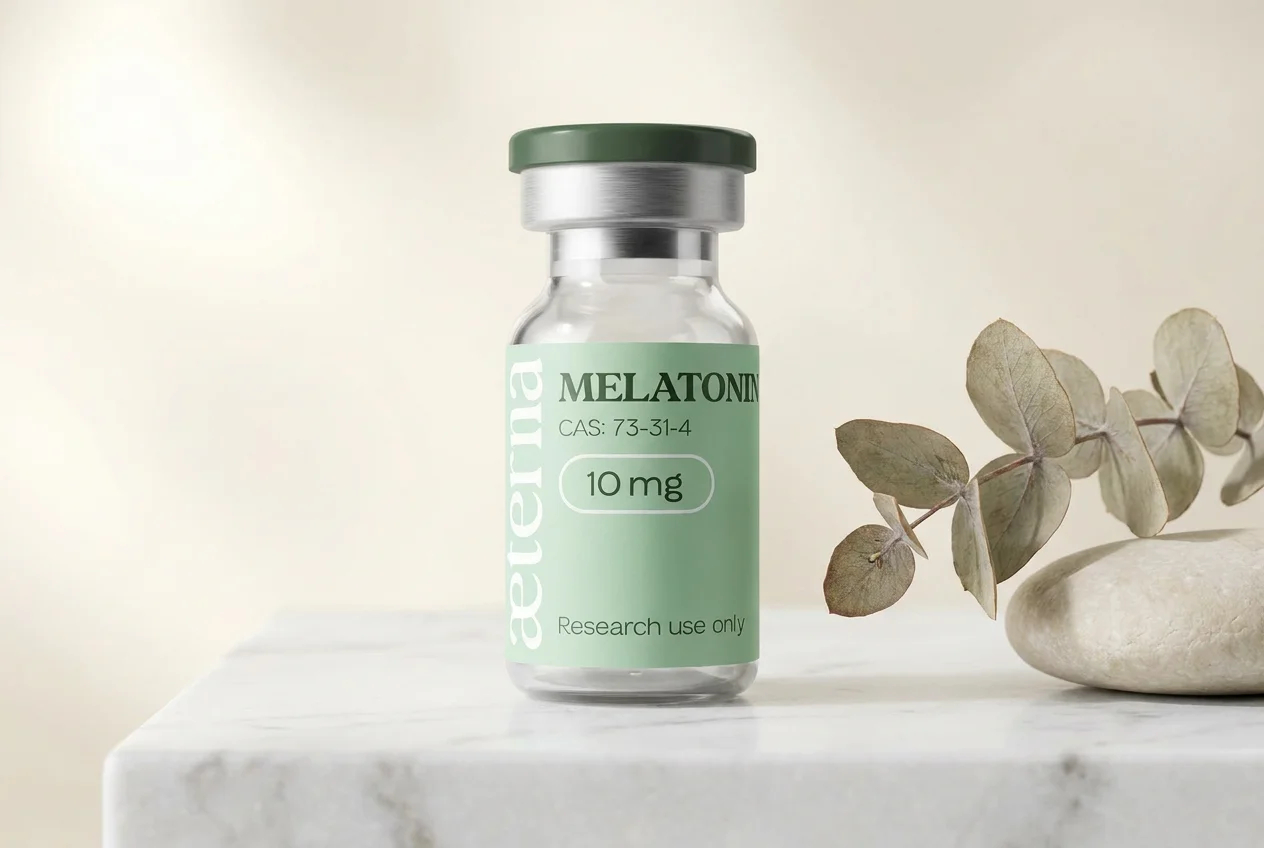
Monograph № 021

Melatonin

Melatonin is the body’s principal signal of biological night, coordinating circadian timing while exerting antioxidant and metabolic effects across multiple tissues.
Sequence
Small molecule
Half-life
20–50 min (immediate-release)
Route
Oral · Sublingual · Transdermal

Aeterna does not sell peptides. External link, vendor independently verified.

Originator
Endogenous (Pineal Gland)
First isolated by Aaron Lerner, Yale University School of Medicine, New Haven, Connecticut · 1958
First disclosed
1958
Structural characterization published in the Journal of the American Chemical Society, Vol. 80, 1958; Lerner et al.
Regulatory status
Dietary Supplement (US) · Prescription (EU/AU)
Classified as a prescription medicine in the European Union and Australia; available OTC in the United States under DSHEA; EMA monograph finalized 2012
Studied for
Circadian Entrainment · Sleep Architecture · Antioxidant Signaling · Immunomodulation
Investigated across chronobiology, oncology, neuroprotection, and metabolic research; over 24,000 indexed publications in PubMed as of 2025

Mechanism

How melatonin signals night to the body

Melatonin is not a sedative. That distinction matters. It is a chronobiotic – a molecule whose primary function is to communicate temporal information from the suprachiasmatic nucleus to peripheral tissues. Synthesized from serotonin in the pineal gland under conditions of darkness, it rises in the evening, peaks between 02:00 and 04:00, and recedes before dawn. What follows is a description of the receptor architecture through which that signal propagates.

MT1 receptor signaling initiates the acute circadian message of biological night. MT1 agonism suppresses SCN neuronal firing through high-affinity Gi-coupled receptor activation and helps explain how melatonin can advance or delay circadian phase depending on timing.

MT2 receptor signaling shapes phase shifting at the margins of the light dark cycle. MT2 agonism mediates responses at light-dark transitions and also modulates insulin secretion in pancreatic beta cells, with MTNR1B variants linking this receptor to elevated fasting glucose and type 2 diabetes risk.

Nuclear receptor effects extend melatonin biology beyond rapid membrane signaling. Binding at RORα and RZRβ influences transcription of core clock genes such as BMAL1, CLOCK, PER, and CRY, providing context for immunomodulatory and anti-inflammatory effects observed outside acute sleep induction.

Antioxidant cascade chemistry distinguishes melatonin from many redox-active molecules. Melatonin and its metabolites participate in sequential one-way antioxidant reactions without redox cycling, and mitochondrial concentrations exceed plasma levels, suggesting preferential activity at sites of high oxidative load.

What we observe

What people notice in sleep and timing

Sleep-onset latency reduction and circadian phase-shifting are among the most robustly documented effects in human chronobiology. Antioxidant and immunomodulatory effects are well-characterized in vitro, with human data still accumulating. Individual response varies with endogenous melatonin status, timing of administration, and dose.

01

Sleep-Onset Latency

Meta-analyses consistently report reductions in time to sleep onset with exogenous melatonin, particularly in populations with delayed circadian phase or disrupted light exposure. Effect sizes are modest but reproducible – more consistent than those observed with many prescription hypnotics in primary insomnia populations.
Effect most pronounced in circadian-phase disorders; less robust in primary insomnia without circadian component.

02

Circadian Phase Advancement

Administered 4–6 hours before the dim-light melatonin onset (DLMO), low-dose melatonin (0.5–1 mg) reliably advances circadian phase. This mechanism underlies its clinical application in jet lag, shift-work adaptation, and delayed sleep-wake phase disorder – contexts where the goal is re-entrainment, not sedation.
Timing relative to DLMO is the critical variable; dose above 1 mg does not proportionally increase phase-shifting efficacy.

03

Mitochondrial Antioxidant Activity

Melatonin accumulates preferentially in mitochondria, where it scavenges reactive oxygen species and appears to support electron transport chain efficiency. Animal models of ischemia-reperfusion injury show consistent attenuation of oxidative damage with melatonin pretreatment. Human data in this domain remain limited but directionally consistent.
Mechanistic evidence strong; clinical translation in humans requires further controlled investigation.

04

Immune Modulation

Melatonin receptors are expressed on lymphocytes, monocytes, and natural killer cells. The literature describes both pro-inflammatory and anti-inflammatory effects depending on context – a pattern consistent with a modulatory rather than suppressive role. Nocturnal melatonin rise appears to coordinate the timing of immune activity with the rest phase.
Bidirectional effects observed; net immunological impact depends heavily on baseline immune state and administration timing.

05

Neuroprotection

In models of neurodegeneration, melatonin attenuates amyloid-beta aggregation, tau hyperphosphorylation, and mitochondrial dysfunction. Epidemiological data suggest an inverse relationship between endogenous melatonin levels and neurodegenerative risk, though causality has not been established. The pineal gland calcifies with age, and melatonin output declines – a pattern that has drawn sustained research interest.
Preclinical evidence extensive; prospective human trials in neurodegeneration are ongoing as of 2025.

06

Intraocular Pressure Regulation

MT1 and MT2 receptors are expressed in the ciliary body and trabecular meshwork of the eye. Melatonin and its analogues have been shown to reduce intraocular pressure in animal models and in small human studies, with a circadian pattern consistent with the nocturnal IOP nadir. This represents an emerging area of ophthalmic research.
Human data limited to small trials; not established as a clinical intervention for glaucoma.

Evidence

What research shows on melatonin

The studies below represent a cross-section of published evidence, chosen to illustrate the range of contexts in which melatonin has been examined. They are not exhaustive, and inclusion does not constitute endorsement of any particular application. The literature is offered as a map, not a prescription.

Journal of Pineal Research
2019

Exogenous melatonin for delayed circadian phase: a systematic review and meta-analysis of randomized controlled trials

Pooled analysis of 18 randomized controlled trials found that melatonin administered 4–6 hours before DLMO produced statistically significant phase advances in adults with delayed sleep-wake phase disorder. Low doses (0.5–1 mg) were as effective as higher doses for phase-shifting, with fewer reports of morning grogginess. Sleep-onset latency was reduced by a mean of 23 minutes across included studies.

23 min
mean reduction in sleep-onset latency across 18 RCTs
Free Radical Biology and Medicine
2021

Melatonin as a mitochondrial protector: evidence from ischemia-reperfusion models and implications for human aging

A comprehensive review of 47 preclinical studies documented consistent attenuation of mitochondrial oxidative stress following melatonin administration in ischemia-reperfusion models across cardiac, hepatic, and neural tissues. Melatonin concentrations in mitochondria were measured at 10- to 100-fold higher than concurrent plasma levels, supporting the hypothesis of active mitochondrial uptake. Authors noted the absence of large-scale human trials as a significant gap in the literature.

10–100×
higher melatonin concentration in mitochondria versus plasma in preclinical models
Diabetes Care
2022

MTNR1B variant rs10830963 and fasting glucose: a Mendelian randomization study in 94,000 European adults

Mendelian randomization analysis using data from the UK Biobank and EPIC-Norfolk cohort found that carriers of the MTNR1B risk allele (rs10830963) had significantly elevated fasting plasma glucose and a 19% higher odds of type 2 diabetes diagnosis compared to non-carriers, independent of BMI and sleep duration. Findings support a causal role for melatonin receptor signaling in pancreatic beta-cell function and glucose homeostasis.

19%
higher odds of type 2 diabetes in MTNR1B rs10830963 risk-allele carriers (n = 94,000)
Reconstitution

From lyophilized powder to a usable solution.

Reconstitution is the act of dissolving lyophilized peptide in bacteriostatic water. Done correctly, it takes under two minutes.

Peptide

Typically 0.5 mg, 1 mg, 3 mg, or 5 mg per unit (tablet/capsule); liquid preparations at 1 mg/mL

Diluent

No reconstitution required for standard oral/sublingual forms

Final concentration

0.5–10 mg per dose unit depending on formulation and intended application

01

Prepare the vial

Allow the lyophilized vial to reach room temperature. Wipe the stopper with an alcohol swab. Do not shake the powder.

02

Draw the diluent

Using a sterile syringe, draw 1 mL of bacteriostatic water (0.9% benzyl alcohol). Use a fresh needle for the draw.

03

Add slowly

Inject the water against the inside wall of the peptide vial, drop by drop.

04

Prepare the vial

Rotate or shake the vial until the solution clears. It should be visually transparent within sixty seconds. You can wait up to 20 minutes.

Note

Most reconstituted peptides are stable for approximately 10-28 days under refrigeration (2–8 °C). Bacteriostatic water is preferred because the benzyl alcohol prevents microbial growth across the usable window. You can use sterile water with shorter timeframes.

Dosing rythm

A patient titration

Melatonin’s efficacy is inseparable from timing; dose and circadian phase interact to produce different, sometimes opposite, effects. The framework below reflects patterns observed in the chronobiological literature and is not a prescription.

For educational reference only. Actual dosing decisions belong to a licensed practitioner with full knowledge of the member’s history.
Phase Assessment
Salivary DLMO
Conducted in dim light beginning 6 hours before habitual sleep onset; establishes individual phase baseline
Phase-Shifting
0.5–1 mg
4–6 hours before DLMO for phase advancement; concurrent morning light exposure maximizes effect
Sleep-Onset Support
0.5–3 mg
30–60 minutes before intended sleep; lower doses preferred to minimize receptor desensitization with chronic use
Extended Protocols
3–
10 mg
(research contexts)
Studied in oncology, surgical, and oxidative stress research; not established for routine use; physician oversight indicated
Handling

Storage, caution, contradiction

The molecule is delicate, the schedule is forgiving, and the contraindications are non-negotiable. Members are taught to take all three with equal seriousness.

Storage

Cold, dark, undisturbed

Side effects

What members describe

Contradictions

Reasons to abstain

Synergies

Melatonin stacks for sleep goals

Melatonin occupies a foundational position in any circadian-aware protocol. Its interactions with other signaling molecules are well-described in the literature – some synergistic, some requiring careful sequencing. The following pairings reflect patterns observed in research contexts. They are not prescriptions. Aeterna does not prescribe, dispense, or sell.

For educational reference only. Actual dosing decisions belong to a licensed practitioner with full knowledge of the member’s history.
Epitalon
Epitalon, a tetrapeptide studied at the St. Petersburg Institute of Bioregulation and Gerontology, is reported to stimulate pineal melatonin synthesis in aging models. The pairing addresses both upstream production (Epitalon) and receptor-level signaling (exogenous melatonin) – a complementary architecture for age-related circadian decline.
Longevity · Pineal Function
BPC-157
BPC-157’s reported influence on serotonergic and dopaminergic tone creates an indirect relationship with melatonin synthesis, which depends on serotonin as a precursor. In recovery protocols, the combination has been explored for its potential to support both tissue repair and restorative sleep architecture – two processes that share the nocturnal window.
Recovery · Sleep Architecture
Selank
Selank’s GABAergic and serotonergic modulation may complement melatonin’s circadian signaling in individuals whose sleep disruption has an anxiety-driven component. The combination addresses both the neurochemical substrate of hyperarousal and the chronobiological signal for sleep onset – distinct mechanisms, convergent goals.
Neuroendocrine · Anxiolysis
Thymalin
The immune system operates on a circadian schedule; melatonin and thymic peptides share overlapping influence over lymphocyte activity and cytokine timing. Thymalin’s thymic peptide fraction has been studied alongside melatonin in Russian gerontological research as part of combined neuroendocrine-immune restoration protocols in aging populations.
Immunomodulation · Circadian Immunity

FAQ

Your questions, patiently answered

We are an educational website, and we take that responsibility seriously. If your question is not here, write to us at [email protected]

In the same family

Further reading in the curriculum.

Circadian & Neuroendocrine
A tetrapeptide studied for its reported capacity to restore pineal melatonin synthesis in aging models – the upstream complement to exogenous melatonin signaling.
Neuroprotection
An anxiolytic peptide with serotonergic and GABAergic activity, studied for its role in neuroendocrine balance and stress-related sleep disruption.
BPC-157
Recovery & Repair
A gastric pentadecapeptide with broad tissue-repair activity and reported influence on serotonergic tone – the precursor pathway from which melatonin is synthesized.

Sourcing · Independently verified

When you're ready, source thoughtfully.

Aeterna does not sell peptides. We maintain a short list of vendors evaluated for purity, third-party testing, handling, and supply consistency. The button here links directly to the vendor we currently recommend.
External link · We receive no remuneration. Verify your prescription before sourcing.