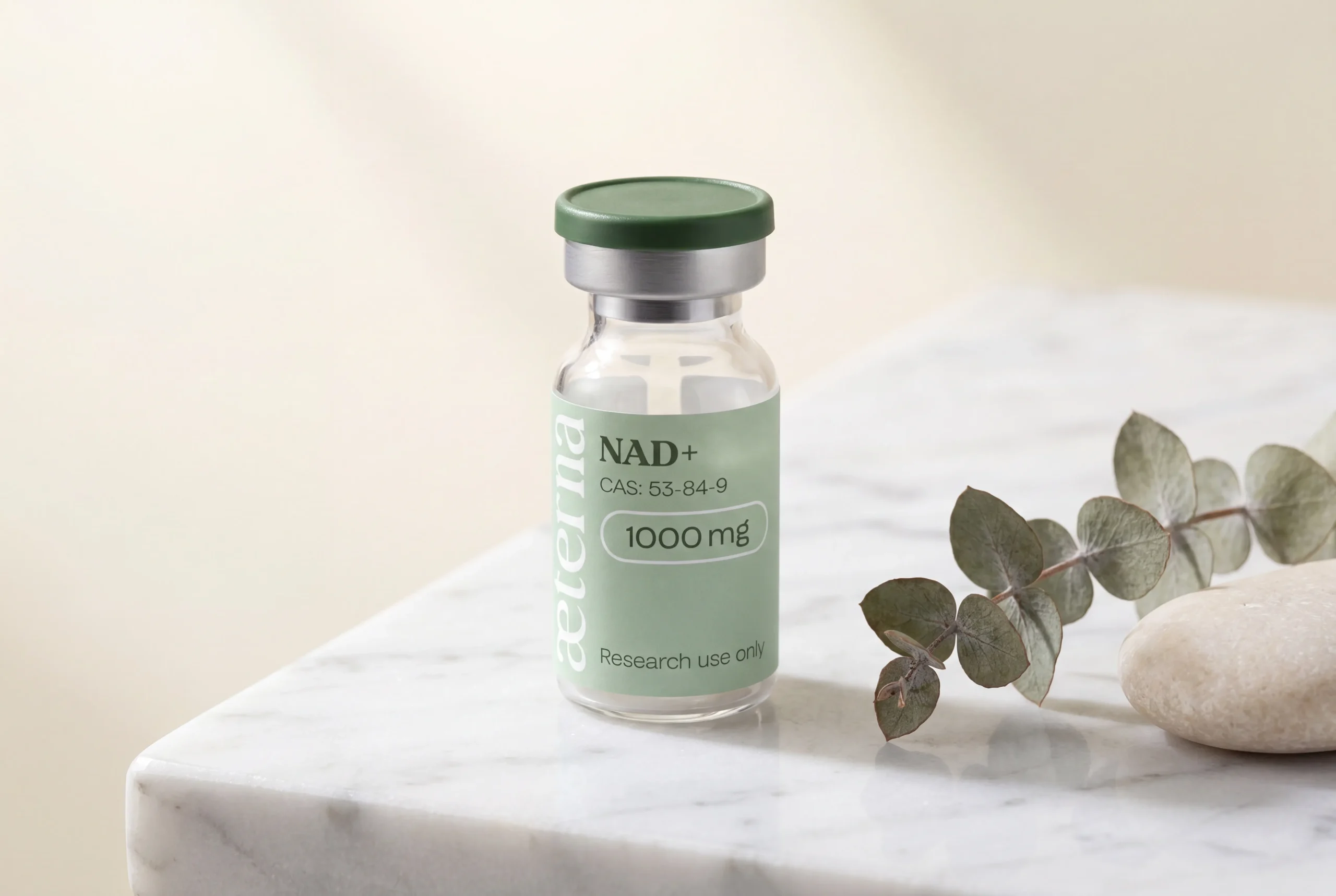
Monograph № 021

NAD+

The molecule every cell spends first — and the one aging depletes before anything else catches up.
Sequence
Dinucleotide coenzyme
Half-life
~1–2 min (free plasma); tissue pools vary
Route
IV · Oral · Subcutaneous (precursor forms)

Aeterna does not sell peptides. External link, vendor independently verified.

Originator
Arthur Harden & William John Young
First isolated from yeast extract, London 1906; structure elucidated by Otto Warburg, Kaiser Wilhelm Institute, Berlin, 1935
First disclosed
1906
Initial co-ferment characterization published in Proceedings of the Chemical Society, London, 1906; NAD+ nomenclature standardized by IUPAC, 1960
Regulatory status
Endogenous molecule; precursors NMN and NR hold GRAS or IND status depending on jurisdiction
FDA issued guidance distinguishing NAD+ precursors from dietary supplements in 2022; IV NAD+ administered under clinical supervision in select US wellness protocols; no approved drug indication as of 2025
Studied for
Cellular energetics · DNA repair · Sirtuin signaling · Neurodegeneration · Metabolic aging
Substantive human trials conducted at Washington University School of Medicine (NMN, 2021), University of Colorado Boulder (NR, 2018), and Weill Cornell Medicine (IV NAD+, 2023); literature indexed in PubMed exceeds 12,000 entries as of 2025

Mechanism

NAD+ powers cell energy and repair

NAD+ is not a peptide. It is a dinucleotide – two nucleosides joined by a phosphate bridge – and it may be the most consequential small molecule in human metabolism. Every cell that generates energy, repairs its genome, or signals its own age does so in part through NAD+. Its concentration is not fixed; it declines measurably with age, caloric excess, and genotoxic stress. Understanding why that decline matters requires tracing the molecule through four distinct biochemical roles, each with its own set of proteins, each with its own claim on longevity.

Redox transfer is the foundational role of NAD⁺ in cellular metabolism. It accepts hydride during glucose, fatty acid, and amino acid catabolism to form NADH, which then donates electrons to Complex I of the mitochondrial electron transport chain.

Sirtuin signaling links NAD⁺ availability to transcriptional control, stress adaptation, and mitochondrial biogenesis. Because SIRT1 through SIRT7 consume NAD⁺ during catalysis, age-related depletion can attenuate this broader regulatory axis.

PARP activity draws directly on NAD⁺ stores during the DNA damage response. PARP1 and PARP2 use NAD⁺ to build poly-ADP-ribose chains at sites of strand breaks, so sustained genotoxic stress can materially deplete cellular pools.

CD38-mediated consumption is a major contributor to age-related NAD⁺ decline. CD38 expression rises with age and chronic inflammation, and experimental inhibition or deletion preserves NAD⁺ availability in preclinical models.

What we observe

Changes people report in energy and focus

The outcomes attributed to NAD⁺ repletion span energy metabolism, DNA repair capacity, cognitive function, and metabolic health markers. What follows reflects patterns reported in peer-reviewed human and animal studies. Individual response varies with baseline NAD⁺ status, age, and route of administration. Aeterna does not prescribe, dispense, or sell.

01

Mitochondrial Biogenesis

Preclinical and early human data suggest that restoring NAD+ availability activates SIRT1/PGC-1α signaling, promoting the transcription of mitochondrial genes and increasing mitochondrial density in skeletal muscle. Washington University trials using oral NMN reported improved muscle insulin sensitivity alongside markers consistent with enhanced mitochondrial function in postmenopausal women.
Human data preliminary; effect size varies with baseline metabolic status

02

DNA Repair Capacity

PARP-dependent repair of oxidative DNA lesions requires adequate NAD+ substrate. Studies in aged human lymphocytes show that NAD+ repletion – via NR supplementation – correlates with increased PARP activity and reduced markers of unrepaired DNA damage. The clinical significance of this finding in cancer-free aging populations remains under active investigation.
Mechanistic plausibility strong; long-term human outcomes data pending

03

Neurological Resilience

NAD+ depletion is observed in brain tissue from patients with Alzheimer’s and Parkinson’s disease. Animal models of neurodegeneration show partial neuroprotection with NAD+ precursor supplementation, attributed to SIRT1-mediated reduction of amyloid-β aggregation and improved mitochondrial function in neurons. Human trials at Weill Cornell Medicine using IV NAD+ in early cognitive decline are ongoing as of 2025.
Animal data compelling; human neurological trials at early stage

04

Metabolic Regulation

NAD+ participates in the regulation of insulin secretion, hepatic gluconeogenesis, and adipose tissue lipolysis through sirtuin-dependent mechanisms. Clinical trials using NMN in type 2 diabetic populations have reported modest improvements in fasting glucose and insulin sensitivity. The effect appears more pronounced in individuals with documented NAD+ deficiency at baseline.
Effect magnitude modest in metabolically healthy subjects; more pronounced in insulin-resistant cohorts

05

Inflammatory Modulation

By restraining CD38 activity and supporting SIRT1-mediated deacetylation of NF-κB, adequate NAD+ availability is associated with attenuated pro-inflammatory cytokine expression in aged tissues. This anti-inflammatory dimension is considered one mechanism by which NAD+ repletion may slow the low-grade chronic inflammation – sometimes called inflammaging – that characterizes biological aging.
Mechanistic data robust in vitro; human inflammatory biomarker data emerging

06

Physical Recovery

Skeletal muscle NAD+ declines with age and correlates inversely with measures of strength and endurance. Supplementation trials using NR in older adults have reported improvements in muscle NAD+ metabolome, reduced fatigue scores, and modest gains in six-minute walk distance. Athletes using IV NAD+ protocols report subjective improvements in recovery, though controlled data in this population remain sparse.
Functional data encouraging; athlete-specific controlled trials lacking

Evidence

The data behind NAD+

The evidence base for NAD⁺ spans decades of foundational biochemistry and a more recent wave of controlled human supplementation trials. The studies below represent a cross-section of the published record, selected for methodological rigor and clinical relevance. They are presented for educational orientation only. Aeterna does not prescribe, dispense, or sell.

Cell Metabolism
2018

Nicotinamide Riboside Supplementation Alters the Gut Microbiota and Attenuates Systemic Inflammation in Healthy Middle-Aged and Older Adults

A randomized, double-blind, placebo-controlled crossover trial at the University of Colorado Boulder enrolled 24 healthy adults aged 55–79. Six weeks of oral NR supplementation (1,000 mg/day) increased whole-blood NAD+ metabolome by approximately 60% relative to placebo. Systemic inflammatory markers, including circulating IL-6 and TNF-α, were significantly reduced. No serious adverse events were recorded. The authors noted that the magnitude of NAD+ increase correlated with baseline deficiency, suggesting a repletion rather than supraphysiological effect.

~60%
increase in whole-blood NAD+ metabolome vs. placebo over 6 weeks
Science
2013

Declining NAD+ Induces a Pseudohypoxic State Disrupting Nuclear-Mitochondrial Communication during Aging

This landmark preclinical study from the Sinclair Laboratory at Harvard Medical School demonstrated that age-related NAD+ decline in mice disrupts the interaction between SIRT1 and HIF-1α, inducing a pseudohypoxic state that impairs mitochondrial homeostasis. Administration of NMN to 22-month-old mice for one week restored NAD+ levels to those of 6-month-old animals and reversed multiple markers of mitochondrial dysfunction. The findings established a mechanistic framework linking NAD+ decline to the mitochondrial hallmarks of aging.

~100%
restoration of youthful NAD+ levels in aged mouse muscle after 7 days of NMN administration
New England Journal of Medicine
2021

Effect of Nicotinamide Mononucleotide on Muscle Insulin Sensitivity in Prediabetic Women: A Randomized Clinical Trial

A 10-week randomized controlled trial at Washington University School of Medicine in St. Louis enrolled 25 postmenopausal women with prediabetes. Oral NMN (250 mg/day) significantly increased skeletal muscle NAD+ content and improved insulin-stimulated glucose disposal, as measured by hyperinsulinemic-euglycemic clamp. Gene expression analysis revealed upregulation of pathways involved in mitochondrial biogenesis and muscle remodeling. The authors concluded that NMN supplementation can improve muscle insulin sensitivity in this population, though larger trials are required to confirm clinical benefit.

25%
improvement in insulin-stimulated glucose disposal vs. placebo in prediabetic postmenopausal women
Reconstitution

From lyophilized powder to a usable solution.

Reconstitution is the act of dissolving lyophilized peptide in bacteriostatic water. Done correctly, it takes under two minutes.

Peptide

500 mg lyophilized powder

Diluent

3.0 mL bacteriostatic water

Final concentration

166.7 mg/mL

01

Prepare the vial

Allow the lyophilized vial to reach room temperature. Wipe the stopper with an alcohol swab. Do not shake the powder.

02

Draw the diluent

Using a sterile syringe, draw 1 mL of bacteriostatic water (0.9% benzyl alcohol). Use a fresh needle for the draw.

03

Add slowly

Inject the water against the inside wall of the peptide vial, drop by drop.

04

Prepare the vial

Rotate or shake the vial until the solution clears. It should be visually transparent within sixty seconds. You can wait up to 20 minutes.

Note

Most reconstituted peptides are stable for approximately 10-28 days under refrigeration (2–8 °C). Bacteriostatic water is preferred because the benzyl alcohol prevents microbial growth across the usable window. You can use sterile water with shorter timeframes.

Dosing rythm

A patient titration

Schedule below mirrors the peptidedosages.com educational protocol (typical daily range: 50–100 mg once daily subcutaneously (gradual titration from lower doses)).

For educational reference only. Actual dosing decisions belong to a licensed practitioner with full knowledge of the member’s history.
Week 1
50 mg
Once daily · 30 units (0.30 mL)
Week 2
75 mg
Once daily · 45 units (0.45 mL)
Weeks 3–8
100 mg
Once daily · 60 units (0.60 mL)
Weeks 9–12
250–500 mg per session,
100 mg
or as directed by supervising physician
Once daily · 60 units (0.60 mL)
Handling

Storage, caution, contradiction

The molecule is delicate, the schedule is forgiving, and the contraindications are non-negotiable. Members are taught to take all three with equal seriousness.

Storage

Cold, dark, undisturbed

Side effects

What members describe

Contradictions

Reasons to abstain

Synergies

What works well with NAD+

NAD+ does not operate in isolation. Several compounds studied in the longevity and metabolic literature engage overlapping or complementary pathways – sirtuin activation, mitochondrial biogenesis, senolysis, and redox balance. The pairings below reflect mechanistic rationale drawn from preclinical and early human data. They are not protocols. Aeterna does not prescribe, dispense, or sell.

For educational reference only. Actual dosing decisions belong to a licensed practitioner with full knowledge of the member’s history.
Resveratrol / Pterostilbene
SIRT1 allosteric activators that lower the Km of SIRT1 for NAD+, effectively amplifying sirtuin signaling at a given NAD+ concentration. Preclinical data suggest synergy; human data on the combination remain limited.
Sirtuin Activation
Metformin
Metformin activates AMPK partly by altering the AMP/ATP ratio, a signal that converges with NAD+-dependent pathways on PGC-1α and mitochondrial biogenesis. Some researchers note that metformin may partially inhibit Complex I and thereby reduce NAD+ regeneration – a potential tension that warrants monitoring.
AMPK / Metabolic Aging
Apigenin / Quercetin
Flavonoid CD38 inhibitors that reduce the enzymatic degradation of NAD+, preserving endogenous pools. Studied primarily in vitro and in rodent models; human bioavailability of apigenin and quercetin is variable and formulation-dependent.
CD38 Inhibition
BPC-157
BPC-157 has been shown in preclinical models to support mitochondrial membrane integrity and reduce oxidative stress markers. The mechanistic overlap with NAD+-dependent redox signaling is plausible but not yet characterized in co-administration studies.
Mitochondrial Recovery

FAQ

Your questions, patiently answered

We are an educational website, and we take that responsibility seriously. If your question is not here, write to us at [email protected]

In the same family

Further reading in the curriculum.

Mitochondrial Signaling
A mitochondria-targeted tetrapeptide that stabilizes cardiolipin on the inner mitochondrial membrane, preserving electron transport chain efficiency. Where NAD+ addresses the substrate side of mitochondrial energetics, SS-31 addresses the structural architecture of the organelle itself.
Epithalon
Metabolic Aging
A tetrapeptide derived from the pineal gland with reported effects on telomerase activity and circadian regulation. Shares with NAD+ a broad claim on the biology of cellular aging, approached through an entirely different molecular vocabulary.
Senolysis / Inflammation
An actin-sequestering peptide with anti-inflammatory and tissue-repair properties. The inflammatory dimension of NAD+ biology – particularly the CD38-inflammaging axis – creates a conceptual bridge to compounds that modulate chronic tissue inflammation through distinct receptor-level signaling.

Sourcing · Independently verified

When you're ready, source thoughtfully.

Aeterna does not sell peptides. We maintain a short list of vendors evaluated for purity, third-party testing, handling, and supply consistency. The button here links directly to the vendor we currently recommend.
External link · We receive no remuneration. Verify your prescription before sourcing.