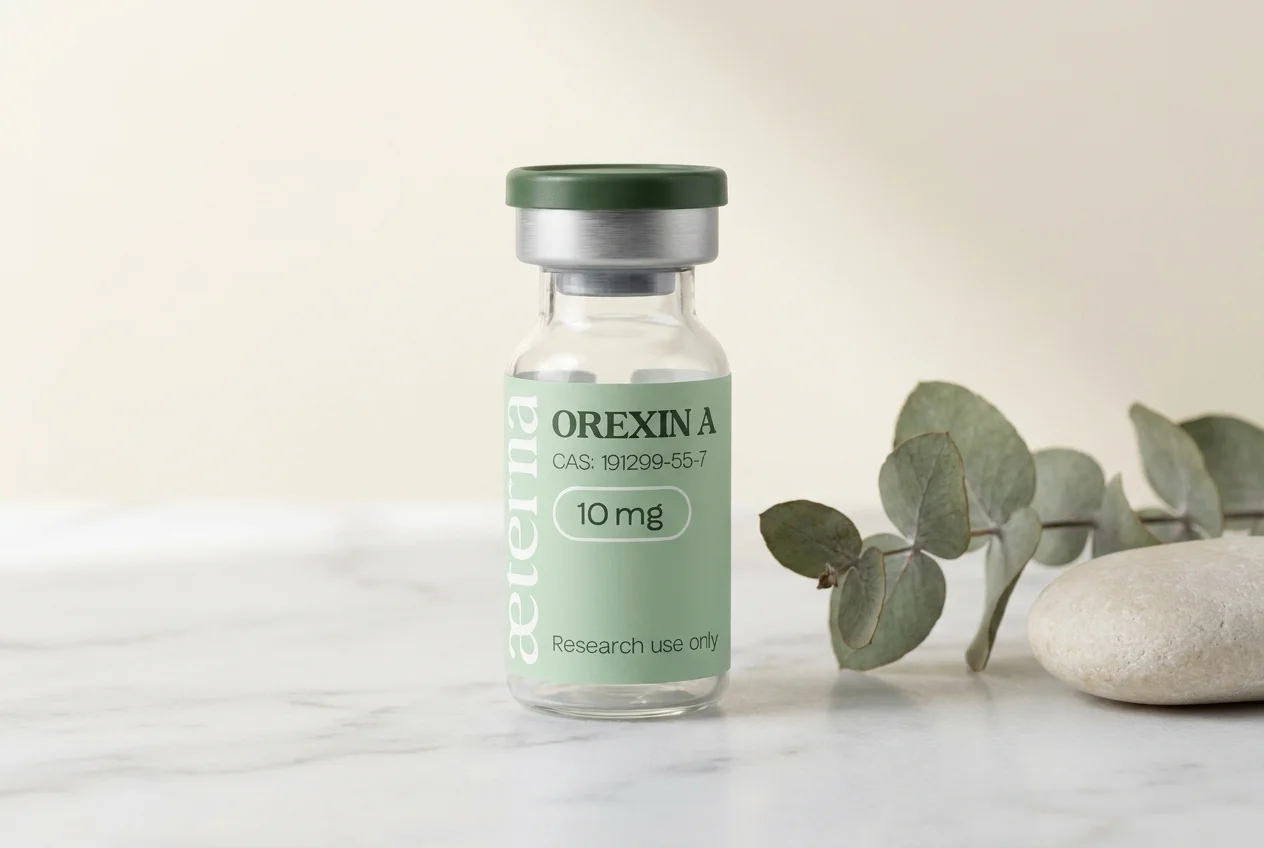
Monograph № 021

Orexin A

The hypothalamic signal that holds wakefulness, appetite, and reward in a single conversation.
Sequence
33 amino acids
Half-life
~20 min (central); longer peripheral estimates reported
Route
Intranasal · ICV (research) · IV (research)

Aeterna does not sell peptides. External link, vendor independently verified.

Originator
University of Texas Southwestern
Dallas, Texas · Yanagisawa laboratory, 1998 · co-discovered concurrently by Scripps Research as hypocretin
First disclosed
1998
First disclosed simultaneously in Cell (de Lecea et al.) and Cell (Sakurai et al.), January 1998 – two independent teams, one peptide
Regulatory status
Investigational
No approved therapeutic formulation as of 2026; intranasal delivery under active preclinical and early clinical evaluation for narcolepsy type 1
Studied for
Wakefulness · Narcolepsy · Metabolic Tone
Primary published inquiry spans sleep architecture, energy expenditure, and reward circuitry; narcolepsy type 1 represents the most clinically developed indication

Mechanism

How Orexin A keeps you awake

Orexin A is a 33-amino-acid neuropeptide synthesized exclusively in a compact cluster of neurons in the lateral and posterior hypothalamus – roughly 70,000 cells in the human brain. That anatomical modesty belies an extraordinary reach. Orexinergic axons project to virtually every arousal-relevant nucleus: the locus coeruleus, the dorsal raphe, the tuberomammillary nucleus, the basal forebrain, and the ventral tegmental area. The peptide does not simply toggle wakefulness on. It stabilizes the entire arousal state, preventing the inappropriate transitions into sleep that define narcolepsy. Understanding its receptor architecture is understanding the architecture of consciousness itself.

Orexin A is a hypothalamic neuropeptide that activates OX1R and OX2R across arousal-regulating networks in the brain. Its signaling helps stabilize wakefulness, coordinate transitions between sleep states, and integrate metabolic and motivational cues.

Loss of orexin neurons is a defining feature of narcolepsy type 1 and provides the clearest biological context for the peptide’s importance. In animal models, restoration of orexin signaling can partially normalize wakefulness and sleep architecture.

Delivery constraints shape the translational literature because Orexin A penetrates the central nervous system poorly when given systemically. Intranasal administration is therefore studied as a practical route for CNS targeting, although bioavailability remains limited and variable.

Pharmacokinetic limits have driven interest in more stable agonists and analogues rather than native peptide replacement alone. The short half-life of Orexin A and the challenge of sustained receptor engagement remain central barriers to therapeutic development.

What we observe

What users noticed in alertness and drive

The outcomes attributed to Orexin A in preclinical and early human research span four domains: sleep architecture, metabolic regulation, cognitive performance, and reward modulation. The literature is richest in rodent and canine models; human data remain limited but directionally consistent. No outcome below constitutes a clinical claim. Each reflects a pattern observed under specific experimental conditions, with the caveats those conditions impose.

01

Sleep-State Stabilization

In orexin-deficient animal models, exogenous Orexin A administration – particularly via intranasal or intracerebroventricular routes – reduces the frequency of direct wake-to-REM transitions and cataplectic episodes. The effect is interpreted as restoration of the flip-flop switch stability that orexin normally provides between wake-promoting and sleep-promoting nuclei.
Demonstrated in canine and murine narcolepsy models; human intranasal data preliminary as of 2026

02

Promotion of Sustained Wakefulness

Orexin A administered intranasally in non-human primates maintained wakefulness for extended periods following sleep deprivation without the rebound hypersomnolence associated with stimulant compounds. EEG profiles during orexin-induced wakefulness more closely resembled natural alert states than those produced by amphetamine or modafinil.
Non-human primate data; human translation not yet established in controlled trials

03

Cognitive Performance

Rhesus macaques receiving intranasal Orexin A after 30–36 hours of sleep deprivation performed comparably to rested controls on working memory and sustained attention tasks. The finding suggests that orexin’s arousal signal is qualitatively different from pharmacological stimulation – preserving cognitive architecture rather than merely elevating alertness.
Primate model; cognitive domain specificity in humans requires further study

04

Metabolic Rate

Central Orexin A infusion in rodents increases oxygen consumption, brown adipose tissue temperature, and sympathetic nerve activity to peripheral metabolic organs. These effects are partially independent of locomotor activity, suggesting a direct thermogenic drive. The metabolic phenotype of orexin-knockout mice – obesity despite reduced food intake – underscores the peptide’s role in energy expenditure beyond appetite alone.
Rodent models predominate; human metabolic data limited to observational studies in narcoleptic populations

05

Feeding Behavior

The relationship between Orexin A and appetite is bidirectional and context-dependent. Acute central administration stimulates feeding, particularly carbohydrate-preferential intake, via OX1R in the hypothalamus. Yet orexin-deficient individuals tend toward obesity – a paradox explained by the dominant role of reduced energy expenditure over reduced appetite. The literature does not support a simple orexigenic or anorexigenic characterization.
Mechanistic complexity acknowledged; net effect in humans depends on route, dose, and metabolic context

06

Reward Salience

Orexin A potentiates dopaminergic signaling in the VTA, increasing the motivational salience of reward-predictive cues. In preclinical addiction models, OX1R antagonism attenuates drug-seeking behavior; conversely, Orexin A administration reinstates extinguished reward-seeking. The implication for therapeutic use is nuanced – restoring motivational drive in hypersomnic or anhedonic states while acknowledging the same pathway’s role in compulsive behavior.
Preclinical addiction literature; therapeutic implications in humans remain investigational

Evidence

What the studies show

The following entries represent a considered selection from a literature that spans more than two decades. Orexin A has been studied in contexts ranging from fundamental neuroscience to translational sleep medicine. The studies below were chosen to illustrate the breadth of that inquiry – basic mechanism, translational model, and early human observation – rather than to constitute a systematic review. Readers are encouraged to consult primary sources and to weigh findings against the methodological constraints of each study design.

Journal of Neuroscience
2007

Intranasal Administration of Orexin A Reverses the Effects of Sleep Deprivation on Cognitive Performance in Nonhuman Primates

Rhesus macaques subjected to 30–36 hours of total sleep deprivation received intranasal Orexin A (2 mg per animal) or vehicle. Animals in the orexin group performed at rested-baseline levels on a delayed match-to-sample working memory task and showed normalized EEG power spectra in the beta and gamma bands. No cardiovascular or behavioral adverse effects were recorded at the dose studied. The authors concluded that intranasal delivery achieved sufficient CNS bioavailability to restore orexinergic tone without systemic stimulant effects.

~80%
recovery of working memory accuracy to rested-baseline levels in sleep-deprived primates receiving intranasal Orexin A versus vehicle
Nature Neuroscience
2009

Orexin A in the VTA Is Critical for the Induction of Synaptic Plasticity and Behavioral Sensitization to Cocaine

Microinjection of Orexin A into the ventral tegmental area of rats produced long-term potentiation of excitatory synapses onto dopamine neurons, an effect blocked by the selective OX1R antagonist SB-334867. Behavioral sensitization to cocaine was attenuated by prior OX1R blockade, and reinstated by Orexin A co-administration. The study established a mechanistic link between orexinergic tone and the synaptic plasticity underlying reward-motivated behavior, with implications for both addiction and motivational disorders.

~60%
reduction in cocaine-induced locomotor sensitization following OX1R antagonism in the VTA microinjection model
Sleep Medicine
2019

Cerebrospinal Fluid Orexin A Levels Correlate with Objective Sleepiness and Metabolic Parameters in Narcolepsy Type 1 Patients

A cross-sectional study of 84 patients with polysomnography-confirmed narcolepsy type 1 measured CSF Orexin A alongside multiple sleep latency test scores, BMI, resting energy expenditure, and fasting metabolic panels. CSF Orexin A was undetectable (<110 pg/mL) in 91% of participants. Lower residual orexin levels correlated with shorter mean sleep latency, higher BMI, and reduced resting energy expenditure independent of physical activity – supporting the hypothesis that orexin deficiency contributes to metabolic dysregulation beyond its sleep-stabilizing role.

91%
of narcolepsy type 1 patients showed undetectable CSF Orexin A (<110 pg/mL), with residual levels inversely correlated with BMI and resting energy expenditure
Reconstitution

From lyophilized powder to a usable solution.

Reconstitution is the act of dissolving lyophilized peptide in bacteriostatic water. Done correctly, it takes under two minutes.

Peptide

0.5 mg or 1 mg (research vial)

Diluent

Sterile water for injection or 0.9% sodium chloride; avoid phosphate-buffered saline with reducing agents; do not use DMSO

Final concentration

0.1–1.0 mg/mL depending on route and application; intranasal research protocols typically use 1–2 mg/mL in isotonic saline

01

Prepare the vial

Allow the lyophilized vial to reach room temperature. Wipe the stopper with an alcohol swab. Do not shake the powder.

02

Draw the diluent

Using a sterile syringe, draw 1 mL of bacteriostatic water (0.9% benzyl alcohol). Use a fresh needle for the draw.

03

Add slowly

Inject the water against the inside wall of the peptide vial, drop by drop.

04

Prepare the vial

Rotate or shake the vial until the solution clears. It should be visually transparent within sixty seconds. You can wait up to 20 minutes.

Note

Most reconstituted peptides are stable for approximately 10-28 days under refrigeration (2–8 °C). Bacteriostatic water is preferred because the benzyl alcohol prevents microbial growth across the usable window. You can use sterile water with shorter timeframes.

Dosing rythm

A patient titration

No approved dosing regimen exists for Orexin A in human therapeutic use as of 2026. The parameters below are drawn from published preclinical and early translational research and are presented as a curriculum in the literature – not as clinical guidance. Route of administration profoundly affects CNS bioavailability; intranasal delivery has demonstrated the most favorable CNS-to-systemic ratio in primate studies. All dosing decisions require physician oversight and institutional or regulatory approval where applicable.

For educational reference only. Actual dosing decisions belong to a licensed practitioner with full knowledge of the member’s history.
Preclinical Reference (Rodent)
0.3–3 nmol ICV
Single administration; behavioral and metabolic endpoints assessed at 30–120 minutes post-injection in published rodent studies
Translational Reference (Primate)
2 mg intranasal
Single administration following 30–36 hours sleep deprivation; cognitive endpoints assessed at 30 and 60 minutes post-dose in Deadwyler et al. (2007)
Early Human Observation
Not formally established
Human intranasal pharmacokinetic and pharmacodynamic studies ongoing as of 2026; no consensus dose published in peer-reviewed literature
Investigational Consideration
Dose selection governed by
route
and CNS bioavailability data; systemic IV administration achieves poor CNS penetration relative to intranasal delivery
Intranasal route preferred in translational models for CNS targeting; ICV reserved for controlled research settings
Handling

Storage, caution, contradiction

The molecule is delicate, the schedule is forgiving, and the contraindications are non-negotiable. Members are taught to take all three with equal seriousness.

Storage

Cold, dark, undisturbed

Side effects

What members describe

Contradictions

Reasons to abstain

Synergies

What pairs with Orexin A

Orexin A does not operate in isolation. Its projections reach every major neuromodulatory system – noradrenergic, serotonergic, histaminergic, dopaminergic. The companions listed below are drawn from the published literature on overlapping circuits and are presented as a map of mechanistic adjacency, not as a protocol. Aeterna does not prescribe combinations. Each pairing reflects a question the literature has begun to ask, not an answer it has yet provided.

For educational reference only. Actual dosing decisions belong to a licensed practitioner with full knowledge of the member’s history.
Selank
Selank modulates GABAergic and serotonergic tone in prefrontal circuits that receive orexinergic input. Where Orexin A drives arousal and attentional readiness, Selank may temper anxiety-like activation through the same cortical networks – a pairing that the literature on stress-arousal interaction suggests is worth examining, though no co-administration study has been published.
Cognitive Architecture
PT-141 (Bremelanotide)
PT-141 acts on melanocortin receptors in the hypothalamus and limbic system, a region that receives dense orexinergic innervation. Both peptides converge on motivational salience and reward-seeking circuitry. The mechanistic overlap is documented in preclinical literature on hypothalamic integration of arousal and reward; clinical co-administration data are absent.
Reward & Motivation
CJC-1295 / Ipamorelin
Growth hormone secretagogues are typically administered at sleep onset to align with the nocturnal GH pulse. In orexin-deficient states, disrupted slow-wave sleep attenuates this pulse. Restoring orexinergic tone may improve slow-wave sleep architecture, potentially enhancing the physiological window for GH secretagogue activity – a hypothesis grounded in sleep endocrinology literature rather than direct co-administration evidence.
Sleep Architecture & Recovery
Epithalon
Epithalon’s proposed effects on pineal melatonin synthesis and circadian gene expression place it at the opposite pole of the sleep-wake axis from Orexin A. In the context of circadian disruption – where both orexinergic tone and melatonin rhythmicity are perturbed – the two peptides represent complementary interventions at different phases of the 24-hour cycle. The pairing is conceptually coherent; empirical co-administration data do not yet exist.
Circadian Regulation

FAQ

Your questions, patiently answered

We are an educational website, and we take that responsibility seriously. If your question is not here, write to us at [email protected]

In the same family

Adjacent entries in the curriculum - peptides that share a circuit or a question.

Neurological
A synthetic heptapeptide derived from tuftsin, Selank modulates GABAergic and serotonergic signaling in prefrontal and limbic circuits that receive orexinergic projections. Where Orexin A drives arousal, Selank addresses the anxiety dimension of the same cortical architecture – a complementary lens on hypothalamic-cortical integration.
MOTS-c
Metabolic
A mitochondria-derived peptide that regulates nuclear gene expression in response to metabolic stress, MOTS-c shares with Orexin A an interest in energy homeostasis – approached from the cellular rather than the hypothalamic level. The two peptides represent different scales of the same metabolic conversation.
Epithalon
Recovery
Epithalon’s proposed influence on pineal melatonin synthesis and telomere maintenance places it at the sleep-onset pole of the circadian axis – the complement to Orexin A’s wake-maintenance role. Together they frame the 24-hour architecture that the orexin system stabilizes from one end and the pineal gland anchors from the other.

Sourcing · Independently verified

When you're ready, source thoughtfully.

Aeterna does not sell peptides. We maintain a short list of vendors evaluated for purity, third-party testing, handling, and supply consistency. The button here links directly to the vendor we currently recommend.
External link · We receive no remuneration. Verify your prescription before sourcing.