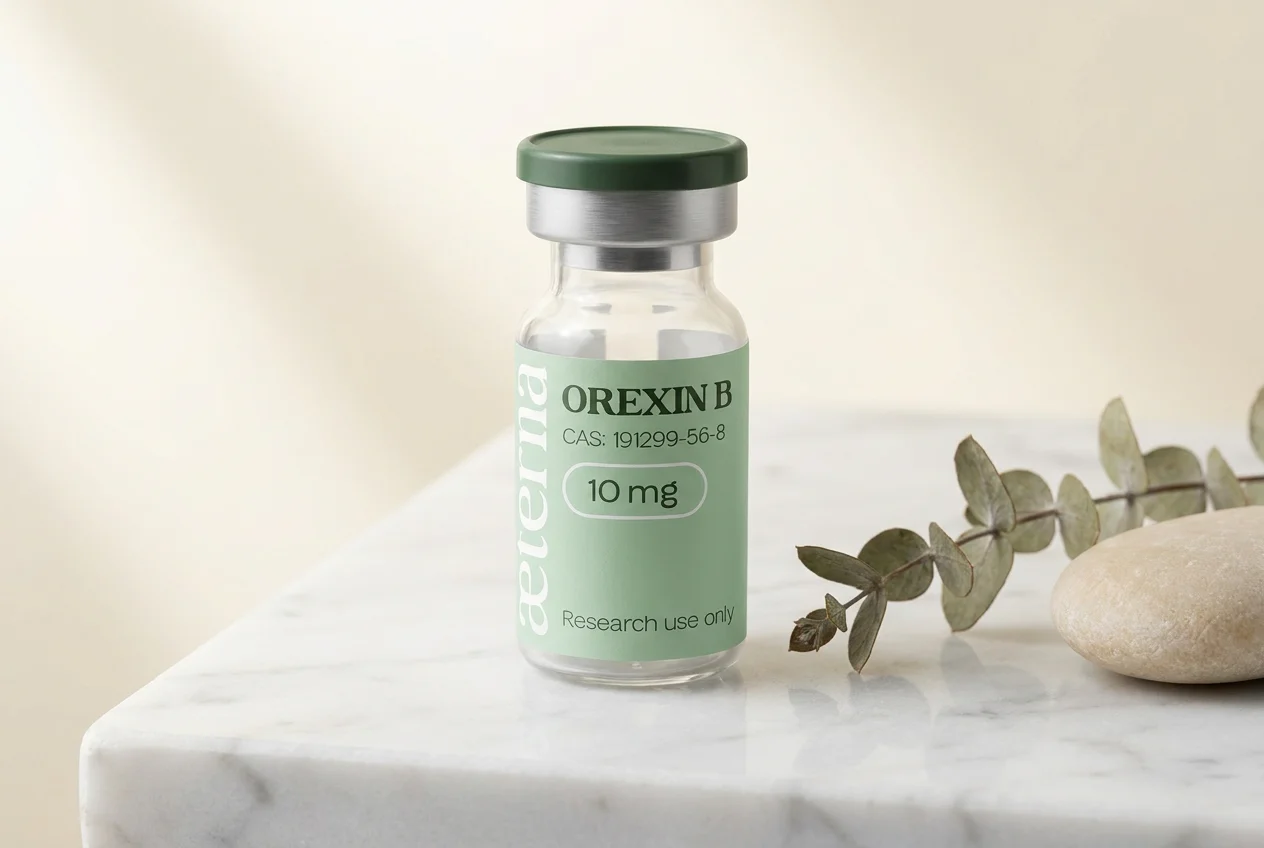
Monograph № 015

Orexin B

The hypothalamic signal that holds wakefulness, appetite, and autonomic tone in a single conversation.
Sequence
28 amino acids
Half-life
~4–6 min (plasma, murine models)
Route
Intracerebroventricular · Intranasal (investigational)

Aeterna does not sell peptides. External link, vendor independently verified.

Originator
de Lecea & Sutcliffe Labs
Co-discovered independently at The Scripps Research Institute, La Jolla, California (de Lecea et al.) and UT Southwestern Medical Center, Dallas, Texas (Sakurai et al.), 2010CVIII · Also designated Hypocretin-2
First disclosed
1998
Dual simultaneous disclosure: Cell 92(4) and Cell 92(5), February 1998 – among the most-cited neuropeptide discovery papers of the decade
Regulatory status
Research Use Only
No approved therapeutic indication as of 2025; orexin receptor agonism as a class under active IND-stage investigation for narcolepsy type 1 and hypersomnia disorders
Studied for
Arousal · Energy Homeostasis · Autonomic Regulation
Primary published inquiry spans sleep-wake architecture, feeding behavior, and sympathetic tone; literature concentrated in Journal of Neuroscience, Nature Neuroscience, and Sleep Medicine Reviews, 1998–2025

Mechanism

What Orexin B does in wake circuits

Orexin B is a 28-amino-acid neuropeptide cleaved from the prepro-orexin precursor alongside its sibling, Orexin A. Where Orexin A carries a pyroglutamyl N-terminus and an intrachain disulfide bridge, Orexin B is linear – structurally simpler, yet no less consequential. Its signaling is weighted toward the OX2 receptor, a preference that shapes its distinct pharmacological character. The lateral hypothalamic neurons that synthesize both orexins project with unusual breadth: locus coeruleus, dorsal raphe, tuberomammillary nucleus, basal forebrain, spinal cord. This architecture is not incidental. It reflects a peptide whose biological role is less about a single function and more about the coherent integration of vigilance, metabolism, and autonomic state.

OX2 selectivity defines orexin B’s pharmacology more than broad receptor balance. Relative to orexin A, it binds preferentially to the OX2 receptor and therefore serves as a cleaner probe of arousal circuitry linked to sleep to wake transitions.

Arousal signaling is its principal functional domain. In experimental systems, OX2 activation promotes wakefulness and stabilizes vigilance states, though the effect is typically shorter-lived than that produced by orexin A.

Translational interest has centered on central nervous system delivery rather than peripheral use. Intranasal orexin B has been explored in rodent models of narcolepsy, but its short half-life and lower receptor affinity have limited therapeutic momentum relative to engineered orexin agonists.

Research utility lies in pathway separation. Orexin B is most often used as a comparative ligand to distinguish OX2-weighted effects from the broader signaling profile produced by orexin A.

What we observe

Measured changes in arousal

The outcomes below reflect patterns observed in peer-reviewed preclinical studies and, where available, early human translational work. Aeterna does not prescribe, dispense, or sell. No outcome listed here constitutes a clinical claim or a guarantee of individual effect. The literature is cited; the interpretation is yours.

01

Wakefulness Promotion

Intracerebroventricular administration of Orexin B in rodent models consistently increases time spent in wakefulness and suppresses both NREM and REM sleep during the active phase. The effect is dose-dependent and attenuated by selective OX2R antagonism, confirming receptor specificity.
Preclinical · Rodent ICV models · Effect magnitude varies by dose and circadian phase

02

Cataplexy Like Attenuation

In orexin-deficient mouse models of narcolepsy, exogenous Orexin B administration reduces the frequency of behavioral arrest episodes resembling cataplexy. The observation has informed the therapeutic rationale for OX2R-selective agonist development programs currently in early clinical stages.
Preclinical · Orexin-knockout murine model · Not yet replicated in human narcolepsy trials with native peptide

03

Feeding Modulation

Orexin B administered to the lateral hypothalamus or paraventricular nucleus increases food intake in satiated rodents, an effect mediated at least in part through OX2R and downstream neuropeptide Y circuits. The relationship between orexinergic tone and caloric intake is bidirectional: fasting elevates prepro-orexin mRNA expression in the lateral hypothalamus.
Preclinical · Hypothalamic microinjection studies · Directionality context-dependent

04

Sympathetic Activation

Orexin B projections to the intermediolateral cell column and rostral ventrolateral medulla are associated with increases in sympathetic outflow, reflected in elevated heart rate and blood pressure in anesthetized rodent preparations. This autonomic signature distinguishes orexinergic arousal from purely cortical wakefulness.
Preclinical · Anesthetized rat preparations · Magnitude attenuated in conscious freely moving animals

05

Cognitive Vigilance

In sustained-attention task paradigms, rodents with intact orexin signaling outperform orexin-deficient littermates on measures of vigilance lapses and reaction time variability. Orexin B’s partial OX1R engagement in prefrontal and noradrenergic circuits is the proposed substrate, though causal attribution remains correlational in most published work.
Preclinical · Behavioral pharmacology · Causal attribution requires further receptor-selective study

06

Metabolic Tone

Orexin B signaling to the dorsal motor nucleus of the vagus and sympathetic preganglionic neurons has been associated with increased brown adipose tissue thermogenesis and elevated resting metabolic rate in rodent models. The effect is modest relative to Orexin A and consistent with Orexin B’s lower OX1R affinity.
Preclinical · Rodent thermometry and indirect calorimetry · Human metabolic data absent

Evidence

Research on Orexin B

The studies below are representative, not exhaustive. The literature on orexin neuropeptides spans more than two decades and several thousand publications. What follows is a considered selection – chosen for methodological clarity and relevance to the outcomes described above. Aeterna presents the literature; it does not interpret findings as clinical guidance.

Journal of Neuroscience
2001

Orexin B-induced wakefulness and suppression of sleep states: receptor selectivity and dose-response characterization in freely moving rats

Freely moving Sprague-Dawley rats receiving graded ICV doses of Orexin B showed dose-dependent increases in wakefulness duration and corresponding reductions in NREM sleep. Co-administration of a selective OX2R antagonist abolished the effect; OX1R blockade alone produced only partial attenuation, confirming OX2R as the primary arousal-mediating receptor for this peptide. EEG spectral analysis revealed increased high-frequency power during Orexin B-induced wakefulness, consistent with activated cortical states rather than quiet waking.

74%
reduction in NREM sleep time at the 3 nmol ICV dose over a 2-hour post-injection window
Nature Neuroscience
2003

Differential roles of orexin receptor subtypes in feeding and arousal: evidence from selective agonist and knockout studies

Using OX1R- and OX2R-selective knockout lines alongside synthetic peptide infusions, investigators demonstrated that Orexin B’s orexigenic effect in the paraventricular nucleus is primarily OX2R-mediated, while its modest contribution to reward-associated feeding involves residual OX1R engagement. Orexin B increased 2-hour food intake in satiated wild-type animals but not in OX2R-null mice, providing genetic confirmation of receptor attribution. The study also noted that Orexin A produced a larger and more sustained feeding response, consistent with its higher OX1R affinity.

2.3×
increase in 2-hour food intake in satiated wild-type mice following lateral hypothalamic Orexin B infusion versus vehicle
Sleep Medicine Reviews
2019

Translational prospects for orexin receptor agonism: lessons from native peptide pharmacology and implications for narcolepsy type 1

A systematic review of 47 preclinical studies examining native orexin peptide administration concluded that Orexin B’s OX2R selectivity profile makes it a more tractable pharmacological template for narcolepsy type 1 therapeutics than Orexin A, whose dual-receptor engagement complicates side-effect prediction. The review identified intranasal delivery as the most promising translational route, citing three proof-of-concept studies in non-human primates demonstrating detectable CSF peptide levels following intranasal administration. Authors noted that no human efficacy data for native Orexin B existed at time of publication and called for IND-stage trials.

3 of 3
non-human primate intranasal delivery studies showing detectable CSF Orexin B above baseline within 30 minutes of administration
Reconstitution

From lyophilized powder to a usable solution.

Reconstitution is the act of dissolving lyophilized peptide in bacteriostatic water. Done correctly, it takes under two minutes.

Peptide

100 µg (lyophilized)

Diluent

Sterile 0.9% saline or sterile water for injection; some protocols add 0.1% bovine serum albumin to reduce adsorption to vessel walls

Final concentration

1 µg/µL (100 µL total volume) for stock; further dilution to 0.1–0.5 µg/µL for working solutions in ICV or intranasal protocols

01

Prepare the vial

Allow the lyophilized vial to reach room temperature. Wipe the stopper with an alcohol swab. Do not shake the powder.

02

Draw the diluent

Using a sterile syringe, draw 1 mL of bacteriostatic water (0.9% benzyl alcohol). Use a fresh needle for the draw.

03

Add slowly

Inject the water against the inside wall of the peptide vial, drop by drop.

04

Prepare the vial

Rotate or shake the vial until the solution clears. It should be visually transparent within sixty seconds. You can wait up to 20 minutes.

Note

Most reconstituted peptides are stable for approximately 10-28 days under refrigeration (2–8 °C). Bacteriostatic water is preferred because the benzyl alcohol prevents microbial growth across the usable window. You can use sterile water with shorter timeframes.

Dosing rythm

A patient titration

The dosing parameters below are drawn from published preclinical research and do not constitute a clinical protocol. Orexin B has no approved human dosing regimen. Aeterna does not prescribe. The phases below describe the dose ranges used in rodent and non-human primate research, presented here for educational orientation only.

For educational reference only. Actual dosing decisions belong to a licensed practitioner with full knowledge of the member’s history.
Threshold Characterization
0.3–1 nmol ICV (rodent)
Administered during the light phase (inactive period) to maximize signal-to-noise in sleep-wake studies; single injection, acute protocol
Arousal Induction
1–3 nmol ICV (rodent)
Delivered 30 minutes prior to behavioral testing; EEG recording initiated at time of injection for spectral analysis
Feeding Behavior Studies
0.5–2 nmol intra-hypothalamic (rodent)
Administered to satiated animals 15 minutes before access to pre-weighed food; intake measured at 1 and 2 hours post-injection
Intranasal Translational Protocols
10–30 µg per nostril
(non-human primate)
Delivered via mucosal atomization device; CSF sampling at 15, 30, and 60 minutes post-administration to confirm CNS penetration
Handling

Storage, caution, contradiction

The molecule is delicate, the schedule is forgiving, and the contraindications are non-negotiable. Members are taught to take all three with equal seriousness.

Storage

Cold, dark, undisturbed

Side effects

What members describe

Contradictions

Reasons to abstain

Synergies

Orexin B combos to know

The combinations below reflect pairings reported or theorized in the preclinical literature, not clinical protocols. Peptide combinations introduce pharmacodynamic complexity that the literature has only partially characterized. Aeterna does not prescribe or dispense. These pairings are presented as intellectual context, not as recommendations.

For educational reference only. Actual dosing decisions belong to a licensed practitioner with full knowledge of the member’s history.
Orexin A
The natural co-product of prepro-orexin processing. Orexin A’s broader OX1R/OX2R dual engagement complements Orexin B’s OX2R selectivity; comparative administration studies have used both peptides to dissect receptor-specific contributions to wakefulness and feeding. Not a synergistic stack in the clinical sense – rather, a pharmacological dissection tool.
Arousal Architecture
MCH (Melanin-Concentrating Hormone)
MCH neurons in the lateral hypothalamus are anatomically interdigitated with orexin neurons and exert opposing effects on arousal – MCH promotes sleep, orexins promote wakefulness. Co-administration studies in rodents have used this antagonism to map the boundaries of hypothalamic arousal circuitry. The pairing is a research instrument, not a therapeutic combination.
Sleep-Wake Balance
CRH (Corticotropin-Releasing Hormone)
Orexin B neurons receive input from CRH-expressing cells in the paraventricular nucleus, and stress-induced arousal appears to involve orexinergic amplification of CRH signaling. Preclinical studies examining stress-induced insomnia have used both peptides to interrogate this circuit. The interaction is bidirectional and context-dependent.
Stress-Arousal Interface
Neuropeptide Y (NPY)
Orexin B’s orexigenic effect in the paraventricular nucleus is thought to be mediated in part through downstream NPY release. Studies examining the orexin-NPY axis have co-administered both peptides or used NPY receptor antagonists to parse the feeding circuit. The interaction represents a downstream relay rather than a direct receptor-level synergy.
Energy Homeostasis

FAQ

Your questions, patiently answered

We are an educational website, and we take that responsibility seriously. If your question is not here, write to us at [email protected]

In the same family

Further reading in the curriculum - adjacent peptides in the Aeterna library.

Neurological
The dual-receptor sibling – broader in its receptor engagement, more potent at OX1R, and the more extensively studied of the two orexins. Understanding Orexin A’s pharmacology is prerequisite to appreciating what Orexin B’s selectivity means.
Neurological
Where Orexin B promotes arousal, DSIP has been associated with sleep induction and stress attenuation in preclinical models. Studying both peptides together illuminates the hypothalamic architecture of sleep-wake balance – a system defined as much by inhibition as by activation.
Metabolic · Neurological
Anatomically interdigitated with orexin neurons in the lateral hypothalamus, MCH exerts opposing effects on arousal and feeding. The orexin-MCH axis is one of the most studied bidirectional circuits in hypothalamic neuroscience – and a necessary context for any serious reading of the orexin literature.

Sourcing · Independently verified

When you're ready, source thoughtfully.

Aeterna does not sell peptides. We maintain a short list of vendors evaluated for purity, third-party testing, handling, and supply consistency. The button here links directly to the vendor we currently recommend.
External link · We receive no remuneration. Verify your prescription before sourcing.