Monograph № 021

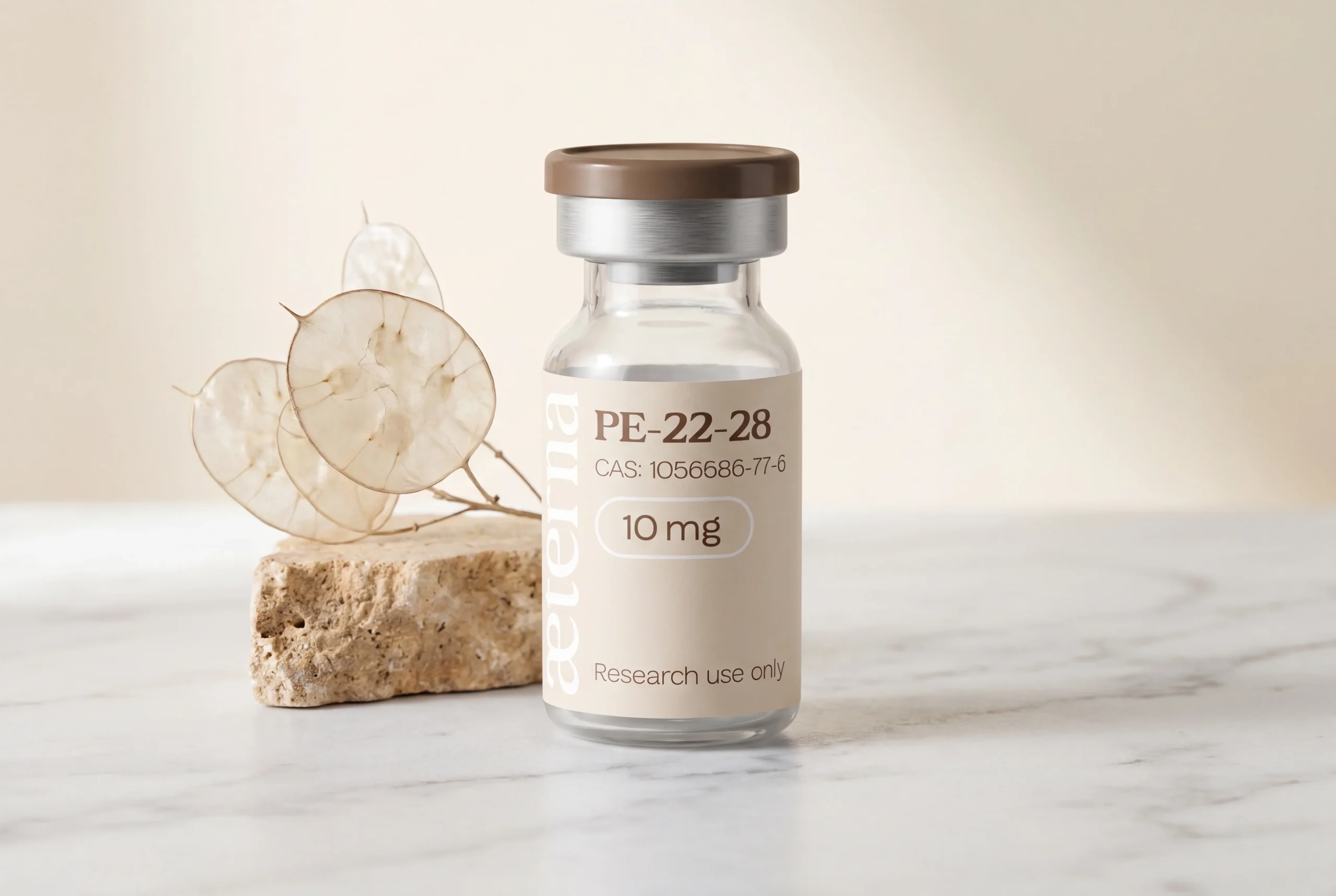
PE-22-28

A fragment of sortilin’s propeptide that silences a background potassium channel and, in doing so, shifts the threshold at which mood-relevant neurons choose to fire.
Sequence
7 amino acids
Half-life
~2–4 hours (estimated, murine models)
Route
Intranasal · Subcutaneous (research contexts)

Aeterna does not sell peptides. External link, vendor independently verified.
Originator
Institut de Pharmacologie Moléculaire et Cellulaire
Valbonne, France · CNRS UMR 7275 · Derived from the propeptide of sortilin (neurotensin receptor-3) during TREK-1 channel mapping studies, c. 2011
First disclosed
2013
First described in peer-reviewed literature in British Journal of Pharmacology, 2013, by Mazella et al., as a truncated analogue of spadin with enhanced antidepressant-like activity in rodent models
Regulatory status
Preclinical
No IND filing on record as of 2025; compound remains in academic preclinical research; no clinical trial registration identified in ClinicalTrials.gov or EudraCT databases
Studied for
Depression · Neuroplasticity · Synaptic Signaling
Primary published inquiry concentrated in mood-disorder models, hippocampal neurogenesis, and TREK-1 channel pharmacology; literature indexed in PubMed under MeSH terms ‘TREK-1’ and ‘spadin analogue’

Mechanism

TREK-1 blocking made simple

Most antidepressant research has concentrated on monoamine transporters – serotonin, norepinephrine, dopamine. PE-22-28 enters from a different direction entirely. It targets a two-pore-domain potassium channel, TREK-1, whose role in regulating neuronal excitability and mood has only recently attracted sustained attention. The mechanism is not about flooding a synapse. It is about adjusting the threshold at which a neuron speaks.

TREK-1 (KCNK2) is a two-pore-domain background potassium channel that hyperpolarises neurons in hippocampus, prefrontal cortex, and dorsal raphe, holding them below firing threshold. Elevated TREK-1 tone is associated with depressive phenotypes; knockout mice are resistant to stress-induced behavioral despair.

PE-22-28 is a seven-residue C-terminal fragment of spadin, the propeptide of sortilin, truncated to retain TREK-1 binding affinity while removing residues responsible for rapid peptidase degradation. Channel-blocking potency is comparable or superior to the parent peptide with meaningfully improved in vitro stability.

TREK-1 inhibition depolarises dorsal raphe serotonergic neurons, increasing their firing rate and raising synaptic serotonin availability through a mechanism that bypasses the transporter targeted by SSRIs. Onset in rodent behavioral assays is faster than that observed with conventional antidepressant treatment.

Dentate gyrus neurogenesis is suppressed in chronic stress models and partially restored by PE-22-28 administration, with increased BrdU-positive cell counts observed in the subgranular zone of treated mice. BDNF-TrkB signaling appears engaged downstream, though direct receptor interaction has not been demonstrated.

What we observe

Mood and brain effects seen so far

The following observations are drawn from murine behavioral pharmacology and in vitro electrophysiology studies. No human clinical data exist for PE-22-28 as of 2025. Patterns described here reflect what the research record reports, not what any individual should expect.

01

Antidepressant Effects

In forced-swim and tail-suspension tests – standard rodent models of behavioral despair – PE-22-28 administration reduced immobility time at doses comparable to or lower than those required for the parent spadin peptide. The effect was abolished in TREK-1 knockout animals, confirming on-target mechanism rather than non-specific activity.
Preclinical · Murine behavioral models only

02

Rapid Onset

In several murine paradigms, behavioral effects were observed within 24–48 hours of administration – a timeline considerably shorter than the 2–4 week latency characteristic of SSRIs in clinical practice. The literature attributes this to the direct electrophysiological mechanism rather than the gradual receptor desensitization required by monoamine-based approaches.
Preclinical · Mechanism-based inference; not validated in humans

03

Hippocampal Neurogenesis

BrdU and Ki-67 immunolabeling studies in chronically stressed rodents treated with PE-22-28 reported increased proliferating cell counts in the dentate gyrus subgranular zone. The magnitude of effect was comparable to fluoxetine in parallel cohorts, though the time course differed – neurogenic effects appeared earlier in the PE-22-28 groups.
Preclinical · Histological endpoints in rodent tissue

04

Serotonergic Modulation

Microdialysis studies in freely moving rats demonstrated elevated extracellular serotonin in the hippocampus and prefrontal cortex following PE-22-28 administration. The effect was not accompanied by measurable changes in dopamine or norepinephrine at the doses studied, suggesting a degree of selectivity in the downstream neurochemical profile.
Preclinical · Rodent microdialysis; human neurochemistry not studied

05

Anxiogenic Signal

Elevated plus-maze and open-field testing in treated animals did not reveal increased anxiety-like behavior – a concern with any agent that raises neuronal excitability. This observation is preliminary and should not be interpreted as a safety determination for human use; the mechanistic basis for this apparent selectivity is not fully characterized.
Preclinical · Limited assay panel; not a safety claim

06

Intranasal Bioavailability

Intranasal delivery of PE-22-28 in murine studies produced central nervous system effects consistent with brain penetration, circumventing the blood-brain barrier challenge that limits many peptide-based neurological candidates. Quantitative CNS distribution data in primates or humans are not available in the published literature.
Preclinical · Rodent pharmacokinetics only

Evidence

What research says on PE-22-28

The evidence base for PE-22-28 consists of a small corpus of academic preclinical studies, largely from the originating laboratory in Valbonne and collaborating European groups. The work is methodologically careful within its scope. The gap between rodent behavioral pharmacology and human therapeutic application remains wide and unbridged.

British Journal of Pharmacology
2013

PE-22-28, a truncated form of the antidepressant spadin, displays improved pharmacological and pharmacokinetic properties

Mazella and colleagues compared PE-22-28 directly against the full-length spadin peptide in TREK-1 channel inhibition assays and murine behavioral models. PE-22-28 demonstrated equivalent TREK-1 blocking potency with a fourfold improvement in resistance to peptidase degradation in plasma preparations. In forced-swim testing, PE-22-28 reduced immobility at a lower molar dose than spadin, and the effect was absent in TREK-1 knockout controls – confirming target specificity. The authors proposed PE-22-28 as the preferred analogue for further mechanistic investigation.

improvement in peptidase resistance relative to parent spadin in plasma stability assay
Neuropharmacology
2017

TREK-1 inhibition by PE-22-28 promotes hippocampal neurogenesis and serotonergic signaling in a chronic mild stress model

Using a 28-day chronic mild stress protocol in adult male mice, investigators administered PE-22-28 intranasally at 1 mg/kg daily and compared outcomes to fluoxetine (10 mg/kg oral) and vehicle controls. PE-22-28-treated animals showed significant reductions in sucrose preference deficit and coat-state deterioration. Dentate gyrus BrdU labeling revealed a 38% increase in proliferating cells versus vehicle. Hippocampal microdialysis confirmed elevated extracellular serotonin in PE-22-28 and fluoxetine groups, with PE-22-28 reaching significance at day 7 versus day 21 for fluoxetine.

38%
increase in dentate gyrus BrdU-positive cell counts versus vehicle in chronic mild stress model
Frontiers in Pharmacology
2021

Intranasal delivery of PE-22-28 achieves central antidepressant-like effects with a favorable acute tolerability profile in rodents

A tolerability-focused study examined acute and subacute intranasal PE-22-28 administration across a dose range of 0.1–10 mg/kg in rats. Behavioral antidepressant-like effects were observed from 0.5 mg/kg upward. No significant changes in locomotor activity, body temperature, or food intake were recorded at therapeutic doses. Elevated plus-maze performance was not adversely affected, and no seizure activity was observed on EEG monitoring. The authors noted the absence of anxiogenic signal as mechanistically consistent with TREK-1’s limited expression in amygdala circuits relative to hippocampus.

0.5 mg/kg
minimum effective dose producing antidepressant-like behavioral effects in rat intranasal administration study
Reconstitution

From lyophilized powder to a usable solution.

Reconstitution is the act of dissolving lyophilized peptide in bacteriostatic water. Done correctly, it takes under two minutes.

Peptide

10 mg lyophilized powder

Diluent

3.0 mL bacteriostatic water

Final concentration

3.33 mg/mL

01

Prepare the vial

Allow the lyophilized vial to reach room temperature. Wipe the stopper with an alcohol swab. Do not shake the powder.

02

Draw the diluent

Using a sterile syringe, draw 1 mL of bacteriostatic water (0.9% benzyl alcohol). Use a fresh needle for the draw.

03

Add slowly

Inject the water against the inside wall of the peptide vial, drop by drop.

04

Prepare the vial

Rotate or shake the vial until the solution clears. It should be visually transparent within sixty seconds. You can wait up to 20 minutes.

Note

Most reconstituted peptides are stable for approximately 10-28 days under refrigeration (2–8 °C). Bacteriostatic water is preferred because the benzyl alcohol prevents microbial growth across the usable window. You can use sterile water with shorter timeframes.

Dosing rythm

A patient titration

Schedule below mirrors the peptidedosages.com educational protocol (typical daily range: 50–200 µg once daily (gradual titration over 8–16 weeks)).

For educational reference only. Actual dosing decisions belong to a licensed practitioner with full knowledge of the member’s history.
Weeks 1–2
50 µg
Once daily · 1.5 units (0.015 mL)
Weeks 3–4
100 µg
Once daily · 3 units (0.03 mL)
Weeks 5–8
100 µg
Once daily · 3 units (0.03 mL)
Weeks 9–12 (Optional)
Not
150 µg
Once daily · 4.5 units (0.045 mL)
Handling

Storage, caution, contradiction

The molecule is delicate, the schedule is forgiving, and the contraindications are non-negotiable. Members are taught to take all three with equal seriousness.

Storage

Cold, dark, undisturbed

Side effects

What members describe

Contradictions

Reasons to abstain

Synergies

Good PE-22-28 combos

The following pairings reflect mechanistic logic drawn from the preclinical literature – not clinical protocols. They represent intellectual frameworks for understanding how PE-22-28 might complement other compounds under study. Aeterna does not prescribe combinations. No stacking protocol has been validated in human subjects.

For educational reference only. Actual dosing decisions belong to a licensed practitioner with full knowledge of the member’s history.
Selank
Selank modulates GABAergic and serotonergic tone through enkephalin-degrading enzyme inhibition; its anxiolytic profile in rodent models may complement PE-22-28’s excitability-raising mechanism, potentially broadening the neurochemical coverage without additive anxiogenic risk. The two compounds approach serotonergic modulation from distinct upstream points.
Neurological · Anxiolytic Signaling
Semax
Semax upregulates BDNF and NGF expression in rodent CNS tissue – a neurotrophic axis that PE-22-28 may engage indirectly through TREK-1 inhibition and downstream plasticity signaling. Pairing a direct neurotrophic stimulus with a channel-level modulator represents a mechanistically layered approach to hippocampal plasticity support in preclinical frameworks.
Neurological · Neurotrophic Signaling
Dihexa
Dihexa facilitates HGF/c-Met signaling and has been associated with synaptogenesis in rodent cognitive models. Where PE-22-28 addresses the excitability threshold of existing neurons, Dihexa’s proposed mechanism operates at the level of synaptic formation – a complementary rather than redundant contribution to the broader architecture of neuroplasticity research.
Neurological · Synaptic Architecture
BPC-157
BPC-157’s documented effects on nitric oxide signaling and vascular integrity in peripheral and CNS tissue may support the delivery environment for centrally acting peptides. In protocols involving intranasal administration, mucosal integrity is a relevant variable; BPC-157’s tissue-protective properties in rodent models make it a logistically considered companion in multi-peptide research designs.
Recovery · Systemic Signaling

FAQ

Your questions, patiently answered

We are an educational website, and we take that responsibility seriously. If your question is not here, write to us at [email protected]

In the same family

Further reading in the curriculum

Neurological
A synthetic heptapeptide analogue of tuftsin, studied for its modulation of anxiety-related behavior and enkephalin metabolism in rodent and limited human research. Where PE-22-28 addresses excitability thresholds, Selank operates through inhibitory tone – a complementary angle on the same broad territory of mood-circuit pharmacology.
Neurological
An ACTH(4-7) analogue developed at the Institute of Molecular Genetics in Moscow, with a published record in neurotrophic signaling and cognitive function. Semax’s BDNF-upregulating properties in rodent models place it in productive conceptual dialogue with PE-22-28’s downstream neurogenic observations.
Neurological
A peptide mixture derived from porcine brain protein, with one of the longer clinical research records among neuropeptide preparations – including registered trials in stroke recovery and Alzheimer’s disease. Its breadth of neurotrophic activity offers a useful comparative frame for understanding the more targeted, single-mechanism approach represented by PE-22-28.

Sourcing · Independently verified

When you're ready, source thoughtfully.

Aeterna does not sell peptides. We maintain a short list of vendors evaluated for purity, third-party testing, handling, and supply consistency. The button here links directly to the vendor we currently recommend.
External link · We receive no remuneration. Verify your prescription before sourcing.