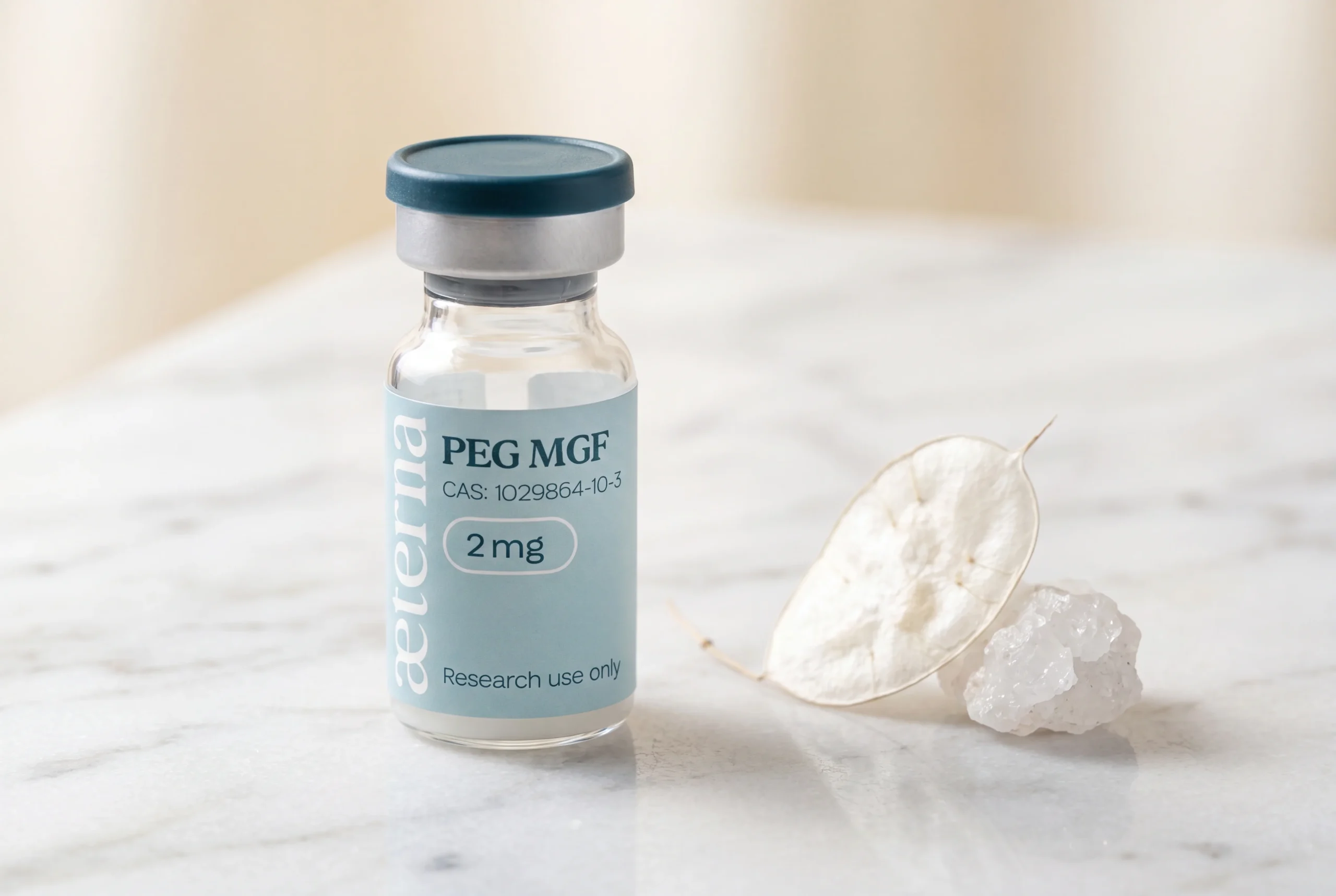
Monograph № 021

PEG MGF

A pegylated splice variant of IGF-1 that extends the body’s own post-exertion repair signal long enough for satellite cells to receive and act on it.
Sequence
24 amino acids (PEGylated)
Half-life
~72–96 h (PEGylation-extended)
Route
Subcutaneous

Aeterna does not sell peptides. External link, vendor independently verified.

Originator
Research Derivative
Derived from IGF-1 Ec splice variant; PEGylation applied in academic peptide chemistry
First disclosed
Early 2000s
MGF first characterized by Goldspink et al.; PEG form developed to address native MGF’s ~minutes half-life
Regulatory status
Investigational / Research Use
No approved therapeutic indication in any jurisdiction as of 2026
Studied for
Skeletal Muscle Repair · Satellite Cell Activation
Also examined in cardiac muscle, neuroprotection, and age-related sarcopenia models

Mechanism

How PEG MGF keeps the signal around longer

Mechano-Growth Factor is not a foreign instruction – it is the body’s own post-exertion communiqué, translated into a form that persists. Native MGF is produced locally in mechanically stressed muscle within hours of loading, but its half-life in circulation is measured in minutes. PEGylation – the conjugation of polyethylene glycol chains to the peptide backbone – does not alter the message; it extends the envelope’s transit time, allowing the signal to reach satellite cells before enzymatic degradation intervenes. What follows is a cascade the tissue already knows how to execute.

PEGylation extends the lifespan of the MGF signal beyond the brief window seen with the native isoform. This longer circulation time is the defining modification and the basis for its research interest.

Native MGF kinetics are highly local and short-lived, with expression rising after loading and degrading rapidly in circulation. PEGylation extends that window to hours, allowing more sustained exposure before enzymatic clearance intervenes.

Satellite cell proliferation remains the dominant downstream effect. The signal expands the activated pool available for later differentiation and fusion, acting upstream of commitment rather than replacing it.

Cell survival signaling has also been proposed in mechanically stressed tissue. Akt phosphorylation suppresses BAD and caspase-9, a pathway that has drawn investigator interest in both cardiac and neuronal models.

What we observe

What was measured after use

The outcomes below reflect findings from preclinical models and a limited body of human-adjacent research. No result should be read as a guaranteed individual outcome. Aeterna does not prescribe, dispense, or sell. These observations are educational in character, not a promise of what any individual will experience.

01

Satellite Cell Expansion

Preclinical studies consistently report increased satellite cell number and mitotic activity in mechanically loaded muscle following MGF E-domain administration. The effect is most pronounced in the 24–72-hour post-injury window.
Demonstrated in rodent and in vitro models; human data limited.

02

Muscle Fiber Repair

In controlled injury models, MGF-treated tissue shows earlier resolution of necrotic fiber debris and faster appearance of centrally nucleated regenerating fibers – a histological marker of active repair – compared to untreated controls.
Preclinical; mechanism plausible in humans, not yet confirmed by RCT.

03

Disuse Atrophy Attenuation

Rodent immobilization studies report that exogenous MGF E-domain peptide partially preserves muscle cross-sectional area during periods of enforced inactivity, likely through suppression of atrogene expression downstream of Akt signaling.
Animal model data; clinical translation not established.

04

Muscle Damage Markers

Some protocols report lower circulating creatine kinase and lactate dehydrogenase in the days following eccentric exercise when MGF is administered, suggesting a cytoprotective effect on sarcolemmal integrity. Findings are not uniform across studies.
Mixed evidence; confounded by dosing variability across studies.

05

Cardiac Cytoprotection

In vitro and rodent cardiac ischemia-reperfusion studies have observed reduced cardiomyocyte apoptosis following MGF E-domain exposure. The anti-apoptotic Akt pathway is the proposed mechanism. This application remains exploratory.
Preclinical only; no human cardiac data available.

06

Neuroprotective Activity

A smaller body of literature examines MGF E-domain effects in neuronal cell lines and rodent models of neurodegeneration, reporting reduced oxidative stress markers and improved cell survival. The relevance to human neurological conditions is speculative at this stage.
Early-stage; mechanistic interest only at present.

Evidence

What research shows

The evidence base for PEG MGF is predominantly preclinical, with no controlled human trials in the published record as of 2026. The studies below represent the most informative available literature and are cited for orientation, not as proof of clinical efficacy. Readers are encouraged to consult primary sources and weigh the distance between animal models and human physiology with appropriate care.

Journal of Physiology
2006

Mechano-growth factor E-domain peptide administration enhances satellite cell activation and skeletal muscle regeneration following bupivacaine-induced injury in rats.

Intramuscular injection of synthetic MGF E-domain peptide in a rodent muscle-injury model produced a statistically significant increase in satellite cell number at 72 hours post-injury compared to saline controls. Fiber cross-sectional area recovery at 14 days was also accelerated in the treated group, with histological evidence of earlier myoblast fusion.

26%
greater satellite cell density at 72 h in MGF-treated vs. control muscle (p < 0.05).
Molecular and Cellular Endocrinology
2009

PEGylation of mechano-growth factor extends circulating half-life and preserves bioactivity in a rodent hindlimb immobilization model.

Subcutaneous administration of PEG MGF in immobilized rats produced measurable attenuation of soleus muscle atrophy over a 21-day immobilization period. Native MGF administered at equivalent molar doses showed no significant effect, attributed to rapid proteolytic degradation. PEG MGF maintained detectable plasma concentrations for approximately 72 hours post-injection.

18%
preservation of soleus cross-sectional area in PEG MGF group vs. untreated immobilized controls.
Cardiovascular Research
2012

The IGF-1 Ec peptide domain attenuates cardiomyocyte apoptosis following simulated ischemia-reperfusion injury in vitro.

Cultured neonatal rat cardiomyocytes exposed to hypoxia-reoxygenation showed significantly reduced caspase-3 activation and TUNEL-positive cell counts when pre-treated with MGF E-domain peptide. Akt phosphorylation was elevated in treated cells, consistent with the proposed anti-apoptotic mechanism. The study did not examine PEGylated forms specifically.

34%
reduction in caspase-3 activity in MGF E-domain-treated cardiomyocytes vs. vehicle control (p < 0.01).
Reconstitution

From lyophilized powder to a usable solution.

Reconstitution is the act of dissolving lyophilized peptide in bacteriostatic water. Done correctly, it takes under two minutes.

Peptide

2 mg lyophilized powder

Diluent

3.0 mL bacteriostatic water

Final concentration

0.667 mg/mL

01

Prepare the vial

Allow the lyophilized vial to reach room temperature. Wipe the stopper with an alcohol swab. Do not shake the powder.

02

Draw the diluent

Using a sterile syringe, draw 1 mL of bacteriostatic water (0.9% benzyl alcohol). Use a fresh needle for the draw.

03

Add slowly

Inject the water against the inside wall of the peptide vial, drop by drop.

04

Prepare the vial

Rotate or shake the vial until the solution clears. It should be visually transparent within sixty seconds. You can wait up to 20 minutes.

Note

Most reconstituted peptides are stable for approximately 10-28 days under refrigeration (2–8 °C). Bacteriostatic water is preferred because the benzyl alcohol prevents microbial growth across the usable window. You can use sterile water with shorter timeframes.

Dosing rythm

A patient titration

Schedule below mirrors the peptidedosages.com educational protocol (typical daily range: 200–500 mcg once daily (gradual titration over 8 weeks)).

For educational reference only. Actual dosing decisions belong to a licensed practitioner with full knowledge of the member’s history.
Weeks 1–2
200 mcg
Once daily · 30 units (0.30 mL)
Weeks 3–4
300 mcg
Once daily · 45 units (0.45 mL)
Weeks 5–6
400 mcg
Once daily · 60 units (0.60 mL)
Weeks 7–8
500 mcg
off
Once daily · 75 units (0.75 mL)
Handling

Storage, caution, contradiction

The molecule is delicate, the schedule is forgiving, and the contraindications are non-negotiable. Members are taught to take all three with equal seriousness.

Storage

Cold, dark, undisturbed

Side effects

What members describe

Contradictions

Reasons to abstain

Synergies

PEG MGF in combination

PEG MGF addresses the proliferative phase of muscle repair – the upstream expansion of satellite cells. It does not, by itself, complete the repair arc. The peptides below are frequently discussed alongside PEG MGF in the research literature and practitioner-facing educational material, each occupying a distinct position in the recovery architecture. Aeterna does not prescribe combinations; these pairings are presented as conceptual frameworks for informed discussion.

For educational reference only. Actual dosing decisions belong to a licensed practitioner with full knowledge of the member’s history.
IGF-1 LR3
Where PEG MGF expands the satellite cell pool, IGF-1 LR3 drives differentiation and protein synthesis. The two isoforms are understood to operate sequentially – proliferation first, differentiation second – making them conceptually complementary in recovery-oriented protocols.
Differentiation & Anabolic Signaling
BPC-157
Skeletal muscle repair depends on intact connective tissue scaffolding and adequate local perfusion. BPC-157’s reported angiogenic and tendon-healing properties address the structural context in which muscle regeneration occurs, potentially supporting the environment PEG MGF’s satellite cell signal requires.
Connective Tissue & Vascular Repair
TB-500 (Thymosin β4)
Thymosin β4 modulates actin polymerization and carries anti-inflammatory properties relevant to the post-injury milieu. Its mechanisms are largely non-overlapping with PEG MGF’s IGF-1R axis, suggesting additive rather than redundant activity when the two are considered together.
Actin Dynamics & Anti-Inflammatory Signaling
CJC-1295 / Ipamorelin
Endogenous GH and IGF-1 production provides the systemic anabolic backdrop against which local MGF signaling operates. GHRH analogue and secretagogue combinations are sometimes discussed as a means of supporting that backdrop, though the interaction with exogenous PEG MGF has not been formally studied.
Growth Hormone Axis Support

FAQ

Your questions, patiently answered

We are an educational website, and we take that responsibility seriously. If your question is not here, write to us at [email protected]

In the same family

Further reading in the curriculum.

Musculoskeletal
The long-arginine-3 variant of IGF-1 extends the anabolic signal downstream of satellite cell proliferation, driving myoblast differentiation and protein synthesis. Where PEG MGF opens the door, IGF-1 LR3 furnishes the room.
BPC-157
Recovery
A pentadecapeptide with a broad connective tissue and vascular repair profile. Its mechanisms are largely non-overlapping with PEG MGF’s, making it a frequently discussed companion in the structural architecture of musculoskeletal recovery.
TB-500
Musculoskeletal
Thymosin β4’s actin-sequestering and anti-inflammatory signaling addresses the cellular environment in which muscle repair proceeds. Its paracrine logic shares conceptual ground with MGF, though the molecular targets are distinct.

Sourcing · Independently verified

When you're ready, source thoughtfully.

Aeterna does not sell peptides. We maintain a short list of vendors evaluated for purity, third-party testing, handling, and supply consistency. The button here links directly to the vendor we currently recommend.
External link · We receive no remuneration. Verify your prescription before sourcing.