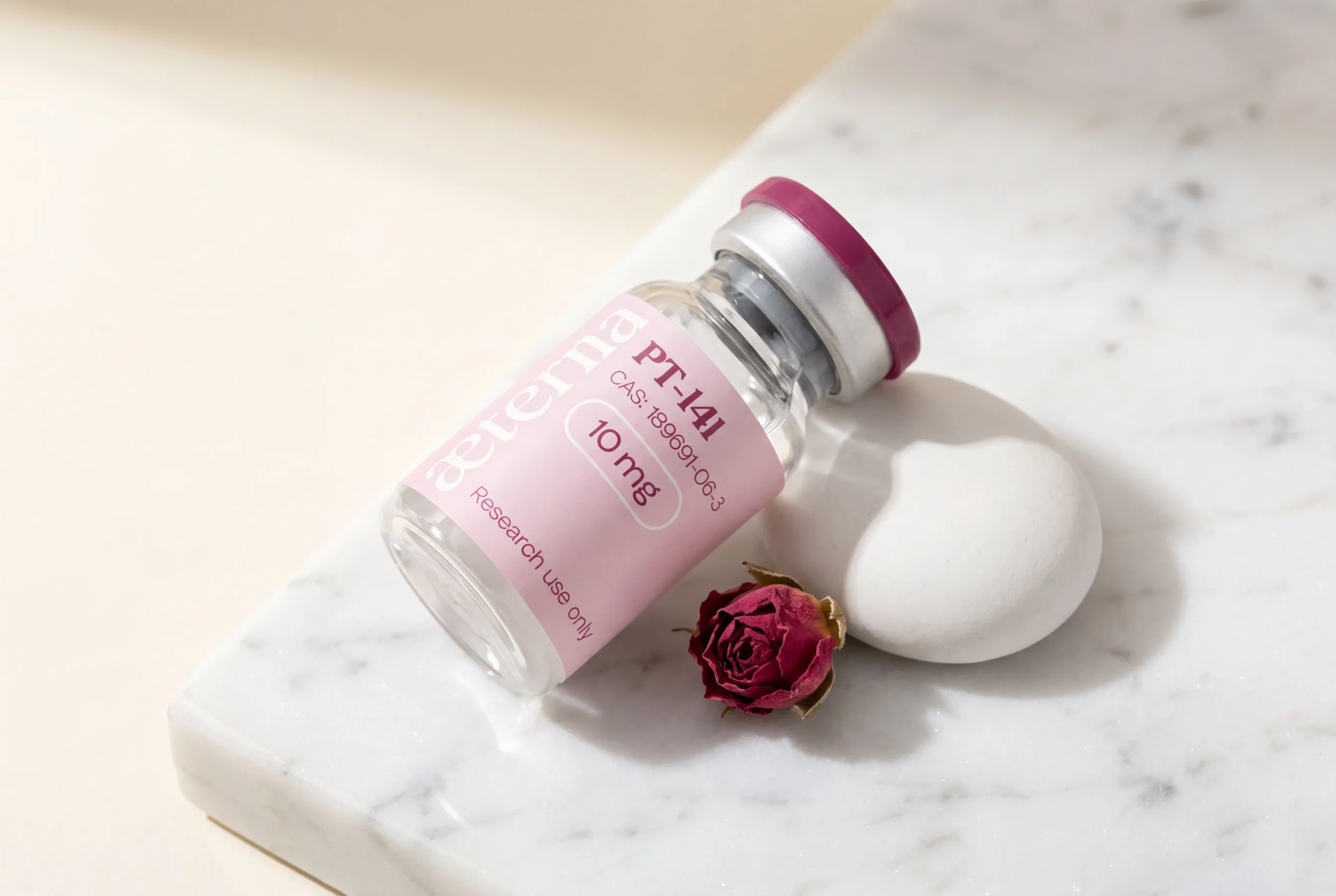
PT-141
Aeterna does not sell peptides. External link, vendor independently verified.
Mechanism
Most pharmacological approaches to sexual dysfunction have addressed the periphery – vasodilation, blood flow, end-organ response. PT-141 operates differently. It enters the central nervous system and engages the melanocortin system, a network of receptors whose role in motivated behavior, appetite, and arousal has been documented across decades of neuroendocrine research. The mechanism is not hydraulic. It is neurological.
MC4R agonism initiates the prosexual cascade by activating melanocortin-4 receptors in central hypothalamic pathways and driving downstream dopaminergic signaling. This is the core reason PT-141 is understood as acting on desire at a central, rather than peripheral, level.
MC3R co-activation appears to shape the autonomic profile, with secondary melanocortin-3 receptor activity contributing to transient blood pressure elevation and modulation of signaling threshold. Its precise contribution to the prosexual response remains less clearly defined than that of MC4R.
Dopaminergic convergence emerges in mesolimbic circuits, where central melanocortin signaling increases dopamine activity in regions linked to anticipatory reward and approach motivation. Human imaging findings are broadly consistent with this reward-circuit mechanism.
Nitric oxide independence distinguishes PT-141 from vasodilatory approaches because its activity does not depend on peripheral nitric oxide signaling. This helps explain why it may remain active in some PDE5 nonresponders and does not carry the nitrate coadministration contraindications typical of that class.
What we observe
What users noticed in arousal and response
The clinical record for PT-141 spans two decades and two indications. What follows reflects outcomes reported in peer-reviewed trials. Individual response varies with hormonal milieu, receptor density, psychological context, and dose.
01
Sexual Desire
02
Erectile Response
03
Onset Profile
04
Hormonal Robustness
05
Mood Adjacent Effects
06
Blood Pressure Elevation
Evidence
What the trials found
Three studies are presented here as entry points into a larger record. They are not the totality of the evidence. Readers are encouraged to examine methodology and weigh findings against individual clinical context.
Bremelanotide for Hypoactive Sexual Desire Disorder in Premenopausal Women - The RECONNECT Trials
Two replicate Phase III randomized controlled trials enrolled 1,267 premenopausal women with HSDD. Bremelanotide 1.75 mg subcutaneous produced statistically significant improvements in both co-primary endpoints: the Female Sexual Function Index desire domain score and the Female Sexual Distress Scale–Desire/Arousal/Orgasm score. Nausea was the most common adverse event, reported in approximately 40% of the treatment group, though it was generally transient and mild.
Intranasal PT-141 for Erectile Dysfunction: A Phase II Dose-Escalation Study Including Sildenafil Non-Responders
A randomized, double-blind, placebo-controlled dose-escalation study evaluated intranasal PT-141 in 271 men with erectile dysfunction, including a pre-specified subgroup of sildenafil non-responders. Clinically meaningful erectile responses were observed at doses of 7.5 mg and 10 mg. The sildenafil non-responder subgroup showed response rates comparable to the overall population, supporting the hypothesis that the central mechanism operates independently of the nitric oxide pathway.
Central Melanocortin Receptors and Sexual Function: Pharmacological Evidence from a First-in-Human Intranasal PT-141 Study
An early Phase II proof-of-concept study in 20 healthy male volunteers established the central mechanism of PT-141 by demonstrating erectile responses in a non-stimulatory laboratory environment – a finding inconsistent with a purely peripheral vascular mechanism. Penile tumescence was measured by RigiScan; responses were statistically significant versus placebo at the 10 mg dose. The study provided foundational human evidence for the melanocortin hypothesis of sexual motivation.
From lyophilized powder to a usable solution.
Peptide
10 mg lyophilized powder
Diluent
3.0 mL bacteriostatic water
Final concentration
3.33 mg/mL
01
Prepare the vial
02
Draw the diluent
03
Add slowly
04
Prepare the vial
Note
Dosing rythm
A patient titration
Schedule below mirrors the peptidedosages.com educational protocol (typical daily range: 500–1500 mcg once daily (gradual titration over 16 weeks)).
Storage, caution, contradiction
Storage
Cold, dark, undisturbed
- Lyophilized: freeze at −20 °C (−4 °F).
- After reconstitution, refrigerate at 2–8 °C (35.6–46.4 °F).
- Avoid freeze–thaw cycles.
- Allow vial to reach room temperature before reconstitution; inject diluent slowly along the vial wall to avoid foaming
- Discard if solution appears cloudy, discolored, or contains visible particulate matter
Side effects
What members describe
- Nausea - the most commonly reported adverse event; typically onset within 30–60 minutes of administration, resolving within 2–4 hours; incidence approximately 40% at the approved dose
- Flushing - transient facial and truncal flushing reported in a subset of subjects; attributed to peripheral melanocortin receptor activity; generally mild and self-limiting
- Transient blood pressure elevation - systolic increases of 2–6 mmHg observed within 1–2 hours; resolves without intervention in healthy subjects; requires monitoring in at-risk populations
- Headache - reported in approximately 11% of subjects in Phase III trials; typically mild; onset correlates with peak plasma concentration
- Injection site reactions - localized erythema, bruising, or mild discomfort at the subcutaneous injection site; consistent with class effects for peptide administration
Contradictions
Reasons to abstain
- Known cardiovascular disease or uncontrolled hypertension - the transient pressor effect of PT-141 is a meaningful risk in this population; contraindicated in the approved labeling
- Concurrent use of antihypertensive medications - potential for pharmacodynamic interaction; blood pressure response may be unpredictable
- History of hypersensitivity to melanocortin peptides or any component of the formulation
- Pregnancy - no adequate safety data; melanocortin system plays roles in fetal development; use is not supported in pregnant individuals
- Concurrent use of naltrexone or other opioid antagonists - potential for attenuation of effect via shared neuromodulatory pathways; clinical significance not fully characterized
Synergies
What to pair with PT-141
PT-141 addresses the central, motivational dimension of sexual health. Companion peptides in a considered protocol typically address the vascular, hormonal, or tissue-level dimensions that PT-141 does not directly engage. The combinations below reflect patterns in the research literature and clinical practice – not prescriptions.
FAQ
Your questions, patiently answered
PDE5 inhibitors act peripherally – they prolong nitric oxide-mediated vasodilation in erectile tissue, facilitating physical response when sexual stimulation is already present. PT-141 acts centrally, engaging melanocortin receptors in the hypothalamus to generate the motivational signal that precedes physical response. The distinction matters clinically: PT-141 has shown activity in subjects for whom PDE5 inhibitors were ineffective, and it does not carry the nitrate contraindication. The two mechanisms are not interchangeable – they address different points in the same system.
The FDA-approved form – bremelanotide, marketed as Vyleesi® – carries an indication specifically for hypoactive sexual desire disorder in premenopausal women. Clinical trials in men with erectile dysfunction were conducted through Phase II, and results were published, but the compound was not advanced to Phase III for a male indication. Research use in men continues under investigational frameworks. Aeterna does not prescribe or dispense.
PT-141 was derived from Melanotan II, a synthetic analogue of alpha-melanocyte-stimulating hormone (α-MSH). Melanotan II was originally studied for tanning and photoprotection; its pro-sexual effects were observed incidentally in early human studies. PT-141 was designed to retain the melanocortin receptor activity responsible for those effects while reducing the tanning and other off-target actions. The structural modification – cyclization and substitution at key residues – produced a compound with a more selective central profile.
Nausea is the most consistently reported adverse effect, occurring in approximately 40% of subjects at the approved dose. The mechanism is not fully resolved, but current evidence points to melanocortin receptor activity in the area postrema – a circumventricular organ in the brainstem that lacks a blood-brain barrier and is sensitive to circulating peptides. The nausea is typically transient, peaking within one to two hours and resolving without intervention. Administering the compound with a light meal and remaining upright may attenuate the response.
PT-141 does not directly alter circulating levels of testosterone, estrogen, or gonadotropins. Its action is at the receptor level in the central nervous system, not at the level of hormone synthesis or secretion. Some downstream effects on prolactin have been noted in animal models, but clinically significant hormonal changes have not been consistently reported in human trials at therapeutic doses.
The approved clinical guidance recommends administration approximately 45 minutes before anticipated sexual activity. Plasma half-life is approximately 2.7 hours. The window of effect in clinical trials was generally described as extending up to 12 hours from administration, though individual variation is considerable. The compound is not intended for daily use; the approved labeling specifies no more than one dose in 24 hours, and the RECONNECT trials did not evaluate chronic daily dosing.
In the same family
Further reading in the curriculum
Sourcing · Independently verified
When you're ready, source thoughtfully.