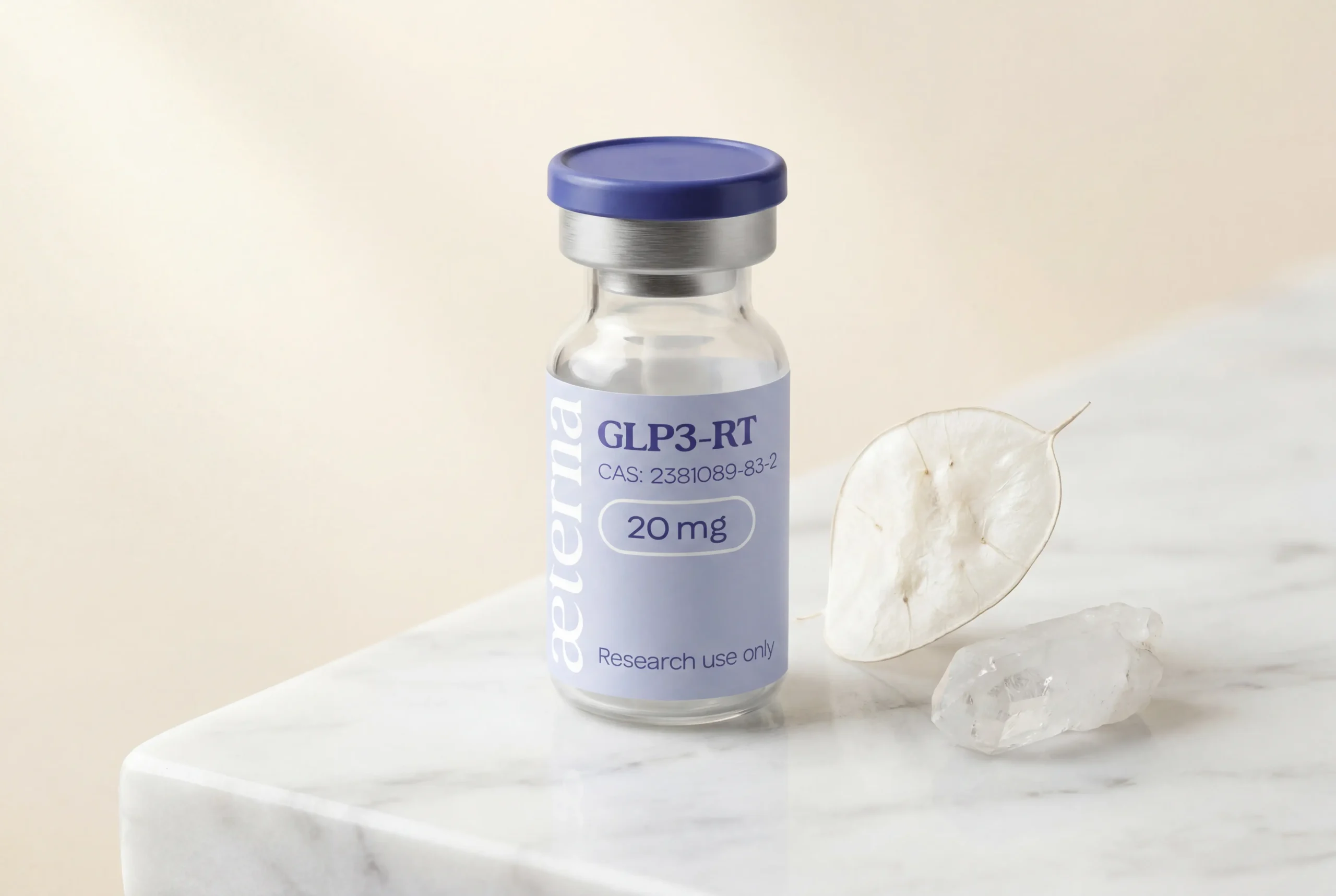
Monograph № 014

Retatrutide

A single molecule speaking three of the body’s most consequential metabolic languages at once.
Sequence
39 amino acids
Half-life
~6 days
Route
Subcutaneous injection, once weekly

Aeterna does not sell peptides. External link, vendor independently verified.

Originator
Eli Lilly
Indianapolis, Indiana · LY3437943
First disclosed
2022
First disclosed in peer-reviewed literature, NEJM 2023
Regulatory status
Investigational
Phase II completed; Phase III enrollment ongoing as of 2025
Studied for
Adiposity · Glycemia
Also under evaluation for MASLD and cardiovascular risk reduction

Mechanism

The architecture of a triple signal

Most metabolic peptides address a single receptor. Retatrutide addresses three simultaneously – GLP-1R, GIPR, and GCGR – each governing a distinct aspect of energy homeostasis. The result is not additive so much as orchestral: each receptor contributes a voice, and the compound conducts all three toward a coherent metabolic outcome. Understanding that architecture is the first obligation of anyone who studies this molecule.

GLP-1 receptor agonism drives the now-familiar cascade: delayed gastric emptying, central satiety signaling, and glucose-dependent insulin release. This is the same axis engaged by semaglutide and tirzepatide.

GIP receptor agonism potentiates insulin secretion and, paradoxically, appears to remodel adipose tissue function. The combined GLP-1 / GIP signature is what produces the step-change in efficacy observed with tirzepatide.

Glucagon receptor agonism is the third – and most distinctive – element. Where GLP-1 alone reduces intake, glucagon signaling increases energy expenditure: hepatic lipid mobilization, thermogenesis, and basal metabolic rate.

The combination is not additive. Engaging all three pathways in a single, balanced molecule produces an effect on body composition and glycemic control that exceeds what any monoagonist has demonstrated to date.

What we observe

Observed thresholds in clinical study

The outcomes below reflect patterns reported in Phase II clinical literature. They describe what investigators observed under controlled conditions. They do not constitute predictions for any individual. Aeterna does not prescribe, dispense, or sell; this summary exists to illuminate the evidence, not to direct its application.

01

Body Weight Reduction

Phase II data reported mean weight loss of approximately 17–24% of baseline body weight at 24 weeks across mid-to-high dose cohorts – a magnitude not previously observed in a single-agent peptide trial of comparable duration.
Observed in Phase II RCT; individual variation substantial; longer-term durability under Phase III evaluation

02

Visceral Adipose Reduction

Imaging substudies indicated preferential reduction in visceral adipose tissue relative to subcutaneous fat, consistent with the glucagon receptor component’s known influence on hepatic lipid metabolism and central fat depots.
Imaging data from substudy cohort; mechanistic attribution to GCGR component remains investigational

03

Fasting Glucose and HbA1c

In participants with type 2 diabetes or prediabetes, reductions in fasting plasma glucose and HbA1c were observed across all active dose arms, consistent with the combined GLP-1R and GIPR insulinotropic mechanisms.
Glycemic endpoints secondary in obesity-primary trials; dedicated T2D trials ongoing

04

Hepatic Lipid Content

Preliminary data from participants with metabolic-associated steatotic liver disease (MASLD) suggested meaningful reductions in hepatic fat fraction, likely mediated through both direct GCGR hepatic signaling and indirect effects of weight loss.
MASLD indication under dedicated investigation; data preliminary as of 2025

05

Lipid Panel Markers

Modest improvements in triglycerides and non-HDL cholesterol were reported in Phase II participants, consistent with the broader metabolic remodeling associated with significant adiposity reduction and improved insulin sensitivity.
Lipid endpoints exploratory in Phase II; not a primary registered endpoint

06

Tolerability Profile

Gastrointestinal adverse events – nausea, vomiting, diarrhea – were the most commonly reported, consistent with GLP-1R agonist class effects. Incidence appeared dose-dependent and generally attenuated over time with gradual titration.
AE profile consistent with incretin class; discontinuation rates higher at maximum dose arms

Evidence

The literature as it stands

Three studies anchor the current evidence base for retatrutide in humans. Each is cited here with its primary finding and a representative statistic. The field is moving; these entries reflect the literature available through early 2025. Readers are encouraged to consult primary sources directly.

New England Journal of Medicine
2023

Triple Hormone Receptor Agonist Retatrutide for Obesity - A Phase 2 Trial

A randomized, double-blind, placebo-controlled trial enrolling 338 adults with obesity (BMI ≥27) across multiple dose cohorts (1 mg, 4 mg, 8 mg, 12 mg weekly). The 12 mg cohort demonstrated the largest weight reduction, with a mean change of −22.8% from baseline at week 24. Gastrointestinal events were the primary adverse finding; no unexpected safety signals were identified. The trial established proof-of-concept for triple agonism as a viable pharmacological strategy.

−22.8%
Mean body weight reduction at 24 weeks, 12 mg cohort (vs. −2.1% placebo)
Diabetes, Obesity and Metabolism
2024

Hepatic and Visceral Fat Responses to Retatrutide in Adults with Metabolic-Associated Steatotic Liver Disease: A Substudy Analysis

A pre-specified imaging substudy of 94 participants from the Phase II trial who underwent MRI-PDFF assessment at baseline and week 24. Hepatic fat fraction declined significantly in all active dose arms relative to placebo, with the greatest reduction in the 8 mg and 12 mg cohorts. Visceral adipose tissue volume declined in parallel, supporting a dual hepatic-adipose mechanism consistent with GCGR and GLP-1R co-agonism. Authors noted the findings as hypothesis-generating for a dedicated MASLD indication trial.

−42%
Relative reduction in hepatic fat fraction, 12 mg cohort at 24 weeks by MRI-PDFF
The Lancet Diabetes & Endocrinology
2024

Cardiovascular and Metabolic Risk Marker Changes with Retatrutide: Secondary Endpoint Analysis of a Phase 2 Randomized Trial

A secondary analysis examining cardiometabolic biomarkers – including triglycerides, blood pressure, C-reactive protein, and waist circumference – across the Phase II cohort. Statistically significant reductions were observed in triglycerides and systolic blood pressure in the 8 mg and 12 mg arms. CRP reductions suggested an anti-inflammatory signal, though the authors cautioned that weight loss alone could account for a substantial portion of the observed effect. A dedicated cardiovascular outcomes trial was recommended.

−28%
Reduction in fasting triglycerides, 12 mg cohort at 24 weeks relative to placebo
Reconstitution

From lyophilized powder to a usable solution.

Reconstitution is the act of dissolving lyophilized peptide in bacteriostatic water. Done correctly, it takes under two minutes.

Peptide

Typically 5 mg or 10 mg lyophilized powder per vial

Diluent

Bacteriostatic water for injection (0.9% benzyl alcohol); sterile water acceptable for single-use preparation

Final concentration

Common working concentration: 2 mg/mL (e.g., 10 mg peptide + 5 mL diluent); adjust to intended dose volume

01

Prepare the vial

Allow the lyophilized vial to reach room temperature. Wipe the stopper with an alcohol swab. Do not shake the powder.

02

Draw the diluent

Using a sterile syringe, draw 1 mL of bacteriostatic water (0.9% benzyl alcohol). Use a fresh needle for the draw.

03

Add slowly

Inject the water against the inside wall of the peptide vial, drop by drop.

04

Prepare the vial

Rotate or shake the vial until the solution clears. It should be visually transparent within sixty seconds. You can wait up to 20 minutes.

Note

Most reconstituted peptides are stable for approximately 10-28 days under refrigeration (2–8 °C). Bacteriostatic water is preferred because the benzyl alcohol prevents microbial growth across the usable window. You can use sterile water with shorter timeframes.

Dosing rythm

A patient titration

The titration schedule below follows the dose-escalation protocol from the Phase II trial (Jastreboff et al., NEJM 2023). Each 4-week block increases the weekly dose, allowing GI adaptation before the next step. The 12 mg maximum was studied in a separate cohort.

For educational reference only. Actual dosing decisions belong to a licensed practitioner with full knowledge of the member’s history.
Week 1-4
2 mg
Weekly · Initiation
Week 5-8
4 mg
Weekly · Escalation
Week 9-12
8 mg
Weekly · Titration
Week 13+
12 mg
maximum
Weekly · Steady state
Handling

Storage, caution, contradiction

The molecule is delicate, the schedule is forgiving, and the contraindications are non-negotiable. Members are taught to take all three with equal seriousness.

Storage

Cold, dark, undisturbed

Side effects

What members describe

Contradictions

Reasons to abstain

Synergies

Companions in the curriculum

Retatrutide’s broad metabolic reach means that companion peptides, when considered, tend to address adjacent pillars rather than overlapping mechanisms. The combinations below reflect patterns discussed in the research literature and among clinicians working in metabolic medicine. They are presented as intellectual context. Aeterna does not prescribe, dispense, or sell; no combination should be initiated without qualified medical oversight.

For educational reference only. Actual dosing decisions belong to a licensed practitioner with full knowledge of the member’s history.
BPC-157
GLP-1R agonism can transiently compromise gastric motility and mucosal comfort during escalation. BPC-157’s reported gastroprotective and mucosal-healing properties in animal models make it a theoretically complementary companion during the early titration window, though human data for this specific combination are absent.
Recovery · Gut Integrity
Tesamorelin
Tesamorelin’s established effect on visceral adipose reduction – particularly in the context of lipodystrophy – may complement retatrutide’s own visceral fat activity through a distinct growth hormone-releasing hormone mechanism. The combination addresses adiposity from two independent axes.
Body Composition · GH Axis
Epithalon
As retatrutide addresses metabolic architecture, epithalon is studied for cellular senescence and telomere maintenance – a different register of longevity entirely. The pairing is conceptually coherent for those approaching health as a multi-pillar practice rather than a single-target intervention.
Cellular Longevity · Telomere Biology
Selank
Significant caloric restriction and rapid body composition change can carry psychological and neuroendocrine stress. Selank’s anxiolytic and nootropic profile in preclinical literature suggests a potential role in supporting cognitive and emotional steadiness during intensive metabolic protocols.
Cognitive Resilience · Stress Modulation

FAQ

Your questions, patiently answered

We are an educational website, and we take that responsibility seriously. If your question is not here, write to us at [email protected]

In the same family

Further curriculum in metabolic pharmacology

Metabolic · Dual Agonist
The immediate pharmacological predecessor to retatrutide in the incretin agonist lineage. Tirzepatide’s GLP-1R / GIPR dual agonism established the clinical and commercial viability of multi-receptor metabolic targeting, and its Phase III data provide the closest available comparator for contextualizing retatrutide’s Phase II results.
Tesamorelin
Metabolic · GH Axis
A growth hormone-releasing hormone analogue with a distinct mechanism and an established regulatory approval for HIV-associated lipodystrophy. Its visceral fat reduction data offer a useful point of comparison for understanding how different pharmacological architectures arrive at overlapping body composition outcomes.
TB-500
Hepatic · Fibrosis
As retatrutide’s potential MASLD indication develops, companion understanding of hepatic repair and anti-fibrotic signaling becomes relevant. Thymosin Beta-4’s role in tissue remodeling and hepatic stellate cell modulation represents an adjacent area of investigation for those studying metabolic liver disease at the cellular level.

Sourcing · Independently verified

When you're ready, source thoughtfully.

Aeterna does not sell peptides. We maintain a short list of vendors evaluated for purity, third-party testing, handling, and supply consistency. The button here links directly to the vendor we currently recommend.
External link · We receive no remuneration. Verify your prescription before sourcing.