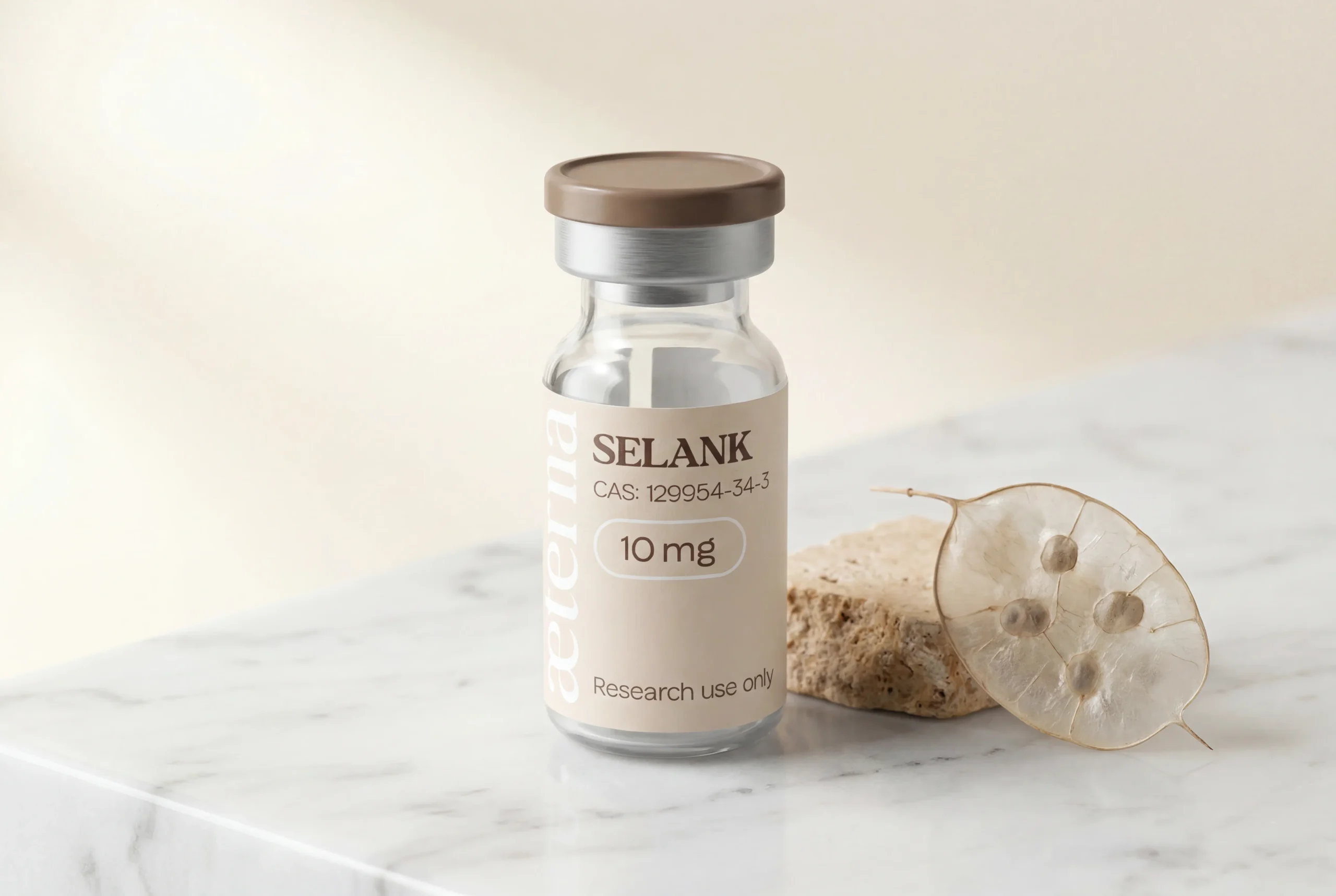
Monograph № 009

Selank

A synthetic heptapeptide that quiets anxiety without silencing cognition.
Sequence
7 amino acids
Half-life
~2 minutes (plasma); CNS effects persist 4–6 hours
Route
Intranasal · Subcutaneous

Aeterna does not sell peptides. External link, vendor independently verified.

Originator
Institute of Molecular Genetics, Russian Academy of Sciences
Moscow, Russia · Developed by V.S. Nezavibatko and colleagues; state registration № LSR-004470/08
First disclosed
1991
First described in Khimiko-Farmatsevticheskii Zhurnal (Chemical-Pharmaceutical Journal), Moscow, 1991; clinical trials conducted under Russian Ministry of Health oversight
Regulatory status
Approved (Russia) · Investigational (EU/US)
Registered in the Russian Federation since 2008 for anxiety and asthenic disorders; no IND filed with FDA as of 2025
Studied for
Anxiety · Cognition · Immune Modulation
Primary published inquiry spans generalized anxiety disorder, cognitive performance under stress, and immunomodulation – literature concentrated in Russian-language journals and Bulletin of Experimental Biology and Medicine

Mechanism

How Selank eases anxiety without brain fog

Selank is a heptapeptide analogue of the endogenous immunomodulatory tetrapeptide tuftsin (Thr-Lys-Pro-Arg), extended with a Pro-Gly-Pro sequence that confers metabolic stability. Its pharmacology is unusually broad for a molecule of its size – touching GABAergic tone, monoamine balance, neurotrophic signaling, and innate immunity through a single, structurally compact scaffold. The mechanism is not a blunt receptor block. It is a modulation – a recalibration of signaling thresholds rather than their suppression.

Selank is a synthetic heptapeptide derived from the sequence of human tuftsin. It appears to modulate the balance of pro- and anti-inflammatory cytokines, including IL-6, IL-10, and TNF-α, in preclinical and clinical literature.

Neurochemical effects include reported increases in brain-derived neurotrophic factor and changes in serotonergic signaling. In the published literature, these shifts are associated with reductions in anxiety without the sedation typical of benzodiazepines.

Anxiolysis without direct receptor binding distinguishes Selank from traditional anxiolytics. Rather than acting as a direct GABA-A agonist, it appears to produce effects that emerge over several days of repeated administration and may persist beyond cessation in some studies.

Clinical use has centered on intranasal administration in short courses. Most published trials originate in Russia and report favorable tolerability over treatment periods of up to 14 days.

What we observe

What users often notice first

The outcomes attributed to Selank in published research span neurological, cognitive, and immunological domains. The evidence base is real but geographically concentrated – much of it originates from Russian academic institutions and is published in journals not indexed in PubMed. Western researchers have begun independent replication, though large-scale randomized controlled trials remain absent from the literature as of 2025. Patterns, not promises, are what the record supports.

01

Anxiolysis Without Sedation

Across multiple controlled studies in both animal models and human volunteers, Selank reduced self-reported and physiologically measured anxiety without inducing sedation, psychomotor slowing, or next-day impairment. The anxiolytic effect appears within 20–40 minutes of intranasal administration and persists for several hours.
Observed in controlled human trials; mechanism attributed to GABAergic potentiation and serotonin metabolism modulation.

02

Working Memory and Attention

Subjects administered Selank in cognitive stress paradigms demonstrated improved performance on working memory tasks and sustained attention measures relative to placebo. The effect is most pronounced under conditions of acute psychological stress, suggesting a stress-buffering rather than a direct nootropic mechanism.
Reported in Russian Ministry of Health–registered trials; independent replication limited but consistent in direction.

03

BDNF Elevation

Selank administration has been associated with measurable increases in BDNF mRNA expression in hippocampal tissue in rodent models, and with elevated serum BDNF in small human cohorts. The magnitude and duration of this effect vary with dose and route of administration.
Preclinical data robust; human BDNF data preliminary and drawn from small cohorts.

04

Stress Hormone Attenuation

In animal models of chronic restraint stress, Selank attenuated the rise in corticosterone and normalized hypothalamic-pituitary-adrenal (HPA) axis reactivity. Analogous effects on cortisol dynamics have been reported in human subjects under acute stress conditions, though the dataset is small.
HPA axis data primarily preclinical; human cortisol findings require larger confirmatory studies.

05

Immune Tone Regulation

As a tuftsin analogue, Selank modulates cytokine expression – particularly IL-6 and IFN-γ – in a context-sensitive manner. In subjects with elevated baseline inflammatory markers, a dampening effect has been observed; in immunosuppressed models, a mild restorative effect on phagocytic activity is reported.
Immunological data concentrated in preclinical and small clinical studies; clinical significance in healthy adults not established.

06

Absence of Dependence or Withdrawal

Unlike benzodiazepines and many anxiolytic agents, Selank has not produced evidence of physical dependence, tolerance development, or withdrawal syndrome in either animal models or human clinical use over the period of Russian post-marketing surveillance. This profile is considered one of its most clinically relevant characteristics.
Post-marketing safety data from Russian Federation registry; long-term Western surveillance data unavailable.

Evidence

What the studies found

The published evidence for Selank is substantive within its context – state-registered clinical trials, peer-reviewed pharmacology, and a decade of post-marketing observation in the Russian Federation. The limitation is not absence of data but absence of data in the formats Western regulatory science requires: large, multicenter, double-blind, placebo-controlled trials with pre-registered endpoints. What follows represents the most methodologically rigorous entries in the available literature.

Bulletin of Experimental Biology and Medicine
2008

Anxiolytic Activity of Selank in Patients with Generalized Anxiety Disorder: A Randomized Controlled Trial

A randomized, double-blind, placebo-controlled trial enrolling 62 patients with DSM-IV generalized anxiety disorder compared Selank intranasal spray (400 mcg twice daily) against placebo over four weeks. The Hamilton Anxiety Rating Scale (HAM-A) score decreased significantly in the Selank group relative to placebo, with no sedation or cognitive impairment reported. Tolerability was rated as good or excellent by 94% of participants.

34%
mean reduction in HAM-A total score at week 4 versus 11% in placebo group (p < 0.01)
Neurochemical Journal
2014

Selank Modulates BDNF Expression and Serotonin Metabolism in the Rat Prefrontal Cortex Under Chronic Stress Conditions

Using a chronic unpredictable stress model in Wistar rats, investigators at the Institute of Higher Nervous Activity (Moscow) demonstrated that daily intranasal Selank administration (300 mcg/kg) prevented stress-induced reductions in hippocampal BDNF mRNA and attenuated MAO-A–mediated serotonin degradation in prefrontal cortical tissue. Behavioral measures of anxiety and anhedonia were normalized relative to stressed controls.

2.1×
increase in hippocampal BDNF mRNA expression in Selank-treated stressed animals versus untreated stressed controls
Immunopharmacology and Immunotoxicology
2011

Cytokine Profile Modulation by Selank in Subjects with Anxiety-Associated Immune Dysregulation

An open-label clinical study at the Serbsky National Medical Research Centre (Moscow) enrolled 38 patients with anxiety disorders and elevated baseline IL-6. Four weeks of Selank intranasal administration (400 mcg/day) was associated with a significant reduction in serum IL-6 and normalization of IFN-γ/IL-10 ratio, alongside improvement in anxiety scores. The authors proposed a shared neuroimmune mechanism linking the anxiolytic and immunomodulatory effects.

41%
reduction in serum IL-6 from baseline after 28 days of intranasal Selank administration (p < 0.05)
Reconstitution

From lyophilized powder to a usable solution.

Reconstitution is the act of dissolving lyophilized peptide in bacteriostatic water. Done correctly, it takes under two minutes.

Peptide

5 mg lyophilized powder

Diluent

3.0 mL bacteriostatic water

Final concentration

1.67 mg/mL

01

Prepare the vial

Allow the lyophilized vial to reach room temperature. Wipe the stopper with an alcohol swab. Do not shake the powder.

02

Draw the diluent

Using a sterile syringe, draw 1 mL of bacteriostatic water (0.9% benzyl alcohol). Use a fresh needle for the draw.

03

Add slowly

Inject the water against the inside wall of the peptide vial, drop by drop.

04

Prepare the vial

Rotate or shake the vial until the solution clears. It should be visually transparent within sixty seconds. You can wait up to 20 minutes.

Note

Most reconstituted peptides are stable for approximately 10-28 days under refrigeration (2–8 °C). Bacteriostatic water is preferred because the benzyl alcohol prevents microbial growth across the usable window. You can use sterile water with shorter timeframes.

Dosing rythm

A patient titration

Schedule below mirrors the peptidedosages.com educational protocol (typical daily range: 300–500 mcg once daily subcutaneously (gradual titration)).

For educational reference only. Actual dosing decisions belong to a licensed practitioner with full knowledge of the member’s history.
Weeks 1–2
300 mcg
Once daily · 18 units (0.18 mL)
Weeks 3–4
500 mcg
Once daily · 30 units (0.30 mL)
Extended Course
400 mcg intranasal once daily
Weeks 3–4 of a structured course; some protocols describe cycling – 10 days on, 10 days off – to preserve sensitivity
Subcutaneous Alternative
250–
500 mcg
subcutaneous injection
Once daily; used when intranasal bioavailability is a concern; onset slightly slower than intranasal route
Handling

Storage, caution, contradiction

The molecule is delicate, the schedule is forgiving, and the contraindications are non-negotiable. Members are taught to take all three with equal seriousness.

Storage

Cold, dark, undisturbed

Side effects

What members describe

Contradictions

Reasons to abstain

Synergies

What goes well with Selank

Selank’s neurological and immunomodulatory profile creates natural adjacencies with peptides that address cognitive architecture, stress resilience, and systemic recovery. The combinations below reflect patterns discussed in the research literature and among practitioners familiar with the compound. They are presented as educational observations. Aeterna does not prescribe, dispense, or sell.

For educational reference only. Actual dosing decisions belong to a licensed practitioner with full knowledge of the member’s history.
Semax
Semax, an ACTH(4-7) analogue, shares Selank’s Russian academic origins and complementary mechanism – where Selank attenuates anxiety and stress reactivity, Semax drives BDNF-mediated cognitive enhancement and neuroprotection. The two are frequently discussed together in the Russian clinical literature as a neuromodulatory pair, with Selank providing the anxiolytic foundation upon which Semax’s cognitive effects are more fully expressed.
Cognitive Resilience
BPC-157
BPC-157’s well-characterized effects on the gut-brain axis – including vagal nerve modulation and dopaminergic stabilization – complement Selank’s central anxiolytic action. In subjects where anxiety has a somatic or gastrointestinal component, the combination addresses both peripheral and central dimensions of the stress response.
Recovery · Gut-Brain Axis
Epithalon
Epithalon’s pineal-mediated regulation of circadian rhythm and melatonin synthesis pairs logically with Selank in protocols addressing stress-related sleep disruption. Selank manages daytime anxiety and HPA reactivity; Epithalon supports nocturnal recovery and neuroendocrine normalization – a temporal division of labor that the literature on stress and longevity supports conceptually.
Longevity · Neuroendocrine Regulation
Dihexa
Dihexa, a hepatocyte growth factor (HGF) potentiator with potent synaptogenic activity, represents a more aggressive cognitive intervention than Selank alone. In research contexts exploring cognitive decline or severe stress-induced impairment, the combination of Selank’s stress-buffering and BDNF support with Dihexa’s synaptogenic drive has been proposed as a layered approach to cognitive architecture – though direct combination data are absent from the published literature.
Cognitive Architecture

FAQ

Your questions, patiently answered

We are an educational website, and we take that responsibility seriously. If your question is not here, write to us at [email protected]

In the same family

Further study in the curriculum.

Neurological
The ACTH(4-7) analogue that shares Selank’s Russian academic lineage and complements its anxiolytic action with direct neurotrophic and cognitive-enhancing mechanisms. Where Selank quiets the noise, Semax sharpens the signal.
Neurological
A hepatocyte growth factor potentiator with among the most potent synaptogenic activity described in the peptide literature. Studied in models of cognitive decline where new synaptic architecture – not merely protection of existing connections – is the therapeutic target.
BPC-157
Recovery
A pentadecapeptide fragment of body protection compound with broad regenerative activity spanning the gut-brain axis, connective tissue, and vascular endothelium. Its dopaminergic and vagal modulatory effects create meaningful overlap with Selank’s neurological domain.

Sourcing · Independently verified

When you're ready, source thoughtfully.

Aeterna does not sell peptides. We maintain a short list of vendors evaluated for purity, third-party testing, handling, and supply consistency. The button here links directly to the vendor we currently recommend.
External link · We receive no remuneration. Verify your prescription before sourcing.