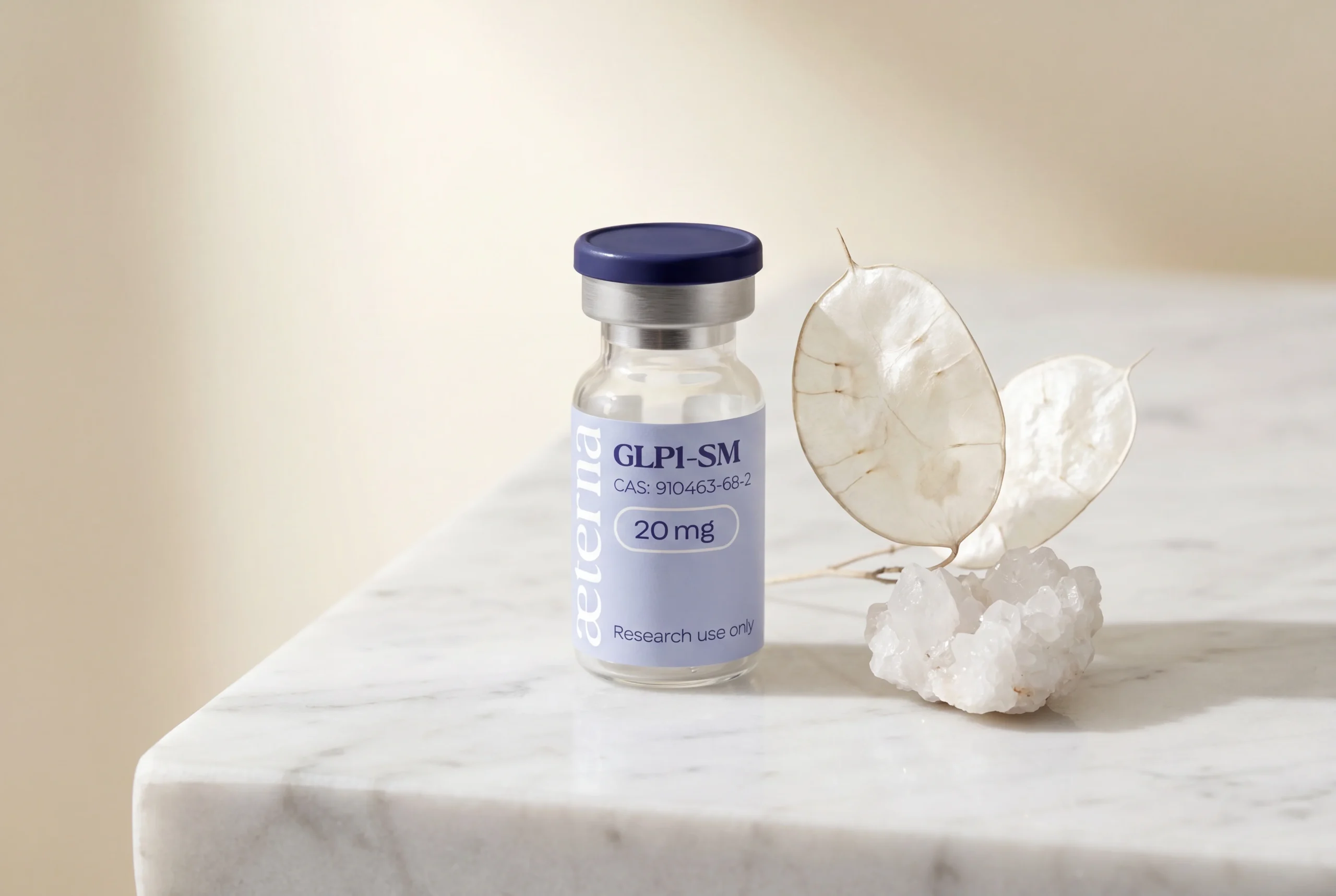
Monograph № 009

Semaglutide

The molecule that established glucagon-like peptide-1 receptor agonism as a cornerstone of both glycemic and weight medicine.
Sequence
31 amino acids
Half-life
~168 hours (7 days)
Route
Subcutaneous injection · Oral (tablet)

Aeterna does not sell peptides. External link, vendor independently verified.

Originator
Novo Nordisk
Bagsværd, Denmark · Internal compound designation NN9535 · Developed from the GLP-1 analogue liraglutide scaffold with C18 fatty diacid conjugation for extended half-life
First disclosed
2012
First disclosed in peer-reviewed literature, Diabetes, Obesity and Metabolism 2012; Phase III SUSTAIN and PIONEER programmes initiated 2015–2016 at Novo Nordisk global trial network
Regulatory status
FDA-Approved
FDA approval: Ozempic (subcutaneous, T2D) December 2017; Wegovy (subcutaneous, chronic weight management) June 2021; Rybelsus (oral tablet) September 2019 – NDA/BLA filings held by Novo Nordisk A/S
Studied for
Glycemia · Adiposity · Cardiovascular Risk · MASH
Primary published inquiry spans SUSTAIN 1–10 trials (glycemia), STEP 1–5 trials (weight), FLOW renal outcomes trial 2024, and SELECT cardiovascular outcomes trial published NEJM 2023

Mechanism

Semaglutide slows hunger and boosts insulin

Semaglutide is a glucagon-like peptide-1 receptor agonist engineered for weekly – and, in its oral form, daily – dosing. Its pharmacological reach extends well beyond the pancreatic islet, engaging circuits in the brainstem, hypothalamus, liver, and vasculature. Understanding its mechanism is understanding how a single receptor class can coordinate appetite, glucose disposal, and cardiovascular risk simultaneously.

GLP-1 receptor activation at the pancreatic islet potentiates glucose-dependent insulin secretion, increasing insulin release when glucose is elevated. This glucose dependence is one reason semaglutide differs mechanistically from older insulin secretagogues.

Central GLP-1 receptor signaling in the hypothalamus and brainstem contributes to reduced appetite and slower gastric emptying. Semaglutide’s acylated structure extends half-life through albumin binding, enabling sustained receptor engagement with once-weekly dosing.

Downstream metabolic effects include reduced energy intake and meaningful shifts in adiposity over time. Clinical imaging from the STEP programme suggests that visceral fat declines substantially alongside total weight loss.

Cardiometabolic benefit extends beyond glycemic control and weight reduction alone. Outcome trials, including SELECT, support a broader effect on cardiovascular risk in appropriately studied populations.

What we observe

Weight and sugar results people measured

The following patterns emerge consistently across the SUSTAIN, PIONEER, STEP, SELECT, and FLOW trial programmes. They represent what the published literature reports, not guarantees of individual response. Magnitude varies with baseline metabolic status, dose, duration, and adherence.

01

Glycaemic Control

Across the SUSTAIN programme, semaglutide 1 mg subcutaneous reduced HbA1c by 1.5–1.8 percentage points from baseline in adults with type 2 diabetes – among the largest reductions reported for any GLP-1 receptor agonist in head-to-head trials.
Observed in SUSTAIN 1–7; effect size varies with baseline HbA1c and concomitant therapy.

02

Body Weight Reduction

In the STEP 1 trial, semaglutide 2.4 mg weekly produced a mean body weight reduction of 14.9% over 68 weeks in adults without diabetes. A subset achieving ≥20% reduction was noted, a threshold previously associated only with bariatric surgery outcomes.
STEP 1, NEJM 2021; effect attenuates after discontinuation – weight regain documented in STEP 4 extension.

03

Cardiovascular Event Reduction

The SELECT trial enrolled 17,604 adults with obesity and established cardiovascular disease but without diabetes. Semaglutide 2.4 mg reduced the composite of cardiovascular death, non-fatal myocardial infarction, and non-fatal stroke by 20% relative to placebo over a median follow-up of 39.8 months.
SELECT trial, NEJM 2023; first cardiovascular outcomes trial of a GLP-1 agonist conducted exclusively in a non-diabetic population.

04

Renal Protection

The FLOW trial (NEJM, 2024) demonstrated that semaglutide 1 mg reduced the composite renal endpoint – sustained ≥50% eGFR decline, kidney failure, or renal/cardiovascular death – by 24% relative to placebo in adults with type 2 diabetes and chronic kidney disease.
FLOW trial, NEJM 2024; trial stopped early for efficacy at interim analysis – a rare regulatory event.

05

Hepatic Steatosis

In a Phase II trial published in The Lancet (2021), semaglutide 0.4 mg daily for 72 weeks produced NASH resolution without worsening fibrosis in 59% of participants, compared with 17% on placebo. Fibrosis improvement did not reach statistical significance – an important caveat the literature does not obscure.
Phase II NASH trial, The Lancet 2021; Phase III ESSENCE trial ongoing as of 2025.

06

Systolic Blood Pressure

Across multiple trials, semaglutide consistently reduces systolic blood pressure by 3–6 mmHg independent of weight loss magnitude. The mechanism is attributed in part to natriuresis, reduced sympathetic tone, and improved endothelial function – though the relative contributions remain an area of active inquiry.
Meta-analysis, Diabetes Care 2022; effect observed at both 1 mg and 2.4 mg doses.

Evidence

What trials showed

The evidence base for semaglutide is among the most extensive assembled for any peptide therapeutic. The trials below represent inflection points where data compelled a revision of clinical thinking. Entries reflect literature available through early 2025.

New England Journal of Medicine
2021

Once-Weekly Semaglutide in Adults with Overweight or Obesity (STEP 1)

A randomised, double-blind, placebo-controlled trial enrolling 1,961 adults with BMI ≥30 (or ≥27 with at least one weight-related comorbidity) and no diabetes. Participants received semaglutide 2.4 mg or placebo weekly alongside lifestyle intervention for 68 weeks. The semaglutide group achieved a mean weight reduction of 14.9% versus 2.4% for placebo. The trial established 2.4 mg as the dose that would anchor the Wegovy approval and the subsequent STEP programme.

14.9%
mean body weight reduction at 68 weeks vs. 2.4% placebo
New England Journal of Medicine
2023

Semaglutide and Cardiovascular Outcomes in Obesity without Diabetes (SELECT)

A landmark cardiovascular outcomes trial enrolling 17,604 adults aged ≥45 with BMI ≥27 and established cardiovascular disease but without diabetes. Participants were randomised to semaglutide 2.4 mg or placebo weekly for a median of 39.8 months. The primary endpoint – a composite of cardiovascular death, non-fatal MI, and non-fatal stroke – was reduced by 20% in the semaglutide group. The trial was the first to demonstrate cardiovascular benefit of a GLP-1 agonist in a population defined by obesity rather than diabetes, fundamentally broadening the therapeutic rationale.

20%
relative reduction in major adverse cardiovascular events vs. placebo
New England Journal of Medicine
2024

Semaglutide in Patients with Chronic Kidney Disease and Type 2 Diabetes (FLOW)

A randomised, double-blind trial enrolling 3,533 adults with type 2 diabetes and chronic kidney disease (eGFR 24–75 mL/min/1.73 m²). Participants received semaglutide 1 mg or placebo weekly. The trial was stopped early at a pre-specified interim analysis after the data monitoring committee confirmed overwhelming efficacy. Semaglutide reduced the primary composite renal endpoint by 24% and all-cause mortality by 20%, establishing renal protection as a class effect with organ-specific trial evidence.

24%
reduction in composite renal endpoint; trial halted early for efficacy
Reconstitution

From lyophilized powder to a usable solution.

Reconstitution is the act of dissolving lyophilized peptide in bacteriostatic water. Done correctly, it takes under two minutes.

Peptide

5 mg lyophilized powder

Diluent

2.0 mL bacteriostatic water

Final concentration

2.5 mg/mL

01

Prepare the vial

Allow the lyophilized vial to reach room temperature. Wipe the stopper with an alcohol swab. Do not shake the powder.

02

Draw the diluent

Using a sterile syringe, draw 1 mL of bacteriostatic water (0.9% benzyl alcohol). Use a fresh needle for the draw.

03

Add slowly

Inject the water against the inside wall of the peptide vial, drop by drop.

04

Prepare the vial

Rotate or shake the vial until the solution clears. It should be visually transparent within sixty seconds. You can wait up to 20 minutes.

Note

Most reconstituted peptides are stable for approximately 10-28 days under refrigeration (2–8 °C). Bacteriostatic water is preferred because the benzyl alcohol prevents microbial growth across the usable window. You can use sterile water with shorter timeframes.

Dosing rythm

A patient titration

Schedule below mirrors the peptidedosages.com educational protocol (typical daily range: 250–2400 mcg (0.25–2.4 mg) once weekly (gradual escalation protocol)).

For educational reference only. Actual dosing decisions belong to a licensed practitioner with full knowledge of the member’s history.
Weeks 1–4
250 mcg (0.25 mg)
Once weekly · 10 units (0.10 mL)
Weeks 5–8
500 mcg (0.5 mg)
Once weekly · 20 units (0.20 mL)
Weeks 9–12
1000 mcg (1.0 mg)
Once weekly · 40 units (0.40 mL)
Weeks 13–16
1700 mcg (1.7 mg)
target
Once weekly · 68 units (0.68 mL)
Handling

Storage, caution, contradiction

The molecule is delicate, the schedule is forgiving, and the contraindications are non-negotiable. Members are taught to take all three with equal seriousness.

Storage

Cold, dark, undisturbed

Side effects

What members describe

Contradictions

Reasons to abstain

Synergies

What works well with semaglutide

Semaglutide has been studied alongside several agents in both clinical and preclinical contexts. The combinations below reflect published or ongoing research pairings – not clinical recommendations. Aeterna does not prescribe, dispense, or advise on combination protocols for individuals.

For educational reference only. Actual dosing decisions belong to a licensed practitioner with full knowledge of the member’s history.
Tirzepatide (comparative)
Head-to-head data from the SURPASS-2 trial (NEJM, 2021) positioned tirzepatide’s dual GLP-1/GIP agonism against semaglutide 1 mg, with tirzepatide demonstrating greater HbA1c and weight reductions – a finding that contextualises semaglutide’s mechanism within the evolving incretin landscape.
Metabolic
Insulin Degludec
The SUSTAIN 11 trial examined semaglutide added to basal insulin in type 2 diabetes, demonstrating additive HbA1c reduction with weight neutrality – a clinically meaningful contrast to insulin’s typical weight-gain profile.
Glycaemic
BPC-157
Preclinical literature suggests BPC-157’s gastroprotective and motility-modulating properties may attenuate the gastrointestinal adverse effects that limit semaglutide dose escalation. Human data are absent; the pairing remains a subject of investigator interest rather than established practice.
Gastrointestinal Tolerance
CJC-1295 / Ipamorelin
Growth hormone secretagogue combinations are sometimes studied alongside GLP-1 agonists in body composition research contexts, given their complementary effects on lean mass preservation during caloric deficit – a concern raised by the muscle loss observed in STEP programme participants.
Body Composition

FAQ

Your questions, patiently answered

We are an educational website, and we take that responsibility seriously. If your question is not here, write to us at [email protected]

In the same family

Further reading in the curriculum on incretin and metabolic peptides.

Metabolic
A dual GLP-1/GIP agonist that extends the incretin architecture semaglutide established. Head-to-head data position it as the next threshold in weight and glycaemic outcomes – at the cost of a more complex receptor pharmacology.
Retatrutide
Metabolic
A triple agonist engaging GLP-1, GIP, and glucagon receptors simultaneously. Where semaglutide refined a single signal, retatrutide multiplies it – with Phase II data suggesting weight reductions that exceed the current clinical standard.
BPC-157
Gastrointestinal
A cytoprotective pentadecapeptide with gastroprotective properties studied in the context of GI mucosal repair. Its relevance to semaglutide users lies in the gastrointestinal adverse effect profile that limits dose escalation in a meaningful proportion of participants.

Sourcing · Independently verified

When you're ready, source thoughtfully.

Aeterna does not sell peptides. We maintain a short list of vendors evaluated for purity, third-party testing, handling, and supply consistency. The button here links directly to the vendor we currently recommend.
External link · We receive no remuneration. Verify your prescription before sourcing.