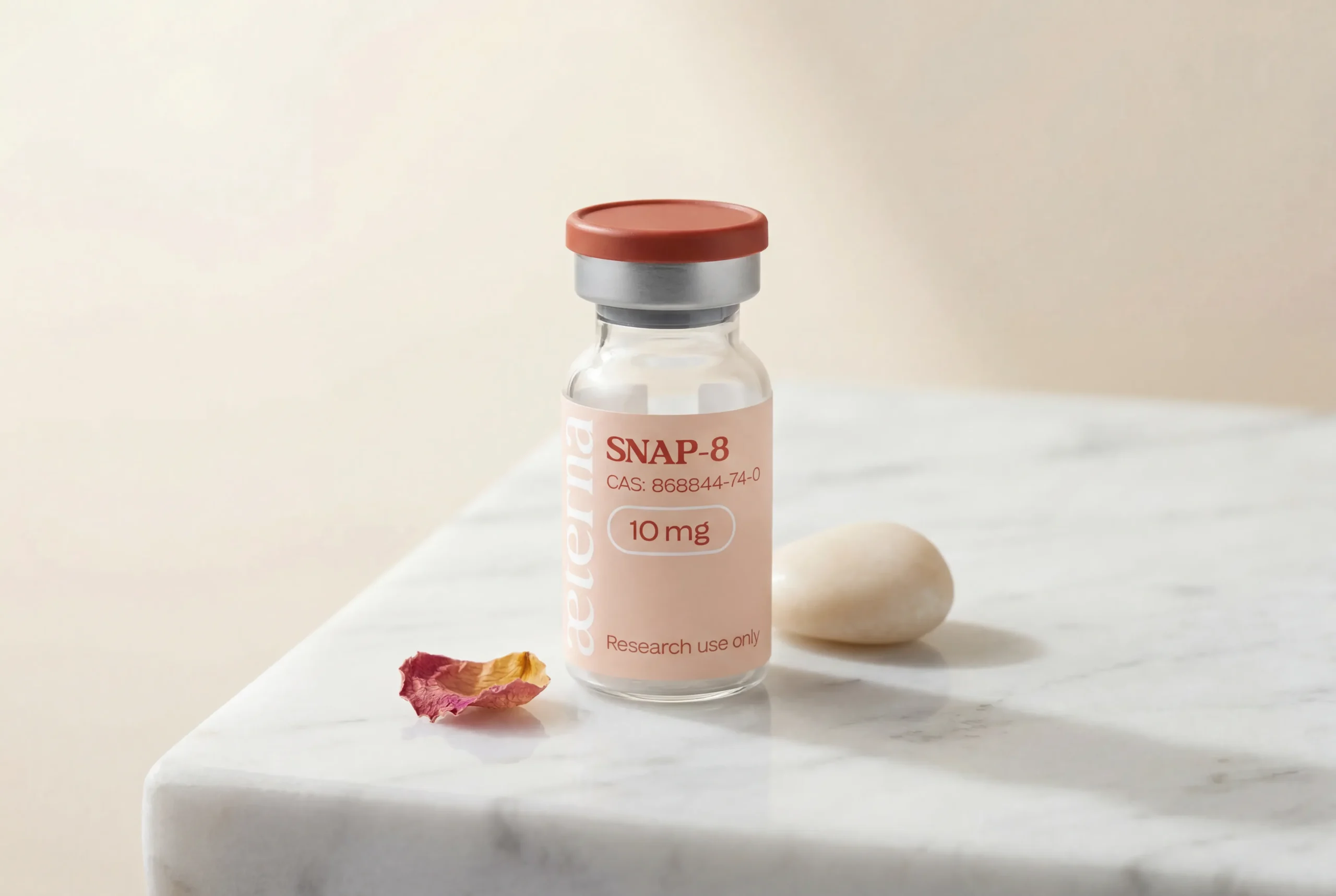
Snap-8
Aeterna does not sell peptides. External link, vendor independently verified.
Mechanism
Snap-8 does not paralyze. It competes – inserting itself into a molecular conversation that has been occurring at the neuromuscular junction since the first voluntary expression crossed a human face. Understanding that conversation requires a brief detour into the machinery of muscle contraction itself.
SNARE interference defines the core mechanism of Snap-8, a peptide designed to mimic the N-terminal domain of SNAP-25 and disrupt assembly of the SNARE complex. In model systems, this competitive interaction reduces acetylcholine vesicle fusion at the neuromuscular junction.
Concentration dependence shapes the magnitude of the effect, with activity increasing as topical concentration rises within studied formulation ranges. In cosmetic literature, formulations around 5-10% have been associated with reduced contraction amplitude in mimic muscle assays.
Competitive reversibility distinguishes Snap-8 from botulinum toxin, because it does not cleave SNARE proteins or produce enzymatic paralysis. Its effect is transient and depends on continued presence in the formulation environment.
Dynamic line softening is the practical consequence most often described in cosmetic studies of topical use. Reported effects typically emerge over 2-4 weeks of regular application and recede after discontinuation.
What we observe
Measured softening of expression lines
The outcomes below reflect patterns reported across controlled cosmetic trials and in vitro studies. They describe what investigators have observed under defined conditions. They do not constitute clinical claims, and individual variation is substantial. Aeterna does not prescribe, dispense, or sell.
01
Wrinkle Depth
02
Contraction Amplitude
03
Forehead Lines
04
Glabellar Creases
05
Skin Tolerability
06
Fibroblast Signaling
Evidence
Research on wrinkle peptide use
The studies below represent the primary published literature on Snap-8. The corpus is smaller than that of pharmaceutical peptides subject to IND-regulated trials. Readers are encouraged to consult primary sources and to weigh sponsor affiliation, sample size, and methodology before drawing conclusions.
Inhibition of SNARE complex assembly by a synthetic octapeptide analogue of SNAP-25: in vitro characterization of Acetyl Octapeptide-3
The foundational disclosure study established that Snap-8 competes with native SNAP-25 for SNARE complex formation in a cell-free assay. Dose-dependent inhibition of vesicle fusion was observed, with the octapeptide demonstrating greater potency than the previously characterized hexapeptide Argireline at equivalent molar concentrations. The authors proposed topical application as a viable delivery route given the peptide’s molecular weight profile.
Clinical evaluation of a topical 10% Acetyl Octapeptide-3 formulation on periorbital and forehead expression lines: a randomized, double-blind, vehicle-controlled study
Forty-four subjects applied either a 10% Snap-8 emulsion or vehicle control twice daily for 28 days. Investigator-graded wrinkle severity scores and three-dimensional profilometric measurements showed statistically significant improvement in the Snap-8 group versus control at day 28. Subject self-assessment scores corroborated investigator findings. No serious adverse events were recorded; mild transient erythema was reported in three subjects in the active arm.
Comparative SNARE inhibition and collagen modulation by acetylated peptide analogues in a reconstructed human skin model
Using a full-thickness reconstructed skin model, investigators compared Snap-8 with acetyl hexapeptide-3 and a vehicle control across markers of SNARE inhibition and extracellular matrix remodeling. Snap-8 produced greater suppression of acetylcholine-evoked contraction markers and a modest but statistically significant increase in collagen I and III gene expression relative to vehicle. The authors attributed the collagen effect to reduced mechanical loading of fibroblasts rather than direct receptor activation.
From lyophilized powder to a usable solution.
Peptide
10 mg lyophilized powder
Diluent
3.0 mL bacteriostatic water
Final concentration
3.33 mg/mL
01
Prepare the vial
02
Draw the diluent
03
Add slowly
04
Prepare the vial
Note
Dosing rythm
A patient titration
Schedule below mirrors the peptidedosages.com educational protocol (typical daily range: 330–1,000 mcg once daily (gradual titration over 8–12 weeks)).
Storage, caution, contradiction
Storage
Cold, dark, undisturbed
- Lyophilized: freeze at −20 °C (−4 °F).
- After reconstitution, refrigerate at 2–8 °C (35.6–46.4 °F).
- Avoid freeze–thaw cycles.
- Peptide is susceptible to oxidation at the methionine residue (position 3); minimize exposure to air during handling and consider antioxidant excipients in the final formulation
- Label all preparations with peptide name, concentration, diluent, preparation date, and expiry; maintain a preparation log for research-grade material
Side effects
What members describe
- Mild transient erythema at the application site, reported in a small proportion of trial subjects; typically resolves within hours without intervention
- Contact sensitization is theoretically possible with any peptide ingredient; patch testing prior to full-face application is a reasonable precaution
- Periorbital edema has been anecdotally reported with high-concentration formulations applied in close proximity to the orbital rim; the mechanism is not established
- No systemic absorption has been demonstrated at cosmetic use concentrations; the peptide's molecular weight and charge profile limit transdermal penetration beyond the epidermis under standard conditions
- Long-term safety data beyond 28-day trial windows are limited in the published literature; extended use patterns have not been formally studied in controlled settings
Contradictions
Reasons to abstain
- Known hypersensitivity to any component of the formulation, including excipients and preservatives
- Active inflammatory skin conditions (e.g., rosacea flare, eczema, psoriasis) at the intended application site; application to compromised barrier may alter absorption profile
- Use in proximity to the eye margin should be approached with caution; no ophthalmic safety data exist for Snap-8 at research concentrations
- Concurrent use of other neuromuscular-modulating topical agents (e.g., botulinum toxin preparations) has not been studied; additive effects are theoretically possible
- Pregnancy and lactation: no safety data available; use is not studied in these populations and cannot be characterized
Synergies
Best pairs for Snap-8
Snap-8 occupies a specific mechanistic niche – presynaptic SNARE modulation – that is distinct from the pathways addressed by matrix-remodeling or growth-factor peptides. The companions below are drawn from the published cosmetic peptide literature and represent mechanistically complementary, not redundant, pairings. Aeterna does not prescribe, dispense, or sell.
FAQ
Your questions, patiently answered
Botulinum toxin cleaves SNARE proteins – specifically SNAP-25 – irreversibly, producing complete and sustained neuromuscular blockade. Snap-8 competes with native SNAP-25 for SNARE complex assembly without destroying the protein. The inhibition is partial, dose-dependent, and fully reversible upon discontinuation. The clinical consequence is a modulation of contraction amplitude rather than paralysis, and the effect dissipates as the peptide clears from the tissue.
They share a mechanism and a target – both are SNAP-25 analogues that compete for SNARE complex formation – but they are structurally distinct. Argireline is a hexapeptide (six amino acids); Snap-8 is an octapeptide (eight amino acids) with two additional residues at the N-terminus. The extended sequence is reported to confer greater binding affinity for the SNARE interface, and in vitro comparisons have shown higher inhibitory potency for Snap-8 at equivalent molar concentrations.
Published trials have used concentrations ranging from 5% to 10% w/w in the final formulation. The 10% concentration is the most studied and the one associated with statistically significant outcomes in the primary clinical trial. Lower concentrations have not been formally evaluated in controlled human studies, though they appear in commercial products. Formulation vehicle substantially influences effective delivery, and concentration in the finished product is not equivalent to bioavailable concentration at the target tissue.
The primary 28-day trial reported measurable profilometric improvement beginning around day 14, with the most pronounced differences at day 28. Because the mechanism is competitive and reversible, effects are expected to diminish after discontinuation – the timeline for reversal has not been formally studied. The literature suggests that continued application is necessary to sustain observed outcomes, distinguishing Snap-8 from injectable neurotoxins with months-long duration.
Periorbital application is the most studied use case in the published literature, and the primary trial specifically evaluated crow’s feet and periorbital lines. However, application directly to the orbital rim or eyelid margin has not been studied for safety, and no ophthalmic data exist. Formulations intended for periorbital use should be designed with this anatomical boundary in mind.
At cosmetic use concentrations, no systemic absorption has been demonstrated. The peptide’s molecular weight (approximately 1,075 Da) and its charged amino acid residues limit passive transdermal penetration under standard formulation conditions. The mechanism of action is therefore considered local to the application site. This profile is one reason Snap-8 is classified as a cosmetic ingredient rather than a pharmaceutical agent in both EU and US regulatory frameworks.
In the same family
Further study in the curriculum.
Sourcing · Independently verified
When you're ready, source thoughtfully.