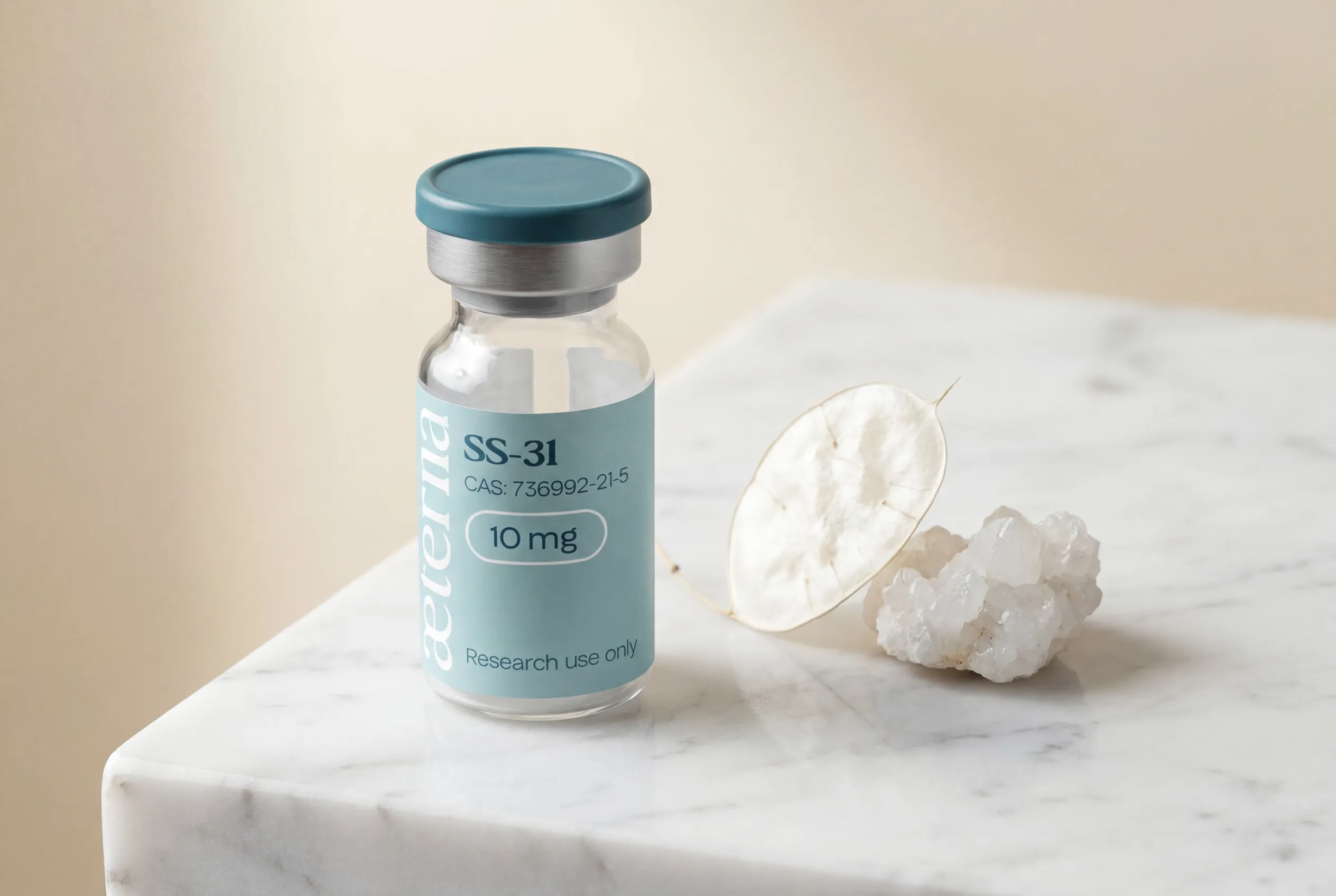
Monograph № 021

SS-31

A tetrapeptide that converses with the inner mitochondrial membrane where energy is either made or lost.
Sequence
4 amino acids
Half-life
~2–3 hours (plasma)
Route
Subcutaneous · Intravenous (investigational)

Aeterna does not sell peptides. External link, vendor independently verified.

Originator
Hazel H. Szeto & Peter W. Schiller
Cornell University Weill Medical College, New York · Developed under the Szeto-Schiller peptide program, circa 2002–2004
First disclosed
2004
First described in JPET (Journal of Pharmacology and Experimental Therapeutics), 2004; also designated MTP-131 and elamipretide in clinical development
Regulatory status
Investigational
Phase II/III completed for heart failure with preserved ejection fraction (HFPEF); FDA Breakthrough Therapy designation reviewed 2019; development continued under Stealth BioTherapeutics
Studied for
Mitochondrial Dysfunction · Cardiac Energetics · Ischemia-Reperfusion Injury
Phase II trial (TAZPOWER, NCT03098797) conducted at Columbia University Irving Medical Center, published in NEJM Evidence, 2022, under the Rare Diseases Clinical Research Network Consortium

Mechanism

SS-31 helps protect mitochondria under stress

SS-31 does not act on a receptor in the conventional sense. It does not bind a surface protein or trigger a downstream signaling cascade in the manner of most peptide therapeutics. Instead, it enters the cell, crosses the inner mitochondrial membrane, and binds directly to cardiolipin – a phospholipid found almost exclusively in that membrane and essential to the structural integrity of the electron transport chain. The conversation it initiates is architectural, not chemical. It restores the geometry of energy production.

Membrane targeting SS-31 localizes to the inner mitochondrial membrane, where it associates with cardiolipin and helps stabilize cristae architecture. This interaction supports electron transport chain efficiency under conditions of oxidative stress.

Energetic preservation Rather than acting as a conventional direct antioxidant, the peptide appears to reduce reactive oxygen species by improving electron flow through the respiratory chain. In preclinical models, this is associated with more efficient ATP production during ischemia-reperfusion stress.

Clinical development SS-31, also known as elamipretide, is among the most clinically advanced mitochondria-targeted peptides. It has been studied in disorders including Barth syndrome and heart failure, with subcutaneous and intravenous protocols evaluated across trials.

Translational signal The strongest preclinical evidence has emerged in cardiac, skeletal muscle, renal, and mitochondrial disease contexts. Human efficacy signals have been mixed, but the compound remains a central reference point in mitochondrial therapeutics research.

What we observe

Energy and recovery: what changed

The evidence base for SS-31 spans two decades of preclinical work and a smaller but growing body of human clinical data. The compound has been studied under multiple designations – SS-31, MTP-131, elamipretide – across cardiac, renal, neuromuscular, and metabolic contexts. What follows reflects patterns reported in peer-reviewed literature; it does not constitute a claim of efficacy for any individual.

01

Cardiac Energetics

In models of heart failure with preserved ejection fraction, SS-31 administration is associated with improved mitochondrial ATP production in cardiomyocytes, reduced oxidative stress markers, and partial restoration of diastolic function indices. The cardiac muscle is among the most mitochondria-dense tissues in the body; its sensitivity to cardiolipin integrity is correspondingly high.
Observed in murine HFpEF models and Phase II human trials (2017–2021)

02

Ischemia Reperfusion Protection

Across renal, cardiac, and cerebral ischemia-reperfusion models, pre- or peri-ischemic administration of SS-31 consistently reduces infarct size, preserves mitochondrial membrane potential, and attenuates the cytochrome c release that would otherwise commit cells to apoptosis. The window of protection appears to extend into the reperfusion phase itself.
Replicated across multiple species and organ systems in preclinical literature

03

Skeletal Muscle Function

In primary mitochondrial myopathy and age-related sarcopenia models, SS-31 is associated with improved exercise tolerance, reduced fatigability, and partial restoration of mitochondrial ultrastructure in muscle biopsy specimens. The MMPOWER-3 trial examined these endpoints in human subjects with genetically confirmed mitochondrial disease.
Human data from MMPOWER-3 (Stealth BioTherapeutics, 2019–2021)

04

Renal Tubular Protection

The proximal tubule is among the most metabolically active epithelial cell populations in the body, relying almost entirely on oxidative phosphorylation. In models of acute kidney injury – cisplatin nephrotoxicity, contrast-induced nephropathy, and renal ischemia – SS-31 reduces tubular cell death, preserves GFR, and attenuates histological injury scores.
Preclinical; limited human data; active area of investigational interest

05

Neurological Resilience

In models of Alzheimer’s disease, Parkinson’s disease, and traumatic brain injury, SS-31 attenuates mitochondrial fragmentation, reduces amyloid-beta-induced synaptic toxicity, and preserves dendritic spine density. Neuronal mitochondria are particularly vulnerable to cardiolipin peroxidation given the high metabolic demand and limited regenerative capacity of post-mitotic neurons.
Preclinical models only; no completed human neurological trials as of 2025

06

Barth Syndrome

Barth syndrome – a rare X-linked cardiomyopathy caused by mutations in the tafazzin gene that result in abnormal cardiolipin remodeling – represents perhaps the most mechanistically direct indication for SS-31. Clinical observations in this population have shown improvements in exercise capacity and cardiac function, consistent with the peptide’s known cardiolipin-stabilizing mechanism.
Orphan disease designation; small-n human studies; mechanistic alignment is high

Evidence

SS-31 in trials and lab work

The studies below represent a cross-section of the published evidence. They are cited for orientation, not as proof of clinical efficacy. Readers are encouraged to consult primary sources and to weigh findings against study design, sample size, and the distance between animal models and human physiology.

Journal of the American College of Cardiology
2020

Elamipretide Improves Mitochondrial Function and Exercise Tolerance in Patients with Heart Failure with Preserved Ejection Fraction: The MMPOWER-HF Pilot Trial

In a randomized, double-blind, placebo-controlled pilot study of 42 patients with HFpEF, a single intravenous infusion of elamipretide (SS-31) was associated with significant improvements in peak oxygen consumption (VO₂ peak) and six-minute walk distance at 24 hours post-infusion. Mitochondrial respiration in peripheral blood mononuclear cells improved in the treatment arm. No serious adverse events were attributed to the compound.

8.4%
mean improvement in VO₂ peak versus placebo at 24 hours post-infusion
Nature Communications
2019

SS-31 Preserves Cardiolipin Architecture and Prevents Cytochrome c Release in a Murine Model of Renal Ischemia-Reperfusion Injury

Using electron microscopy and cardiolipin-specific fluorescent probes, investigators demonstrated that SS-31 administered 30 minutes prior to ischemia preserved inner mitochondrial membrane cristae morphology, reduced cardiolipin peroxidation by approximately 60%, and prevented cytochrome c translocation to the cytosol. Serum creatinine at 24 hours post-reperfusion was significantly lower in treated animals, and histological tubular injury scores were reduced by more than half.

~60%
reduction in cardiolipin peroxidation versus vehicle control in renal tubular cells
Aging Cell
2021

Long-Term SS-31 Administration Attenuates Age-Associated Mitochondrial Dysfunction and Preserves Skeletal Muscle Mass in Aged Mice

Twenty-four-month-old C57BL/6 mice receiving daily subcutaneous SS-31 for 8 weeks showed significant preservation of gastrocnemius muscle mass, improved grip strength, and restored mitochondrial membrane potential compared to age-matched controls. Electron microscopy revealed partial restoration of cristae density. Markers of mitochondrial biogenesis (PGC-1α, TFAM) were elevated in treated animals, suggesting a secondary adaptive response beyond direct cardiolipin stabilization.

18%
greater preservation of skeletal muscle mass in SS-31-treated aged mice versus vehicle controls
Reconstitution

From lyophilized powder to a usable solution.

Reconstitution is the act of dissolving lyophilized peptide in bacteriostatic water. Done correctly, it takes under two minutes.

Peptide

10 mg lyophilized powder

Diluent

1.0 mL bacteriostatic water

Final concentration

10 mg/mL

01

Prepare the vial

Allow the lyophilized vial to reach room temperature. Wipe the stopper with an alcohol swab. Do not shake the powder.

02

Draw the diluent

Using a sterile syringe, draw 1 mL of bacteriostatic water (0.9% benzyl alcohol). Use a fresh needle for the draw.

03

Add slowly

Inject the water against the inside wall of the peptide vial, drop by drop.

04

Prepare the vial

Rotate or shake the vial until the solution clears. It should be visually transparent within sixty seconds. You can wait up to 20 minutes.

Note

Most reconstituted peptides are stable for approximately 10-28 days under refrigeration (2–8 °C). Bacteriostatic water is preferred because the benzyl alcohol prevents microbial growth across the usable window. You can use sterile water with shorter timeframes.

Dosing rythm

A patient titration

Schedule below mirrors the peptidedosages.com educational protocol (typical daily range: 5–10 mg once daily (gradual titration); advanced protocols may reach 15–20 mg/day under supervision).

For educational reference only. Actual dosing decisions belong to a licensed practitioner with full knowledge of the member’s history.
Weeks 1–2
5 mg (5000 mcg)
Once daily · 50 units (0.50 mL)
Weeks 3–8
10 mg (10,000 mcg)
Once daily · 100 units (1.0 mL)
Barth Syndrome / Mitochondrial Myopathy (Clinical Reference)
40 mg/day subcutaneous (MMPOWER-3 protocol)
Once-daily subcutaneous injection; 36-week treatment duration in the MMPOWER-3 trial design
Exploratory Longevity Context
Lower end of investigational range
(0.5–1 mg/day)
discussed in preclinical aging literature
Chronic daily administration in murine aging models; human translation remains speculative and requires clinical oversight
Handling

Storage, caution, contradiction

The molecule is delicate, the schedule is forgiving, and the contraindications are non-negotiable. Members are taught to take all three with equal seriousness.

Storage

Cold, dark, undisturbed

Side effects

What members describe

Contradictions

Reasons to abstain

Synergies

What to stack with SS-31

SS-31 occupies a distinct position in the peptide landscape: it acts at the organelle level rather than the receptor level. Its natural companions are agents that address upstream metabolic signaling, downstream cellular repair, or parallel pathways of oxidative stress and inflammation. The combinations below reflect mechanistic logic and patterns in the preclinical literature – not clinical protocols.

For educational reference only. Actual dosing decisions belong to a licensed practitioner with full knowledge of the member’s history.
BPC-157
BPC-157 supports angiogenesis and connective tissue repair through nitric oxide pathways and growth factor signaling; SS-31 addresses the mitochondrial energetics that underpin cellular survival during repair. Together they address both the scaffolding and the power supply of tissue recovery – complementary rather than redundant.
Tissue Repair · Vascular Integrity
Humanin
Humanin is a mitochondria-derived peptide (mitokine) that activates STAT3 and IGF-1R signaling to suppress apoptosis. Where SS-31 acts structurally – stabilizing cardiolipin and preserving electron transport geometry – humanin acts as a signaling molecule. The combination addresses mitochondrial protection at both the architectural and the communicative level.
Mitochondrial Signaling · Cytoprotection
Epithalon
Epithalon’s proposed mechanism involves telomerase activation and epigenetic modulation of gene expression in aging tissues. SS-31’s contribution to a longevity-oriented stack is energetic: cells with restored mitochondrial function are better positioned to execute the repair and replication programs that longevity peptides aim to support. The pairing is conceptually coherent, though direct combination data are absent.
Longevity · Telomere Biology
Thymosin Beta-4 (TB-500)
TB-500 modulates actin polymerization and attenuates inflammatory signaling in damaged tissue. In ischemia-reperfusion contexts – where both peptides have preclinical evidence – SS-31 addresses the mitochondrial injury that drives cell death while TB-500 addresses the inflammatory sequelae that follow. The mechanistic division of labor is clear.
Inflammation · Cytoskeletal Repair

FAQ

Your questions, patiently answered

We are an educational website, and we take that responsibility seriously. If your question is not here, write to us at [email protected]

In the same family

Further reading in the curriculum.

Mitochondrial
A mitochondria-derived peptide that operates through STAT3 and IGF-1R pathways to suppress apoptosis and modulate metabolic signaling. Where SS-31 addresses mitochondrial architecture, humanin addresses mitochondrial communication – the two form a coherent pair in the study of organelle-level longevity biology.
BPC-157
Cardiac · Repair
A gastric pentadecapeptide with a broad preclinical evidence base in tissue repair, angiogenesis, and cytoprotection. Its vascular and connective tissue actions complement SS-31’s intracellular energetic focus, particularly in ischemia-reperfusion and post-injury recovery contexts.
Epithalon
Longevity
A tetrapeptide derived from the pineal gland extract cortexin, studied for its effects on telomerase activity and epigenetic regulation of aging-associated gene expression. Alongside SS-31, it represents a different architectural approach to the same broad question: what determines the pace at which cells age.

Sourcing · Independently verified

When you're ready, source thoughtfully.

Aeterna does not sell peptides. We maintain a short list of vendors evaluated for purity, third-party testing, handling, and supply consistency. The button here links directly to the vendor we currently recommend.
External link · We receive no remuneration. Verify your prescription before sourcing.