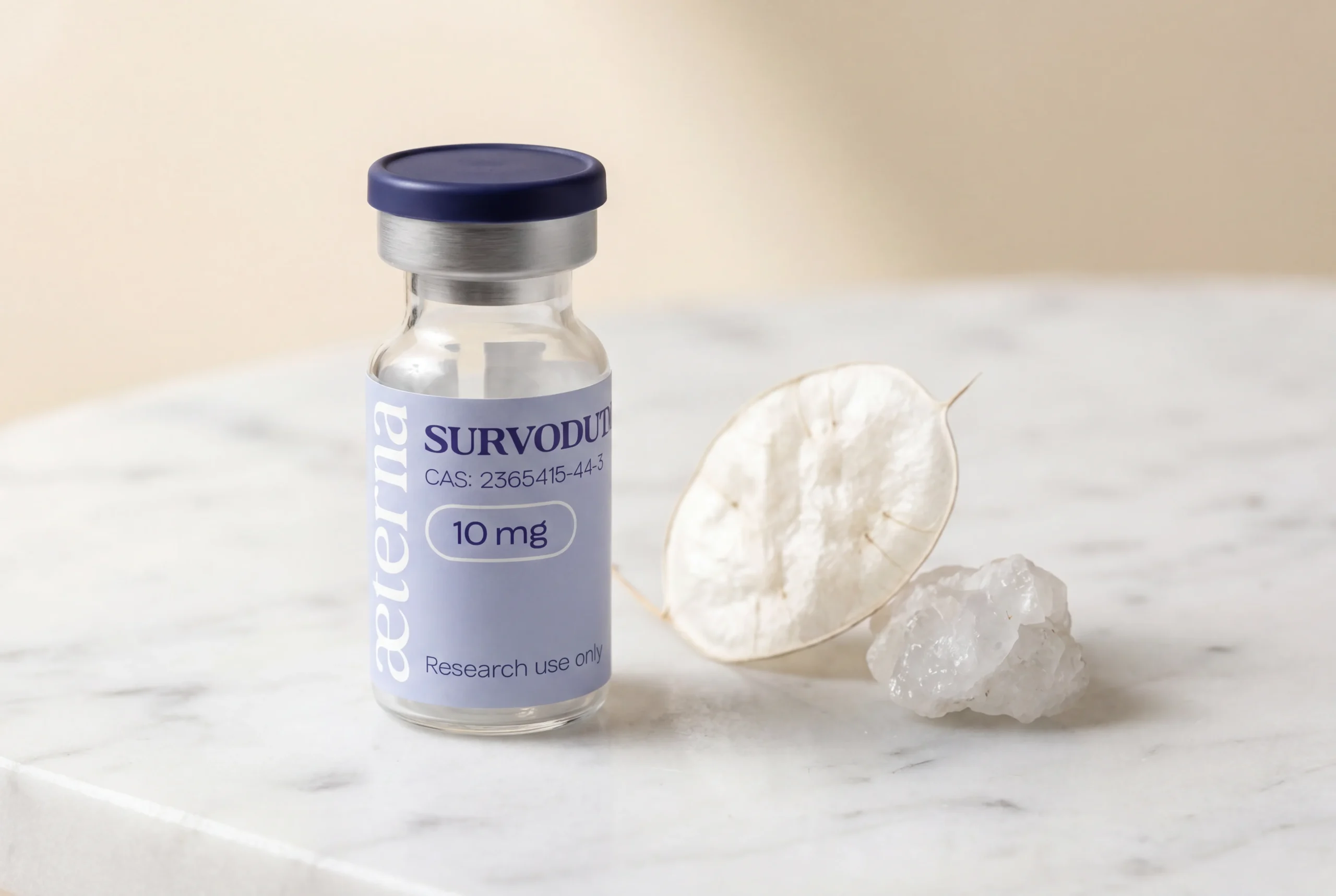
Survodutide
Aeterna does not sell peptides. External link, vendor independently verified.
Mechanism
Survodutide does not act through a single channel. It holds two conversations simultaneously – one with the incretin system, one with the energy-expenditure axis – and the result is a metabolic dialogue that neither receptor could sustain alone. Understanding the compound means understanding both sides of that exchange.
GLP-1 receptor agonism drives delayed gastric emptying, central satiety signaling, and glucose-dependent insulin release. This is the same incretin axis engaged by semaglutide.
Glucagon receptor agonism stimulates hepatic fatty-acid oxidation, brown adipose thermogenesis, and basal energy expenditure. Pure GLP-1 monotherapy does not produce these expenditure effects.
The GLP-1 arm functionally constrains the hyperglycemic risk that isolated glucagon agonism would otherwise introduce. Receptor balance is the design, not a side effect.
Downstream GCGR signaling activates hepatic AMPK and suppresses de novo lipogenesis. Preclinical models show reductions in hepatic steatosis that appear distinct from caloric-restriction effects alone.
What we observe
Observed drops in weight and liver markers
The following observations are drawn from clinical trial data available as of early 2025. They describe what investigators reported under controlled conditions, not outcomes any individual should anticipate. Aeterna does not prescribe, dispense, or sell. These entries exist to illuminate the pharmacological record.
01
Body Weight Reduction
02
Hepatic Fat Reduction
03
MASH Histological Improvement
04
Glycemic Attenuation
05
Cardiovascular Risk Markers
06
Tolerability Profile
Evidence
What research shows today
Three studies anchor the current evidence base for survodutide in humans. Each is cited with its primary finding and a representative statistic. The field is active; these entries reflect literature available through early 2025. Readers are encouraged to consult primary sources directly.
Survodutide versus placebo in adults with overweight or obesity: a randomised, double-blind, Phase II dose-finding trial
This multicenter Phase II trial enrolled adults with BMI ≥27 kg/m² across four dose cohorts and placebo over 46 weeks. The highest dose cohort (4.8 mg weekly) demonstrated mean body weight reduction of approximately 18.7% from baseline. Gastrointestinal adverse events were the primary tolerability signal, with rates declining after the titration period. The authors concluded that the GLP-1/GCGR dual mechanism produced weight loss of a magnitude warranting Phase III investigation.
Dual GLP-1 and glucagon receptor agonism with survodutide in metabolic dysfunction-associated steatohepatitis: a Phase II randomised controlled trial
Participants with biopsy-confirmed MASH and fibrosis stage F1–F3 were randomised to survodutide or placebo for 48 weeks. The primary endpoint – histological resolution of steatohepatitis without worsening of fibrosis – was achieved in a significantly greater proportion of the survodutide arm. MRI-PDFF-measured hepatic fat fraction declined by a mean of 54% from baseline in the active group. The authors noted that the glucagon receptor component appeared to drive hepatic lipid clearance beyond what GLP-1 monotherapy has historically achieved.
Cardiovascular and metabolic biomarker response to survodutide in a Phase II obesity cohort: secondary endpoint analysis
A pre-specified secondary analysis of the Phase II obesity trial examined lipid panels, blood pressure, and inflammatory markers at weeks 24 and 46. Triglycerides declined by a mean of 31% and systolic blood pressure by 4.2 mmHg in the highest dose group relative to placebo. LDL-cholesterol reductions were modest but consistent. The authors cautioned that these biomarker improvements, while favorable, require confirmation in cardiovascular outcomes trials before clinical conclusions can be drawn.
From lyophilized powder to a usable solution.
Peptide
10 mg lyophilized powder
Diluent
2.0 mL bacteriostatic water
Final concentration
5 mg/mL (5000 mcg/mL)
01
Prepare the vial
02
Draw the diluent
03
Add slowly
04
Prepare the vial
Note
Dosing rythm
A patient titration
Schedule below mirrors the peptidedosages.com educational protocol (typical daily range: 0.6–6.0 mg once weekly (gradual titration over 10–12 weeks)).
Storage, caution, contradiction
Storage
Cold, dark, undisturbed
- Lyophilized: freeze at ≤−20 °C (≤−4 °F).
- After reconstitution, refrigerate at 2–8 °C (35.6–46.4 °F).
- Protect from light.
- Allow refrigerated solution to reach room temperature for 10–15 minutes before injection to reduce injection-site discomfort.
- Do not expose to temperatures above 30 °C for extended periods; thermal degradation of the fatty-acid conjugate may compromise activity.
Side effects
What members describe
- Nausea and vomiting - most common during titration; typically attenuates with continued dosing and slower escalation.
- Diarrhea or constipation - GI motility effects consistent with GLP-1R agonist class; usually transient.
- Transient heart rate elevation - attributable to GCGR agonism; monitor in individuals with pre-existing cardiac conditions.
- Injection-site reactions - erythema, induration, or mild pain; rotate injection sites systematically.
- Decreased appetite and early satiety - pharmacologically expected; monitor nutritional adequacy during prolonged use.
Contradictions
Reasons to abstain
- Personal or family history of medullary thyroid carcinoma or Multiple Endocrine Neoplasia syndrome type 2 (MEN2) - class precaution shared with GLP-1R agonists.
- History of pancreatitis - GLP-1R agonist class carries a precautionary signal; use requires careful clinical evaluation.
- Severe hepatic impairment - pharmacokinetic data in this population are limited; caution warranted given hepatic mechanism of action.
- Pregnancy and lactation - no safety data available; use is not appropriate in these populations.
- Concurrent use of other GLP-1R agonists or glucagon-based therapies - receptor saturation and additive adverse effects are theoretical concerns requiring clinical judgment.
Synergies
Survodutide partners that make sense
The following pairings reflect patterns discussed in the research literature and among clinicians working in metabolic medicine. They are presented as intellectual orientation, not as protocols. Aeterna does not prescribe combinations. Every pairing requires independent clinical evaluation.
FAQ
Your questions, patiently answered
Semaglutide is a GLP-1R monoagonist. Tirzepatide adds GIP receptor agonism to GLP-1R activity. Survodutide takes a different second axis entirely – pairing GLP-1R with glucagon receptor (GCGR) agonism. The glucagon component drives hepatic fatty-acid oxidation and thermogenesis in ways that GIP agonism does not, which may explain survodutide’s particular efficacy signal in MASH and its thermogenic contribution to weight loss. These are distinct pharmacological architectures, not incremental refinements of the same molecule.
This is the central pharmacological tension in any GLP-1/GCGR co-agonist. Glucagon raises blood glucose; GLP-1 lowers it. Survodutide’s design attempts to balance these opposing effects such that net glycemic impact is neutral or modestly favorable. Phase II data suggest this balance is achievable at studied doses, though the margin requires careful titration. Individuals with impaired beta-cell reserve may have less capacity to buffer the glucagon signal and warrant closer monitoring.
Most GLP-1R agonists reduce hepatic fat as a secondary consequence of weight loss and improved insulin sensitivity. Survodutide’s GCGR component adds a direct hepatic mechanism – stimulating fatty-acid oxidation, reducing de novo lipogenesis, and activating AMPK pathways in hepatocytes. This dual approach addresses both the lipid accumulation and the metabolic dysfunction underlying MASH more directly than incretin monotherapy. Phase II histological data have been sufficiently encouraging to advance the compound into dedicated MASH trials.
Survodutide incorporates a fatty-acid side chain that enables reversible binding to circulating albumin. This depot effect substantially extends the compound’s plasma half-life – estimated at approximately 168 hours – relative to native glucagon or GLP-1, which are degraded within minutes. The conjugation strategy is analogous to that used in semaglutide and other long-acting incretin agents, and it is what makes once-weekly subcutaneous dosing pharmacologically viable.
As of 2025, survodutide is in Phase II and Phase III investigation across obesity and MASH indications, developed jointly by Boehringer Ingelheim and Zealand Pharma. It does not hold regulatory approval in any jurisdiction. It is not available as a licensed therapeutic. Research-use material exists in some contexts, but any clinical application requires physician oversight and operates outside approved labeling.
The compound’s clinical program has focused on populations with significant metabolic burden – obesity, MASH, and associated glycemic dysregulation. Its mechanism is potent and its tolerability profile requires careful management. The literature does not support its use in metabolically healthy individuals, and the risk-benefit calculus in such populations has not been studied. This is a compound whose pharmacological weight demands proportionate clinical justification.
In the same family
Further reading in the curriculum.
Sourcing · Independently verified
When you're ready, source thoughtfully.