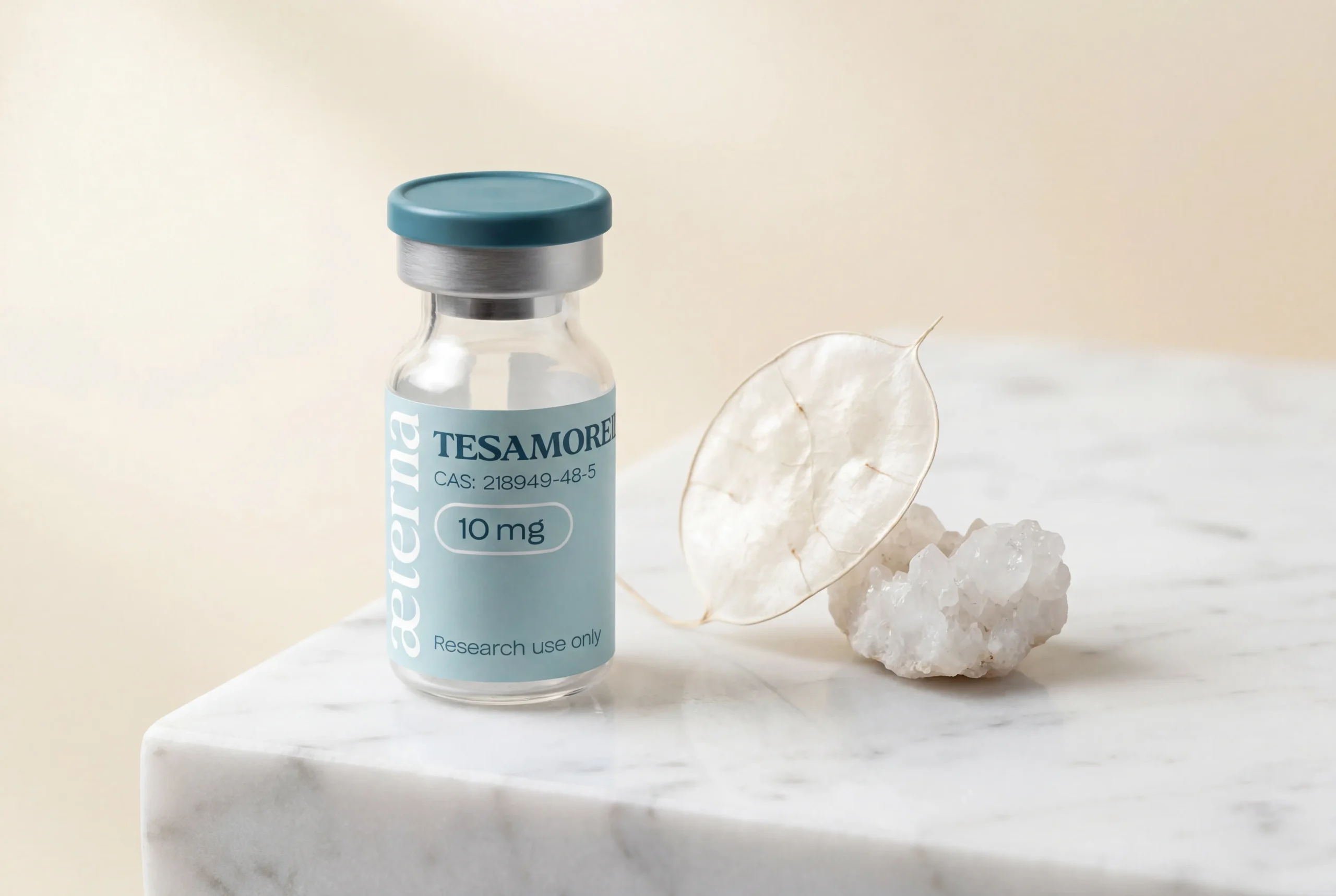
Tesamorelin
Aeterna does not sell peptides. External link, vendor independently verified.
Mechanism
Tesamorelin does not deliver growth hormone. It restores the conversation the hypothalamus was already trying to have. By mimicking endogenous GHRH with a stabilized analogue, it re-engages the pituitary’s own secretory machinery – preserving the pulsatile rhythm that synthetic GH administration cannot replicate. The result is a physiologically patterned release, not a pharmacological flood.
GHRH receptor agonism selectively engages anterior pituitary somatotrophs to restore a more physiologic growth hormone signal. Tesamorelin’s modified structure improves resistance to enzymatic degradation and extends functional activity into a clinically usable range.
Growth hormone signaling increases hepatic IGF-1 production through the canonical JAK2-STAT5 axis. Unlike exogenous GH administration, this effect remains constrained by intact hypothalamic and somatostatin feedback.
Visceral adipose tissue appears particularly responsive to restored GH signaling, with reductions in central fat observed in clinical study. This depot-selective effect is the basis for tesamorelin’s use in HIV-associated lipodystrophy rather than as a general weight-loss agent.
Hepatic lipid handling also shifts as GH pulsatility is restored. In clinical literature, these changes have been associated with improvements in triglycerides and related cardiometabolic markers.
What we observe
Results on belly fat and labs
The outcomes below reflect patterns reported in peer-reviewed clinical trials and published observational studies. They describe what investigators observed under controlled conditions. Aeterna does not prescribe, dispense, or sell tesamorelin. Individual response varies; no outcome is guaranteed.
01
Visceral Fat Reduction
02
IGF-1 Normalization
03
Triglyceride Reduction
04
Preservation of Lean Mass
05
Cognitive Signal in MCI
06
Pulsatile GH Rhythm Restoration
Evidence
Clinical trials and findings
Three studies are presented as representative of the tesamorelin evidence base. Selection prioritizes methodological rigor and breadth of inquiry – from the pivotal regulatory trial to emerging neuroscience. The literature is larger; these are entry points, not conclusions.
Tesamorelin, a Growth Hormone–Releasing Factor Analogue, in HIV-Infected Patients with Abdominal Fat Accumulation
Two Phase III randomized, double-blind, placebo-controlled trials (LIPO-010a and LIPO-010b) enrolled 816 HIV-positive adults with antiretroviral-associated lipodystrophy. Participants received tesamorelin 2 mg or placebo subcutaneously once daily for 26 weeks. The primary endpoint – change in visceral adipose tissue by CT – showed a statistically significant reduction in the tesamorelin group versus placebo. IGF-1 and triglycerides improved as secondary endpoints. The safety profile was consistent with GH-axis activation: fluid retention, arthralgia, and modest glucose elevation were the most common adverse events. These trials formed the basis for FDA approval in November 2010.
Maintenance of Visceral Fat Reduction and Metabolic Effects of Tesamorelin in HIV-Infected Patients: A 52-Week Extension Study
Participants who completed the 26-week pivotal trials were re-randomized to continue tesamorelin or switch to placebo for an additional 26 weeks. Those maintained on tesamorelin preserved visceral fat reductions and IGF-1 normalization through week 52. Participants switched to placebo experienced partial rebound of visceral fat within 12 weeks, confirming that the effect is treatment-dependent rather than disease-modifying. Triglyceride and non-HDL cholesterol benefits were similarly sustained in the continuation arm. No new safety signals emerged over the extended observation period.
Growth Hormone–Releasing Hormone and Cognition in Older Adults with Mild Cognitive Impairment: A Randomized Controlled Trial
A single-site, double-blind, placebo-controlled trial at Massachusetts General Hospital randomized 152 older adults (mean age 68) with mild cognitive impairment to tesamorelin 1 mg daily or placebo for 20 weeks. The primary outcome was change in a composite verbal memory score. The tesamorelin group demonstrated statistically significant improvement in verbal memory and a secondary measure of executive function. Serum IGF-1 correlated positively with cognitive improvement, suggesting a mechanistic link. The authors noted the preliminary nature of the findings and called for multi-site replication before clinical translation.
From lyophilized powder to a usable solution.
Peptide
5 mg lyophilized powder
Diluent
2.5 mL bacteriostatic water
Final concentration
2.0 mg/mL
01
Prepare the vial
02
Draw the diluent
03
Add slowly
04
Prepare the vial
Note
Dosing rythm
A patient titration
Schedule below mirrors the peptidedosages.com educational protocol.
Storage, caution, contradiction
Storage
Cold, dark, undisturbed
- Lyophilized: refrigerate at 2–8 °C (35.6–46.4 °F).
- Reconstituted: refrigerate and use within 7 days with bacteriostatic water.
- Once reconstituted, use immediately or store at 2–8 °C for no more than 24 hours
- Do not use if solution is cloudy, discolored, or contains visible particulates
- Discard unused reconstituted solution after 24 hours; do not pool vials
Side effects
What members describe
- Injection-site reactions: erythema, pruritus, and induration are the most commonly reported adverse events; rotate sites to reduce incidence
- Fluid retention: peripheral edema, arthralgia, and myalgia consistent with GH-axis activation; typically mild and transient
- Glucose metabolism: modest elevations in fasting glucose and HbA1c reported; monitor in individuals with pre-diabetes or insulin resistance
- IGF-1 excess: headache and carpal tunnel syndrome may indicate supraphysiological IGF-1; check serum levels and reduce dose
- Nausea and paresthesia reported in a minority of trial participants; generally self-limiting within the first four weeks
Contradictions
Reasons to abstain
- Active malignancy or history of malignancy: GH-axis stimulation is contraindicated given theoretical mitogenic risk via IGF-1; absolute contraindication in FDA labeling
- Pituitary tumor, structural hypothalamic disease, or prior cranial irradiation affecting the hypothalamic-pituitary axis
- Pregnancy: tesamorelin is classified FDA Pregnancy Category X; fetal harm demonstrated in animal studies
- Hypersensitivity to tesamorelin, mannitol, or any component of the formulation
- Disruption of the hypothalamic-pituitary axis (e.g., hypophysectomy, pituitary apoplexy) renders GHRH-receptor stimulation ineffective and potentially unsafe
Synergies
What goes well with Tesamorelin
Tesamorelin occupies a specific niche – GHRH-axis restoration – that complements rather than duplicates other peptide mechanisms. The combinations below reflect patterns discussed in the research literature and clinical practice. They are presented as intellectual context, not as prescriptive protocols. Aeterna does not prescribe or dispense.
FAQ
Your questions, patiently answered
The FDA approval is indication-specific because the pivotal trials enrolled exclusively HIV-positive adults on antiretroviral therapy – a population with a defined pathological mechanism (ART-induced suppression of the GH axis and visceral fat accumulation). Extrapolating to healthy adults or general obesity requires separate trial evidence, which has not been submitted for regulatory review. The pharmacology is not inherently HIV-specific; the approval pathway is.
The evidence suggests it does not, in the way that exogenous GH suppresses endogenous GH secretion. Because tesamorelin acts upstream – stimulating the pituitary rather than replacing its output – normal somatostatin feedback remains intact. Upon discontinuation, the axis returns toward baseline, which is why visceral fat partially rebounds. This is a feature of the mechanism, not a failure of the drug.
All three are GHRH analogues acting at the same receptor. The distinctions are structural and pharmacokinetic. Sermorelin is GHRH(1–29), the minimal active fragment, with a very short half-life. Tesamorelin is the full GHRH(1–44) sequence with an N-terminal trans-3-hexenoic acid modification that resists DPP-IV degradation, extending activity while preserving pulsatility. CJC-1295 adds a DAC modification that binds albumin, extending half-life to several days – a different pharmacokinetic profile with different implications for GH pulse architecture.
The FDA prescribing information and clinical trial protocols recommend baseline and periodic serum IGF-1 measurement – typically at weeks 4 and 12, then every three to six months. Fasting glucose and HbA1c should be monitored given the counter-regulatory effect of GH on insulin. In individuals with cardiovascular risk, lipid panels are informative given the triglyceride-lowering signal. Injection sites should be inspected for local reactions.
Not yet. The Massachusetts General Hospital trial published in JAMA Neurology in 2021 is a single-site, 20-week study in 152 participants – a signal, not a conclusion. The investigators themselves characterized it as hypothesis-generating. Multi-site replication with longer follow-up and harder endpoints (conversion to dementia, neuroimaging biomarkers) is required before the finding can inform clinical practice. It is, however, a scientifically coherent hypothesis: IGF-1 has established roles in neuronal survival and synaptic plasticity.
Extension trial data show partial rebound of visceral adipose tissue within 12 weeks of discontinuation. The mean increase in VAT area in participants switched to placebo at week 26 was approximately 8.4 cm² by week 52 – meaningful but not a complete return to baseline in all participants. This suggests that some structural remodeling may persist, but the primary effect is treatment-dependent. Clinicians managing HIV-associated lipodystrophy typically consider this in long-term treatment planning.
In the same family
Further study in the curriculum
Sourcing · Independently verified
When you're ready, source thoughtfully.