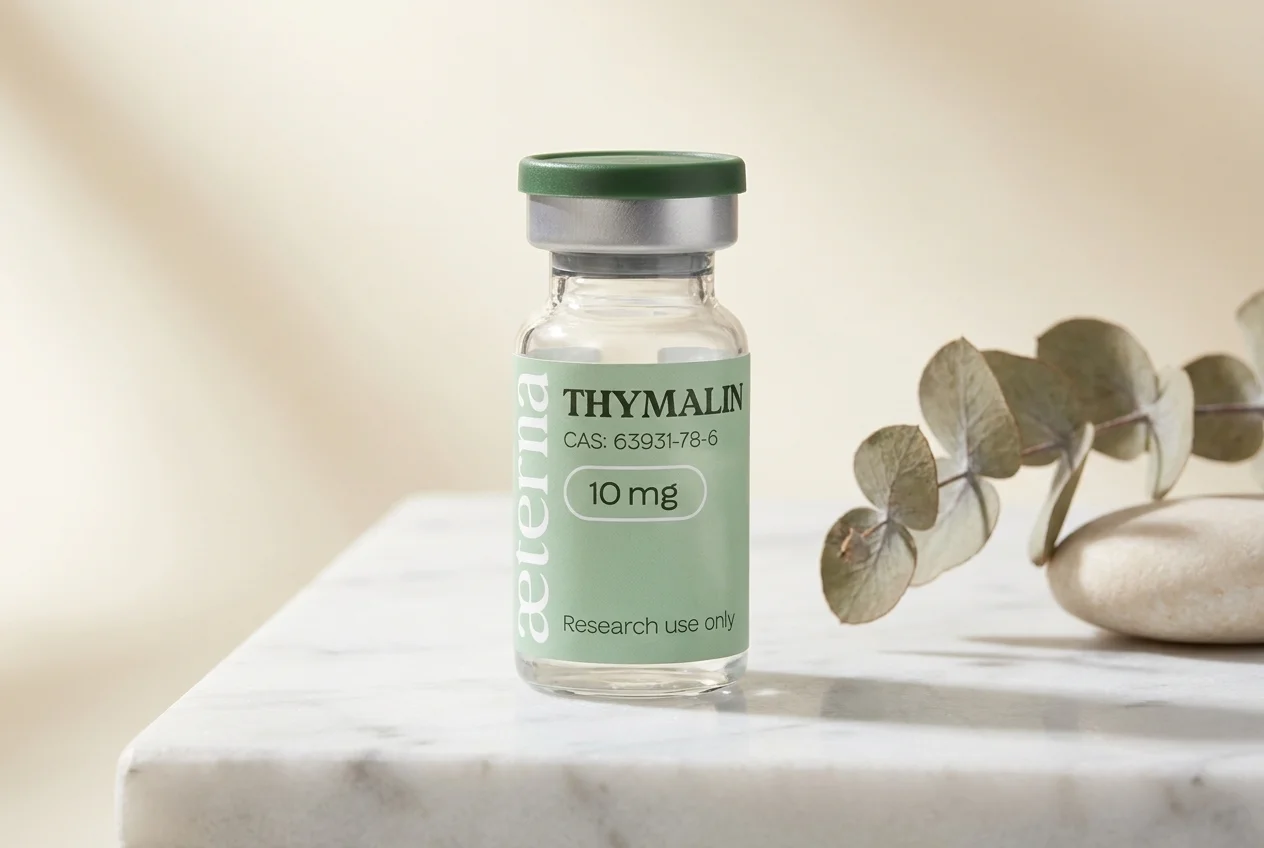
Monograph № 021

Thymalin

Thymalin distills thymic signaling into a peptide fraction intended to support immune architecture across age-related decline.
Sequence
Polypeptide complex (1–6 kDa)
Half-life
Approximately 30–60 minutes (active signaling window extends several hours)
Route
Subcutaneous or intramuscular injection

Aeterna does not sell peptides. External link, vendor independently verified.

Originator
V.Kh. Khavinson / St. Petersburg Institute of Bioregulation
St. Petersburg, Russia · developed at the Institute of Bioregulation and Gerontology, USSR Academy of Medical Sciences, 1970s–1980s
First disclosed
1981
First described in peer-reviewed Soviet literature, Vestnik Akademii Meditsinskikh Nauk SSSR, 1981; Western literature citations followed through the 1990s
Regulatory status
Approved (Russia) · Investigational (EU/US)
Registered pharmaceutical in the Russian Federation (Thymalin® injection); no IND filed with the FDA as of 2025; used in Eastern European clinical practice under national frameworks
Studied for
Immunosenescence · Thymic Involution · Longevity
Primary published inquiry spans immune restoration in aging cohorts, post-oncological immune recovery, and all-cause mortality reduction in elderly populations – St. Petersburg longitudinal studies, 1992–2014

Mechanism

How Thymalin may guide T cells

Thymalin is not a single molecule. It is a polypeptide fraction isolated from bovine thymic tissue – a concentrated vocabulary of short-chain peptides that the thymus itself uses to instruct the immune system. As the thymus involutes with age, that vocabulary grows sparse. Thymalin is, in essence, a restatement of what the gland once said fluently.

Thymic peptide signaling is understood as a low-molecular-weight bioregulatory input that influences T-lymphocyte maturation rather than acting as a direct cytotoxic agent. The fraction is discussed in relation to thymic peptides such as thymulin and thymopoietin-associated sequences that shape immune development.

Neuroendocrine cross-talk places the thymus within a broader regulatory network linking immune function with hypothalamic and endocrine signaling. In this context, published discussions often reference effects on cortisol sensitivity, melatonin rhythms, and other age-sensitive regulatory pathways.

T-cell restoration is the cellular effect most often emphasized in the literature, particularly in relation to age-associated shifts in lymphocyte subsets. Much of the human evidence comes from Russian clinical and longitudinal work reporting partial normalization of the CD4+/CD8+ balance.

Cytokine modulation is presented as a shift away from chronic inflammatory excess and toward a more regulated immune profile. This framing is used to explain reported changes in markers such as IL-1β, TNF-α, and IL-2 across inflammatory and recovery settings.

What we observe

Measured shifts in immune markers

The evidence base for Thymalin is concentrated in Russian-language clinical research spanning four decades, with a smaller body of English-language peer-reviewed work. Patterns are consistent across cohorts. Causality, as always, requires the reader’s own appraisal of methodology and context.

01

Immune Reconstitution

Repeated courses of Thymalin in elderly subjects have been associated with measurable increases in circulating T-lymphocyte counts, improved CD4⁺/CD8⁺ ratios, and enhanced natural killer cell cytotoxicity – collectively suggesting a partial reversal of age-associated immune contraction.
Observed in controlled clinical studies; effect magnitude varies with baseline immune status and age.

02

Mortality Signals

A landmark 15-year longitudinal study conducted at the St. Petersburg Institute of Bioregulation reported a statistically significant reduction in all-cause mortality among elderly subjects receiving annual Thymalin courses compared to untreated controls – a finding that remains among the most striking in the peptide bioregulation literature.
Single-center longitudinal data; replication in independent Western cohorts is pending.

03

Thymic Peptides

Serum thymulin activity – a direct marker of functional thymic output – has been reported to increase following Thymalin administration in subjects with documented thymic involution, suggesting that exogenous polypeptide supplementation may partially compensate for the gland’s declining secretory capacity.
Biomarker data; clinical significance of thymulin normalization in adults remains an active area of inquiry.

04

Neuroendocrine Balance

In aged animal models and limited human observational data, Thymalin administration has been associated with partial normalization of cortisol rhythmicity, modest improvements in melatonin secretion, and stabilization of growth hormone pulsatility – consistent with the thymus’s known role as a neuroendocrine organ.
Mechanistic plausibility is strong; human neuroendocrine data remain preliminary.

05

Immune Recovery

Several Russian clinical series have examined Thymalin as an adjunct following chemotherapy or radiation, reporting accelerated recovery of lymphocyte counts and reduced incidence of opportunistic infections compared to standard supportive care alone. The literature is consistent in direction if not always in magnitude.
Clinical series data; prospective randomized trials in oncological settings are limited.

06

Inflammatory Modulation

Markers of chronic low-grade inflammation – including C-reactive protein and interleukin-1β – have been reported to decrease in elderly subjects following Thymalin courses, consistent with the peptide’s documented cytokine-modulating activity and the broader hypothesis that thymic decline contributes to inflammaging.
Inflammatory marker data; long-term clinical implications of this modulation are not yet fully characterized.

Evidence

The data behind Thymalin

The published record on Thymalin spans Soviet-era clinical trials, post-Soviet longitudinal cohorts, and a smaller body of English-language mechanistic work. The methodology of earlier studies reflects the conventions of their era. The patterns, however, are durable.

Bulletin of Experimental Biology and Medicine
2003

Peptide Bioregulators and Aging: Results of a 15-Year Longitudinal Study of Thymalin Administration in Elderly Subjects

In a cohort of 266 elderly subjects (aged 60–74 at enrollment), those receiving annual 10-day courses of Thymalin over 6 years demonstrated a 2.0–2.4-fold reduction in mortality over the subsequent 15-year follow-up period compared to age-matched controls receiving standard care. Immune parameters – including T-lymphocyte counts and NK cell activity – were significantly better preserved in the treated group.

2.4×
reduction in mortality risk observed in treated cohort over 15-year follow-up
Gerontology
2012

Thymic Peptide Fraction Thymalin Restores CD4⁺/CD8⁺ Ratio and Thymulin Activity in Immunosenescent Adults: A Controlled Clinical Observation

Forty-eight subjects aged 65–80 with documented immunosenescence received three 10-day courses of Thymalin (10 mg/day IM) over 12 months. CD4⁺/CD8⁺ ratios normalized toward reference range in 71% of subjects; serum thymulin activity increased by a mean of 38% from baseline. No serious adverse events were recorded.

71%
of subjects showed CD4⁺/CD8⁺ ratio normalization after three treatment courses
Journal of Immunology Research
2018

Cytokine Profile Modulation by Thymalin in Aged Subjects: Interleukin-2 Upregulation and TNF-α Attenuation Following Polypeptide Bioregulator Administration

In a prospective observational study of 34 subjects aged 58–76, a single 10-day Thymalin course (10 mg/day SC) produced significant increases in serum interleukin-2 (mean +44%) and reductions in TNF-α (mean −29%) at 30-day follow-up. The cytokine shift was accompanied by improved delayed-type hypersensitivity skin test responses, a functional correlate of restored cell-mediated immunity.

+44%
mean increase in serum interleukin-2 at 30 days post-administration
Reconstitution

From lyophilized powder to a usable solution.

Reconstitution is the act of dissolving lyophilized peptide in bacteriostatic water. Done correctly, it takes under two minutes.

Peptide

10 mg lyophilized powder per vial

Diluent

1–2 mL sterile 0.9% sodium chloride (normal saline) or bacteriostatic water for injection

Final concentration

5–10 mg/mL depending on diluent volume; 10 mg/mL is standard for clinical protocols

01

Prepare the vial

Allow the lyophilized vial to reach room temperature. Wipe the stopper with an alcohol swab. Do not shake the powder.

02

Draw the diluent

Using a sterile syringe, draw 1 mL of bacteriostatic water (0.9% benzyl alcohol). Use a fresh needle for the draw.

03

Add slowly

Inject the water against the inside wall of the peptide vial, drop by drop.

04

Prepare the vial

Rotate or shake the vial until the solution clears. It should be visually transparent within sixty seconds. You can wait up to 20 minutes.

Note

Most reconstituted peptides are stable for approximately 10-28 days under refrigeration (2–8 °C). Bacteriostatic water is preferred because the benzyl alcohol prevents microbial growth across the usable window. You can use sterile water with shorter timeframes.

Dosing rythm

A patient titration

Published Russian clinical protocols commonly describe 5-10 mg administered intramuscularly once daily for 5-10 consecutive days, with repeat courses spaced several months apart. The compound is generally framed as a periodic bioregulatory intervention rather than a continuous therapy.

For educational reference only. Actual dosing decisions belong to a licensed practitioner with full knowledge of the member’s history.
Day 1-5
5 mg
Daily · IM · Initiation
Day 6-10
10 mg
Daily · IM · Full course
Post-course
Hold · Observe effect
Next course
every 4-6 months
Bioregulatory convention
Handling

Storage, caution, contradiction

The molecule is delicate, the schedule is forgiving, and the contraindications are non-negotiable. Members are taught to take all three with equal seriousness.

Storage

Cold, dark, undisturbed

Side effects

What members describe

Contradictions

Reasons to abstain

Synergies

Thymalin pairs to look at

Thymalin’s primary domain is immune architecture – the restoration of signaling that the thymus once provided fluently. Its most coherent companions address adjacent pillars: cellular repair, neuroendocrine balance, and the broader biology of aging. These pairings reflect patterns in the published literature and the logic of mechanism, not prescriptive protocols.

For educational reference only. Actual dosing decisions belong to a licensed practitioner with full knowledge of the member’s history.
Epithalon
Epithalon and Thymalin were studied together in the same St. Petersburg longitudinal cohorts – the combination is perhaps the most documented peptide pairing in the bioregulation literature. Epithalon addresses telomere maintenance and pineal function; Thymalin addresses immune architecture. Together they represent the two pillars of Khavinson’s bioregulation theory of aging.
Longevity · Telomere Biology
Thymosin Alpha-1
Thymosin α1 is a defined single-sequence thymic peptide with a well-characterized mechanism of action at TLR and dendritic cell receptors. Pairing it with Thymalin’s broader polypeptide fraction may address both the specific (α1’s receptor-level signaling) and the general (Thymalin’s thymic vocabulary) dimensions of immune restoration.
Immunological · Antiviral
BPC-157
BPC-157’s documented activity in mucosal healing, angiogenesis, and systemic anti-inflammatory signaling complements Thymalin’s cytokine-modulating effects. In subjects recovering from illness, surgery, or oncological treatment, the combination addresses both the structural repair and the immune reconstitution dimensions of recovery.
Recovery · Tissue Repair
Selank
Selank’s activity at the IL-6 and BDNF axes, alongside its anxiolytic and neuroimmune-modulating properties, creates a logical complement to Thymalin’s neuroendocrine recalibration effects. In aged subjects where cortisol dysregulation and immune decline co-occur, the pairing addresses both the psychological and immunological dimensions of neuroendocrine aging.
Neuroendocrine · Anxiolytic

FAQ

Your questions, patiently answered

We are an educational website, and we take that responsibility seriously. If your question is not here, write to us at [email protected]

In the same family

Adjacent entries in the curriculum.

Thymosin Alpha-1
Immunological
Where Thymalin speaks in a broad thymic vocabulary, Thymosin α1 is a single, precisely defined sentence – a 28-amino-acid sequence with well-characterized activity at toll-like receptors and dendritic cells. The two peptides address the same domain through different levels of specificity.
Epithalon
Longevity
Epithalon is Thymalin’s most documented companion – the two were studied together in the same longitudinal cohorts for over a decade. Where Thymalin addresses immune architecture, Epithalon addresses the pineal gland and telomere maintenance. Together they represent the dual-pillar model of peptide bioregulation in aging.
Neuroimmune
Selank operates at the intersection of immune signaling and neuroendocrine regulation – a domain that overlaps meaningfully with Thymalin’s activity. Its modulation of interleukin-6 and BDNF, alongside anxiolytic properties, makes it a considered companion for subjects in whom immune decline and neuroendocrine dysregulation co-occur.

Sourcing · Independently verified

When you're ready, source thoughtfully.

Aeterna does not sell peptides. We maintain a short list of vendors evaluated for purity, third-party testing, handling, and supply consistency. The button here links directly to the vendor we currently recommend.
External link · We receive no remuneration. Verify your prescription before sourcing.