Monograph № 015

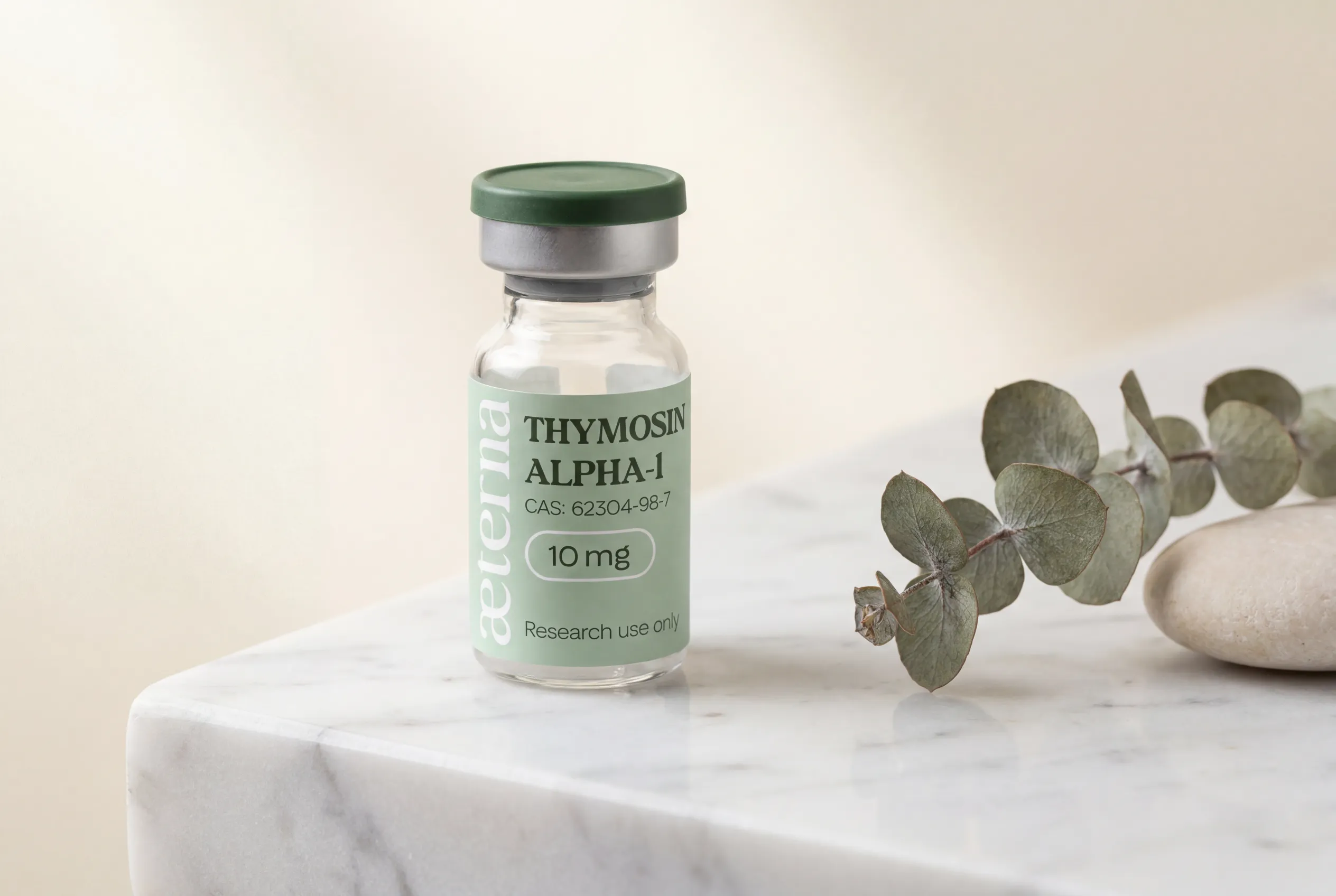
Thymosin Alpha-1

A 28-amino-acid peptide restoring the signaling grammar that a compromised immune system has begun to lose.
Sequence
28 amino acids
Half-life
~2 hours (terminal); biological effects persist 24–48 h
Route
Subcutaneous injection

Aeterna does not sell peptides. External link, vendor independently verified.

Originator
Allan L. Goldstein / George Washington University
Washington, D.C. · Isolated from bovine thymic tissue, 1972; synthetic sequence confirmed by Goldstein et al., Science 1977
First disclosed
1977
First full sequence disclosure: Goldstein AL et al., Proc. Natl. Acad. Sci. USA, Vol. 74, 1977; thymosin fraction 5 precursor work published 1972
Regulatory status
Approved (select jurisdictions); Investigational (USA)
Marketed as Zadaxin® (SciClone Pharmaceuticals) in 35+ countries for hepatitis B/C and as adjuvant in immunocompromised states; IND-eligible in the United States as of 2025
Studied for
Immune Reconstitution · Viral Hepatitis · Oncology Adjuvant · Sepsis
Primary published inquiry spans hepatitis B/C (Phase III, SciClone/RegeneRx), non-small-cell lung cancer adjuvant therapy, and sepsis-associated immunoparalysis (critical care literature, 2010–2024)

Mechanism

How it tunes up immune signals

Thymosin Alpha-1 is a 28-amino-acid peptide acetylated at its N-terminus, cleaved endogenously from the 113-residue precursor prothymosin alpha within thymic epithelial cells. Its biological role is not stimulation in the crude sense – it is calibration. The peptide does not simply accelerate immune output; it restores the signaling grammar that a compromised or aging immune system has begun to lose. Four receptor-level conversations underpin this effect.

Innate immune priming begins with TLR9 engagement on plasmacytoid dendritic cells and macrophages, activating MyD88-dependent signaling and increasing type I and type II interferon output. This helps explain why Thymosin Alpha-1 is studied as an immune modulator rather than as a blunt inflammatory stimulant.

T cell maturation is strengthened as Thymosin Alpha-1 supports the differentiation of immature thymocytes into functional CD4⁺ and CD8⁺ populations. In contexts marked by thymic involution or immune depletion, this has been associated with improved immune competence and shifts in lymphocyte balance.

Cytokine balance shifts toward a more effective cellular immune response, with greater expression of Th1-associated mediators such as IL-2, IFN-γ, and TNF-α. At the same time, regulatory T-cell populations appear to be preserved, reinforcing its profile as an immunomodulator rather than a nonspecific activator.

Antigen presentation improves as exposure increases MHC class II, CD80, and CD86 expression on monocyte-derived dendritic cells. In settings such as chronic viral infection and post-chemotherapy immunosuppression, this may support more effective antigen-specific T-cell priming.

What we observe

Results seen in immune response and illness

The clinical record for Thymosin Alpha-1 spans hepatitis, oncology, critical care, and aging research across multiple continents. The patterns below reflect what published studies report. They are observations drawn from the literature — not predictions, not guarantees.

01

HBsAg Clearance

In randomized controlled trials of chronic hepatitis B, Thymosin Alpha-1 monotherapy and combination regimens with interferon-alpha produced HBsAg seroconversion rates meaningfully above placebo. The mechanism is consistent with TLR9-mediated IFN-α induction and restored CD8+ cytotoxic T-lymphocyte activity against hepatocyte-expressed viral antigens.
Observed in Phase III trials; effect size varies by baseline viral load and HBeAg status.

02

Hepatitis C Response

When added to pegylated interferon and ribavirin regimens, Thymosin Alpha-1 was associated with improved sustained virological response rates in genotype 1 hepatitis C – historically the most treatment-resistant genotype. The proposed mechanism involves augmentation of endogenous interferon signaling rather than direct antiviral activity.
Reported in multicenter trials; effect most pronounced in prior non-responders.

03

Immune Reconstitution

Sepsis frequently induces a state of profound immune suppression – reduced HLA-DR expression on monocytes, lymphopenia, and impaired cytokine production – that persists well beyond the acute inflammatory phase. Thymosin Alpha-1 administration in this context has been associated with restoration of monocyte HLA-DR expression and reduced secondary infection rates in several Chinese critical care trials.
Evidence base concentrated in Chinese ICU literature; larger multinational trials warranted.

04

Infectious Complications

In patients receiving cytotoxic chemotherapy, Thymosin Alpha-1 has been studied as an immune-supportive adjuvant. Published series report reductions in febrile neutropenia episodes and opportunistic infections, consistent with the peptide’s capacity to accelerate post-chemotherapy T-cell and dendritic cell recovery.
Primarily reported in Asian oncology literature; prospective Western trial data limited.

05

Vaccine Response

In elderly and immunocompromised populations – where vaccine immunogenicity is characteristically diminished – Thymosin Alpha-1 co-administration has been associated with enhanced antibody titers and T-cell responses to influenza and hepatitis B vaccines. The effect is consistent with its role in DC maturation and Th1 polarization.
Observed in controlled studies of elderly cohorts and dialysis patients; effect magnitude varies by vaccine platform.

06

Thymic Involution

Preclinical and early clinical data suggest that chronic Thymosin Alpha-1 administration may slow the age-associated decline in thymic output – the progressive reduction in naïve T-cell egress that leaves the aging immune repertoire increasingly narrow. Quantitative measures include T-cell receptor excision circle (TREC) frequency and naïve CD45RA+ T-cell counts.
Mechanistically plausible; human longevity data preliminary and not yet replicated at scale.

Evidence

Trials and clinical data

The literature on Thymosin Alpha-1 is unusually deep for a peptide of its era, accumulated across four decades and disease states ranging from viral hepatitis to septic shock. Three studies are selected here for methodological rigor, clinical relevance, or mechanistic clarity. They are starting points, not summaries.

Journal of Hepatology
2005

Thymosin Alpha-1 Plus Interferon-Alpha Versus Interferon-Alpha Alone in Chronic Hepatitis B: A Randomized Controlled Trial

In 200 treatment-naïve patients with chronic hepatitis B, combination therapy with Thymosin Alpha-1 (1.6 mg twice weekly SC) and interferon-alpha-2b produced significantly higher rates of HBeAg seroconversion and HBV DNA suppression at 12-month follow-up compared to interferon monotherapy. CD8+ T-lymphocyte counts and IFN-γ production were significantly elevated in the combination arm, consistent with TLR9-mediated immune priming.

40%
HBeAg seroconversion rate in combination arm vs. 26% in interferon monotherapy arm at 12 months
Critical Care Medicine
2019

Thymosin Alpha-1 for Sepsis-Associated Immunosuppression: A Multicenter Randomized Trial in Chinese ICUs

Among 361 patients with sepsis-associated immunoparalysis (defined as monocyte HLA-DR expression below 30%), Thymosin Alpha-1 administration (1.6 mg SC daily for 5 days) significantly restored HLA-DR expression by day 7 and was associated with a reduction in 28-day mortality compared to standard care. Secondary infection rates were also reduced in the treatment arm, suggesting functional immune reconstitution rather than mere biomarker improvement.

22%
Relative reduction in 28-day mortality in the Thymosin Alpha-1 arm versus standard care (p=0.031)
Vaccine
2013

Thymosin Alpha-1 as an Adjuvant to Influenza Vaccination in Elderly Adults: A Double-Blind Placebo-Controlled Study

In 120 adults aged 65 and older, Thymosin Alpha-1 (1.6 mg SC on days 0 and 2 post-vaccination) significantly enhanced hemagglutination inhibition titers against all three influenza strains in the seasonal vaccine at day 28. CD4+ T-helper cell activation and IL-2 production were significantly elevated in the Thymosin Alpha-1 group, consistent with enhanced Th1 polarization and dendritic cell co-stimulatory activity.

68%
of Thymosin Alpha-1 recipients achieved seroprotective titers against all three strains vs. 44% in the placebo group
Reconstitution

From lyophilized powder to a usable solution.

Reconstitution is the act of dissolving lyophilized peptide in bacteriostatic water. Done correctly, it takes under two minutes.

Peptide

5 mg lyophilized powder

Diluent

3.0 mL bacteriostatic water

Final concentration

1.67 mg/mL

01

Prepare the vial

Allow the lyophilized vial to reach room temperature. Wipe the stopper with an alcohol swab. Do not shake the powder.

02

Draw the diluent

Using a sterile syringe, draw 1 mL of bacteriostatic water (0.9% benzyl alcohol). Use a fresh needle for the draw.

03

Add slowly

Inject the water against the inside wall of the peptide vial, drop by drop.

04

Prepare the vial

Rotate or shake the vial until the solution clears. It should be visually transparent within sixty seconds. You can wait up to 20 minutes.

Note

Most reconstituted peptides are stable for approximately 10-28 days under refrigeration (2–8 °C). Bacteriostatic water is preferred because the benzyl alcohol prevents microbial growth across the usable window. You can use sterile water with shorter timeframes.

Dosing rythm

A patient titration

Schedule below mirrors the peptidedosages.com educational protocol (typical daily range: 300–500 mcg once daily (gradual titration)).

For educational reference only. Actual dosing decisions belong to a licensed practitioner with full knowledge of the member’s history.
Week 1
300 mcg (0.3 mg)
Once daily · 18 units (0.18 mL)
Weeks 2–8
500 mcg (0.5 mg)
Once daily · 30 units (0.30 mL)
Days 1–7 | 1.6 mg | Daily · Critical care
1.6 mg subcutaneously once daily
For 5–7 consecutive days; initiated upon confirmed immunoparalysis criteria
Week 1–6 | 1.6 mg | Twice weekly · Longevity
1.6 mg subcutaneously
twice weekly
for 4–6 weeks, repeated quarterly
Morning administration used in most published protocols; circadian optimization not yet established
Handling

Storage, caution, contradiction

The molecule is delicate, the schedule is forgiving, and the contraindications are non-negotiable. Members are taught to take all three with equal seriousness.

Storage

Cold, dark, undisturbed

Side effects

What members describe

Contradictions

Reasons to abstain

Synergies

What to pair with Thymosin Alpha-1

Thymosin Alpha-1 is most often considered alongside peptides that address immune signaling, tissue repair, or the broader architecture of cellular resilience. The combinations below reflect patterns observed in the literature and in practitioner-reported protocols. They are not prescriptions. They are a vocabulary for informed conversation.

For educational reference only. Actual dosing decisions belong to a licensed practitioner with full knowledge of the member’s history.
BPC-157
BPC-157’s cytoprotective and anti-inflammatory signaling complements Thymosin Alpha-1’s immune-reconstituting activity. Where Thymosin Alpha-1 restores adaptive immune competence, BPC-157 addresses the local tissue environment – reducing inflammatory burden that can impair immune cell trafficking and function.
Tissue Repair & Immune Modulation
Thymosin Beta-4 (TB-500)
Thymosin Beta-4 and Thymosin Alpha-1 originate from the same thymic fraction 5 precursor pool and operate through complementary mechanisms – Alpha-1 through immune cell maturation and TLR signaling, Beta-4 through actin dynamics, angiogenesis, and tissue remodeling. Together they approximate a broader reconstitution of thymic peptide signaling.
Thymic Peptide Synergy
Epithalon
Epithalon’s telomerase-activating and pineal-regulatory effects address the cellular aging dimension that Thymosin Alpha-1 approaches from the immune side. In the context of thymic involution and immune senescence, the two peptides address overlapping but distinct aspects of the aging biology – one at the level of telomere maintenance, one at the level of T-cell repertoire breadth.
Longevity & Immune Aging
LL-37 (Cathelicidin)
LL-37 operates at the innate immune frontier – direct antimicrobial activity, TLR modulation, and neutrophil recruitment – while Thymosin Alpha-1 works deeper in the adaptive immune architecture. In contexts of chronic infection or post-viral immune dysregulation, the combination addresses both the immediate innate response and the longer-arc adaptive reconstitution.
Innate Immune Defense

FAQ

Your questions, patiently answered

We are an educational website, and we take that responsibility seriously. If your question is not here, write to us at [email protected]

In the same family

Further reading in the curriculum - adjacent peptides worth understanding.

Thymic Peptide
Where Thymosin Alpha-1 addresses immune cell maturation and signaling, Thymosin Beta-4 works at the level of tissue architecture – actin polymerization, wound healing, and angiogenesis. Both originate from thymic fraction 5; their mechanisms are complementary rather than redundant.
Epithalon
Longevity Peptide
Epithalon engages the aging biology from a different angle – telomerase activation and circadian regulation via the pineal gland. In the context of immune senescence and thymic involution, Epithalon and Thymosin Alpha-1 address overlapping but distinct cellular thresholds of aging.
Immune Peptide
LL-37 is the primary human cathelicidin – an innate immune peptide with direct antimicrobial activity and TLR-modulatory signaling. It occupies the innate immune frontier that Thymosin Alpha-1 approaches from the adaptive side, making the two peptides natural companions in immune reconstitution protocols.

Sourcing · Independently verified

When you're ready, source thoughtfully.

Aeterna does not sell peptides. We maintain a short list of vendors evaluated for purity, third-party testing, handling, and supply consistency. The button here links directly to the vendor we currently recommend.
External link · We receive no remuneration. Verify your prescription before sourcing.